Square
Following
Hot
News
Profile

Tindorr🚢

vip
Active for: 3.4y
Peak Tier 0
No content yet
0
Following
28
Followers
236
Liked
Citrini included @LayerZero_Core in their article as one of the RWA interoperability plays.
But I think the $ZRO thesis is becoming much bigger than just interoperability:
• Issuance → OFT
• Distribution → LayerZero
• Trading → ATLAS
• Settlement → Zero
The interesting part is that LayerZero is trying to sit underneath more of the full lifecycle of an onchain asset, not just move it between chains.
Start with issuance.
OFT gives issuers one standard for assets that need to exist across multiple chains.
That matters a lot for stablecoins, tokenized equities and RWAs.
Instead of creating fragmen
ZRO+4.87%
CORE+1.08%
RWA-0.23%
STG0.00%
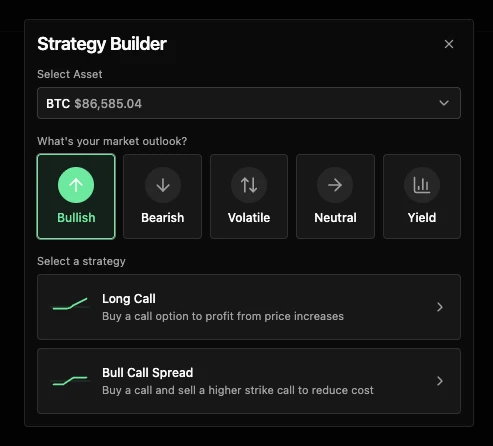
I might have an uncle-level contrarian take on onchain options:
UI is NOT the biggest problem stopping mass adoption.
A good interface can absolutely reduce friction, onboard new users, and make options feel less intimidating.
It might even get more people to try the degen side first, like buying 1-day calls because the payoff looks fun.
But I don't think that's where the real foundation of options adoption comes from.
The first users that matter are traders who are willing to learn the basics:
• how options actually behave
• risk and position sizing
• Greeks
• volatility
• basic strategies
•
post-image
HYPE+1.54%
  • 1
The most dangerous thing about a bull market is that everyone feel smarter.
They inflate our confidence. Even your mistakes can print if it's altcoin season.
And that's exactly when ego starts becoming expensive.
The dangerous loop starts:
• You make a few good calls.
• You start sizing bigger and taking more risk.
• You think the returns are coming entirely from your ability to pick tokens.
I've been through this before. There were periods where almost everything I touched worked, and I genuinely started thinking I had become much better at finding winners.
Some of that was skill.
But a much
Volatile markets are exactly why asset allocation matters.
It’s the most important things for surviving a bull market without constantly chasing pumps and rotating into whatever already moved.
For crypto, I personally prefer keeping more than 50% in $BTC , with another 20%+ in higher-conviction large-cap positions like $ETH or $HYPE .
Then I use the remaining allocation for higher-beta bets where I still have real conviction, like $LIT or $DRV + the rest for aping
The point isn’t that BTC will protect you from every drawdown.
It’s that having a large part of the portfolio in relatively lower-bet
BTC+0.28%
ETH+0.26%
HYPE+1.54%
LIT-2.66%
DRV-6.01%
  • 1
This is one of the worst environments to run 3x+ leverage, especially if you have weak hands or don’t fully understand what you’re trading.
Market is choppy as hell right now and it feels like both longs and shorts are getting shaken out.
Holding through this volatility won’t be easy either.
So do the research, build conviction, and actually understand the tokens you’re investing in.
For me, I’d rather stay mostly spot, ignore the short-term noise, and hold the names I believe in through the bull run. (Assuming the bull run is still alive lol)
The TAM play I think the market is starting to agr
A green candle can make almost any thesis look intelligent.
That’s probably one of the biggest traps in a bull market.
Something pumps 50%, and suddenly everyone can explain exactly why it was obvious:
• ā€œnew narrativeā€
• ā€œundervalued fundamentalsā€
• ā€œinstitutional adoptionā€
• ā€œthe next big ecosystemā€
• ā€œstructural repricingā€
But sometimes none of that was really why it moved.
Price moved first. Then people built the story around the price.
And once the chart keeps going up, the thesis becomes harder to question because PnL starts looking like proof.
That’s dangerous because a profitable trade
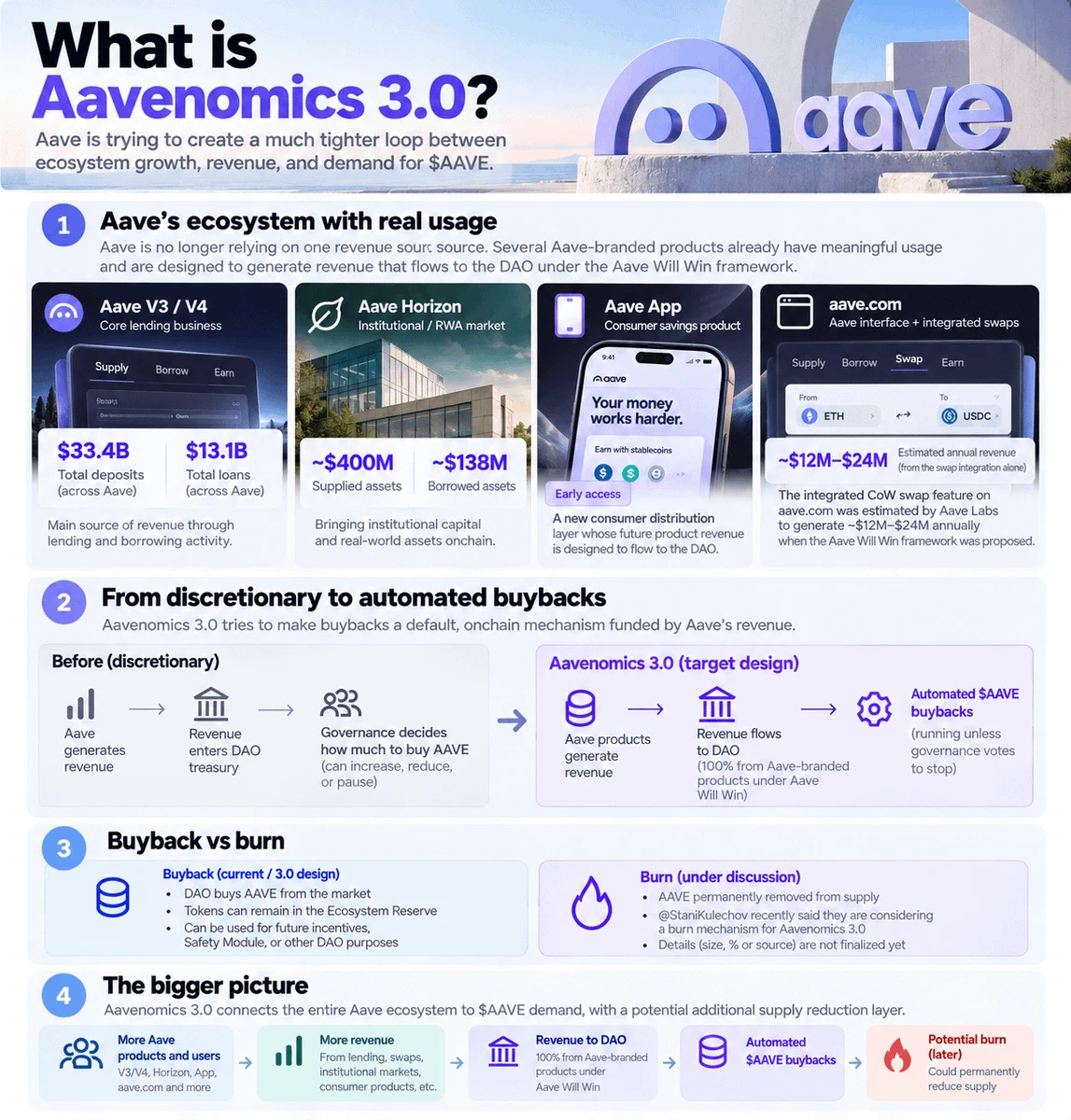
What is Aavenomics 3.0?
Aave is trying to create a much tighter loop between ecosystem growth, revenue, and demand for $AAVE .
The old buyback model was more discretionary. Those buybacks could be increased, reduced, or paused depending on conditions.
Aavenomics 3.0 is trying to make that relationship more structural.
And this matters more now because Aave is no longer relying on one revenue source.
There are already several parts of the ecosystem with real usage:
• Aave V3/V4 → the core lending business, with roughly $33B in deposits and $13B in loans across Aave
• Aave Horizon → the instituti
post-image
AAVE-3.34%
RWA-0.23%
  • 1
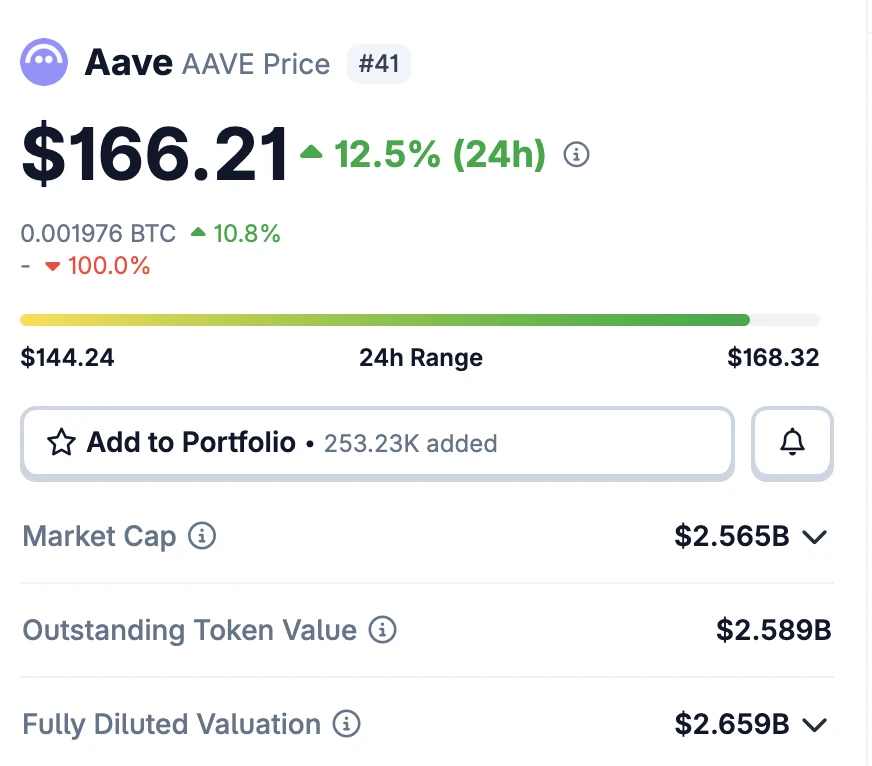
Nice to see $AAVE moving up again.
@Aave is a really good example of how much token price changes the way we perceive a project.
When price is down, we tend to overestimate how broken something is.
When price is up, we tend to overestimate how well everything is going.
Think back to Q1.
ACI announced it was leaving Aave after a very public governance dispute.
Suddenly the conversation became:
- Does this create more risk going into V4?
- Is Aave governance falling apart?
- Who is going to handle these responsibilities?
And when the token was also performing badly, every negative development fe
post-image
AAVE-3.34%
USDC0.00%
COINON+0.06%
NVDA-0.67%
META-0.42%
Sounds bullshit, but this was real:
I was earning ~50%+ APR on sUSDe using @pendle_fi.
Basically getting paid to leave a limit order to buy YT at a yield I was already happy with.
Here’s how it worked:
- Get USDe from @ethena and stake into sUSDe
- Go to @pendle_fi and place a YT limit order inside the incentivized range
- Keep the order resting and earn $PENDLE maker incentives
This stuff is probably too much effort for 99% of us lol, which is exactly why opportunities like this can exist.
At the time, the maker incentives pushed the APR above 50%.
And the interesting part was the payoff stru
PENDLE+0.70%
USDE0.00%
ENA+0.89%
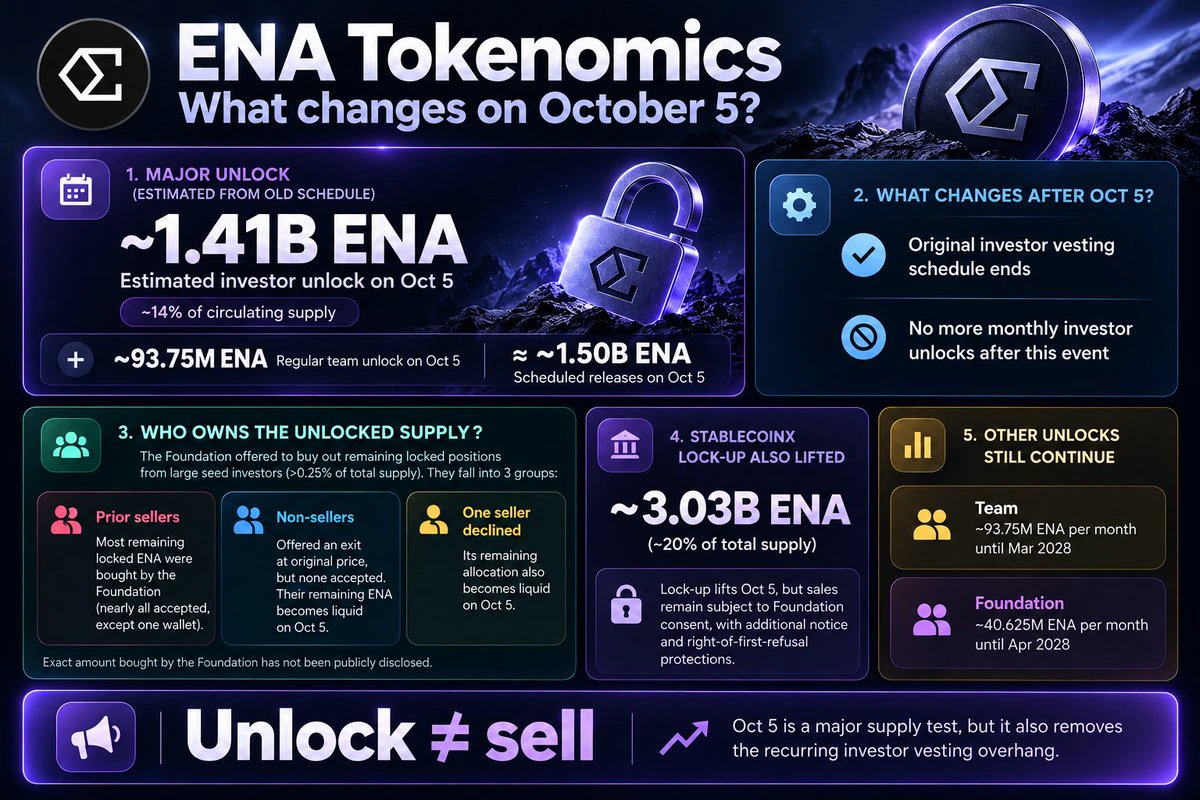
$ENA has one of its biggest tokenomics changes coming on October 5.
And I think people need to understand both sides of it.
TLDR: Unlocks ≠ sell pressure
Under the original schedule, investor $ENA was supposed to keep unlocking monthly until March 2028.
Instead, @ethena is accelerating the remaining original investor allocation into October 5.
Based on the old published vesting schedule, that works out to an estimated ~1.41B ENA, around 14% of current circulating supply, becoming unlocked at once.
So yes, there is a very real near-term supply event here.
But who actually owns that supply matte
post-image
ENA+0.89%
  • 1
  • 1
September 25 should be on your radar, especially if you're sitting on big unrealized gains.
One of the biggest crypto options expiries of the quarter is coming.
As of Sep 21, BTC alone has ~$16.2B of options OI expiring on Sep 25, with roughly:
• $10.3B calls
• $5.9B puts
• Put/call OI ratio: ~0.57
So the book is heavily tilted toward calls. Depending on when they entered, many of those call holders could be sitting on sizable gains.
Why does that matter even if you don't trade options? Because expiry isn't only about options disappearing.
As we get closer to settlement, profitable traders may
BTC+0.28%
ETH+0.28%
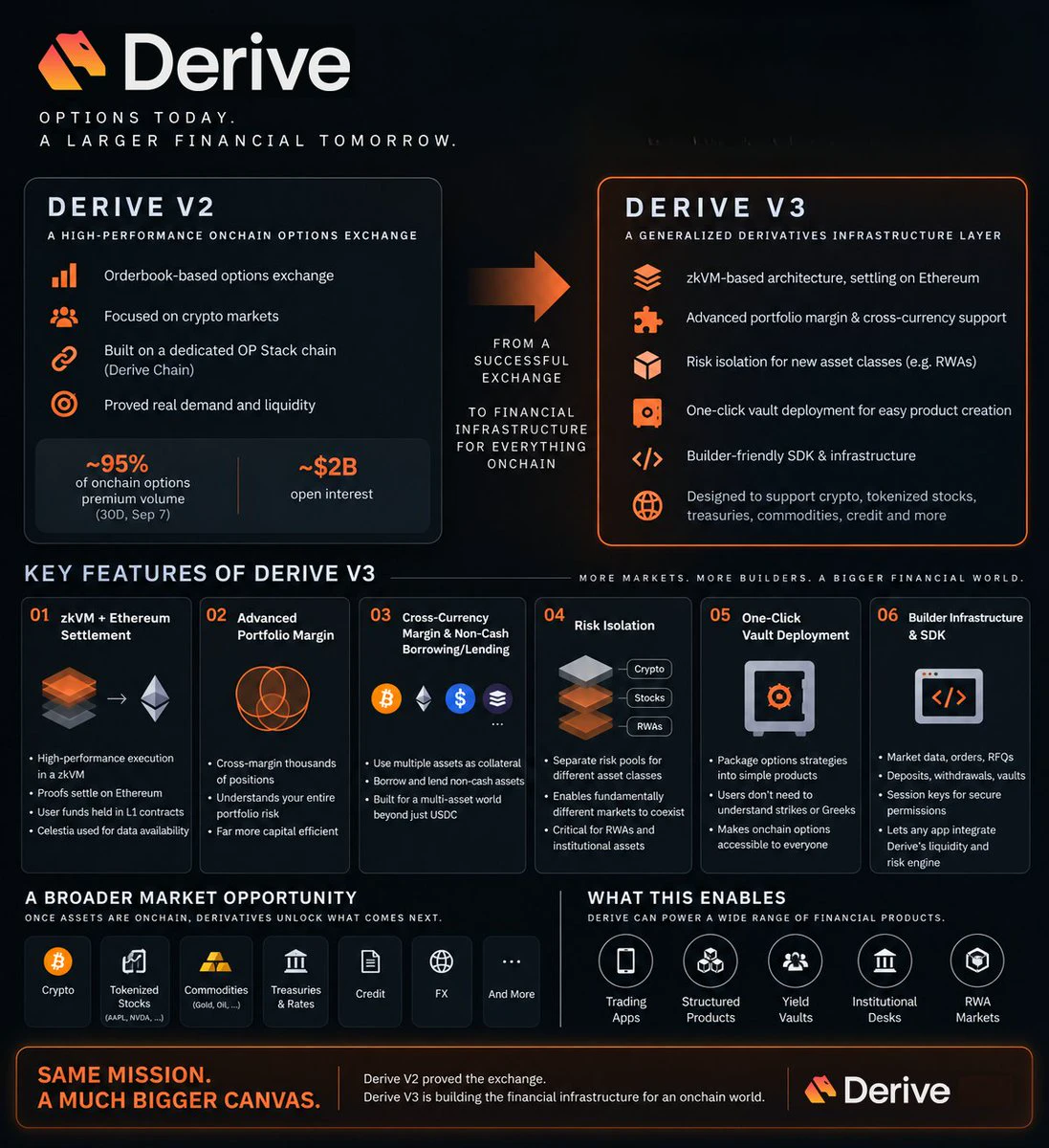
Making this post because more people are interested in how Derive V3 actually is.
V3 is basically rebuilding @DeriveXYZ into infrastructure for a much broader financial market.
The easiest way to understand it is through these 6 new features:
1. zkVM + Ethereum settlement
Execution and risk calculations happen efficiently in the zkVM, while proofs settle on Ethereum.
This lets Derive keep exchange-like performance while moving settlement and custody closer to Ethereum.
2. Much stronger portfolio margin
Instead of treating every position separately, V3 can understand the risk of your entire por
post-image
DRV-6.01%
ETH+0.26%
BTC+0.28%
USDC0.00%
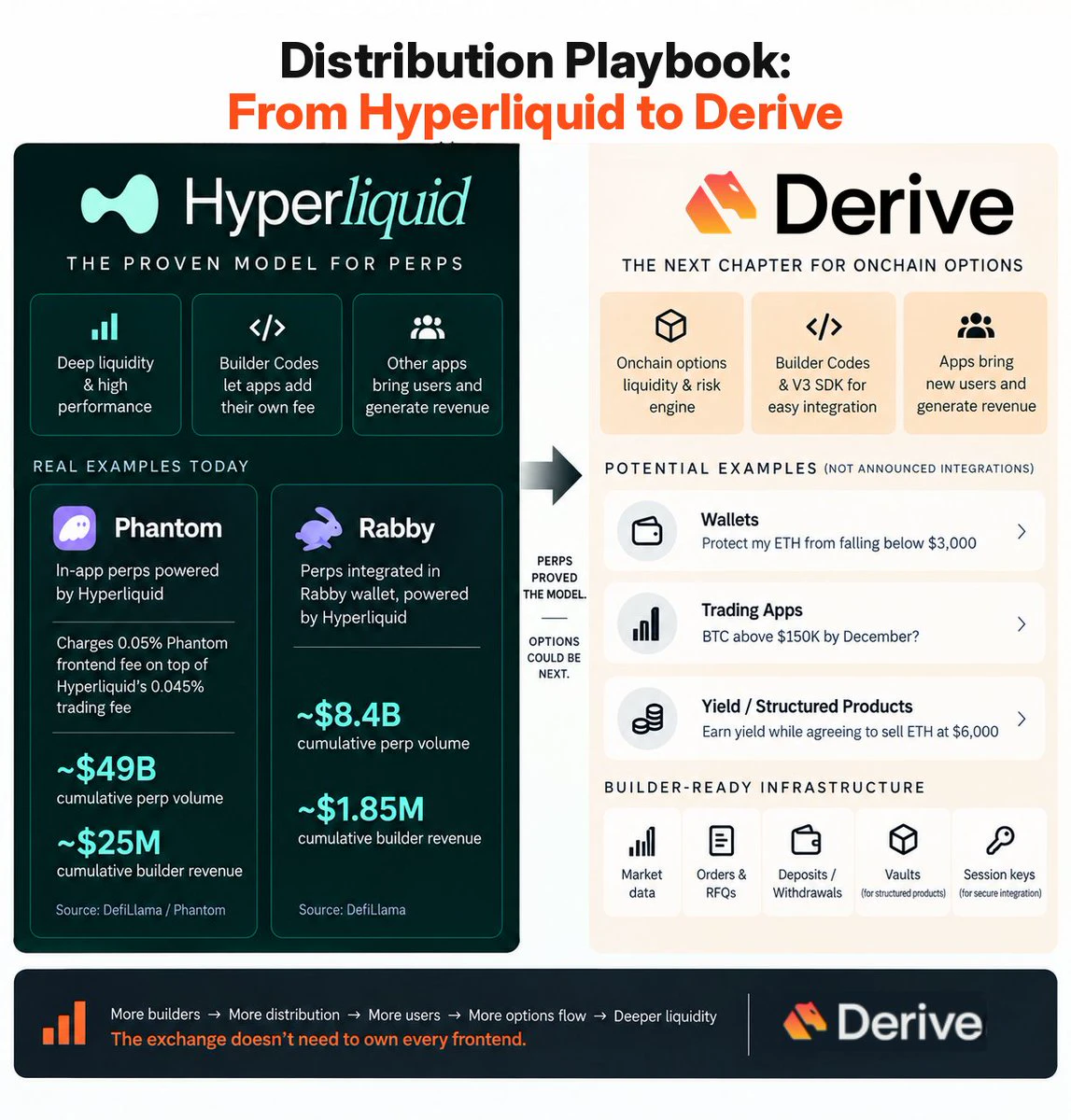
The most interesting part of @DeriveXYZ V3 has very little to do with people trading directly on Derive.
It’s about distribution.
Hyperliquid already showed what can happen when an exchange becomes infrastructure for other apps:
• Wallets like Phantom and Rabby own the frontend and the user relationship.
• Hyperliquid provides the trading infrastructure.
• The apps get paid for bringing the flow.
And I think this is one of the more interesting ways to think about Derive V3.
Derive doesn’t necessarily need every future options trader to become a direct Derive user either. It can become the opti
post-image
DRV-6.01%
HYPE+1.54%
ETH+0.26%
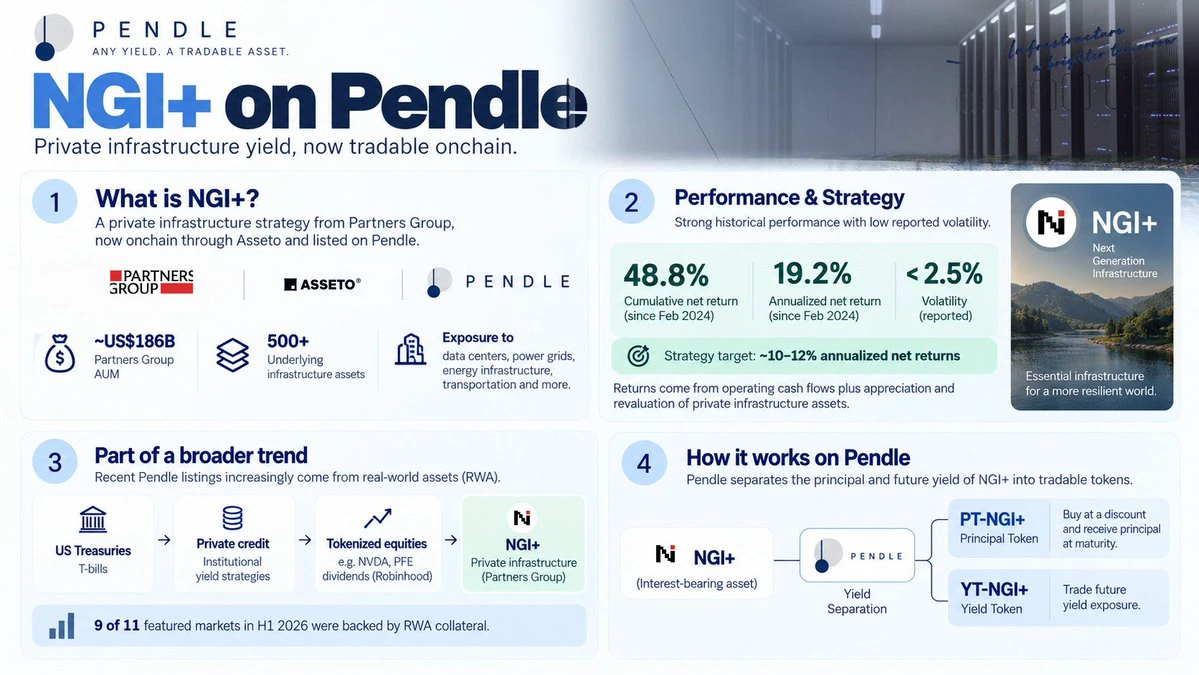
I think a new phase of @pendle_fi has quietly started.
The latest NGI+ market is the signal.
Pendle just brought Partners Group’s Next Generation Infrastructure strategy onchain through Asseto.
NGI+ gives exposure to a private infrastructure strategy spanning 500+ underlying assets across data centers, power grids, energy infrastructure, transportation and other essential infrastructure.
Since February 2024, the underlying strategy has returned 48.8% net, with reported volatility below 2.5%. Its long-term target is closer to 10-12% annualized net returns.
What interests me is what happens afte
post-image
PENDLE+0.70%
RWA-0.23%
I think the market is rerating, and people need to stop obsessing over protocol metrics.
At some point, asking ā€œHow is this protocol at X mcap while only generating Y revenue with Z users?ā€ stops being a useful question.
That framework was built for the bear market.
Back then, the game was finding the strongest protocols, buying during accumulation, and waiting for fundamentals to get recognized.
I think that phase is over.
Now the market is increasingly driven by narratives, expectations and stories about what comes next.
Revenue can look terrible and the token can still fly. Also, revenue ca