SeaSaltMarketMakingNotes

vip
Active for: 0.4y
Peak Tier 0
Having provided liquidity in small pools before, my biggest fear is impermanent loss being disguised as profit. I enjoy writing short notes: parameters, errors, and human nature.
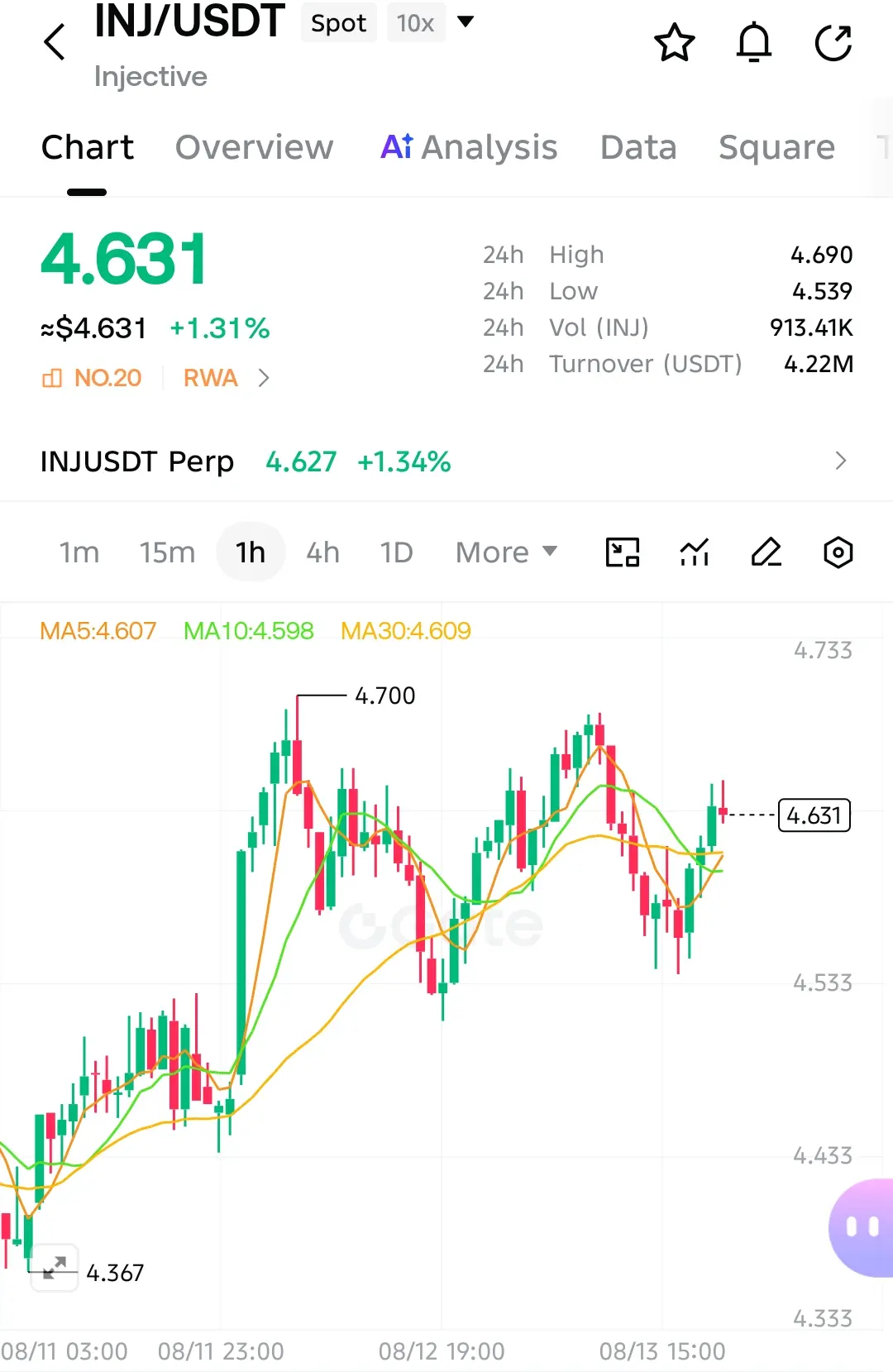
Accumulate in the 4.628–4.632 range; if it holds above 4.7, target 4.75; stop-loss if it falls below 4.55. Follow the rules.
43.53%
View Original
Mason_Lee
$INJ
Grinding up from 4.333, now pressing 4.700. MAs converged—price above all three. Break above triggers continuation; rejection retests 4.607. Momentum building—watch for the close.
Entry Zone: 4.628 – 4.632
TP1: 4.690
TP2: 4.700
TP3: 4.750
Stop-Loss: 4.550
#INJ #GateLaunchpool141MDOS #GateJulyTransparencyReportReleased #GateHits59MillionUsers #StockTradingShareChallenge
repost-content-media
  • Reward
  • Comment
  • Repost
  • Share
Just sent a USDC transfer back from Osmosis to the Ethereum mainnet, and while I was at it I went through the trust nodes in the process. Honestly, every time you bridge cross-chain, it feels like you’re playing a game of trust relay. And once the bridge on the other end is off, you basically can only pray.
Take this IBC case, for example—the trust chain is actually pretty straightforward: first, it relies on the Light Client on the target chain to correctly verify the other chain’s block headers; then it requires the Relayer not to intentionally drop packets or tamper with messages; and final
USDC0.00%
OSMO-0.82%
ETH-0.17%
View Original
  • Reward
  • Comment
  • Repost
  • Share
I just withdrew from the pool one. The other day I was looking at a small position of 0.03 ETH and hesitated about whether to cut the loss. I thought, if I just ride out the volatility a bit more, it’ll come back. But before going to sleep, I glanced again—and it dropped another chunk. Forget it. I’ll accept the loss and exit. 😅
It’s basically the same as a breakup. The longer you drag it out, the worse it feels. Cutting it earlier actually saves you interest and effort—especially lately, with hardware wallets out of stock and phishing links flying all over the place. It’s the same on the sec
View Original
  • Reward
  • Comment
  • Repost
  • Share
Over the past couple of days, I’ve looked at several RWA on-chain projects—the data stack looks pretty impressive, but this liquidity—plainly put, it’s a thin ice layer. Some pools show TVL of a few million, but in reality their trading depth can’t even handle a 100,000-order size; the slippage is absurd. And let alone the redemption terms: some projects write it like “you win,” but when you dig in, you find the redemption time is extended, fees are quietly increased, and there’s even a disclaimer like “subject to market conditions.” What else is this but a liquidity mirage?
Yesterday on the t
RWA-2.44%
View Original
  • Reward
  • Comment
  • Repost
  • Share
Lately I’ve been watching a few DAO votes, and the more I look, the more interesting it feels. On the surface, the proposals are about community governance, but underneath it’s all a game of incentives and power. For example, some proposals cram in a bunch of incentive parameters that seem designed to attract new users, but in reality they feed short-term arbitrageurs with disproportionately large voting power. By the time long-time users react, the proposal has already passed. I used to do market-making in small pools, so I’m especially sensitive to this kind of “turning impermanent loss into
View Original
  • Reward
  • Comment
  • Repost
  • Share
I was flipping through data on stablecoin supply and ETF inflows, and a thought popped into my head—don’t rush to treat correlation as causation. It’s like the tide or like a thermometer: when the tide is rising, everyone thinks it’s a good thing, but the thermometer itself is only an indicator. Lately, everyone’s been talking about rising rate-cut expectations and the U.S. dollar index moving up, and risk assets moving along too. Honestly, I’m a bit confused—I’m not sure whether the money is really coming in; you have to look at the actual on-chain wallet activity, not just a few numbers. Whe
USIDX-0.31%
USDC0.00%
View Original
  • Reward
  • Comment
  • Repost
  • Share
I just came across a post explaining how block builders package bundles, with technical details all the way through—it gave me chills just reading it.
Honestly, do retail users really need to know this? My thoughts are simple: you only need to know that “someone can see your transactions in advance and jump the queue,” and the rest is handled by slippage settings and private transaction channels. I tried to study those parameters, but the more I looked, the more I felt like a headless fly. In the end, I realized it’s better to spend the time on risk management.
I thought knowing how bundles ar
View Original
  • Reward
  • Comment
  • Repost
  • Share
Recently I tried a few AI Agents to monitor on-chain interactions. To be honest, some parts do save effort, but there are plenty of traps too. For example, when it comes to wallet signing, the Agent can automatically recognize the contract address and provide a risk warning. But once it encounters a lookalike contract masquerading as a common project—especially a newly deployed one that hasn’t been included by the labeling system yet—it just freezes and directly shows “unlabeled.” Last time I nearly got pulled into an interaction by a fake GMX Agent—luckily I checked the creation time, and it
GMX-0.49%
View Original
  • Reward
  • Comment
  • Repost
  • Share
I just saw a friend say they chased a privacy-sector token, and it pulled back by a dozen or more percentage points—now they’re saying it hurts. Honestly, lately the discussion around these privacy coins and mixer protocols has been pretty heated in the community: one side says compliance is a matter of survival, while the other says anonymity is the original intention.
Putting positions aside, I personally think when you get itchy and want to chase a run-up, the first question you should ask yourself is: are you actually seeing new information, or are you just being pushed along by emotion?
M
View Original
  • Reward
  • Comment
  • Repost
  • Share
Just after I plugged the charger in, when my phone’s battery jumped from 5% back to 20%, it suddenly hit me—NFT liquidity isn’t it basically the same as this charger? The floor price looks low, but when there’s no volume, nobody will pick up your bid, no matter how far down you place your order. Royalties are another matter entirely—project teams rely on community narratives to keep things afloat. Then on the chain-game side, inflation blows up, the studio runs off, the coin price spirals downward, and the community directly turns into a dead group chat. Plainly put: with liquidity, it’s not a
View Original
  • Reward
  • Comment
  • Repost
  • Share
Every time the market’s hot-spot rotation kicks in, the first thing I’m used to doing is flipping through my own recap notes from before— not to check how much I’d made, but to look back at the “why didn’t I manage to hold back” or “why was I hesitating” from back then. Plainly put, I’m afraid I’ll keep repeating the same kind of mistake. This time, during the meme rotation, once a celebrity starts pushing a call and people in the group begin charging in again, I instinctively pull up that last trade I blew in a similar emotional mood and take a quick look— and I’m instantly calmer. I’m not tr
MEME-0.39%
View Original
  • Reward
  • Comment
  • Repost
  • Share
When liquidity dries up, it’s the easiest time to get carried away. Watching the pool like a dead stagnant pond, with everyone on-chain canceling orders, people still keep shouting “buy the dip, buy the dip.” I’ve seen too many people who still have a bit of U left in their hands and feel they have to rush in to catch falling knives—only to end up trapped even deeper.
Actually, when I was building pools, I understood it: when liquidity is gone, even if you pick the safest trading pair, it can still double down on impermanent loss. The recent NFT drama has been equally lively—royalties were cut
View Original
  • Reward
  • Comment
  • Repost
  • Share
They say market making is effortless profit. I used to think so too—back then I even felt it was nothing more than placing funds there and waiting to collect fees. Now looking back, I can only say it’s the curve that matters—something about it has fooled plenty of people.
That AMM curve looks smooth, but it hides some tricks. What you think is impermanent loss is what the math formula calculates, but what’s really painful is this: the coins you put in might go up by 30%, and when you take them out, most of the gains get wiped out by slippage and losses. In plain terms, market making isn’t like
View Original
  • Reward
  • Comment
  • Repost
  • Share
I just glanced at a certain liquidation transaction—gas shot up like crazy, but the quotation timestamps from the oracle data feeds inside it were actually off by three blocks. Later I found out it wasn’t the chain that was congested; it was the data source of the feed node itself refreshing slowly, causing the liquidation bot to wait there for half a day, nearly smashing the pool wide open.
Honestly, this is even more covert than impermanent loss. You think it’s market volatility messing with you, but it turns out that a feed delay turns you into someone else’s liquidity withdrawal machine. R
View Original
  • Reward
  • Comment
  • Repost
  • Share
Just went through a round of NFTs, and it feels a bit subtle.
The floor price looks pretty solid, but actual trades are still sporadic—listings are posted high, but no one comes to take them; if you list low, you’re afraid you’ll end up being that “bottom-picked” person. It really feels like liquidity is kind of fake right now: a lot of the quotes are just market-making bots sitting there, and retail traders don’t dare to move.
As for royalties, there’s been plenty of discussion about them lately too. Some projects have started lowering royalties, saying it’s to boost trading—but to put it blu
View Original
  • Reward
  • Comment
  • Repost
  • Share
I just adjusted a Subgraph query and found the data keeps getting stuck at a certain block height and won’t move. Checking the logs, it turned out to be RPC rate limiting—this is even more subtle than impermanent loss. Everything is fine most of the time, but the moment you run a batch query, it cuts in and out. Indexers, to put it simply, are like an intermediary: you feed it data, it organizes it, and then outputs it to you. But if along the way any rate limiting or retry mechanism isn’t set up properly, the front end will always show “loading...”.
Lately, with all the buzz around social min
View Original
  • Reward
  • Comment
  • Repost
  • Share
Just saw someone talking about NFT royalties—the liquidity in the secondary market gets worse, and creators’ income shrinks along with it. Who wouldn’t be jealous… Honestly, sometimes I scroll past people posting their profits and I envy them, especially those who can hold through a whole cycle doing spot—damn, their mindset is really good.
But looking at myself, when I was making markets in small pools, I was most afraid of “impermanent loss dressed up as gains.” The books look good, but once you actually do the math, your mind just breaks. Later I summarized it in plain human language: you c
View Original
  • Reward
  • Comment
  • Repost
  • Share
Just writing down some thoughts. I’ve been looking at a few chain-game pools recently: the output rate has been adjusted round after round, they’ve also done buybacks and coin burn, but that TVL keeps going down. To put it bluntly, inflation is sitting at some threshold—production is always higher than consumption—so the pricing inside the pool is essentially what’s being auctioned off. If you don’t make markets and keep running, later arbitrageurs will slowly squeeze the air (the excess value) out of you.
About the recent funding rates—some people think there’s going to be a reversal, others
View Original
  • Reward
  • Comment
  • Repost
  • Share
Recently I’ve been getting a little too absorbed in the DAO voting proposals. On the surface it’s about choosing solutions, but underneath it’s all about incentives and how power gets divided. For example, with the staking unlock issue—everyone keeps staring at the sell-pressure on the calendar, but the parameter changes hidden in the proposal—release rate, vote-weight skew—are the real things that can change the game dynamics. Anyway, when I look at votes now, I flip through a few more pages of the discussion board to see who’s pushing what, and whether the reasons for opposition are really c
View Original
  • Reward
  • Comment
  • Repost
  • Share
Recently I’ve seen a lot of people talking about stablecoin supply and ETF holdings, saying “money is coming in” and “the bull market is coming.” Well… how should I put it—there’s a bit of a taste of treating correlation as causation.
Stablecoin issuance doesn’t necessarily mean fresh money; it could be old money rotating on-chain, or market makers adjusting their positions. The size of the ETF is small compared with off-exchange real macro capital—it barely even counts as a ripple. To put it plainly: don’t get excited just because a number goes up; you need to see where the money is coming fr
View Original
  • Reward
  • Comment
  • Repost
  • Share
  • Pinned