StardustRouter

vip
Active for: 0.4y
Peak Tier 0
I enjoy researching cross-chain and routing optimization—every bit saved counts. Occasionally, I write small tools for friends to use; I keep a low profile but take things seriously.
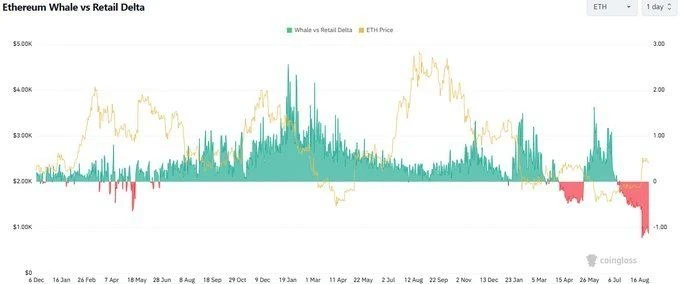
Whale shorts haven’t let up yet; ETH only has a chance once this wave of selling pressure runs its course.
ETH1.84%
View Original
Alek_Carter
ETH whale vs retail data is still negative, with bigger players holding more shorts.
If this short pressure starts reducing, ETH could finally get some upside momentum.
#U.S.StrikesIranBTCDips
#GateLaunchesJapaneseStockTrading
repost-content-media
  • Reward
  • Comment
  • Repost
  • Share
Lately, looking at the delegated voting data has been pretty frustrating: the top ten addresses have taken nearly half the votes, and it’s called decentralized governance, but in reality the whales are just moving things from one hand to the other. I increasingly feel that governance tokens govern retail investors’ fantasies, not the protocol’s direction. I once painstakingly dug into a project’s delegation graph and found that a bunch of addresses had been transferred funds from the same fund at the same time, then voted for one another after the transfers. The on-chain records were glaringly
View Original
  • Reward
  • Comment
  • Repost
  • Share
When funding rates go extreme, I usually don’t take the other side. The profits look fat, but reversals can hit just as hard, while sitting out the volatility leaves me feeling left behind. AI Agent automated trading has been hot lately, but honestly, most of it is just narrative hype; few can really nail the details of slippage and contract security. Never mind—I’ll stick with the little tool I wrote to monitor cross-chain spreads. Every bit saved counts; staying alive matters.
View Original
  • Reward
  • Comment
  • Repost
  • Share
Just finished going through a round of trust models for IBC versus ordinary bridges, and there are some things I want to write, but I feel like no one will read it. Forget it.
To put it simply, the hardest part of cross-chain isn’t the technology—it’s who you actually trust. For an ordinary bridge, you basically hand your coins over to a multisig group, then they “map” you a balance based on their mood. In essence, it’s credit custody.
IBC is a bit better: the set of validators is shared, consensus security is tied to the base chain, and an attacker can’t simply “change state” on either side w
View Original
  • Reward
  • Comment
  • Repost
  • Share
I just spent the whole afternoon looking at options data, and I can’t help thinking that time value is something I both love and hate. Buyers always feel like they can bet correctly on direction, but they get eaten up by theta every day. No matter how anxious you feel, you can’t outpace time. Anyway, it’s a grind.
As for the sellers, they’re steadier, but they’re not pushovers either. In recent macro news, rate-cut expectations and the US dollar index have been pulling in opposite directions. Risk assets have been rising and falling together, and volatility has been stirred up like crazy. I wr
View Original
  • Reward
  • Comment
  • Repost
  • Share
At 3:00 a.m., I’ve been watching the charts so closely that my eyes are almost ruined. To be honest, the flashy narratives in recent Meme coins—things like cats, dogs, and galaxy battlecruisers—look exciting on the surface, but the liquidity behind them can get pulled just like that, as fast as flipping the table. My own strategy right now is: for anything that has a narrative but no fundamental support, set a stop-loss first—if it drops 15–20%, I leave immediately, no overthinking the impulse. These days in the group, people keep circulating charts about stablecoins losing their peg. We’re no
MEME2.09%
DOGE0.86%
View Original
  • Reward
  • Comment
  • Repost
  • Share
After the latest series of public chain upgrades, everyone’s been wondering whether ecosystem projects will also jump on the bandwagon and migrate. Honestly, I’m really sick of this kind of “switch lanes overnight” pace—better to first figure out whether the project itself is even trustworthy.
For newcomers checking GitHub, the biggest mistake is only looking at the number of stars. Sigh—stars can be bought, and they can be boosted, but commit history and how fast issues get handled can’t be faked. I usually scan the updates from the past few months to see whether people are really fixing bugs
View Original
  • Reward
  • Comment
  • Repost
  • Share
To be honest, I’ve found the recent royalty dispute quite interesting. Should the secondary market really take a cut and split a payment with creators? On one hand, I feel it should be done that way—otherwise, what do creators rely on to make a living? On the other hand, on-chain liquidity is already not high; if you slice off another fee, trading volume could basically come to a halt. If creator royalties had been written into the smart contract layer back then, instead of relying on market goodwill, we probably wouldn’t be arguing so endlessly now.
As for social mining and fan tokens—honestl
View Original
  • Reward
  • Comment
  • Repost
  • Share
I recently looked through the NFT floor prices of a few old projects, and honestly, it’s pretty heartbreaking. Liquidity fragmentation has long stopped being news: royalties have kept getting cut again and again, and even top blue chips have started doing dynamic adjustments, but the community narrative has only gotten colder. Put simply, everyone is now focused on actual returns rather than sentiment—back when you could hype “culture” to move the market, now even minting is too lazy to bother with.
Yesterday I tested a new on-chain data tool and found that its tagging system classifies the ad
View Original
  • Reward
  • Comment
  • Repost
  • Share
Check your own wallet’s transaction history and you’ll be shocked—many old contract approvals are still set to unlimited amounts. Back then, to save time, you just tapped confirm on cross-chain bridges and aggregators and moved on. Now that you think about it, your back goes cold. If any project goes wrong, your wallet could be drained instantly. Revoking permissions is like locking your door before bed—annoying to do once, but it keeps you safe. Recently, I’ve been looking at social mining and attention tokens; to put it plainly, user authorizations are the shovels in other people’s hands. If
View Original
  • Reward
  • Comment
  • Repost
  • Share
Honestly, I feel that an unrealized loss is more tormenting than an unrealized gain. It’s really not a question of psychological resilience. When your position drops 5%, your mind is like it’s been scratched by a cat—you instinctively want to flip your phone, check the charts, and look for good news everywhere to comfort yourself. But when you’re up? A 20% gain and you only glance at it, thinking, “It’s fine, no need to sell yet.” When it climbs to 50%, though, you start wondering whether you should run.
Put simply, loss aversion is a built-in “bug” in the system. When I was writing a cross-ch
View Original
  • Reward
  • Comment
  • Repost
  • Share
Recently, I’ve been watching the sandwich trades on-chain, and honestly, it leaves me feeling a bit complicated. On the surface, it looks like arbitrage, but the truth is it’s basically taking other people’s fees—especially those orders with large slippage. Once they get targeted, you’re really wiped out in an instant by a big bite. I’m not really into this kind of play; it just feels a bit… not very classy, if you know what I mean. In any case, I’d rather tweak my routing parameters more—so I can save on gas and slippage—and treat it as money I earned myself.
When the funding rate has been ex
View Original
  • Reward
  • Comment
  • Repost
  • Share
Just scanned a few cross-chain transfer txs—pretty interesting. One address transferred a chunk of USDT from Polygon to Arbitrum, but it took two hours to arrive. In the meantime, it interleaved interactions with more than a dozen small addresses. At first glance it looks like random transfers, but the route hides several gas optimizations and contract calls. I’m not saying everyone needs to understand it, but behind every “coincidence transfer,” you can basically break out an explainable routing logic. The recent back-and-forth over NFT royalties—at its core—is also a battle between creators
View Original
  • Reward
  • Comment
  • Repost
  • Share
To be honest, I’ve been tinkering with modularity for a while, but honestly, for end users it feels like… not much has really changed?
For cross-chain routing tasks, even if you break them down further, users still only touch the same frontend and click those same buttons. Gas fees are either saved or spent as usual, and whatever the underlying abstractions are doesn’t really show up in what they see. I studied it purely because when I was optimizing routing, I found that modularity let me write fewer lines of logs and remember fewer RPC addresses—made things comfortable for me.
But lately, se
View Original
  • Reward
  • Comment
  • Repost
  • Share
I can’t keep up with the group chat lately—there are hundreds of messages out of nowhere: KOLs calling out buys, meme screenshots, project tutorials… it’s pretty exhausting. To be honest, some KOLs are even more nitpicky than I am, but we still have to be realistic in our own heads—not every single message is worth following. As for this round of meme celebrity buy calls, I’m bowing out for now. Old players are advising newcomers not to take the last step— I believe that.
If you think about it, impulsively buying usually means you didn’t think it through. The group chat messages and the KOLs a
MEME2.09%
View Original
  • Reward
  • Comment
  • Repost
  • Share
I just took a look at the APY of a certain aggregator— the numbers look pretty good, but when I clicked through to the underlying contracts and counterparty, it felt like there was a whole tangle of nested components behind the scenes, and the liquidity source was also unclear. Anyway, I don’t dare to blindly rush in—saving money is the same as making money.
Recently, the DA layer of modular blockchains has been pretty hot in discussions. Developers are excited about it, and I’m just sitting there completely clueless— the user-layer stuff still isn’t clear to me yet. If I’d put a bit more time
View Original
  • Reward
  • Comment
  • Repost
  • Share
Hey, honestly, when I’m watching the charts at 2:00 AM, seeing a floating loss of $1 feels more likely to make your heart race than a floating gain of $5. I recently tried a cross-chain router and saved a 0.005 ETH fee, and I was excited for half an hour—then the next day I found that an approval hadn’t been revoked, so I ended up closing for 0.002 ETH more, and I was annoyed all day. That loss aversion is really a disease—no matter how much the algorithm gets optimized, it can’t fix my own psychological anchor. Like now, some region is raising taxes, so deposits and withdrawals are slower. I
ETH1.86%
View Original
  • Reward
  • Comment
  • Repost
  • Share
Seeing people in the group arguing again about which is better for hardware wallet multisig or social recovery, there really isn’t a fixed answer. It all depends on how much of your assets you have, and whether you’re willing to put in the effort.
Personally, I’m more of a practical type. If your assets are within a few dozen thousand USDT (or under that scale), then a hardware wallet plus a physical backup of your recovery phrase is the most solid approach—don’t get too fancy. Once you go beyond that amount, single-point risk becomes bigger. At that point, multisig or social recovery can inde
View Original
  • Reward
  • Comment
  • Repost
  • Share
I’m just an ordinary player who writes little tools for personal use, and lately I’ve been a bit confused looking at those social mining projects. It’s all full of points, badges, and identity levels—feels like clocking in for work. Every day you go and tap it at set times. To get that bit of stacked weighting, it’s like people are tied to the chain.
To put it simply, the logic behind the re-staking setup sounded pretty appealing at first—shared security and compounded rewards. But now it’s starting to look more and more like a nesting doll: one layer after another, and the risks are actually
View Original
  • Reward
  • Comment
  • Repost
  • Share
I just went through the NFT market—floor prices are dropping hard, but everyone thinks this is a “bargain-buying opportunity.” In reality, liquidity has almost frozen; orders posted for half a day still aren’t getting picked up, and royalties have been cut as if they were nonexistent. No matter how hot the community narrative is, if nobody’s buying, it’s just cold leftovers. Macros-wise, rate-cut expectations are being blown up aggressively; the US dollar index and risk assets move up and down together—but this NFT move doesn’t seem to have caught the hype. Anyway, in the cross-chain routing t
View Original
  • Reward
  • Comment
  • Repost
  • Share
  • Pinned