Mint-ColoredSlippage

vip
Active for: 0.5y
Peak Tier 0
I hate it when slippage eats into my profits. I often research routing, aggregators, and liquidity distribution, and I'm willing to spend half an hour tinkering just to save a bit of money.
Honestly, when I see news that a stablecoin has depegged slightly, my first reaction isn’t to rush in and buy the dip, but to calculate its liquidity and pool depth.
The liquidity up there is paper-thin, and the slippage keeps eating into you until you start questioning your life choices. I’ve always felt that a bank run isn’t something you can simply shout into existence—it gets triggered by one loud cry. In any case, those big-money players are smarter than us; when they run, they don’t wait for confirmation from the candlesticks.
I’ve also seriously looked at the balances and contract TVLs
Stop-losses are really just like breakups. When things first start feeling off, you keep thinking, “Maybe I should wait a little longer—what if it bounces back?” But what you end up waiting for isn’t a change of heart; it’s getting trapped deeper and deeper. I cut my losses yesterday. I did lose some money, but I slept soundly, paid less interest, and actually saved money overall. I’m increasingly convinced that admitting defeat early is a gain. Lately, I’ve seen everyone interpret ETF fund flows together with U.S. stock risk appetite, finding external reasons for every rise and fall. But don’
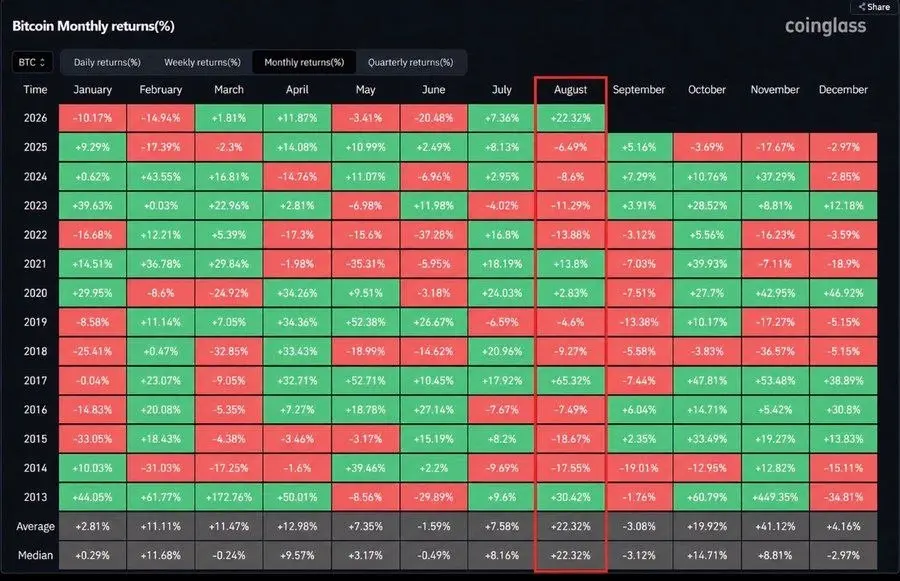
Historical patterns are meant to be broken. August is already up 22%; if it closes green, it will be the first red August to turn positive in a U.S. midterm election year. This rally is playing completely dirty. #BTCBreaks77000
Alek_Carter
🚨 $BTC IS ON TRACK TO MAKE HISTORY
Bitcoin is currently up around 22% in August.
If it closes green, this could be the first positive August for BTC in a US midterm election year.
This cycle keeps breaking the script.
#BTCBreaks77000
repost-content-media
I just saw someone hype RWA on-chain again, saying US Treasury yields are so great and on-chain returns are so steady… How should I put it? It looks pretty wonderful at first glance, but if you look closely at the redemption terms, it’s a bit of a headache. Liquidity, to put it bluntly, is basically an illusion: you think you can turn it into cash anytime, but the product tells you, “redemptions require T+2, or even T+5.” When you suddenly need money urgently, the slippage can completely throw you off. Also, the US Treasuries underlying it are volatile in their own right—compared with those on
RWA-0.88%
Everyone already knows loss aversion, but the moment it happens to you, those few dollars of unrealized losses are more upsetting than ten times as much unrealized gain. Last night, I watched my position flip from green to red, and my stomach dropped. I clearly know that lately ETF fund flows and U.S. stock market risk appetite are tied together, and that crypto following the same kind of gyrations is normal—but I just couldn’t stop myself from doing the math: if I’d waited ten more minutes then, or switched routes, would I have saved a few percentage points? In the end, this “I can’t help it”
Over again around 3 a.m. I kept refreshing the group messages; the more I read, the more irritated I got. A bunch of people were reposting screenshots from a KOL, saying that xx aggregator has the best slippage, and that yy routing can save gas—yet when I clicked in to test it myself, it was simply not the case. Some of them looked cheap, but the actual route was winding like a maze; instead, it took away the profit. Honestly, the mood in the group is too easy to be led by. Yesterday, someone even followed the trading calls and went into a new pool; with trading fees and slippage added up, the
Honestly, the royalty dispute has been going on and on, and the more I think about it, the more I feel that everyone is pretty good at keeping the numbers straight. When I was a newcomer, I thought royalties were exactly what creators should earn—it felt completely justified. If someone didn’t respect that, then they were just heartless. But now? After turning it over and over in my head, I’m thinking the opposite: in on-chain trading, the slippage and ordering are the real “implicit royalties”—miners and validators get paid first, retail investors end up losing, and to put it plainly, the way
Cointelegraph news: The National Industrial Information Security Development Research Center has officially launched the action to jointly build an LLM security evaluation benchmark. Focusing on six dimensions—content security, value alignment, robust and steady performance, fairness and non-bias, privacy protection, and true and trustworthy reliability—it will construct a systematic, end-to-end evaluation system. It is now soliciting co-building units—this signal suggests that domestically developed LLM security standards are entering the implementation stage.
CoinNetwork
Binjie.com News: The National Industrial Information Security Development Research Center, drawing on its technical accumulation and practical experience in the large model security assessment field, has officially launched the action to jointly build a large model security assessment benchmark. The Center is now soliciting participating units for co-building, with the aim of creating an AI security evaluation and testing system that covers all dimensions and is systematic. Built around the security governance needs of real-world applications of large models, this benchmark establishes a panoramic assessment framework. It covers six core security dimensions: content security, value alignment, robust resilience, fairness and impartiality, privacy protection, and real trustworthiness, forming a systematic end-to-end evaluation and testing system.
SOL/BTC breaks through the one-year downward channel, but the dollar-denominated move hasn’t been confirmed yet—waiting for a pullback to buy is even more appealing.
CoinNetwork
CoinWorld News: Solana has recently broken through the downward trend against Bitcoin, with the SOL price target at $90. Analyst Michaël van de Poppe noted that Solana has already broken the one-year downtrend, and the current price is close to $80. The market is now watching for further upside. However, a breakout in SOL/BTC does not automatically confirm a breakout in the USD price. The analyst said that if the price pulls back, he will consider buying at lower levels. Solana performed well over the past July, rising 10.2% in July 2026.
SOL-2.92%
BTC-3.42%
Memory cycle bottoming out + AI computing arms race, dual narratives stacked, no wonder ADR oversubscribed. But how much can ultimately be realized depends on yield and production ramp-up.
Ai_Power
#SKHynixADROversubscribed 🔥.
SK Hynix ADR Oversubscribed: A Powerful Signal Behind the AI Semiconductor Boom
🚨 Powerful Hook
The AI revolution is creating a new race for the future of technology, and investors are searching for the companies powering this transformation.
When an ADR offering becomes heavily oversubscribed, it sends a clear message: market demand is stronger than available supply.
SK Hynix's ADR oversubscription highlights growing investor interest in one of the most important sectors of the next decade, where artificial intelligence, advanced memory, and semiconductor innovation are becoming the foundation of global technology growth.
Why SK Hynix Matters in the AI Era
Artificial intelligence is not only about software and applications. Behind every powerful AI model is a massive infrastructure network requiring advanced chips, high-performance memory, and efficient computing systems.
SK Hynix has positioned itself as a major player in the semiconductor industry, especially in the high-bandwidth memory market that supports the growing demand for AI data centers and advanced computing.
As AI adoption expands globally, the demand for specialized memory solutions continues to increase.
What Does ADR Oversubscription Mean?
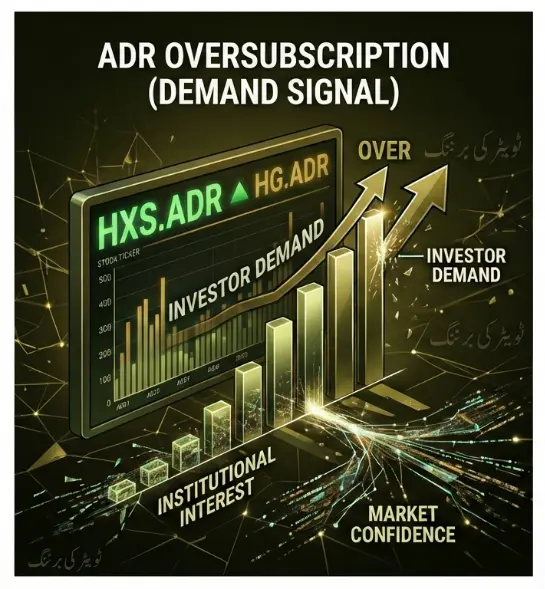
An oversubscribed ADR offering means investor demand exceeds the number of shares available.
This can indicate:
• Strong market confidence.
• Growing institutional interest.
• Increased attention toward the company's future growth potential.
However, investors should remember that strong demand during an offering is only one part of the bigger picture. Long-term performance depends on revenue growth, innovation, competition, and market conditions.
The Bigger AI Semiconductor Story
The semiconductor industry has become one of the most important battlegrounds in global technology.
From AI data centers to next-generation computing, advanced chips are becoming strategic assets.
Companies that can provide critical infrastructure for AI development may benefit from the long-term expansion of this industry.
SK Hynix's position in memory technology places it directly in the middle of this transformation.
Investor Perspective
The key question is not only whether demand is strong today.
The bigger question is:
Can SK Hynix continue converting AI demand into sustainable growth over the coming years?
Investors are watching factors such as:
• AI infrastructure spending.
• Memory market cycles.
• Innovation speed.
• Global semiconductor competition.
Market Outlook
The oversubscription of SK Hynix ADR reflects a broader market trend: investors are looking beyond traditional technology companies and focusing on the companies supplying the foundation of the AI economy.
The AI revolution requires hardware, and semiconductor leaders are becoming increasingly important players in this new digital era.
Final Analysis
SK Hynix's ADR oversubscription is more than just an investment event. It represents the growing belief that AI infrastructure will remain one of the strongest technology narratives of the future.
As demand for advanced computing continues to rise, companies at the center of the semiconductor ecosystem could play a crucial role in shaping the next phase of technological growth.
Do you think AI semiconductor companies will become the biggest winners of the next technology cycle?
AI_Power
repost-content-media
Trump's Bitcoin strategic reserve is stuck in departmental wrangling; the confiscated coins haven't even warmed up yet, and they're already arguing over who should manage them — classic Washington efficiency.
WuSaidBlockchainW
According to Bloomberg, the Trump administration's plan to establish a strategic Bitcoin reserve is facing adjustments due to issues of authority and legal authorization. Sources say the original plan was for the U.S. Treasury to manage the reserve, but there are doubts within the government about whether the Treasury has the legal authority to manage the relevant Bitcoin assets. As a result, alternatives such as placing it under the U.S. Department of Commerce are being evaluated. The Office of Legal Counsel of the U.S. Department of Justice is working with the Treasury and the Commerce Department to study legally viable implementation paths. The White House stated that the government is still evaluating the best structure for a strategic Bitcoin reserve and a U.S. digital asset reserve. Trump had previously asked the Treasury and the Commerce Department to jointly develop a budget-neutral plan for acquiring more Bitcoin, with reserve assets primarily coming from Bitcoin confiscated by the federal government, and additional purchases could be made through budget-neutral means.
BTC-3.42%
7546 ETH withdrawn from Coinbase, institutions always have such a unified posture for bottom-fishing—by the time retail investors realize, the ship has already sailed.
CoinNetwork
According to a report by Bianjie News, based on monitoring by Onchain Lens, the BlackRock ETF address has withdrawn 7,546 ETH from Coinbase, worth approximately $13.2 million based on the current real-time price.
ETH-3.83%
Going long four times in a row and still opening a short for 20,000 coins—this position management and mindset crash feels a little too real. Gone: 3.5 million “dao” in three days. The tuition fee to learn in crypto is really expensive.
CoinNetwork
CoinJie.com News: According to on-chain analyst AI Yi’s monitoring, a trader opened a short position of 22,000 ETH after incurring losses from four consecutive long trades. The trader opened the position at an average price of $1,613 and exited with a stop loss at an average price of $1,772, losing approximately $3.5 million over three days.
The more volatile the market, the more I find this dollar-pegged, yield-bearing infrastructure interesting — not about betting on price moves, but using on-chain funds as a legitimate financial tool.
Original content no longer visible
When the liquidation line is three steps away, my hands are weak but my mind is clear. First, I borrow some stablecoins to pad the health factor, even if the APR looks painful, it's better than getting bitten by a bot. Anyway, with my stingy nature, I'd rather pay interest than fines.
Recently I've come across a bunch of social mining posts, and honestly I'm a bit jealous. Others can just move a finger and post content to farm tokens, while I'm here staring at the gas fee for each block to calculate the optimal path… But calm down and think about it, turning attention into tokens sounds flimsy
TOKEN-3.74%
This former HUD official's perspective is quite interesting. The efficiency of XRP for cross-border payments is indeed recognized by many institutions, but is it a bit too much to say that Bitcoin has no practicality? The two have fundamentally different positioning—one serves as a settlement layer, the other as a store of value. Does it have to be an either-or choice?
CoinNetwork
CoinWorld news: Catherine Austin Fitts, the former Assistant Secretary for Housing and Urban Development in the United States, said in a recent interview that XRP and Ripple are crucial for the new financial infrastructure currently being built, while Bitcoin does not have such functionality. She noted that XRP and Ripple will play core roles in enabling cross-border payments for financial institutions quickly and at low cost, and she believes Bitcoin is not an efficient payment system and lacks the necessary practicality. Fitts emphasized that building the financial system is a gradual process, and financial institutions have already made clear choices when selecting infrastructure.
XRP-1.11%
BTC-3.42%
More than $50 million worth of BTC flowed out of Coinbase Institutional. Whale activity is always three steps ahead of the news—so who’s swooping in to pick up the next bag this time?
CoinNetwork
CoinJie Network news. According to Whale Alert monitoring, Coinbase Institutional has just transferred 859 BTC to an unknown wallet. Based on the current price, it is approximately $52.6578 million.
BTC-3.42%
In three days, they swept up 40,000 units. This is not a gaming company, it's clearly an ETH bull army.
WuSaidBlockchainW
Wu learned that, according to Onchain Lens monitoring, SharpLink Gaming has purchased a total of 39,196 ETH (approximately $62.43 million) over the past 3 days, with the latest large-scale purchase amounting to 29,196 ETH (approximately $46.7 million).
ETH-3.83%
Deutsche Bank's report has somewhat dampened the recent 'hawkish panic' — speculation that there will be no rate hike this year is gaining the upper hand.
CoinNetwork
CoinWorld News: As the market lowers its expectations for a Fed rate hike, the U.S. dollar edged lower. Data on Thursday showed the Personal Consumption Expenditures (PCE) price index rose 0.4% month-on-month, below the 0.5% expected by economists. Deutsche Bank analysts said in a report that this "has dampened the narrative of a Fed rate hike that has been heating up in recent weeks." They noted that while Fed officials remain cautious about the inflation outlook, there is growing speculation that the Fed may not need to raise rates at all this year.
At last, there’s an on-chain solution for tracing the source and verifying ownership of AI training data—Story Protocol’s latest transformation is hitting the pain point head-on.
CoinNetwork
Coin World News, as reported by The Block, Story Protocol has transformed into the Data Foundation, shifting its business focus to an AI training data network. The project has launched the Trace system, which generates verifiable on-chain contribution credentials for AI training data, recording sources, authorization terms, user consent, and payment information.