
Square
Following
Hot
News
Profile

OldBlackVelvetKey

vip
Active for: 0.6y
Peak Tier 0
Obsessed with privacy and self-custody, often discusses hardware wallets, signing habits, and social engineering prevention. Slow to warm up but reliable.
86
Following
10
Followers
4
Liked
Someone asked me whether restaking is actually worth touching. I said: first understand one thing—when yields stack up, risk multiplies; it doesn’t just add up.
These days, various restaking protocols treat ETH like Lego bricks, stacking one layer on top of another. The APY looks pretty enticing, but shared security is, in plain English, putting all your eggs in one basket and then telling you it’s diversified. I’ve studied the EigenLayer approach. It works logically, but if a black swan hits—for example, a major node gets slashed or an oracle feeds the wrong price—the chain reaction could be
ETH+0.47%
EIGEN-5.89%
We’ve been chatting about social mining in the group for several days. To be honest, I’m not really interested. Monetizing attention sounds novel, but I haven’t even figured out the basics of what’s happening on-chain.
Lately, though, I’ve been watching block explorers: a dozen or more transactions get squeezed in within the same second, some people pay several times more in gas to cut in line, some get sandwiched, and others simply fail. I used to think “first come, first served” was only natural. Now I realize that ordering itself is a business. As for MEV, you could say it’s fair because it
I’m more the type to dig through transaction histories from treasury addresses six months ago than someone who watches project teams make empty promises in their tweets.
Put bluntly, the blockchain doesn’t lie, but people do. MEV has been causing heated debate lately, with retail investors criticizing unfair ordering, but I’ve noticed that some project teams’ own treasury spending is even more opaque than block building—the milestones are written beautifully, yet the money flows into vague accounts like “ecosystem partnerships.”
My habit is to find the multisig address first, then check the fr
I used to take price feed delays lightly, until I nearly got liquidated last winter.
The chain stalled for more than thirty seconds. My position was actually safe, but the oracle price failed to keep up with the spot market, so the protocol thought I had been liquidated. Luckily, I usually keep my liquidation threshold well out of reach; otherwise, it really would have become someone else’s profit.
Now I’ve started recording every anomaly—not the price, but how long the delay lasted, which node caused the problem, and what percentage of my portfolio was in the position at the time. After track
RWA+0.55%
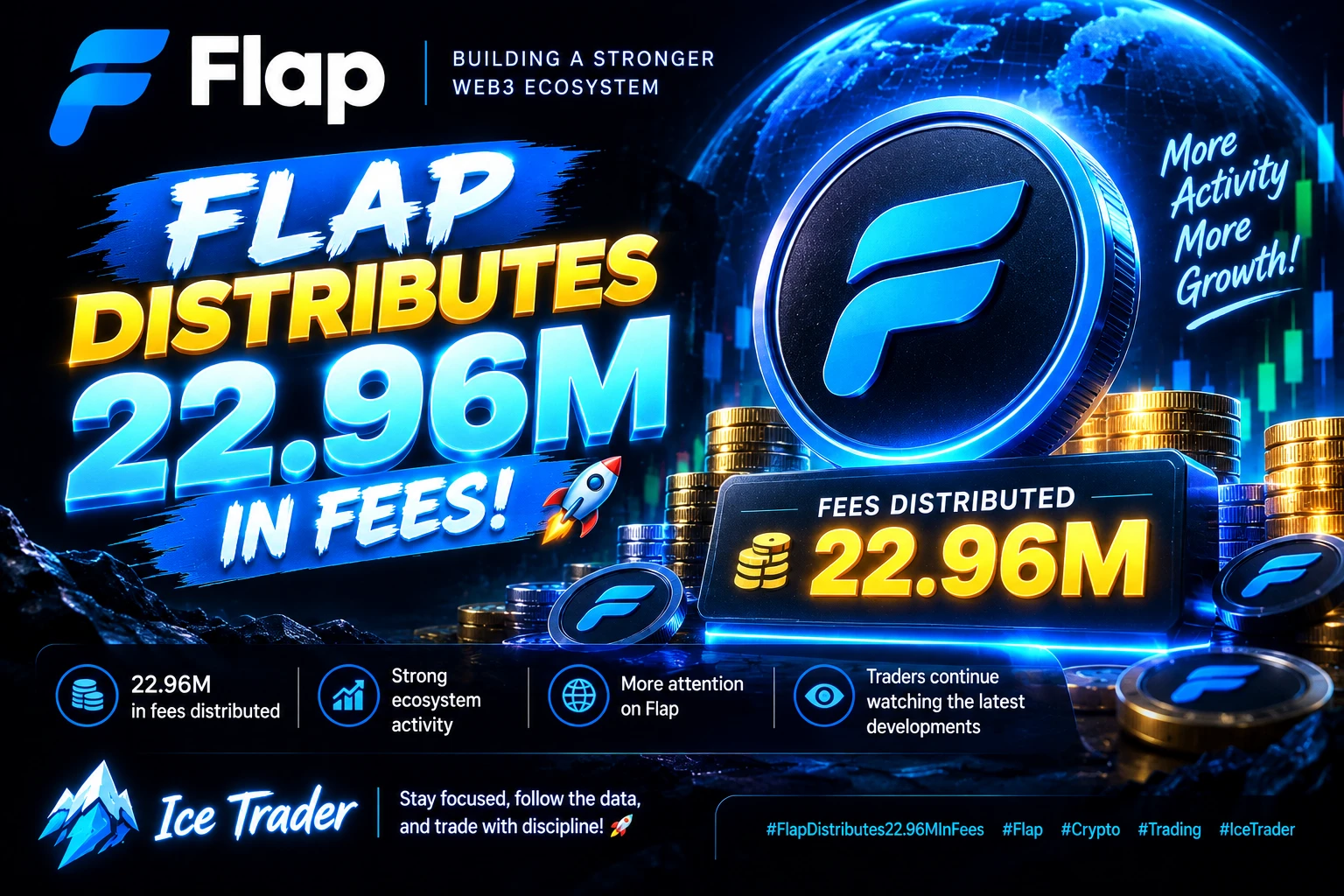
22.96M fees distributed — the ice trader was right, discipline comes first, I kept my eye on this move
IceVortex
🚀 Flap Distributes 22.96M in Fees! 💰🔥
Flap has distributed 22.96M in fees, highlighting strong activity across its ecosystem. 📊⚡
💰 22.96M in fees distributed
📈 Strong ecosystem activity
🌐 More attention on Flap
👀 Traders continue watching the latest developments
🧊 Ice Trader — Stay focused, follow the data, and trade with discipline! 🚀
#FlapDistributes22.96MInFees #Flap #Crypto #Trading #IceTrader
repost-content-media
$GT This deflationary model looks solid: platform profit buybacks + 60% burns, much more reliable than pure narrative coins.
CryptoBigBoss
Most exchange tokens rely on hype. $GT relies on tokenomics.
• 15%+ platform profit buybacks
• Over 60% total supply permanently burned
• Native gas for GateChain & Gate Layer L2
• Exclusive access to Gate Startup IEOs
The main reason I'm in love with $GT is the access to Gate Startups
GT-0.30%
I came across a phrase called “attention is mining,” and honestly, it’s a bit of a mix of feelings. Recently, social mining, points, and fan tokens have been getting all the hype. In the group, everyone is showing off badges and points— the vibe is even more addictive than contracts. But the more I look, the more something feels off—this isn’t us using our attention to get points; it’s the platform using points to take our attention.
Put simply, those badges and identity tags essentially help build a new kind of “social asset” for you, and then get you to willingly hand over your time and emot
I feel like my eyes are about to be pierced—I've been staring at that transfer since this morning, and the more I think about it, the more interesting it feels. On the surface, it looks like a certain address just sent a not-too-small, not-too-large amount from one address to another. Anyone can scan the chain at a glance and no one bothers to look closely. But once you break it down and trace it step by step, you’ll realize it’s completely different. That receiving address first got fed some ETH from a multi-sig a few times as gas, then went silent for a week or two. Suddenly, it started hopp
ETH+0.47%
I’ve browsed around online at the L2 spats—things like arguing about TPS, transaction fees being low, and ecology subsidies rolling out like crazy… honestly, I don’t really care. No matter how fast or cheap your chain is, if liquidity dries up, it’s still just a place for people to watch fireworks.
Recently I saw that some small chains have order book depth so thin it’s like paper, with slippage high to the point of absurdity—and that really made me worry. Before you argue which L2 is the best, first think about whether you can safely get yourself out.
My principle is simple: when liquidity dr
This is the 3rd time it’s stuck in the mempool. Tonight the chain is clogged again—my transaction is queued up like it’s at a highway during rush hour. The gas price keeps jumping around, and in the end I had to bite the bullet and add at the mid-market price just to squeeze in. Honestly, every time it gets congested, it reminds me of the anxiety when I sign with a hardware wallet—the kind of restlessness of “I don’t know when this will actually land.” Lately I’ve heard that a certain region is raising taxes, and compliance is tightening too. My mindset around depositing and withdrawing has go
GWEI+3.44%
That recent Chain Game crash wave really makes my scalp tingle. Inflation, studios, and coin prices spiraling—put simply, the internal economic model didn’t work, and then retail investors ended up holding the bag. I actually almost rushed in earlier, too. There was a project whose community hyped it up like it was god-tier, but when you look closely at the whitepaper, the economic model reads like a joke—there’s no way to figure out how to balance production and consumption. Back then, I thought: if I can’t understand it, I won’t move—just hold your hands. And sure enough, it later crashed, s
To be honest, whether the project team is actually working seriously can be judged by whether the treasury spending and on-chain interactions look off. Some projects post weekly reports every day, and even their salaries get piled up for people writing reports, with no real output—when you look at the on-chain data, most of the big transfers are basically benefits for their own people. At that point, if they still start talking up “milestones,” it’s just self-congratulation. Honestly, I’m not really into the whole “smart money” narrative. Every time I see a bunch of people interpret on-chain l
Whenever I see task assignments, it used to give me a headache—I always worried I’d miss something. But now what I fear even more is the data “sticking.” Especially during the recent airdrop season, the points system has turned bounty hunters into office-commuters: you just open a task platform, and the Subgraph progress bar freezes. Then an RPC rate-limiting warning pops up, and my mood completely shatters.
Anyway, for someone like me—someone who’s really fixated on self-custody and privacy—when I run into this kind of data delay, my first reaction is to check whether my signing habits are th
The CEX delisting wave has dropped from 786 to 400+—has the regulators’ scythe dulled, or have the project teams learned their lesson?
Original content no longer visible
ZK computing power networks are moving into the AI sector—are the old hands in the staking mining model seeing “cut costs in half” as genuinely great, or just a sales pitch?
WuSaidBlockchainW
The zero-knowledge proof and distributed computing project Boundless announced that it will expand its compute network, which is made up of about 4,000 GPUs, into AI inference services. The network previously mainly handled Ethereum mainnet and Base-related zero-knowledge proof tasks; it has now completed hardware tuning, workload adaptation, and routing and scheduling upgrades for AI inference, and the existing ZK proving network will continue running in parallel. In the future, AI compute operators will need to stake ZKC to join the network, and the staking amount will be linked to potential rewards. The company said that the early testing costs for some asynchronous inference tasks are up to about 50% lower than those of major cloud service providers. (The Block)
ZK-1.64%
A 50%-65% profit growth rate; the sudden surge in demand for optical transceiver modules in data communications is directly reflected in the financial report. With domestic cloud providers ramping up investment in data centers, FiberHome’s full-scenario product lineup has indeed secured the right position with precision.
Original content no longer visible
550 BTC, address 15od9 is associated with the Tokyo Vault. Is an institution rebalancing or is there another story? On-chain detectives should get to work.
Original content no longer visible
BTC+0.97%
From "team ownership" to "general ticketing", Ice Cube's BIG3 taught NFT players a lesson: celebrity endorsement + legal terms = your rights go to zero.
Original content no longer visible
Monero's network upgrade pace is very steady, and the demand for financial privacy will not disappear. Long-term holders should understand what I mean.
KingAlpha
Monero (XMR) Market Update: Privacy leader maintains strong network activity
Monero (XMR) remains the world's leading privacy-focused cryptocurrency, offering confidential transactions through advanced cryptographic technology. Unlike many public blockchains, Monero hides wallet addresses, transaction amounts, and sender information, making it one of the most private digital assets available. Despite increased regulatory scrutiny on privacy coins, Monero continues to maintain an active community and steady network development.
The network regularly receives upgrades to improve transaction efficiency, privacy protection, and resistance to blockchain analysis. Long-term supporters view XMR as a key project for financial privacy, while investors continue monitoring exchange listings and global regulatory developments.
Conclusion: Monero remains the benchmark privacy coin, supported by strong technology, an active developer community, and growing demand for financial privacy.
#GUSDYieldRisesto3.8% #PredictWorldCup🇦🇷vs🇪🇬 #StrategySells3588BTC #GTBurns2.57MInQ2 #SKHynixADROversubscribed $XMR ‌$XMR ‌
XMR+0.00%
Just saw a video of explosions in Kyiv. It's 2024 and they're still exchanging missile strikes. Ironically, crypto assets have become the last escape route for ordinary people in times like this.
Original content no longer visible