Square
Following
Hot
News
Notifications
Profile

HashPeak

vip
Watching the hash rate and difficulty adjustments daily, I believe miners are the backbone of Bitcoin. Focus on holding long-term, occasionally judging the bottom based on mining costs and electricity prices.
Peak Tier VIP 00.7 Year(s)
120
Following
11
Followers
2
Liked
The structure is broken, the boundary is unconfirmed
andrehol
That was a liquidity sweep from the old zone. So now, upward to new price levels. Or another option: a spike down, which would mean Bitcoin is in danger...
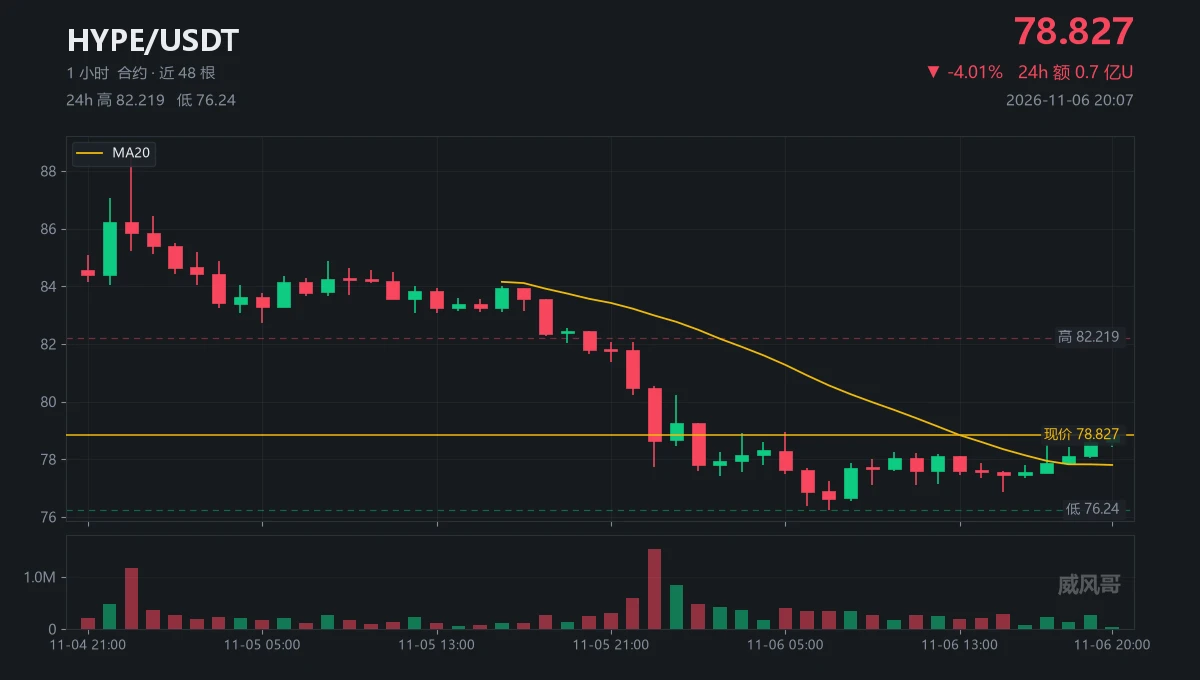
76.24
TheMagnificentEighteenFaces
11-05 23:00, one candle printed 1.52 million contracts.
The previous hour was 290k contracts; this candle was 5.3 times that.
Assessment: Someone actively sold it down; it wasn't a lack of buyers.
Evidence: In the two hours after the sell-off, volume fell to 470k and 430k, and the price didn't break below 76.24 again.
Now $HYPE 78.83, with ma20 at 77.80, slightly below the price.
Over twenty-one hours, it moved from 76.24 to 78.9, just $2.7 back and forth.
Scenario one: If it loses 76.24 and can't rebound back above it, the next level to watch is 74.
Scenario two: If it holds 76.24, reclaim the 80.46 starting point of the dump.
I won't guess which path it'll take; I'll go with whichever one appears first.
Conditions: If 76.24 breaks, I won't catch the dip; if it closes above 80.46, I won't chase.
(Not investment advice. You are responsible for your own gains and losses)
repost-content-media
Every time there's a gas spike, I just stare at the mempool, watching pending transactions pile up like mountains, like a supermarket checkout line. You never know how many people ahead of you are actually buying something and how many are just taking up space in the queue.

Sometimes I set the slippage too low, and a transaction gets stuck for over ten minutes. More than ten blocks go by and it's still pending, but I can't bring myself to spend the gas to cancel it. Basically, it's a gamble—betting on the miners' mood, betting bots haven't spotted your transaction, betting the next block happ
Lately, I’ve had mixed feelings about using L2s. On one hand, gas really is cheap, and I don’t mind doing hundreds of swaps; on the other, I can’t help wondering who’s actually responsible for the security of these bridges.

I use OP and Arbi a lot, mostly out of habit, and I haven’t really compared them carefully. Either way, I still use mainnet for large amounts, and leave smaller amounts on L2 for convenience. Basically, I’m trying to find a balance between “how much money I save” and “who do I turn to if something goes wrong”—one I can live with.

I did see people in the group arguing abou
OP-1.33%
Just now, I was looking at a block explorer when an arbitrage bot slipped in five orders within three seconds, paying more in gas than my daily wage. I used to think MEV was a game for geeks, but now I realize that ordinary swap users have actually been paying “invisible fees” all along—having their slippage eaten and their prices sandwiched, while the interface simply doesn’t tell you.

The recent rise of restaking is essentially another stratification of ordering rights: whoever stakes more and whose nodes are faster gets access to profit information first. So-called shared security sometime
Seeing that cross-chain bridge incident reminded me of how I almost fat-fingered a trade last week—a small-cap coin had a sudden wick, and I was staring at the “Confirmed 0/3” prompt with my finger hovering over the buy button. In the past I definitely would have clicked instantly, but now… anyway, I’ll wait for one block first.

Put simply, terms like data availability, sequencing, and finality all boil down to one thing: the price you think you’re seeing may not actually be “settled” yet. During that oracle mispricing incident, many people got burned because they didn’t wait for confirmation
The short setup for $CHIP is clear: stalled at elevated levels + an exhausted rebound, with staggered downside targets from TP1 to TP3 and clear risk controls, making it worth considering.
Original content no longer visible
CHIP+3.52%
This morning I saw the economic data of a blockchain game project—another inflationary spiral, with the studio selling, retail investors buying, and the token price slowly bleeding. Not really surprising; when the incentives in a token model are incompatible, they basically all end up like this.

I’ve been wanting to write about my thoughts on modular blockchains, but honestly, they’re… pretty hard for end users to perceive. No matter how much the underlying layers are split up, or how clearly settlement, execution, and DA are separated, all users see is clicking confirm and waiting a few seco
Price is surging around 0.1406, with the initial target at the 0.1428 yellow line; a breakout would send it toward 0.147. Hold your trend position firmly and don’t exit impulsively.
Original content no longer visible
We’ve been talking about modularity for quite a while, but honestly, what have ordinary users actually felt? Trades got a few milliseconds faster? Gas got a few dimes cheaper? Maybe not even that. It has made things somewhat friendlier for developers: split into different layers, each doing its own job, making debugging a bit more satisfying. But ordinary users only care about the end experience. What do all these layers have to do with me?

The recent collapse in blockchain games is a pretty typical example: the inflation model was a complete mess, studios kept producing endlessly within the
I’ve been sorting out a year’s worth of on-chain transaction records lately, and my head is almost bald. I used to think that all I needed was to note a wallet address—turns out that at the end of the year, when I flipped through the on-chain data, the cross-chain bridge had been used back and forth dozens of times. Gas fees, mining rewards, and LP fees were all mixed together, and I couldn’t even tell which trades were profit and which were principal.

Now I’m being honest with it: for every interaction, I quickly take a screenshot and write down the date and the rough purpose. Especially whe
I just went through a few project documents I’d been looking at today, and my brain is all over the place.

Actually, terms like data availability, ordering, and finality sound intimidating—but when you boil it down, it’s basically: “confirm that the data is stored safely,” “decide who comes first and who comes after,” and “once you’ve decided, you can’t change your mind.” Lately, all these testnets have been making people dizzy, with all kinds of token-related expectations going through the roof. A lot of people start guessing whether the mainnet will issue tokens. But in my view, it’s more i
Just saw a whale address doing some pretty weird on-chain activity—tons of messy token swaps, along with the staking actions from a new protocol. Honestly, when it’s this kind of on-chain clutter, I usually take a screenshot first and keep it for later; I don’t rush to get involved. I can’t tell whether they’re truly building a position, hedging their exposure, or just doing mining arbitrage. When I can’t figure it out, I usually don’t move first—I'll wait until the structure is clearer.

I’ve tried this twice before. I saw the whale going crazy to build a defi protocol’s governance token, so
Circle picked a great partner for this collaboration. With Tokyo stores piloting first and then rolling out later, stablecoins in Japan’s offline scenarios really could gain traction—Lawson is also testing JPYC, and the regulatory outlook is clearly getting looser.
WuSaidBlockchainW
JCB has reached a cooperation with Circle’s affiliated entities, and plans to test USDC payments within the year at a store in Tokyo with a high number of foreign tourists, evaluating expansion to more partner merchants. The pilot is intended to reduce tourists’ currency exchange steps and lower payment processing fees. Previously, JCB had tested offline USDC and JPYC payments with Digital Garage, Resona Holdings, and others; Japan has also recently been accelerating stablecoin merchant payment trials, including Lawson planning to test JPYC in-store settlement in August. (CoinPost)
CRCLG-1.08%
CRCLX-1.79%
Fidelity says 56,500 is a potential target—so the question is: are you building a position now or waiting for a spike? During the market consolidation phase, position management is more important than trying to guess the bottom.
Original content no longer visible
Grayscale’s move is quite interesting—selling BTC to protect the USD instead ends up “backstopping” the downside. Institutions are starting to play with risk management now.
Original content no longer visible
BTC-0.67%
Mukhmas is in trouble again, civilians are being pursued, the military is arresting people. When will the vicious cycle between Palestine and Israel end?
Original content no longer visible
After two weeks of market making, I finally got used to that curve — it turns out that impermanent loss is not "potentially losing," but "definitely losing in a certain range," you just don't know when you'll step into it.

I used to think that just putting it in the pool and lying back to collect fees would be fine, but after calculating, during those weeks of high volatility, the fees couldn't cover the deviation in price spread. It's annoying, but there's no way around it; it's part of the structure.

Recently, seeing everyone farming airdrops like clocking in for work, I'm actually a bit g
Load More