Square
Following
Hot
News
Profile

OracleSkeptic

vip
Active for: 0.5y
Peak Tier 0
An oracle failure is scarier than a contract bug. I always check the price feed source and update frequency first. I'm cautious and prefer to use case studies to convince people.
63
Following
11
Followers
2
Liked
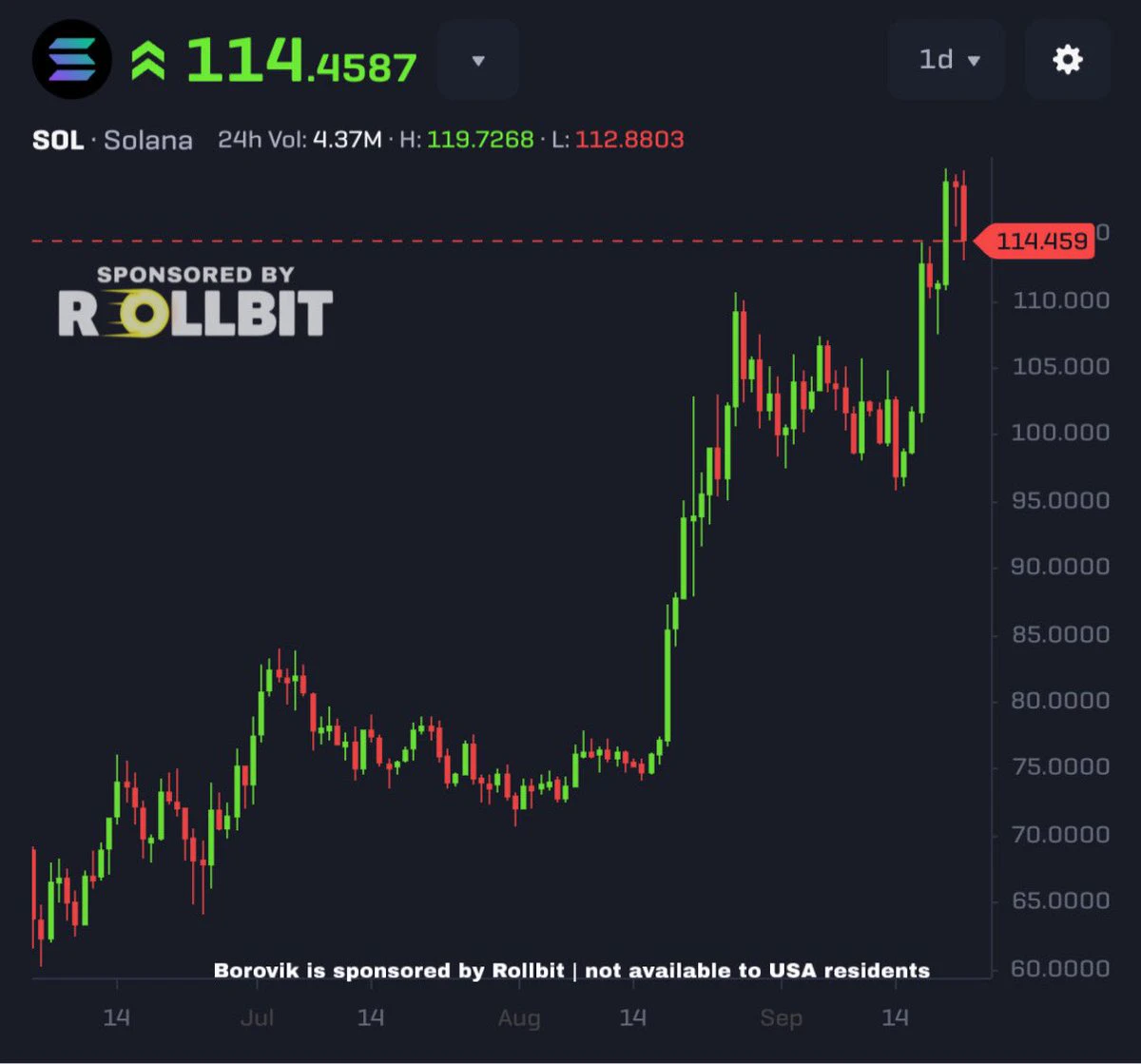
SOL doubling over the past three months is indeed impressive. I believe it will reach a new high in 2027.
CryptoOnline
Solana’s ascent has been nothing short of remarkable, doubling its value in a mere three months! 🚀 The momentum suggests that SOL could be on a trajectory toward record‑setting highs by 2027. 🌟 I’m feeling incredibly bullish about its future prospects and can’t wait to see how far it climbs. 📈
#ShareWeekly
repost-content-media
SOL-1.54%
If 1800 holds, we're heading higher—the bullish signal this time is pretty strong. I'm in, I'm in.
Cryptoguider
$SNDK SNDK/USDT — 1H
BIAS: Strong Bullish 🟢
LONG:
Entry: 1,800+
SL: 1,765
TP1: 1,825
TP2: 1,850
TP3: 1,900
Rule of 2:
Candle 1 breaks 1,800.
Candle 2 holds above 1,800.
Rule of 4:
Break → retest → hold → continuation.
SHORT:
Below 1,745
SL: 1,790
TP1: 1,725
TP2: 1,700
TP3: 1,675
FINAL CALL: 🟢 LONG above 1,800#GateEventContractTradeSharingChallenge #GateGloballyLaunchesStockEventContracts
Watching the bundling order of the latest few large transactions on a block explorer, I saw someone get sandwiched again. On-chain queue-jumping is basically paying for priority. The transaction you painstakingly submit gets sandwiched in the middle, and the price slippage is absurdly high. The wallet shows one price, while the actual execution happens at another. After running into it a few times, it really makes you want to give up.
As it happens, a major chain is undergoing an upgrade and maintenance, and people in the community are already speculating about whether ecosystem projects might
Market making isn’t “easy money,” and I’ve said that a lot. You often see people treating AMM like an automatic cash machine, but in a volatile market the impermanent loss is actually pretty scary. Plainly put, if you provide liquidity and the coin price rises and falls, the losses you end up with could be more than just holding the tokens. Some people think that if they only provide liquidity in stablecoin pools it’s fine, but if the price oracle feed used by the protocol updates slowly or gets manipulated, it can still hit you unexpectedly. I’ve seen AI Agents doing automated market making a
I copied the testnet address wrong—almost sent the gas to a discarded contract. I only realized after fumbling for three seconds… When I see platforms with all these tasks, multi-layer scoring, and Sybil detection, my first reaction is to check whose price-feed source it uses, and what the update frequency is. 😂 I used to think farming for rewards was just picking up easy money, but now it feels more and more like a job: every day you log in to check in, do tasks, and if you’re not careful, you’ll trigger a model “blowing up.” Even more outrageous is that some rules aren’t transparent at all—
Oh, it’s that time of year again when the airdrops are rolling around. In the groups, those points-based tasks get competitive like they’re going to work—“anti-sybil/anti-fraud” efforts have turned into something bordering on mysticism. Anyway, I don’t have the energy for it. Just keeping track of the transaction history alone already gives me a headache.
Back when I filed taxes at the end of the year, I’d open the CSV exports from the exchange and see a huge gap. On-chain transfer fees and staking rewards were all just bare data—no useful context. I was furious about it at the time.
Now I’ve
Talking about modularity—honestly, my first reaction is: do end users really need to care? Lately I’ve been seeing spot/perps funding rates get so extreme they’re basically ridiculous. Even in the community everyone’s guessing whether there’ll be a reversal or whether we’ll keep squeezing the bubble. Then I come across modular projects that are hyping “composability” and “customizable execution layers”… Anyway, what I care about is this: even if your components are flexible, the price feeds are still the same old ones. If a module’s oracle doesn’t keep up, and something goes wrong—say a cross-
Recently, I’ve been watching the L2 crowd argue with each other—comparing TPS, comparing fees, comparing ecosystem subsidies—like a market stall fight over prime spots. Honestly, as someone more conservative, I’m actually calmer: when I feel an itch to chase the surge, I first ask myself— is this real information, or are others using emotions to push my position?
I’ve been burned before. Every time I see some chain’s data suddenly spike, I let my heart get hot and rush in, only to find the price-feed/source update lags by half a beat—then the ones stuck are just watching someone else’s “excite
I just saw someone say that on-chain data transparency is a good thing, and I guess that’s true—but privacy, the boundaries really are pretty blurry. The recent staking unlock round stirred up quite a commotion; many people were staring at the calendar and anxious out of their minds. Put simply, once the data is transparent, others can also figure out your operational tempo. I ran into a case before: because the update frequency of the price feed source got stuck, the contract was almost exploited in reverse. No matter how strong the privacy protection is, if the oracle source at the root fail
A lot of people are saying that USDT is being issued more and that ETF inflows are coming in, so they’re convinced that over-the-counter funds are moving into the market—“the big bull run is coming.” I’m a bit worried.
Last month, on-chain data tools and labeling systems have been checked pretty strictly. A friend said the label for a certain whale address has been changed: it shows “inflow to CEX,” but what’s actually happening is internal transfers. In other words, those “smart money” labels that get picked up in bulk with a delay of two or three days—are you really going to treat them as a
BTC-1.86%
What I regret isn’t the outcome, but the fact that even though I clearly knew the whole logic of wash trading and KOL shilling, I still couldn’t resist a round of “narrative upgrade” NFTs. The floor price is down by nearly 70%; setting royalties to 0 also doesn’t work, and not setting them doesn’t get anyone to buy either. The community hypes “Alpha” every day, but in the end it’s just a few old bagholders propping things up in the group chat.
To be honest, NFT liquidity is poor—not basically because the floor price is low, but because everyone knows in their hearts: most projects only have
At 3 a.m., I’m still digging through a month’s worth of transaction history in a pile of browser tabs—it’s giving me a headache. After using a multi-chain wallet, it feels like asset fragmentation is even harder to prevent than oracle data latency—you never know which corner might still have a few tenths of an ETH sitting there that hasn’t been pulled back. I’m more conservative: I only use two fixed wallets, and I even made an EXCEL sheet (manual—embarrassing), reconciling my balances at midnight every weekend. Recently, with RWA and US Treasuries being brought up and put on stage compared wi
ETH-1.76%
RWA-1.45%
I just saw a news story about another bridge incident, and the more I read, the more it’s just tears. As for cross-chain bridges, to put it bluntly, they amount to putting your trust on a handful of multisig signers plus an oracle: who exactly those multisig signers are, how the keys are distributed, and whether the signing parties are independent—these things are often a black box. The oracle side is even crazier: the price feed source is usually just one or two, and if it goes down, everyone gets stuck at the same time, and nobody knows why. I’m an old-school person, so I still prefer the “w
Just saw someone talking about AI agents doing automatic trading. A lot of people are hyping it, but honestly, my first reaction was: “What if the price feed source gets tampered with?” Once an oracle goes wrong, no matter how many signatures the contract has, it’s all pointless.
Recently I dug my hardware wallet back out and wiped the dust off it. I used to think multisig was really cool, but when I do the math on my own assets, a cold wallet plus screen confirmation is really enough. For social recovery, I don’t trust friends, and I also don’t trust the guardians I chose—if they get phished,
To be honest, when I see posts about RWA being put on-chain, my first reaction is, “Don’t rush to hype the liquidity.” Two years ago, I looked at all kinds of high-quality NFT lending protocols and felt like adding another trading venue. Later, I realized that the oracle price feed frequency for many of those assets simply can’t keep up with on-chain volatility—this isn’t a technical bug; it’s a trade-off. Recently, I saw people criticizing that data tools are lagging and can be misled, and I actually think that’s normal.
Think about it: if an on-chain representation of a property/bond/fund ha
RWA-1.45%
I just took a look at the funding rate—ETH is back to a very deep positive number. Longs really aren’t panicking at all. At times like this, I’m not interested in rushing to join the trade. A friend suggested I could post a short to earn the funding rate; that sounds pretty good. But what if I get swept out by a spike and liquidated? In that case, the funding rate likely wouldn’t be enough to cover the loss. I’m even more worried that something might go wrong with the oracle side—there was a project that had abnormal quotes before, and they couldn’t fix it for several consecutive blocks. Back
ETH-1.80%
I just saw an on-chain data point saying that a certain whale is accumulating the token of a particular project. In the comments, a bunch of people are shouting to follow the trade. But when I checked his position structure, that same address opened a large number of short positions at the same time. It looks more like borrowing spot assets to hedge and set up a risk offset, not like building a bullish position.
A lot of people see a whale “buy” and rush in. Then they end up stuck somewhere around mid-slope. I’ve been burned myself. Earlier, when LINK pushed up to a certain level, the whale wa
When it comes to NFT liquidity, quite a few floor prices have recently been cut in half, but the royalty mechanism is still hanging there. Some project teams are stubbornly trying to keep collecting royalties, and the community has actually started to cool down instead. I’ve always felt that oracle problems are scarier than smart contract bugs. Every time I see an NFT quote depending on a single feed source, I get a bit panicky. If the update frequency is slow and the price lags by a few days, liquidity becomes even harder. In the hot spots, hardware wallets went out of stock and phishing link
I muted the group chat, and it feels like the world has gotten a lot quieter. Before, a whole bunch of people were touting PFPs as “digital business cards,” saying that membership fees are basically the entry ticket to buying future airdrops. The pitch sounds familiar—when you think about it carefully, isn’t it just the same “pay money first to buy consensus” game from back then? Long-term value? I, for one, haven’t seen many projects manage to last a year without collapsing. But as for the attention economy, everyone is still very eager, pushing hard to be the next one to get turned into liqu
To be honest, every time I open a DAO voting page, my first instinct isn’t to read the proposal itself—it’s to first check the addresses and the reasons behind the “no” votes. In fact, the voting power structure is often more revealing than the proposal. It’s those details—who holds a large amount of veTokens, who quietly changes delegations behind the scenes—that are usually more concrete than the “pie” drawn in the whitepaper. I’ve seen a dividend proposal that looked perfectly reasonable, only to discover that the voting threshold was just barely set to align with a particular whale’s colle