StargazingUnderTheGlassDome

vip
Active for: 0.4y
Peak Tier 0
I look at both macro and on-chain data, and enjoy finding rhythm within cycles. Occasionally, I write long posts, but mostly I quietly focus on portfolio allocation.
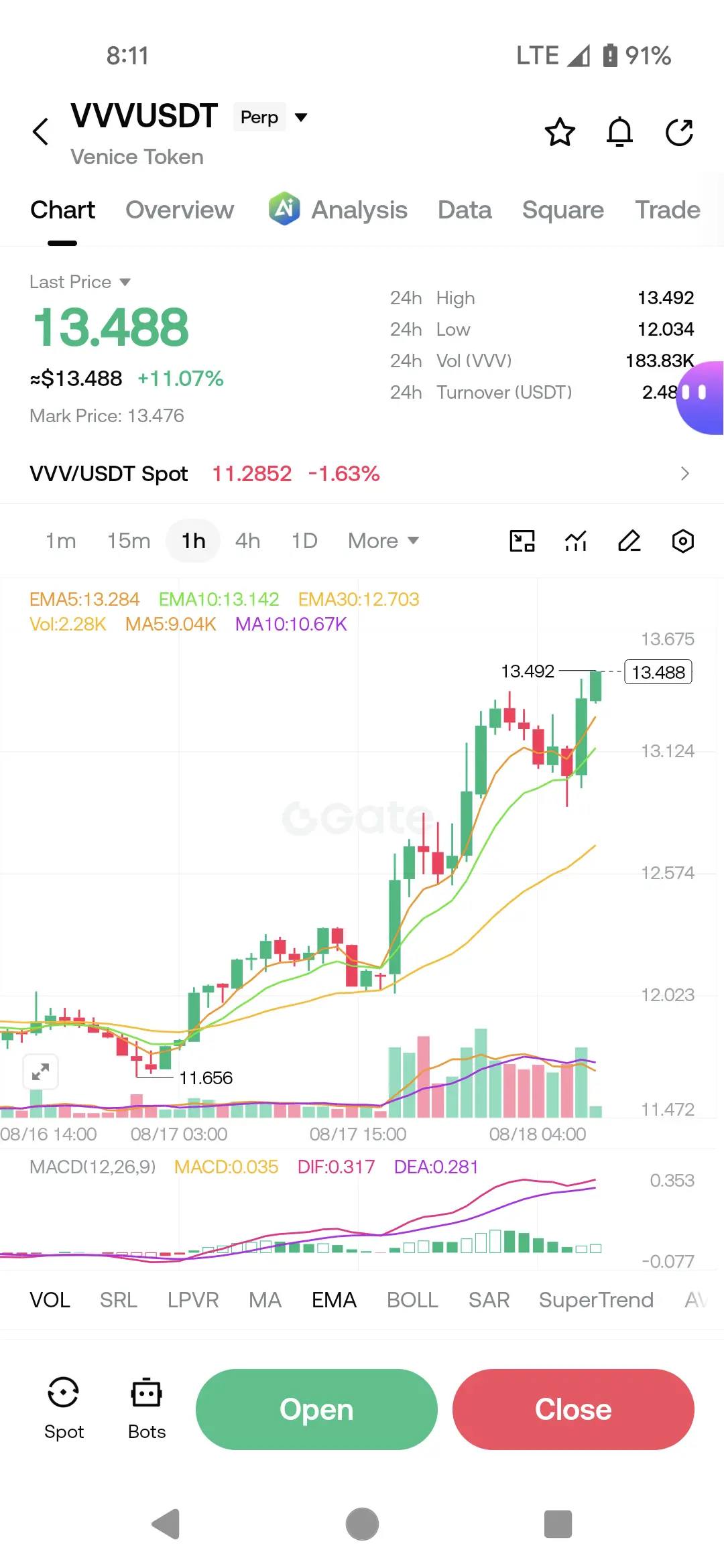
Few coins can stand above all EMAs amid broad market weakness, and VVV is one of them. The current 11% gain is not the endpoint; a break above 13.5 will accelerate the move. A prudent approach: enter with half now, set a stop-loss at 12.5 to limit risk, take some profit at 14, and set 15 as the main target. Remember, don't rush to go all in; it's better to leave room for trend confirmation.
VVV14.35%
View Original
CryptoJourney1
$VVV ‌ — LONG (STRONG UPTREND)
VVV is up 11% and trading at $13.488. Price is above all EMAs — EMA5 ($13.284), EMA10 ($13.142), EMA30 ($12.703). MACD is positive. Solid bullish structure.
Plan:
· Entry: $13.488 (current) or $13.000 on a dip.
· Target 1: $14.000 — psychological level.
· Target 2: $15.000 — bigger target.
· Stop-loss: $12.500.
Advice: This is one of the few coins showing strength. Enter a portion now. If it breaks $13.500, add more.
#GateEventPointsSystemLaunched
---
repost-content-media
  • Reward
  • Comment
  • Repost
  • Share
To be honest, airdrop farming is increasingly starting to feel like a job. Task platforms break interactions into standardized steps: click through them daily like clocking in, then check your score. Sybil screening has everyone on edge, and even the little gas money in your wallet feels like a bet that you’re not just a cog doing repetitive work.
You used to be able to participate whenever you had time. Now the process is more formal than the project teams themselves—it’s only missing a timesheet. What else would you call this if not a job? One where you’re responsible for your own profits an
View Original
  • Reward
  • Comment
  • Repost
  • Share
Recently, I’ve been seeing all kinds of projects launch PFPs and membership cards, and honestly, I’m a bit confused. Some projects really do look great, and their communities are lively, but I always feel like something isn’t quite right.
My own feeling is that, put simply, a PFP is a symbol of identity. When you join a group chat with one that has a high floor price, people treat you differently. But here’s the question—how long can that identity hold up? Are the project teams genuinely building, or are they just riding this wave of attention to generate hype?
Around the upgrade of a certain
View Original
  • Reward
  • Comment
  • Repost
  • Share
Recently, I went through the concepts of data availability, ordering, and finality step by step. Honestly, I got confused by these terms before too. There’s really just one main line: first, the data is proven to truly exist (availability), then it’s packaged in whatever order (ordering), and finally, who has the power to decide and make it unchangeable (finality). It’s like looking at the stars: you have to see them in the sky first, record their trajectory, and only then can you confirm their coordinates.
Lately, everyone’s been talking about restaking and shared security. Some people say it
View Original
  • Reward
  • Comment
  • Repost
  • Share
I recently saw a maintenance and upgrade update for a public chain. As soon as the news came out, a lot of people immediately started guessing whether ecosystem projects would be affected. To be honest, I’m also pretty curious. There are more and more automated tools now, and AI Agents can help monitor markets and run simple on-chain interactions, saving a lot of effort. But when it comes to critical steps—like when a certain protocol needs to urgently cast votes on someone’s behalf, or when a contract interaction structure is complex and parameters need to be verified—I still feel like people
View Original
  • Reward
  • Comment
  • Repost
  • Share
Trade every day to get $10–$160 cash back, and there’s an extra reward for continuing for three days—don’t miss out on the free cash.
View Original
Original content no longer visible
  • Reward
  • Comment
  • Repost
  • Share
The recent airdrop season is indeed lively, but to be honest, the assets in my wallets are getting more and more scattered. I use multi-chain wallets plus various task platforms, and the number of accounts is so high that I can’t even count them myself. In the past, I thought managing all of that would be a real headache, but now I just do one thing per wallet: one wallet is dedicated to holding my long-term allocations, and another is for interacting with projects I think still have room to grow. The rest—those point-based “farm airdrops” tasks—are so competitive that it feels just like work,
View Original
  • Reward
  • Comment
  • Repost
  • Share
I just looked at a data dashboard, and it froze again. It doesn’t necessarily mean the chain is the problem—most of the time, it’s the part that includes the nodes, the indexers, or the Subgraph layer that can’t hold up first. RPC rate limiting and query timeouts—plainly put, the infrastructure can’t keep up with the real-time performance you want. I’m used to it. I’ll just wait for ten-plus seconds and refresh again. After all, I’m not a market maker; being a little behind actually helps reduce emotional volatility.
When a certain public chain caused an uproar around an upgrade recently, the
View Original
  • Reward
  • Comment
  • Repost
  • Share
I just tried an AI agent auto-interaction script. It ran all night and the data looked good, but as for “farming free rewards,” it’s starting to look more and more like an office job—task platform entry thresholds are getting higher, and scoring rules are getting more and more detailed. You just stare at the screen and click around, and it’s not much different from clocking in. I tried doing it once by splitting a few tasks and running them as a script, but the safety checks didn’t pass and I was immediately flagged as abnormal. Now you can tell at a glance who’s selling the narrative and who’
View Original
  • Reward
  • Comment
  • Repost
  • Share
Recently I’ve been thinking about RWA on-chain, and honestly, the more I look at it, the more interesting it feels. Issuing debt backed by on-chain collateral sounds great, but liquidity really ends up being an illusion—most people only see the T+0 thrill, and they don’t notice the fine print buried in the redemption terms. A friend asked me whether I’d push it. I told him I’ll wait and watch first. This isn’t the same thing as DeFi—you have to let time validate it.
Last night I spent time staring at a chain-based MEV validator and ran through it—my neck is almost stiff now. Now retail is comp
RWA3.66%
View Original
  • Reward
  • Comment
  • Repost
  • Share
Lately, watching the chart, the more I look, the more it feels like we’re waiting for an engine that hasn’t started yet. When liquidity dries up, people talk about “waiting to buy the dip,” but when you actually get to that point, nobody really has certainty in their heart— the market looks like an ECG, and I chose to shrink my exposure first, cutting my position down to a level that lets me sleep at night. ETF fund flows and U.S. stock risk appetite get brought up and discussed over and over. Honestly, it feels like a bit of over-interpretation, but what can you do—the market’s sentiment is j
View Original
  • Reward
  • Comment
  • Repost
  • Share
To be honest, I’ve been looking into LSTs and restaking lately—it’s pretty interesting, but also kind of tangled.
Where does the yield come from? Basically, most of it is carved out from the staking rewards of underlying assets (like ETH). Restaking is just adding that yield on top—kind of like putting several layers of leverage on the same asset. But the risk comes from the same place too: if the underlying asset runs into problems—say, the nodes get slashed, or there’s a contract vulnerability—then those layers of leverage can blow up together, and the losses won’t be linear.
Recently, I’ve
ETH9.74%
View Original
  • Reward
  • Comment
  • Repost
  • Share
Honestly, cutting your losses is pretty much the same as breaking up. The longer you drag it out, the more uncomfortable it gets—you just keep thinking, “Let me endure a little longer; maybe it will rebound.” In the end, you lose even more, and you even end up covering the interest too. Cutting it early and admitting it instead is more convenient and less of a hassle, and you save on the interest as well.
Recently, it’s airdrop season, and efforts are targeting anti-botting and anti–female scammers. The task platforms are so competitive it’s like clocking in for work—using a points-based syste
View Original
  • Reward
  • Comment
  • Repost
  • Share
To be honest, I use both grid trading and DCA, but in the end, nothing feels truly safe while you can sleep at night. I can’t just go all-in; my heart can’t take it.
Recently, though, I’ve noticed that on-chain data tag systems look pretty intimidating, but when it comes to using them as a basis for configuration, they always feel a beat late—sometimes even misleading me.
I’m not sure if it’s just that I don’t understand them well enough. Anyway, I’m more inclined now to split my positions into smaller chunks, DCA in, and not obsess over the charts. I just wake up at night and glance at th
View Original
  • Reward
  • Comment
  • Repost
  • Share
Recently, I’ve seen a lot of people arguing about royalties in the secondary market. Honestly, this is pretty interesting.
Royalties were originally meant to protect creators, but once they’re moved into the secondary market, when liquidity gets squeezed and prices drop, they end up becoming a “cash-grab machine.” Some people think it’s exploitation of collectors, while others think platforms are just cutting corners and taking advantage of users—actually, both sides have some truth, but the real issue isn’t the royalty itself; it’s the market structure. When liquidity is good, royalties are l
View Original
  • Reward
  • Comment
  • Repost
  • Share
To be honest, I used to be the kind of person who gets itchy the moment there’s volatility—couldn’t hold spot, got liquidated in futures. To put it simply, my position management wasn’t thought through. Later, I slowly did a “version update” for myself—from V1.0 “chasing pumps and dumping dumps,” to V2.0 “holding on faith,” and now to V3.0 “not going to extremes.” Now when I see a big amount moving on-chain, my first reaction isn’t “wow, smart money is moving,” but “oh, it’s starting to move—let me check whether there are signals in my framework.” Anyway, position management is just one piece
View Original
  • Reward
  • Comment
  • Repost
  • Share
Honestly, I got confused for a while too. “Modular” has been talked about a lot in the development community, but for someone like me who only uses dApps, it doesn’t really make much difference.
To put it simply, who cares which layer your data is in or how it’s ordered? I just want to know whether transfers are fast, whether slippage is low, and whether switching chains in a wallet doesn’t keep crashing. No matter how much you break down the underlying layer, if the experience isn’t smooth once it reaches the application, then it’s all pointless.
When I looked at some projects promoting the m
TIA15.72%
View Original
  • Reward
  • Comment
  • Repost
  • Share
Just took a look at the mempool—it's jammed solid. Every time this happens, sending a transaction feels like waiting in line to buy milk tea: there’s a whole bunch of people cutting in (adding gas). If you don’t move, you just end up staring. Anyway, I usually check the average gas of the same type of transactions in the pending pool first, then decide whether to tip a little extra—otherwise getting stuck for half a day is really annoying.
The recent RWA wave has been pretty lively, with US Treasury yield and on-chain yield products being compared side by side. To be honest, seeing others maki
RWA3.66%
View Original
  • Reward
  • Comment
  • Repost
  • Share
Just saw the group arguing again about L2’s TPS. I did the math: whichever chain is faster and whichever offers more subsidies, people seem to think that one is also safer. But if you think about cross-chain bridges, multi-signatures are understandable, but on the oracle side, if the quoted price goes slightly wrong, liquidation or arbitrage can all fall apart. Waiting for confirmation, in plain terms, is leaving yourself some buffer—don’t rush in. In any case, my habit is to wait a few more minutes if needed, and only act after there’s more confirmation. It feels like the trust model of a cro
View Original
  • Reward
  • Comment
  • Repost
  • Share
  • Pinned