GateUser-94818fd0

vip
Age 0.2 Year
Peak Tier 0
I like to observe the market as if looking in a mirror: watching the flow of funds and the reflection of sentiment. Most of what I post are screenshots with a one-sentence conclusion.
AI customer service needs to be fast; on-chain settlements are an order of magnitude faster than traditional banks, that logic makes sense.
View Original
CoinNetwork
Netomi CEO: The $5 trillion AI customer experience market will drive demand for stablecoins
Netomi founder Puneet Mehta states that by 2030, the customer experience industry will reach $5 trillion, driven by demand for stablecoins and blockchain payment infrastructure rather than capital from the crypto sector; the company's annual expenditure on customer experience-related knowledge work is about $500 billion. As AI expands from customer service to sales and other areas, market opportunities are expected to grow tenfold. He believes AI and crypto are complementary, with AI agents requiring faster financial infrastructure, which could become a driving force for stablecoin adoption.
  • Reward
  • Comment
  • Repost
  • Share
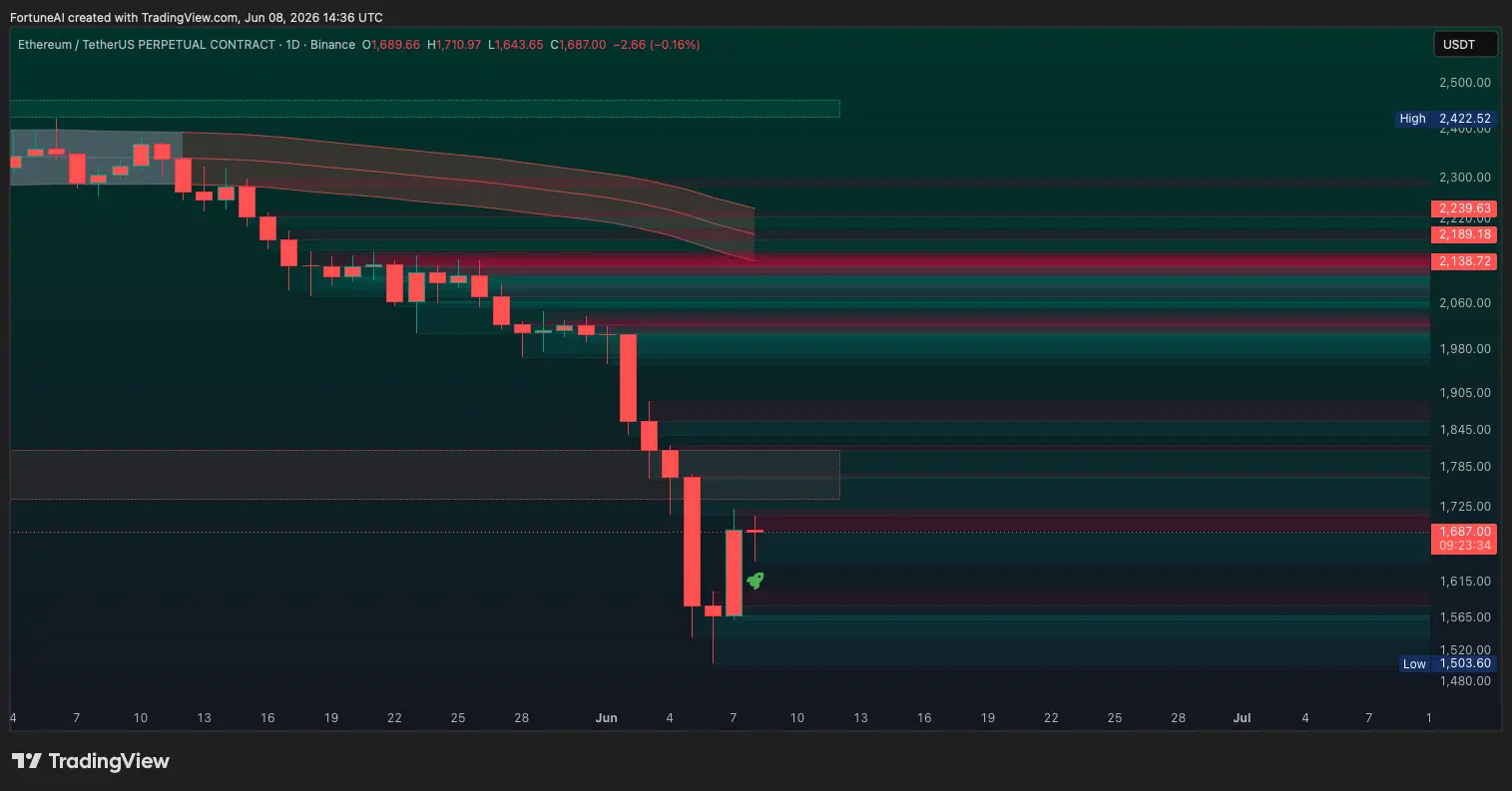
How many times has ETH died? I can't count anymore.
ETH-1.42%
View Original
FortuneAi
ETH was dead at $200.
ETH was dead at $800.
ETH was dead at $1,400.
Now, $ETH is dead at $1,600.
You know what's coming next.
repost-content-media
  • Reward
  • Comment
  • Repost
  • Share
After 10 liquidation balances, only $50k remaining, then immediately went all-in on 1,075 ETH.
I don't understand Huang Licheng's move, but I am deeply shocked.
The liquidation price at 1,560 is nerve-wracking.
ETH-1.39%
View Original
CoinNetwork
Crypto news, according to Lookonchain monitoring, Huang Licheng experienced 10 liquidation events within 8 hours, with his account balance dropping to $52,000. He then increased his long position to 1,075 ETH, which is worth approximately $1.71 million at the current price, with a new liquidation price of $1,560.81.
  • Reward
  • Comment
  • Repost
  • Share
I just checked the funding rate, and it’s starting to drift into extremes again… At times like this, I actually don’t want to be “smart.” Flipping to the opposing side feels great, but when that sharp spike hits, the volatility can rip people’s emotions out by the roots. My habit is: either take a small position and try to stand against the other side—if you’re wrong, admit it; or simply stay away and let it cool down on its own. Recently, everyone has been talking about staking unlocks and token unlock calendars—basically, they’re afraid that, at that moment, sell-off pressure will come crash
View Original
  • Reward
  • Comment
  • Repost
  • Share
Today the group was flooding again, and KOLs are also urging updates, with so much information that it feels like pushing people forward. To be honest, when it comes to impulsive buying, neither the group nor the KOLs are responsible; in the end, it's still your own finger slipping that makes the deal, me included. Recently, the Layer2 debate has been more about TPS, fees, and subsidies, looking lively, but actually it's more like an outlet for emotions. Now I simply keep a few fixed windows, ignore what I don't understand as noise, take screenshots and save them, and revisit tomorrow to see w
View Original
  • Reward
  • Comment
  • Repost
  • Share
Lately, I’ve been staring at address labels and clustering too much—it’s kind of dizzying: the same wallet looks like “smart money” today, and like retail chasing the highs tomorrow… Put simply, it’s more like a filter than an ID card. Fund flows can give you a sense of direction, but don’t put too much faith in “profiles,” especially when a bunch of addresses keep trading hands among each other—because the algorithm can also lead you straight into a ditch.
These days, hardware wallets are all out of stock, and phishing links are flying around everywhere. It feels like everyone’s security awar
View Original
  • Reward
  • Comment
  • Repost
  • Share
Lately, watching the governance voting page, it increasingly looks like the market is holding up a mirror: they say everyone decides together, but once delegation starts, the votes get pulled toward a few big addresses—so in the end, who exactly has the governance token been “governing” (or controlling)? I’m starting to have a few answers. People talk about proposals with their mouths, but in their hands they’re really more concerned with the unlock calendar; the moment staking unlocks, they start imagining sell pressure, and their emotions run even higher than the voting participation rate. A
View Original
  • Reward
  • Comment
  • Repost
  • Share
Last night, I saw a string of “coincidental transfers” on-chain: one moment A sends to B, and then B loops back to C. At first glance, it looks like it’s all being washed and re-washed. Later, I forced myself to trace the path. In fact, it’s basically a cross-chain bridge → an aggregator → an exchange’s hot wallet → and then redistributed to a few small accounts. When the timing is so tightly packed, it starts to feel almost mystical. Plainly speaking, many of these “coincidences” are just the result of a process that’s too long and involves too many nodes.
Recently, more new L1/L2 networks ha
L1-1.66%
View Original
  • Reward
  • Comment
  • Repost
  • Share
This capital flow is quite interesting; the courage to bet on geopolitical conflicts is really bold.
View Original
MeNews
"Will the United States strike Iran before February 22, 2026?" Multiple addresses place concentrated bets, totaling over $1M.
ME News message. April 19 (UTC+8). Forecast market data shows that within 24 hours, multiple addresses were concentrated in participating in the event “Will the U.S. strike Iran before February 22, 2026?” and selected the outcome “Yes.” The total bet amount is approximately $2098.5k, indicating that this result received significant funding attention in a short period.
  • Reward
  • Comment
  • Repost
  • Share
A 45x performance gap is too exaggerated: 45 minutes to slide 3.2% vs 1 minute to slide 0.1%. Only after calculating this time cost can you understand the value of the aggregator.
View Original
CoinNetwork
Swapzone: Add real-time KYC and execution data to the pre-trade interface
CryptoWorld News reports that Swapzone has announced the addition of real-time KYC and execution data in its pre-trade interface, allowing users to assess a provider’s operational risk before submitting funds. This update addresses structural issues identified through independent research quantification. According to Bitcoin.com’s speed benchmark: the Non-Custodial Exchange Comparison 2026 report, based on Swapzone data covering 150,000 transactions, execution speed has become a key factor in value preservation. The study found that performance gaps between leading platforms and median platforms can reach up to 45 times. For example, a $1,000 USDT to ETH swap with an industry median execution time of about 45 minutes results in a 3.2% loss, while platforms with execution times under 1 minute only lose 0.1%. Each additional minute of execution time is expected to reduce the value of every $1,000 swap by $2–5. Swapzone’s aggregation architecture, by drawing from 18
  • Reward
  • Comment
  • Repost
  • Share
Recently, airdrop season has heated up again, with task platforms both fighting against scams and doing point systems, and the grab-and-go crowd feels like they're clocking in at work... I just casually thought about it, and it turns out that wallets are actually quite compatible with asset size.
Small amounts for convenience, a hardware wallet is enough, just don’t take photos of your seed phrase and store it randomly; once assets are involved, the biggest risks aren’t market fluctuations, but slipping up yourself or losing your device. Multi-signature is like adding a “Are you sure?” step to
View Original
  • Reward
  • Comment
  • Repost
  • Share
These past couple of days, everyone’s been arguing about which Layer 2 has higher TPS, lower fees, and more aggressive subsidies. To be honest, it’s all pretty lively—but what I fear more is that kind of “I forgot.” If the contract authorization is granted with an unlimited allowance and you just leave it there, it’s the same as a faucet that you never shut off. Most of the time nothing happens, but the moment something goes wrong, it can instantly drain everything. It really doesn’t leave any room for you to explain your way out of it.
My own mindset has basically updated, too. In the past, I
View Original
  • Reward
  • Comment
  • Repost
  • Share
This money laundering chain makes my scalp tingle; the dark route from Hyperliquid to Monero is probably going to become the new standard.
HYPE-7.46%
View Original
MeNews
Chainalysis traces THORChain attack source: skilled in money laundering, moving funds across chains for weeks before executing the attack
Chainalysis reports that the stolen wallet from THORChain transferred funds over several weeks through Monero, Hyperliquid, and THORChain. In April, funds were deposited into Hyperliquid via a privacy bridge, then transferred to USDC on Arbitrum before bridging to Ethereum, with some ETH entering THORChain to become new RUNE nodes. The attacker split RUNE into four routes back to Ethereum, one of which directly sent 8 ETH to the final wallet about 40 minutes before the attack. The other three routes flowed funds in reverse through Hyperliquid/Monero back to Monero. As of Friday, the funds have not been moved, but the cross-chain money laundering capability has been demonstrated, with the Hyperliquid to Monero path potentially being the next step.
  • Reward
  • Comment
  • Repost
  • Share
These days, I see a bunch of people rushing into memes, chasing after celebrities' words, and I can't help but think of the AMM curve: when the price moves, your position is "automatically adjusted," not just sitting there collecting fees as you might think. When the market is sideways, it's not a big deal, but once there's a sharp upward or downward move, the fees might not cover the impermanent loss. It looks like you're not losing money on paper, but when you actually do the math, it’s a real gut punch. Anyway, I only choose pools with less crazy volatility now, and keep my positions smalle
MEME-4.19%
View Original
  • Reward
  • Comment
  • Repost
  • Share
Pixel-level compliance evasion—this wording is quite interesting. With TSMC’s foundry manufacturing + Qualcomm’s design, bypassing NVIDIA’s calculated move is basically a known fact.
View Original
MarsBitNews
Avoiding U.S. AI export bans, Qualcomm teams up with ByteDance for pixel-level aligned compliant chip manufacturing.
ByteDance and Qualcomm have reached a procurement and contract manufacturing agreement for millions of custom AI ASIC chips, which will be mass-produced by manufacturing partners such as TSMC and used in AI systems like Doubao. To address geopolitical scrutiny, the design adopts pixel-level alignment compliance avoidance strategies to ensure it stays within legal thresholds. This move alleviates dependence on NVIDIA GPUs and marks Qualcomm's entry into the AI infrastructure market, with ByteDance becoming one of the first major clients. ByteDance's AI infrastructure budget has been increased to approximately 200 billion RMB.
  • Reward
  • Comment
  • Repost
  • Share
Reverse Perplexity course + two-stage RL + test-time scaling—this combo punch has once again pierced the ceiling of post-training inference models.
View Original
MeNews
The post-training inference model SU-01 achieves gold medal performance in Olympiad-level questions
AIMPACT proposes a systematic approach to convert post-training inference models into Olympic-level problem solvers, in three steps: supervised fine-tuning with an inverse perplexity curriculum to instill proof search and self-checking; then expanded through two-stage reinforcement learning; and finally, perform scaling improvements during testing. Applied to the 30B-A3B backbone, it uses approximately 340k sub-8K trajectories for supervised fine-tuning, followed by 200 steps of RL, to obtain SU-01. This model can carry out stable reasoning on challenging problems; its trajectories exceed 100k tokens. In competitions such as IMO, USAMO, and IPhO, it achieves gold-medal-level performance, and also demonstrates scientific reasoning generalization across fields beyond mathematics and physics.
  • Reward
  • Comment
  • Repost
  • Share
I recently realized that what I am most easily exploited by is not technology, but attention... When a hot topic changes, I get itchy to chase after it, and as a result, I always buy in at the moment when "everyone just started discussing it." Now I’ve set a simple rule for myself: when I see a flood of posts, I pause first, wait for two rounds, and see if it’s still hot; especially when it comes to incidents like cross-chain bridges failing or oracles reporting errors, and the whole internet shouting "wait for confirmation," I’d rather be a background observer, willing to miss out rather than
View Original
  • Reward
  • Comment
  • Repost
  • Share
Narayanan's perspective is quite interesting—ability ≠ reliability, open-world evaluation is the real tough nut to crack, and the downstream bottleneck of automating cognitive labor has been underestimated by many.
View Original
MeNews
Professor Princeton proposed an AI automation knowledge work assessment framework
Princeton computer science professor Arvind Narayanan stated at the Stanford Digital Economy Lab seminar that AI will automate a large amount of cognitive labor, but downstream capacity bottlenecks will gradually emerge over the next few decades. He criticized the evidence infrastructure for over-focusing on capability dimensions and introduced his team's work in measuring diffusion characteristics, such as open-world evaluation and viewing AI reliability as orthogonal to capability. He proposed a future-oriented cognitive labor automation agenda, predicting workforce demand, institutional risks, and new social ethical challenges, advocating for the development of contextual awareness and a dual-track approach to predicting new equilibria.
  • Reward
  • Comment
  • Repost
  • Share
From now on, just say a word to AI and you can operate on the blockchain. This wave of Base has pushed the threshold down to the floor price.
View Original
WuSaidBlockchainW
Coinbase's Ethereum Layer 2 network Base launches AI tool Base MCP, which can connect users' Base wallets to AI clients such as ChatGPT, Claude, and Cursor through the Model Context Protocol (MCP). Users can perform operations like transferring funds, token swaps, balance inquiries, transaction history viewing, and DeFi interactions using natural language commands. The initial integrated protocols include Uniswap, Morpho, Moonwell, and Avantis. Base states that it is betting on AI agents and conversational interfaces becoming important gateways for discovering and interacting with on-chain applications in the future. (CoinDesk)
  • Reward
  • Comment
  • Repost
  • Share
  • Pinned