Square
Following
Hot
News
Notifications
Profile

MintConditionHuman

vip
Prefers NFT financialization and lending, skilled at calculating collateral ratios and liquidation thresholds; speaks directly but without malice.
Peak Tier VIP 00.7 Year(s)
122
Following
10
Followers
7
Liked
“The structure is right there”—go on, tell us which tier the liquidation threshold is stuck at?
空梧区块捕手
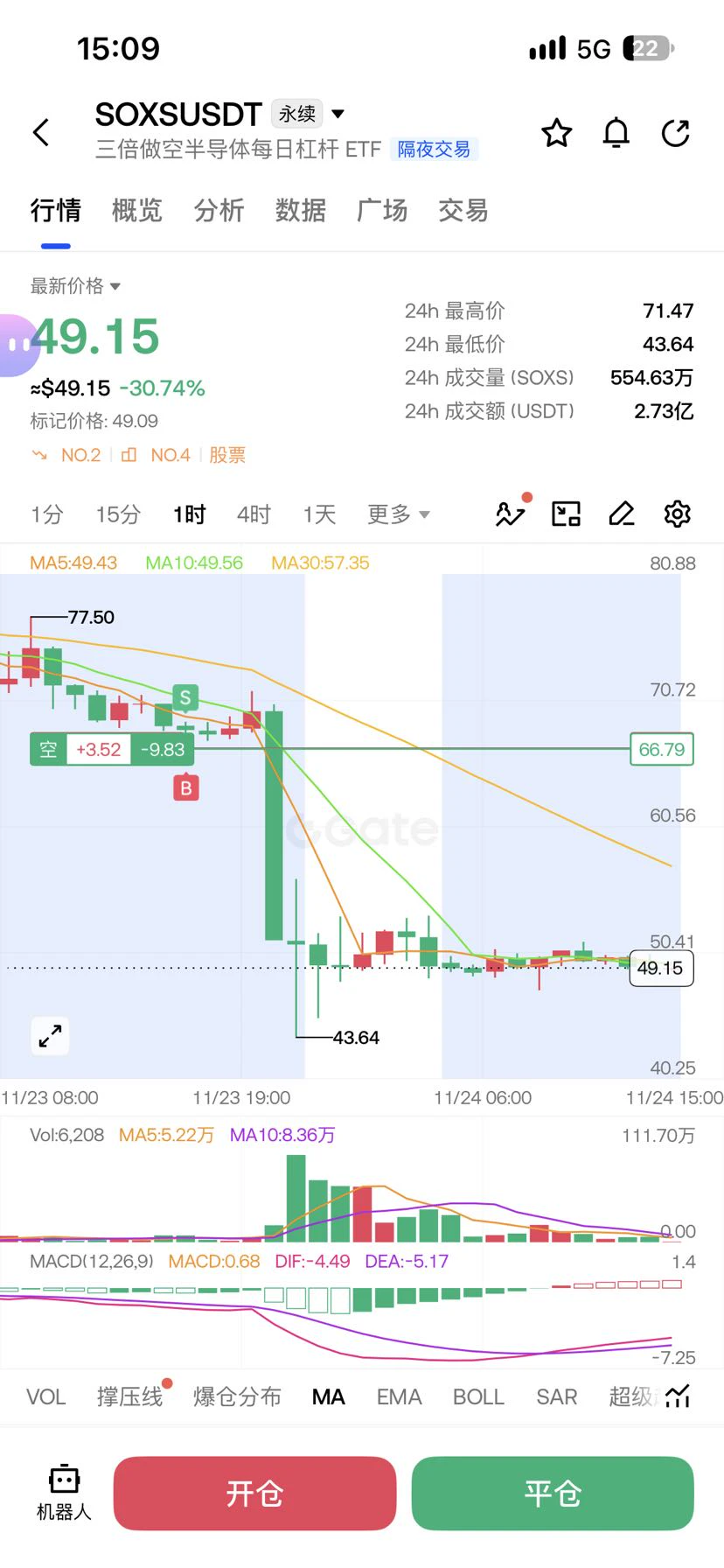
This trade we positioned for early yesterday, $SOXS nailed the entry, and this huge drop felt great.
Don’t think this was luck. Looking at the previous price action, it’s pretty easy to understand, right? The structure was right there, and volume-price action doesn’t lie. Those who could read it naturally followed along. We caught this move with a heavy position, took profits while ahead—cashing out and locking in gains is the real skill.
The thing traders fear most isn’t a lack of opportunities; it’s not daring to act when an opportunity comes. When the market gives a signal, be decisive. Hesitant traders are always left watching from the sidelines$AIOT $AKE
repost-content-media
Airdrop farming is practically like having a job now. You used to just click around a couple of times, but now you have to build up your accounts, establish behavioral profiles, and avoid Sybil detection. The more competitive the task platforms get, the more their rules feel like KPI reviews. If you don't meet the targets, you don't even get the scraps.

I saw someone talking about MEV and fair ordering a couple of days ago. Retail traders can complain all they want, but it's the same with airdrop farming: big studios have tools and nodes, and ordinary people just can't compete. Fairness? Does
The whole options buyer vs. seller thing, simply put, is getting slowly eaten away by time value.

A buyer is like renting hope with an expiration date: every day you wake up, theta takes a bite. If the direction is right, fine; if not, it’s a slow, painful bleed. Sellers collect rent, but one black swan can wipe them out—in three days last year, a GameFi token plunged 90%, and put sellers got blown through. Looking back, it’s pretty laughable; at the time, they still thought they could “safely collect time value.”

The economic model behind GameFi now—inflation, studio bots, and a token-price
I was checking on-chain data all morning and found something pretty frustrating—my side showed the block as confirmed, while my friend’s was still pending. Turns out he was using a free RPC node, whose latency was nearly ten seconds higher than that of my paid one.

Modular blockchains get plenty of hype, and developers are all excited about things like the DA layer, but honestly, the user experience is still stuck on these same old issues. You think it’s real-time on-chain data, but it may simply be that your node hasn’t finished syncing.

If I could keep only one habit, I’d continue cross-ch
Watching blockchain games collapse yet again, I suddenly started wondering how reliable the address clustering we study every day really is. Under the same “smart money” label, half could be studio scripts and the other half unlucky retail traders, with the entire flow of funds linked together after one round.

Last week I scanned a small address whose behavior looked almost exactly like that of an NFT whale I had tagged before. Its collateral ratio looked quite solid, so I followed with a small position, 0.3e, only to discover three days later that it was just a shell used for testing. I’ve l
Price tells you what happened, volume tells you why it happened—$KAIO this move depends on whether the market is willing to accept this new pricing.
SulaimanZerohunter
$KAIO is up +75.09% — but this move has a different data profile.
Current price: $0.02630
24h range: $0.01456 → $0.04450
24h volume: approximately $369.8K
Market cap: approximately $18.26M
Compared with some of the ultra-low-cap names on this list, KAIO has a substantially larger market-cap and volume profile.
So the question isn't simply:
“Can it pump more?”
The better question:
“Can the market sustain this repricing?”
I'd watch volume behavior, range acceptance and the structure of any pullback.
If participation fades quickly, the quality of the momentum becomes a different question.
Price tells you what happened. Volume helps investigate why it happened.
‍#KAIO #MarketResearch #GateSquare #GateMeme
KAIO-3.89%
Gate Live’s real-time analysis is really keeping pace this time—might as well grab some red packets while we’re at it.
ForestCrypto
🚨 What’s the market’s next move? Find the answer on Gate Live!
Professional analysts interpret market changes in real time, break down trends and opportunities, and help you quickly grasp the market rhythm.
🧧 Daily red packet rain is live—enter the livestream and click the red packets to claim them
📺 Watch now: https://gate.com/live
  • 1
At three in the morning, I went through the LP records in my wallet again. Honestly, a lot of people think market making means tossing in some coins and picking up money every minute—if only it were that easy. The AMM curve may look flat, but impermanent loss cuts you one slice at a time. I’ve been burned myself: I thought I had calculated everything properly, but then the market made a sharp one-way move, and all the money I made on one side was wiped out by inventory losses—and I ended up paying extra.

Now, before adding to a pool, I run the numbers three times: how volatile it is, how larg
Another one has fallen, and North Korean hackers are ruthless enough.
Original content no longer visible
Honestly, every time I get itchy and want to chase the pump, I first force myself to calm down—“Has something real changed in the information, or is FOMO emotions just pushing me up here?” With this recent market move, so many people around me are shouting “If you don’t get in now, you’ll miss it,” and even hardware wallets are selling out… Then I looked at the news—one phishing link screenshot from the community is more outrageous than the last. The security guys are basically about to burst bloodshot eyes from yelling “don’t click anything,” and I genuinely feel: better to wait on the sideli
I just saw more news about a cross-chain bridge incident. Back when the oracle pricing was abnormal, everyone across the whole chain was waiting for confirmation, which really made people uneasy. To be honest, the fragmentation of assets across multiple chains is pretty annoying now—every time you open a new chain you have to set up a new address. Moving funds around eats up a lot in fees, and it’s also easy to get the addresses mixed up. Personally, I prefer splitting the wallet by chain: keep only one main address per chain, and don’t put lending and NFTs in the same pool, otherwise liquidat
Just after I noticed the coffee had gone cold, I casually checked the wallets on-chain and found that someone else is batch-sweeping those social mining points and badges again. Honestly, it’s kind of moving.

I’ve seen plenty of people burn time—interacting all day, sending money back and forth, staying up until the early hours—just to assemble a particular project identity. Then the project team changes the rules, or shuts things down altogether, and all that time goes to waste. I’m stingy, but I’m clear-headed—my time costs far more than those points.

With the market currently hyping AI Ag
I just saw that another cross-chain bridge incident happened. After the oracle issued abnormal quotes, everyone is waiting for confirmation—honestly, it’s really scary. I’ve been thinking a lot lately: what kind of approach is actually suitable for ordinary people to protect their assets?

What I fear most isn’t losing money—it’s losing control. If you lose money, you can still blame the market, but once your assets are gone, taken by someone else, and you can’t even control them yourself anymore—that’s what truly feels awful.

With my current size (only a few ETH), a hardware wallet is enough
ETH-1.26%
I took a look at the interest rates, and it actually made me feel more at ease. At the end of the day, macro is basically about where the money is going. When rates are high, people’s risk appetite naturally shrinks, and positions get tighter too. Lately I’ve basically reduced leverage, raised my liquidation threshold, and I’d rather earn a bit less than be woken up in the middle of the night to top up margin. After all, the flow of funds is the biggest trend—it's not something you can draw on a K-line.

As for social mining and fan tokens, I’ve always been half skeptical. Even if attention is
Someone asked me how to set a stop-loss for memes. To be honest, this is pretty hard, because meme pumps and dumps basically don’t follow any logic. Right now, public opinion keeps linking ETF fund flows and US stock risk appetite to crypto in their interpretation, and it sounds plausible. But if you try to apply that framework to a cheap dog coin, you’ll probably get liquidated down to your last pair of underwear. I’m personally more cautious. Before buying, I calculate in advance how much I can afford to lose—for example, setting a warning line for the loan-to-value ratio. When the narrative
MEME-1.03%
To be honest, the chains keep multiplying—my wallets are almost becoming a jigsaw puzzle. L2s compete on TPS today, and chase subsidies tomorrow. I watch the spectacle, but it’s even more of a headache: assets are scattered everywhere like fog. Without a checklist of how much is on each chain, it’s really easy to forget.

A couple of days ago, my dad asked me, “You’ve split your money across so many places—aren’t you afraid you won’t be able to find it one day?” I told him, “I’m afraid of it running away, but even more afraid that I can’t get it back.”

What I do now is: put only a thin layer
Can’t hold your spot, and then your contract gets blown up—at the end of the day, it’s just one sentence: you never really figured out how much you’re actually able to lose.

A lot of people jump in going all-in right away. When it pumps they want to sell, and when it dumps they try to hold on, and in the end they end up pleasing neither side. Actually, position management isn’t that mysterious. In plain language: **treat your position as the money you can afford to lose in your wallet, not the money you think you can earn in your dreams**.

When I do NFT lending and collateral myself, I spend
Just closed that airdrop task page, and the more I look, the more it feels like the way to play now is off. They say it’s about interaction to prevent female Sybils, but in the crowded spots it’s all scythes—one wrong move and you get hit with anti-scam rakeback fees. Lately, the privacy coin side has been noisy too: where exactly is the compliance boundary for mixers? Some projects just run off, while others stubbornly push through regulation. Bottom line: I’m leaning toward being more cautious now—rather grab less than get trapped by the protocol, or worse, help with laundering/clearing. In
Farming rewards now really feels like working a regular job: task platforms one after another. After you finish, you still have to guard against Sybils and boost your rating, and you get docked points at the drop of a hat. It’s exhausting. Put simply, it’s just switching workplaces to work—and even “slacking off” feels like overtime.

Recently I’ve been looking at those RWA yield products tied to U.S. Treasuries. Compared with traditional options, the on-chain yields don’t seem that appealing either—at the end of the day, it’s all just bookkeeping. Forget it. In plain terms: farming rewards is
I felt itchy just now and wanted to chase an NFT higher, but I forced myself to hold off and go check the on-chain settlement data. Turned out the depth in those liquidity pools is so shallow that if you chase in, you’d probably end up as a bag holder for someone else. In plain terms, in this market, before you impulse-buy, ask yourself one thing: did you see exact information, or are you being carried away by FOMO emotions? Anyway, I kept myself in check by calculating the collateral ratio—once I ran the numbers, I knew it was a dead end.

The recent cross-chain bridge theft has caused quite
Load More