MemeFisher

vip
Age 0.3 Year
Peak Tier 0
Fishing for narratives and market trends—when I see something trending, I check on-chain to see who's pushing it. I like to translate complex data into a single sentence.
Just found a blue-chip PFP running a membership model. When I checked the on-chain holdings, it was still those same “scythes” swapping aliases and rotating wash trades… stop—don’t let the hype take you off course.
Honestly, all this “brand empowerment” stuff looks like operational KPIs. It’s better to just look at the address graph—who posted orders early, who’s hoarding on DEXs—than to take the so-called community culture they’re bragging about at face value. On-chain data tools are a bit laggy, but at least it’s harder to fake than persona-based marketing, right? Anyway, I’ve stopped lookin
View Original
  • Reward
  • Comment
  • Repost
  • Share
The wall between Wall Street and the crypto world has finally crumbled. Institutional ETFs, commercial bank custody, and macro strategies are all flooding in, and traditional finance’s venture capital is crazily doubling down—so is this truly a fusion, or is the old order absorbing a new asset?
View Original
CoinNetwork
According to a report from CoinJie.com, based on market data analysis, the boundary between Wall Street and modern capital markets is rapidly disappearing. The content covers macro stress testing, changes in Federal Reserve policy, institutional Bitcoin ETF adoption, trends in commercial banks’ custody, the structure of digital asset investment portfolios, the correlation between Bitcoin and stocks, risks of fiat currencies, forward-looking macro trading data, the relationship between risk and strong infrastructure, the convergence of traditional finance and crypto, a surge in traditional finance venture capital, and U.S. policy and election analysis, among multiple other aspects.
  • Reward
  • Comment
  • Repost
  • Share
The Japan- and Korea markets are clearly split: ASML’s cautiousness ahead of its earnings report versus KOSPI’s AI frenzy; geopolitical risks are still fueling the oil price.
ASML-0.41%
View Original
CoinNetwork
CoinJie.com news: The Nikkei Index rose, but its advance was capped ahead of the release of the ASML earnings report. Meanwhile, South Korea’s KOSPI Index surged sharply as U.S. inflation data came in softer, boosting overall market risk appetite. The strong performance in the Korean market prompted exchanges to briefly suspend trading, indicating that concentration in AI-related stocks has increased. Japan’s market gains were more moderate, reflecting investors’ cautious sentiment ahead of the ASML earnings release. Oil prices continued to rise due to the U.S. blockade of Iran and a new round of attacks, showing the market’s disagreement when pricing geopolitical risk and the outlook for U.S. inflation.
  • Reward
  • Comment
  • Repost
  • Share
IRGC’s funds wallets can be precisely identified; now on-chain tracking technology is far more mature than people think, and compliance pressure directly feeds through to stablecoin issuers
View Original
CoinNetwork
CoinWires news: According to on-chain investigator Specter’s monitoring, Tether has frozen four TRON chain wallets holding a total of about $131 million USDT. These funds were withdrawn from DTC Pay and Bitso, and are linked to the Islamic Revolutionary Guard Corps and the Central Bank of Iran, which are listed on the sanctions list of the U.S. Department of the Treasury’s Office of Foreign Assets Control.
  • Reward
  • Comment
  • Repost
  • Share
Disagreement within the Fed over the dot plot and the balance sheet reduction path is a good thing—it shows the decision-making layer hasn’t fallen into groupthink, and the market can read more real signals from it.
View Original
CoinNetwork
CoinWorld News: Goolsbee said that Federal Reserve Chair Kevin Wosch previously expressed different views on the dot plot and the balance sheet, and reexamining these issues is healthy.
  • Reward
  • Comment
  • Repost
  • Share
In this pre-IPO AI chess game, valuation discipline matters more than FOMO—don’t just look at how fast it’s rallying.
View Original
2In1
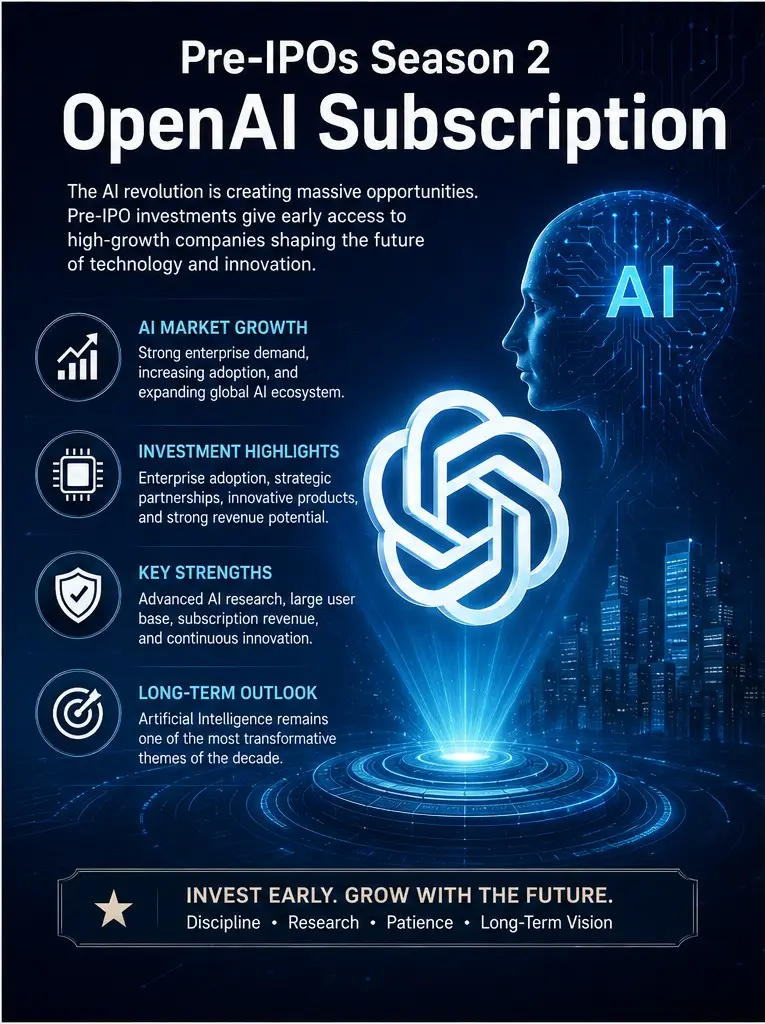
#PreIPOsSeason2OpenAISubscription
THE AI INVESTMENT LANDSCAPE CONTINUES TO EVOLVE AS PRIVATE-MARKET OPPORTUNITIES ATTRACT GLOBAL ATTENTION.
PRE-IPO THEMES REMAIN HIGHLY SPECULATIVE, BUT INVESTOR INTEREST IN LEADING AI COMPANIES HAS GROWN BECAUSE OF RAPID ADVANCES IN GENERATIVE AI, ENTERPRISE SOFTWARE, CLOUD INFRASTRUCTURE, AND DIGITAL PRODUCTIVITY.
WHILE ENTHUSIASM REMAINS STRONG, SUCCESSFUL INVESTING STILL REQUIRES DISCIPLINE, RISK MANAGEMENT, AND A CLEAR upUNDERSTANDING OF BOTH VALUATION AND MARKET CONDITIONS.
Market Overview
Global equity markets continue to balance optimism surrounding artificial intelligence with uncertainty over interest rates, inflation, and geopolitical developments.
Technology remains one of the strongest long-term growth sectors, while investors continue monitoring corporate earnings, AI adoption, and capital spending across the semiconductor ecosystem.
Private-market interest has also increased as investors look for exposure to companies that are not yet publicly listed. However, access to private shares varies by platform and jurisdiction, and valuations can fluctuate significantly before any IPO occurs.
Current Market Update
AI-related companies continue benefiting from expanding enterprise adoption. Businesses are increasing investment in automation, large language models, cloud computing, cybersecurity, and productivity software.
Institutional investors remain focused on companies capable of delivering sustainable revenue growth rather than relying solely on AI-related excitement.
Live/Current Price Overview
Since OpenAI is a private company and not publicly traded, there is no official live stock price available on public exchanges. Any private-market valuation should not be interpreted as an exchange-traded market price.
Price Performance
Because there is no publicly traded stock, traditional price-performance analysis cannot be performed.
Instead, investors monitor:
- Private funding rounds
- Estimated company valuation.
- Strategic partnerships
- Revenue growth
- AI adoption trends
- Enterprise customer expansion
Technical Analysis
No official technical chart currently exists because OpenAI shares do not trade on public exchanges.
For investors participating through pre-IPO products, valuation trends and market demand become more important than conventional chart analysis.
Market Structure
The broader AI investment theme remains structurally bullish.
Key characteristics include:
- Strong enterprise demand
- Increasing AI infrastructure spending
- Continued cloud expansion
- Growing software integration
- Long-term productivity gains
Trend Analysis
Long-Term Trend:
Bullish
Mid-Term Trend:
Constructive with periodic valuation adjustments.
Short-Term Trend:
Driven primarily by news flow, funding announcements, strategic partnerships, and overall technology market sentiment.
Support Levels
Since no public trading price exists, support is better viewed conceptually:
- Institutional demand
- Enterprise AI adoption
- Revenue growth
- Product innovation
- Strategic partnerships
Resistance Levels
Potential resistance may come from:
- High private-market valuations
- Regulatory uncertainty
- Increased competition
- Slowing enterprise spending
- Delayed IPO expectations
Key Buying Zones
For long-term investors, attractive opportunities generally appear during:
- Broad technology market corrections
- Reduced speculative sentiment
- Improved valuation discipline
- Long investment horizons
Key Selling Zones
Investors should consider reducing exposure when:
- Valuations become excessively stretched.
- Market speculation greatly exceeds business
fundamentals.
- Risk-reward becomes unfavorable.
Bullish Scenario
The bullish case includes:
- Continued rapid AI adoption
- Strong enterprise subscriptions
- Expanding developer ecosystem
- Increasing recurring revenue
- Additional strategic partnerships
- Growth in AI infrastructure demand
- Favorable macroeconomic conditions
Under this scenario, investor confidence in leading AI companies could continue strengthening over the coming years.
Bearish Scenario
Risks include:
- Higher interest rates
- Regulatory pressure
- Increased competition
- Margin compression
- Slower enterprise spending
- Economic recession
- Technology spending cuts
These factors could reduce private-market valuations despite long-term AI potential.
Volume Analysis
Traditional volume analysis is unavailable because OpenAI shares are not publicly traded.
Instead, investors monitor:
- Funding activity
- Venture capital participation
- Institutional investment
- Secondary-market liquidity
- Strategic investment rounds
Momentum Indicators
Traditional indicators such as RSI, MACD, and Moving Averages are not applicable to a private company without a public trading chart.
Instead, momentum can be evaluated through:
- Revenue acceleration
- User growth
- Enterprise adoption
- Product launches
- Partnership announcements
AI & Semiconductor Industry Update
The AI ecosystem continues expanding rapidly.
Key industry drivers include:
- Advanced GPU demand
- AI cloud infrastructure
- Enterprise software integration
- AI copilots
- Data-center expansion
- Edge AI computing
- Robotics
- Automation
Semiconductor companies remain among the largest beneficiaries due to accelerating compute demand.
Company Background
OpenAI develops advanced artificial intelligence models and enterprise AI products used across software development, education, research, productivity, and business automation.
Its technologies have become widely adopted by consumers and enterprises, making AI one of the fastest-growing technology segments globally.
Business Fundamentals
Key strengths include:
- Strong AI research
- Large enterprise ecosystem
- Global user adoption
- Subscription revenue
- Expanding API business
- Continuous product innovation
- Strategic partnerships
Institutional & Investor Sentiment
Institutional interest in AI remains positive.
Professional investors continue focusing on:
- Sustainable revenue growth
- Capital efficiency
- Product monetization
- Enterprise expansiol
- Competitive advantages
- Long-term profitability
Market Catalysts
Major positive catalysts include:
- New AI model launches
- Enterprise customer growth
- Increased AI spending
- Cloud partnerships
- Government AI investment
- Productivity improvements
- Expansion into new industries
Risk Factors
Important risks include:
- Regulatory changes
- Cybersecurity challenges
- Competitive pressure
- Execution risk
- Valuation risk
- Macroeconomic slowdown
- Technological disruption
Today's Market Outlook
Technology sentiment remains constructive despite periodic volatility.
AI continues attracting long-term capital, although investors should expect valuation swings during uncertain macroeconomic conditions.
Short-Term Outlook
Neutral to moderately bullish.
News events and broader technology market performance will likely remain the primary drivers.
Mid-Term Outlook
Bullish.
Enterprise AI adoption is expected to continue expanding across industries.
Long-Term Outlook
Constructive.
Artificial intelligence is likely to remain one of the defining structural growth themes of the coming decade, although returns may not be linear and periods of volatility should be expected.
Futures Market Analysis
Because OpenAI is privately held, there are no official futures contracts tied directly to the company.
Investors instead monitor AI-related equity index futures, technology sector sentiment, and semiconductor futures as indirect indicators.
Advanced Trading Strategy
Professional investors should:
- Focus on valuation rather than hype.
- Diversify across multiple AI-related opportunities.
- Scale into positions gradually.
- Maintain disciplined position sizing.
- Avoid emotional decision-making.
- Continuously monitor macroeconomic developments.
Risk Management Tips
- Never risk more than a predefined percentage of portfolio capital on a single investment.
- Diversify across sectors.
- Avoid excessive leverage.
- Review portfolio exposure regularly.
- Maintain adequate liquidity.
- Prepare for higher-than-normal volatility in private investments.
Essential Support & Resistance Levels
For the broader AI sector:
Support:
- Long-term enterprise demand
- AI infrastructure investment
- Cloud computing expansion
Resistance:
- Elevated valuations
- Regulatory uncertainty
- Macroeconomic tightening
Key Price Targets
Because OpenAI is not publicly traded, there are no official exchange-traded price targets.
Investors should instead monitor changes in private-market valuation and company fundamentals rather than attempting traditional chart-based targets.
Trading Plan for Swing & Day Traders
Since OpenAI shares cannot be actively traded on public exchanges, swing and day traders may instead focus on publicly listed AI and semiconductor companies whose prices respond to similar industry catalysts.
Investment Perspective
Artificial intelligence remains one of the most transformative technological shifts in decades.
Long-term investment success will likely depend on identifying businesses capable of converting innovation into sustainable cash flow, recurring revenue, and durable competitive advantages rather than relying solely on market excitement.
Investors should remain disciplined, patient, and valuation-focused while recognizing that private-market investments carry unique liquidity and pricing risks.
Conclusion
The AI revolution continues reshaping global markets, and interest in pre-IPO opportunities reflects growing confidence in the long-term potential of advanced artificial intelligence.
Nevertheless, private investments require greater due diligence than publicly traded securities because of limited liquidity, fewer pricing benchmarks, and higher uncertainty.
A balanced approach that combines strong research, prudent risk management, and realistic expectations is essential for navigating this rapidly evolving sector.
Engagement Question:
If you had the opportunity to invest in a leading AI company before its IPO, what factor would influence your decision the most: valuation, revenue growth, competitive advantage, long-term AI adoption, or overall market conditions?
repost-content-media
  • Reward
  • Comment
  • Repost
  • Share
Coinbase Ventures has made 30 investments in the past six months—its pace is really intense, and both a16z and Tether have been left behind.
COIN2.21%
View Original
CoinNetwork
CoinWorld News: According to cryptoRank data, Coinbase Ventures became the most active crypto investment institution in the first half of 2026, participating in 30 deals and significantly leading its market peers. Other leading active institutions also include Animoca Brands (19 deals), a16z Crypto (18 deals), and Tether (15 deals). Castrum Capital, Becker Ventures, and Galaxy followed closely with 10 deals each.
  • Reward
  • Comment
  • Repost
  • Share
250 million USDC freshly minted, addresses posted — on-chain sleuths will be busy again.
View Original
Original content no longer visible
  • Reward
  • Comment
  • Repost
  • Share
When group messages hit 99+, I actually want to turn off notifications. When a KOL shouts "staking unlock is going to dump the market," I can't help but check on-chain to see who's moving.
To put it bluntly, when there's information overload, people easily mistake others' anxiety for their own decisions. It's fine when your position is light, but when it's heavy, a screenshot of an "unlock calendar" can make you change your take-profit in the middle of the night.
For now, I'm muting a few groups, treating KOLs' words as background noise. If I really need to check, I'll look at what on-chain wa
View Original
  • Reward
  • Comment
  • Repost
  • Share
ATMs have been removed by nearly 30%, and regulation is colder than a bear market 🥶
View Original
CoinNetwork
Bitse Media reported via Cointelegraph that, in the first half of this year, the number of global crypto ATMs fell from 39,158 to 28,322. Within six months, 10,836 machines were decommissioned, a decline of 27.7%, with about 96% located in the United States.
The number of crypto ATMs in the US dropped from 30,617 to 20,237, a decline of 33.9%. As of the end of June, they still accounted for about 71.5% of the world’s active devices.
Experts interviewed by finbold said the decrease in numbers is not driven by a decline in demand, but because operators have scaled back infrastructure due to crypto market volatility and tighter regulatory requirements. One of the major US crypto ATM operators, Bitcoin Depot, announced bankruptcy in May, after previously experiencing a $3.6 million hacker attack.
  • Reward
  • Comment
  • Repost
  • Share
The Giga whitepaper v2 puts MEV protection and deterministic ordering into the consensus layer. Sei’s upgrade this time is nothing to sneeze at—let’s see how the tokenomics will evolve and be adjusted.
GIGA2.47%
View Original
CoinNetwork
CoinWorld News, Wu learned that Sei Labs has released Giga Whitepaper v2, adding new privacy and fairness designs, reducing the finality target of Giga's Autobahn consensus protocol from 400 milliseconds to below 250 milliseconds, while maintaining a throughput of 200k+ transactions / 5 gigagas per second. The new whitepaper introduces the Sedna private transaction layer and a deterministic transaction ordering mechanism to provide pre-execution privacy, MEV resistance, and censorship resistance. Sei Labs stated that the Giga upgrade is progressing, with subsequent development including a complete transaction fee mechanism, Autobahn consensus upgrade, and new tokenomics for the Sei token.
  • Reward
  • Comment
  • Repost
  • Share
Tennessee will completely ban crypto ATMs starting July 1, with 185 machines disappearing overnight—the regulatory crackdown is coming faster than expected.
View Original
CoinNetwork
US crypto ATM ban wave hits, operators face bankruptcy risk
Tennessee banned the operation and installation of crypto ATMs entirely on July 1, with Governor Bill Lee signing the bill in April and taking effect in July; violators face a misdemeanor. Before the ban, the state had 185 crypto ATMs. Indiana passed emergency measures in March, becoming the first state with a full ban; Minnesota plans to implement a ban on August 1. Georgia has taken restrictive measures, imposing transaction caps and refund obligations, trying to protect consumers while preserving access. Bitcoin ATM operators are experiencing regulatory pressure, and bankruptcy filings also show that regulation is beginning to directly affect operators.
  • Reward
  • Comment
  • Repost
  • Share
Masayoshi Son is going all in with his family's wealth, with a $40 billion bridge loan pressing down. The equity pledge of OpenAI shares isn't enough, so a group guarantee is needed—leverage pushed to the extreme.
View Original
CoinNetwork
SoftBank restarts negotiations on a $10 billion loan with corporate guarantees, attempting to "roll over debt" through equity pledges.
CoinWorld News: The SoftBank Group is renegotiating with a syndicate of banks. It plans to apply for a $10 billion margin-loan backed by its stake in OpenAI, and for the first time has raised that it is willing to provide a corporate guarantee as a compromise. The immediate backdrop to the talks is SoftBank’s immense debt leverage pressure: on July 1, SoftBank drew down the bridge loan agreed in March this year to complete the second $10 billion funding round for OpenAI. To support more than $60 billion in investment in OpenAI and related infrastructure, SoftBank is extremely reliant on debt leverage and is currently facing a hard deadline to repay $40 billion in bridge loans before March 2027. Because it is difficult to value equity stakes in non-public companies and hard to liquidate them, banks such as Goldman Sachs, JPMorgan Chase, and Mizuho have previously been cautious about a scheme that relies solely on pledging shares. SoftBank’s forced addition of a corporate guarantee this time means that if the pledged shares depreciate, the banks can directly seek repayment from the SoftBank Group. And Ope
  • Reward
  • Comment
  • Repost
  • Share
$10 billion milestone, nearly 2.5 times year-on-year increase, indicating that traditional financial entry points are being quietly eaten by crypto payments — once the compliance channel is opened, the incremental space is far from its peak.
View Original
CoinNetwork
CoinWorld News, total crypto card deposits have exceeded $10 billion for the first time, up 82% year-to-date and nearly 250% year-over-year.
  • Reward
  • Comment
  • Repost
  • Share
India's USDT premium has surged to 7-10%. Once the Enforcement Directorate stepped in, supply became directly constrained, and retail investors have to pay extra to buy dollar-pegged stablecoins.
View Original
CoinNetwork
Coin World News, USDT (the world's largest dollar-pegged stablecoin) is trading far above its face value on Indian crypto platforms, with a premium of 7% to 10%. Local exchanges say this phenomenon is mainly due to supply and demand. Over the weekend, the premium on USDT reached 7-10%, and at one point, USDT was trading at around ₹102.88, while the official USD-INR exchange rate was about 94.65. As of now, USDT's market cap stands at $184.68 billion, still the world's largest dollar-pegged stablecoin. The premium usually ranges between 3% and 4%, reflecting the extra rupees buyers pay to gain dollar exposure via USDT. When local demand exceeds the available supply of tradable tokens, the premium widens. Recent actions by India's Enforcement Directorate against USDT payments may have led to supply tightness, further pushing up the premium.
  • Reward
  • Comment
  • Repost
  • Share
Huang Licheng is playing a big position, the liquidation price of 1,557 looks a bit risky.
View Original
CoinNetwork
CoinWorld News: Huang Licheng (“Maji”) increased his ETH long position by 325.00 ETH, approximately $536,380.00. The current position size is $3,028,030.00. The average price has been adjusted from $1,568.56 to $1,572.01. The current profit and loss is +$41,194.17 (+34.01%). The current coin price is $1,593.69, and the liquidation price is $1,557.52. The trader previously profited from blue-chip NFTs, but this year—after becoming active—has experienced consecutive massive drawdowns since October, with funds shrinking from over $100 million to several hundred thousand dollars.
  • Reward
  • Comment
  • Repost
  • Share
Bitcoin Suisse's move is steady; the license in Liechtenstein is quite valuable, officially taking effect only in June 2026, and the time window for competitors is narrowing.
View Original
WuSaidBlockchainW
Wu Says learned that Bitcoin Suisse’s European entity, Bitcoin Suisse (Europe) AG, has obtained a MiCAR license as a crypto asset service provider (CASP) granted by the Liechtenstein Financial Market Authority (FMA). According to information on the FMA official website, the company has been authorized to operate as a CASP starting from June 22, 2026. Bitcoin Suisse said the license will enable it to serve customers in certain markets within the European Economic Area (EEA), and has appointed Roman Przibylla as CEO to oversee its European expansion.
  • Reward
  • Comment
  • Repost
  • Share
The lowest level since 1983; the third-largest weekly decline in history—energy politics has entered deep waters
View Original
CoinNetwork
CryptoWorld News reports that, according to data released by the U.S. Department of Energy, the crude oil inventory in the U.S. Strategic Petroleum Reserve has fallen to 331.2 million barrels, the lowest level since June 1983.
The government’s emergency oil reserve stockpile decreased by 9.05 million barrels, marking the third-largest weekly decline on record.
This inventory decrease is part of the U.S. previously pledged plan to release 172 million barrels of crude oil from the Strategic Petroleum Reserve.
  • Reward
  • Comment
  • Repost
  • Share
Prince Group's Hu Shi was arrested by the Japanese side for forging electronic documents. It seems that the 2025 U.S. sanctions list has become a shared blacklist for global law enforcement, with on-chain activities being trackable and offline identities being untraceable.
View Original
WuSaidBlockchainW
Asahi Shimbun: Crown Prince Group's top executive Hu Shi arrested in Japan
According to Asahi Shimbun, the Tokyo Metropolitan Police Department arrested Hu Shi (44 years old, of Cambodian nationality), who was identified as a senior executive of Prince Group (Tai Zi Group), for making false entries in original electronic official documents and providing such documents for use. He is implicated in submitting a false address change in April, claiming he had moved to Chuo Ward in Tokyo. In 2025, the U.S. imposed sanctions on Prince Group for conducting international online investment fraud using Cambodia as its base, and Japanese police reportedly identified “Chen Xiaoer” in the sanctions list as Hu Shi. Police also arrested two Chinese nationals who were instructed by him to submit the relevant applications and seized related smartphones for analysis.
  • Reward
  • Comment
  • Repost
  • Share
€105 billion bet on Bitcoin, Europe's move is even bolder than MicroStrategy's. Accumulating 1% of the supply by 2033—is this genuine conviction or a gamble on national destiny?
BTC1.35%
View Original
CoinNetwork
CryptoWorld News reports that European capital B (formerly known as Blockchain Group) announced on June 17th that its shareholders have approved a plan to raise up to 105 billion euros (approximately $120 billion) to support the company's Bitcoin treasury strategy. The company plans to request 5 billion euros in new equity and 100 billion euros in debt from shareholders to facilitate its Bitcoin accumulation plan. Under the approved plan, Capital B can issue up to 5 billion euros in shares (equivalent to 1.25 trillion shares) and borrow up to 100 billion euros through credit instruments. The company currently holds 3,135 Bitcoins on its balance sheet, with a cost basis of approximately 283.6 million euros. Capital B aims to accumulate 1% of the Bitcoin supply by 2033.
  • Reward
  • Comment
  • Repost
  • Share
  • Pinned