MintAfterCoffee

vip
Age 0.3 Year
Peak Tier 0
Morning coffee, evening mint. Focused on NFT financialization and floor liquidity. I say I won't chase the highs, but my hands still tremble.
No margin calls, no forced liquidations—this design directly removes the liquidation anxiety of DeFi, but who holds the disposal rights after the 10-day grace period?
View Original
WuSaidBlockchainW
Bitcoin payment platform Strike launches a new loan product collateralized by Bitcoin. According to the introduction, as long as the borrower pays interest and principal on time, even if the BTC price drops significantly, there will be no margin call or forced liquidation due to changes in the collateral ratio, and the collateral assets will remain unchanged. If the borrower fails to pay on time and remains in default after a 10-day grace period, the collateral may be partially liquidated. The product currently offers term loans to users in certain U.S. states and does not support revolving credit. (The Block)
  • Reward
  • Comment
  • Repost
  • Share
When the production speed of air defense weapons can't keep up with the frequency of missile strikes, civilians become the price—this is not only Ukraine's predicament but also a wake-up call for the global military-industrial supply chain.
View Original
CoinNetwork
CoinWorld News, Ukrainian President Zelensky: The lack of weapons to counter ballistic missiles and the inability of air defense weapon production to meet the needs of protecting the people is "absurd".
  • Reward
  • Comment
  • Repost
  • Share
JPM and State Street have a difference of $1,000 in their 2027 targets. When there is such a large divergence among institutions, I choose to wait and see.
View Original
2In1
#TradFiCFDGoldMasters
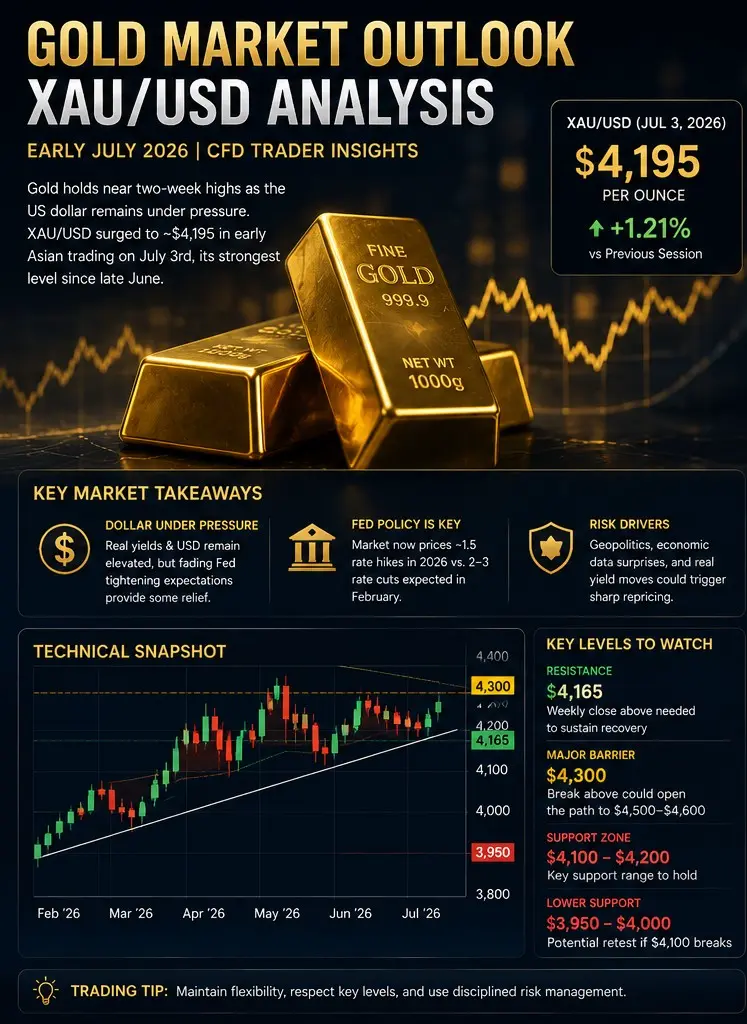
The gold market stands at a fascinating crossroads in early July 2026, presenting both challenges and opportunities for CFD traders who understand the underlying dynamics at play. As we examine the current state of XAU/USD, several critical factors emerge that demand careful consideration before executing any positions.
Gold has demonstrated remarkable resilience in recent sessions, holding near two-week highs as the US dollar remains under pressure. The precious metal surged to approximately $4,195 per ounce in early Asian trading on July 3rd, marking its strongest level since late June. This recovery represents a significant bullish counterattack following the turbulence experienced earlier in the year, particularly the sharp correction that occurred in the wake of geopolitical tensions involving Iran.
The technical picture reveals a market that has successfully defended key support levels. Price action shows gold maintaining position above ascending trendlines, with the formation of higher highs and higher lows suggesting that the short-term bullish structure remains intact. However, traders must remain cognizant of the broader context: gold is currently trading approximately 4.6% lower than its opening level at the start of 2026, and significantly below the record highs near $5,600 reached in January.
The Federal Reserve's monetary policy stance remains the primary driver of gold price action. Market participants have witnessed a dramatic repricing of rate expectations throughout 2026. The US OIS curve now reflects approximately 1.5 rate hikes anticipated for the year, a stark contrast to the two to three rate cuts that were expected as recently as February. This hawkish pivot has propelled real yields higher across the curve and driven assets in US money market funds to an unprecedented $7.9 trillion, simultaneously providing strong support for the US dollar.
The implications for gold are significant. Real yields and the greenback typically move inversely to precious metals, and the current environment presents headwinds that have capped upside momentum. However, the fading expectations for aggressive Fed tightening have provided some relief, allowing gold to reclaim ground above the $4,100 level.
Major financial institutions present a nuanced outlook for gold. JPMorgan has adopted a cautious near-term stance, suggesting that softer demand from key sectors and gold's renewed sensitivity to real yields could keep prices range-bound in the immediate future. Their analysts project gold averaging $4,300 per ounce in the third quarter and $4,500 in the fourth quarter of 2026, with risks skewed toward the downside if economic data surprises to the upside over the summer months.
Conversely, State Street Global Advisors maintains a more bullish structural view. Their baseline scenario envisions gold reaching as high as $5,500 per ounce by the first quarter of 2027, driven by persistent Asian and central bank demand, diversification needs amid elevated stock-bond correlations, and enduring accumulation trends. This divergence in institutional opinion underscores the complexity of the current market environment.
The World Gold Council anticipates prices remaining range-bound through year-end, with expectations that gold will trade within 5% of current levels around $4,000 per ounce. This projection suggests 2026 could mark the first year since 2022 that gold closes lower than its opening level, representing a significant shift from the multi-year bull market that characterized recent trading history.
Central bank demand, which has been a cornerstone of gold's structural support, shows signs of moderation. Additionally, physical demand from key Asian markets has softened compared to previous periods, contributing to the range-bound price action observed in recent months.
From a technical perspective, the immediate focus centers on the $4,165 level. A weekly closing above this threshold would be necessary to sustain the current recovery and signal a potential resumption of the uptrend that began in October. Support is expected to hold at the median-line of the consolidation formation, with the broader range defined by the $4,100-$4,200 zone.
Traders should monitor the $4,300 level as a significant psychological barrier, with a sustained break above potentially opening the path toward the $4,500-$4,600 region. Conversely, a failure to hold above $4,100 could trigger a retest of lower support zones near $3,950-$4,000.
Several risks warrant attention for CFD traders. Geopolitical developments remain an ever-present wildcard, with the potential to trigger rapid repricing of safe-haven assets. Economic data surprises, particularly regarding inflation metrics and labor market conditions, could force a reassessment of Fed policy expectations. Additionally, currency fluctuations and their impact on dollar-denominated gold prices require constant monitoring.
The correlation between gold and real yields has reasserted itself in 2026, meaning that any sustained move higher in Treasury yields could pressure precious metals regardless of other bullish factors. Traders must also consider the potential for year-end rebalancing flows and position adjustments as we approach the second half of 2026.
For traders utilizing Gate's TradFi CFD platform, the current environment presents both opportunities and challenges. The range-bound nature of recent price action suggests that range-trading strategies may be appropriate, with clear risk management protocols essential given the potential for breakout moves. Trend-following approaches may find limited success until a definitive directional bias emerges.
Long-term structural bulls may view current levels as accumulation opportunities, particularly if they subscribe to the view that central bank demand and diversification trends will ultimately prevail over near-term headwinds. Conversely, those with a bearish outlook may find opportunities in short positions, particularly if economic data strengthens and Fed hawkishness intensifies.
The key to navigating this market lies in maintaining flexibility and adapting to evolving conditions. With major institutions presenting divergent forecasts and technical levels providing clear reference points, disciplined risk management and position sizing become paramount for success in gold CFD trading.
repost-content-media
  • Reward
  • Comment
  • Repost
  • Share
These statistics are giving me the creeps. 82% of projects are down, and there's no money on the chain. We should wait for the real bottom signal.
View Original
WuSaidBlockchainW
CryptoRank: In Q2, 82.1% of the top 100 non-stablecoin assets declined, and the market is still in an adjustment phase.
CryptoRank's "2026 Q2 Crypto Market Review" shows that the market was still in adjustment in Q2: 82.1% of the top 100 non-stablecoins fell in June, the median returns of all 8 tracked sectors were negative, on-chain fees decreased by 44.6% compared to last year, and market breadth and activity weakened. BTC's dominance is about 56%, with funds continuing to concentrate on top assets. The Fear and Greed Index has been in extreme fear for a long time, while Ethereum has fallen for three consecutive quarters. The market has not yet fully recovered, and attention should be paid to whether indicators such as breadth, fees, BTC dominance, and sentiment improve.
  • Reward
  • Comment
  • Repost
  • Share
Disaster strikes right before the MICA compliance deadline—the timing is way too precise. Is it just a coincidence, or a structured wind-down? CoinMetro shifts the blame to the service provider, but after years of internal investigations, they’re only saying it now—leaving users to take the hardest hit.
View Original
CoinNetwork
CoinWorld news, according to Protos, the Estonian cryptocurrency exchange CoinMetro has applied for bankruptcy reorganization with the Estonian court, and suspended user registration, deposits, and withdrawals on June 22. CoinMetro stated that the failure of a financial service provider led to a deterioration of its financial condition. CEO Kevin Murcko said in a YouTube livestream that multiple service providers are actually involved, and the company has been conducting internal investigations for years. Murcko stated that as the MICA compliance deadline of July 1 approaches, this financial issue has become significant.
  • Reward
  • Comment
  • Repost
  • Share
Anthropic’s de-lifting of the ban came quite suddenly; the Fable 5 compute power card can finally circulate, and the AI arms race is set to escalate again.
View Original
CoinNetwork
CoinWorld news, the United States will lift export controls on Anthropic's Fable 5 tonight.
  • Reward
  • Comment
  • Repost
  • Share
The kind of trust that comes with "getting it right in one sentence" with Claude Code—people who go through 13 rounds of back-and-forth on the web interface would fall silent.
View Original
CoinNetwork
Coinjie.com news: Anthropic has released its latest AI Economic Index report, which combines a survey of 9,700 users with telemetry data to reveal the impact of artificial intelligence on work patterns and career prospects. The report finds that the higher the “gold content” of a job, the more AI computing power it consumes: the average compute consumption for high-paying roles is 2.07 times that of low-paying roles. The survey shows that more than one-third of users expect AI to take over most of their work within a year. When using different AI tools, users delegate to AI to very different extents: when users write articles on the web, they tend to go back and forth with AI for 13 rounds of revisions, while when using the terminal tool Claude Code, they usually just issue a single instruction, letting the AI generate the output in one step.
  • Reward
  • Comment
  • Repost
  • Share
Starship reusable is maxed out directly, Musk has made an early move in the orbital computing chess game.
View Original
CoinNetwork
Coin World News, David George stated that SpaceX's Starship has rapid reusability, which helps realize Elon Musk's vision of using orbital data centers to expand AI computing power. He believes that as the capacity of Earth's AI data centers becomes constrained, expanding AI capabilities into space is an inevitable trend, and orbital data centers will serve as a complement to existing Earth facilities. SpaceX has already demonstrated the technical capability to deploy such systems.
  • Reward
  • Comment
  • Repost
  • Share
5% of Bitcoin could wipe out $39 trillion in national debt? I need to think carefully about this mathematical model.
BTC-1.07%
View Original
CoinNetwork
CoinWorld News, Senator Cynthia Lummis stated that if the United States purchases more than 5% of the total Bitcoin supply, "it could actually wipe out" the $39 trillion national debt.
  • Reward
  • Comment
  • Repost
  • Share
Long-term over five years, first secure the $50 profit and then consider it done.
View Original
FangHan_sCryptocurrenc
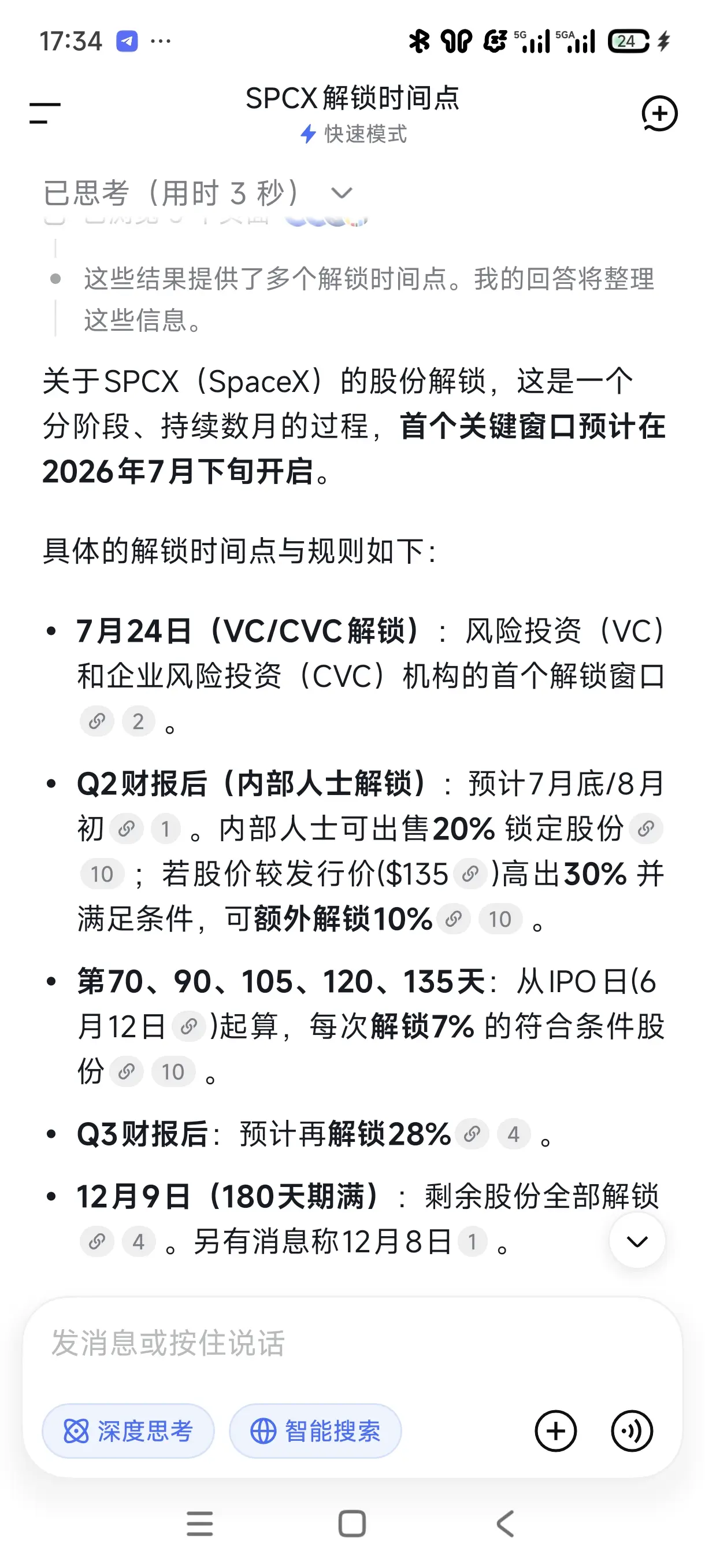
#我的Gate交易时刻 If you followed Xiaohan's advice during the opening and on June 7th, and if $SPCX fell below 200, bought at 160 for a bottom-fishing and went long, then you should be smiling now.
Next, we need to pay attention to the unlocking schedule of SPCX shares. Although we are optimistic about its long-term returns, short-term profit-taking and focus points are still indispensable.
From the current increase, our previous judgment was still very accurate. We couldn't get much at 135, but we could grab at 160 and 150. Currently, there is already a $50 profit!! Back then, the rise was judged based on heat points and low circulating volume, among other factors.
So, to be cautious, we can gradually start selling some short-term profits.
After all, there are still 5 years until 2031, so in these 5 years, pay more attention to news and Xiaohan's information to help you make judgments.
repost-content-media
  • Reward
  • Comment
  • Repost
  • Share
The three items in the Yimei memorandum—ceasefire, unfreezing assets, and lifting maritime shipping bans—appear to be the result of each side making concessions in a bargaining game, but the key is whether subsequent nuclear negotiations can truly produce results; otherwise, it will just be a cycle.
View Original
CoinNetwork
Iran Negotiation Team Advisor Reveals Details of Proposed Memorandum of Understanding
According to Fars News Agency, Iran's negotiation team leader Mehdi Mohammadi revealed the key points of the memorandum with the United States: first, to cease hostilities, ensure security, prevent further escalation, and negotiate on subsequent nuclear issues; second, to unfreeze some frozen assets and initiate the process of suspending certain sanctions to promote the economy and oil trade; third, to lift maritime and trade restrictions, restore Iran's maritime trade, and facilitate merchant vessel passage.
  • Reward
  • Comment
  • Repost
  • Share
135 million USDC entered the market, is this to buy the dip or to provide liquidity?
View Original
CoinNetwork
CryptoWorld News reports that, according to Whale Alert monitoring, an unknown whale has just transferred in 135,034,682 USDC, which is approximately $135,072,560 based on the current price.
  • Reward
  • Comment
  • Repost
  • Share
Once legislation is enacted, the money from pensions and sovereign funds will truly enter the market; this is the trigger for the next bull market.
View Original
CoinNetwork
Crypto news: Investor Kevin O’Leary said that the next round of gains for Bitcoin may depend on legislation from the U.S. Congress. He noted that although Bitcoin has already broken above the previous highs, large institutions remain cautious because digital assets lack clear regulatory rules. O’Leary emphasized that pension funds, sovereign wealth funds, and large institutions are waiting for regulatory clarity before making larger-scale investments. He believes that the adoption of cryptocurrencies in the future may rely more on legislation than on speculation. O’Leary also mentioned that the current market needs policy triggers to bring in the next wave of capital inflows.
  • Reward
  • Comment
  • Repost
  • Share
The phrase "systematic purge" sounds cold, adding more fuel to the Middle East powder keg.
View Original
CoinNetwork
CoinWorld News reports that, according to a statement by Israeli Prime Minister Benjamin Netanyahu on the 10th local time, so far, the Israeli Defense Forces have killed nearly 10,000 Lebanese Hezbollah personnel in clashes. The Israeli military is currently “systematically” clearing Hezbollah forces active in southern Lebanon. In a statement issued the same day, the Israeli Defense Forces said they struck Hezbollah infrastructure targets in the Tyre area of southern Lebanon and in other regions over the past 24 hours, killing multiple armed personnel. The IDF said that during an operation in the Tyre area, an airstrike hit a Hezbollah weapons storage site, and multiple secondary explosions then occurred at the scene. So far, there has been no response from Hezbollah regarding this.
  • Reward
  • Comment
  • Repost
  • Share
Tyr has been attacked again, and civilians don't even have time to evacuate. This situation looks heartbreaking.
View Original
CoinNetwork
CryptoWorld News reports that after a nationwide evacuation warning was issued in Israel, the southern Lebanese city of Tyre was attacked.
  • Reward
  • Comment
  • Repost
  • Share
I'm now checking whether a project is "reliable or not," and I'm actually paying less attention to how they boast verbally. First, I go check GitHub and audit reports... But honestly, it's easy for beginners to be misled. An update on GitHub doesn't necessarily mean a useful update; sometimes they just change a README and act very diligent. Don't just look at the cover logo of the audit report; scan for whether issues are marked as "fixed/accepted risk/next time," because those reports with a bunch of medium-high risk issues ending with "team promises future optimization" make me put my hands
View Original
  • Reward
  • Comment
  • Repost
  • Share
Honestly, these past two days of monitoring on-chain data have made me doubt life... For the same transaction, I already "succeeded" on Tool A, but on Tool B it's still spinning, and it only updates after a while. Thinking about it later, it's normal: which node you're connected to, whether the RPC is stable, whether the indexer has caught up—all are different, so what you see as "real-time on-chain" is often actually "slightly delayed on-chain." Mainstream public chains are always upgrading/maintaining, and the group is starting to speculate whether projects will migrate. I, for one, am not i
View Original
  • Reward
  • Comment
  • Repost
  • Share
I check whether the project team is actually serious about doing work. Lately I’ve gotten more and more reluctant to listen to their grand narratives—I just watch two things: how the treasury money gets spent, and how milestones get delivered. If treasury spending is always “market promotion/partnerships/consulting fees,” with money being passed around layer after layer, then it basically boils down to buying attention; but if I can see releases following a monthly rhythm, tied to specific deliverables (for example, new mechanisms going live, liquidity tools that genuinely get used, NFT floors
MEME-5.88%
View Original
  • Reward
  • Comment
  • Repost
  • Share
A six-figure lobbying budget, in exchange for a few lines in the "Clear Act"—the survival rules of Crypto in Washington.
View Original
CoinNetwork
According to Crypto World news, the new PAC organization “Defend Developers PAC” will support lawmakers who provide legal protection for blockchain developers and decentralized finance (DeFi) builders. The PAC plans to spend more than six figures across dozens of midterm elections, mainly funded by founders, builders, and executives in the crypto industry. Its support may help push for developer protection measures to be included in the final version of the “CLEAR Act.”
  • Reward
  • Comment
  • Repost
  • Share
  • Pinned