




#ETHBreaks1900
ETHEREUM RECLAIMS $1,900: IS THIS THE START OF A NEW BULLISH PHASE FOR ETH?
MARKET OVERVIEW
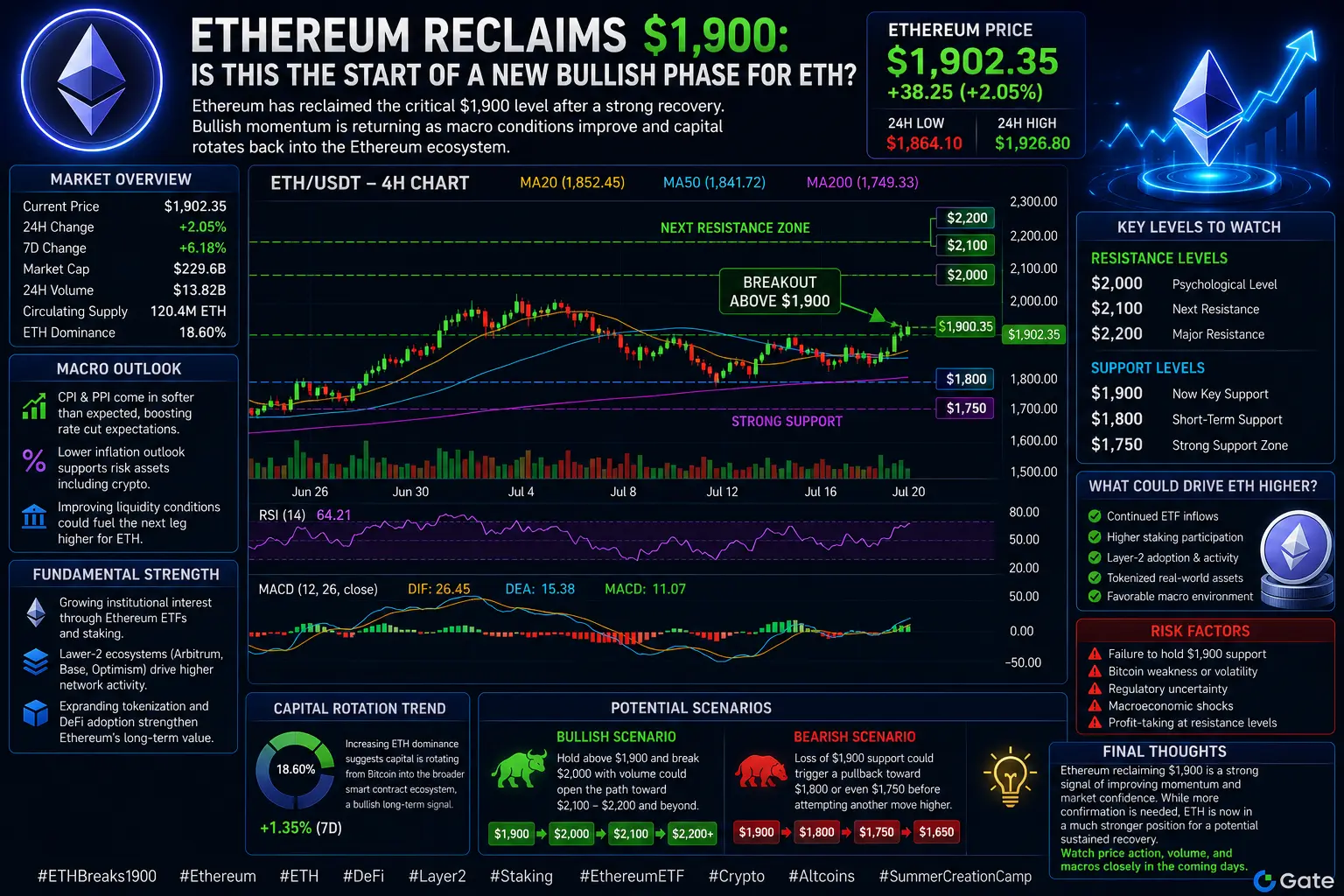
Ethereum has successfully moved back above the $1,900 level, marking one of its strongest recoveries in recent weeks. After trading around $1,864 earlier, buyers regained momentum and pushed ETH through this important psychological resistance, strengthening confidence across the broader crypto market.
While one price level doesn't confirm a long-term trend on its own, reclaiming $1,900 signals that bullish sentiment is gradually returning as investors position for the next stage of Ethereum's recovery.
MACRO CONDITIONS ARE TURNING MORE SUPPORTIVE
The broader economic environment has become increasingly favorable for risk assets.
Recent U.S. inflation reports showed softer-than-expected CPI and PPI data, encouraging investors to speculate that interest rate cuts could arrive sooner than previously expected. Lower inflation expectations and improving liquidity often create a stronger environment for cryptocurrencies and other growth assets.
Ethereum, with its central role in decentralized finance, tokenization, staking, and smart contract applications, continues to benefit whenever macro conditions become more supportive.
CAPITAL IS ROTATING TOWARD ETHEREUM
Market participants are also watching the shift in capital allocation across the crypto sector.
Ethereum's market dominance has continued improving, suggesting that some investors are rotating capital from Bitcoin into the broader smart contract ecosystem. Historically, periods of strengthening ETH dominance have often been followed by increased activity across Layer-2 networks and major altcoins.
If this rotation continues, Ethereum could remain one of the strongest-performing large-cap digital assets during the current market cycle.
FUNDAMENTAL STRENGTH CONTINUES TO GROW
Beyond short-term price action, Ethereum's long-term fundamentals remain one of its biggest strengths.
Institutional interest has continued expanding through growing Ethereum ETF participation, while staking remains an attractive option for long-term holders seeking network rewards.
At the same time, Layer-2 ecosystems including Arbitrum, Base, and Optimism continue processing increasing transaction volume, reinforcing Ethereum's position as the settlement layer supporting a growing multi-chain ecosystem.
The continued expansion of tokenized real-world assets and decentralized financial applications also strengthens Ethereum's long-term value proposition.
KEY LEVELS TO WATCH
Now that ETH has reclaimed $1,900, this area becomes the first important support level.
If buyers successfully defend this zone, attention could gradually shift toward $2,000, followed by $2,100-$2,200, where stronger resistance is expected to emerge.
However, failure to maintain trading above $1,900 could trigger short-term profit-taking, leading to another retest of nearby support before the broader recovery resumes.
Volume confirmation and sustained higher lows will remain essential for validating any continued bullish momentum.
WHAT COULD DRIVE THE NEXT MOVE?
Several catalysts could influence Ethereum's next major trend.
Continued ETF inflows, stronger staking participation, accelerating Layer-2 adoption, expanding real-world asset tokenization, and improving macroeconomic conditions all have the potential to support higher prices over the coming months.
Meanwhile, Federal Reserve policy decisions, inflation data, Treasury yields, and Bitcoin's overall market direction will continue influencing sentiment across the entire digital asset market.
FINAL THOUGHTS
Ethereum's recovery above $1,900 represents more than a psychological milestone it reflects improving investor confidence supported by strengthening fundamentals and a more favorable macro environment.
While additional confirmation is still needed before declaring a full trend reversal, the recent breakout places Ethereum in a much stronger technical position than it occupied just a few weeks ago.
If buyers continue defending this level, the focus could gradually shift toward the next major resistance zones and the possibility of an extended recovery throughout the remainder of the year.
#SummerCreationCamp
@Gate_Square
ETHEREUM RECLAIMS $1,900: IS THIS THE START OF A NEW BULLISH PHASE FOR ETH?
MARKET OVERVIEW
Ethereum has successfully moved back above the $1,900 level, marking one of its strongest recoveries in recent weeks. After trading around $1,864 earlier, buyers regained momentum and pushed ETH through this important psychological resistance, strengthening confidence across the broader crypto market.
While one price level doesn't confirm a long-term trend on its own, reclaiming $1,900 signals that bullish sentiment is gradually returning as investors position for the next stage of Ethereum's recovery.
MACRO CONDITIONS ARE TURNING MORE SUPPORTIVE
The broader economic environment has become increasingly favorable for risk assets.
Recent U.S. inflation reports showed softer-than-expected CPI and PPI data, encouraging investors to speculate that interest rate cuts could arrive sooner than previously expected. Lower inflation expectations and improving liquidity often create a stronger environment for cryptocurrencies and other growth assets.
Ethereum, with its central role in decentralized finance, tokenization, staking, and smart contract applications, continues to benefit whenever macro conditions become more supportive.
CAPITAL IS ROTATING TOWARD ETHEREUM
Market participants are also watching the shift in capital allocation across the crypto sector.
Ethereum's market dominance has continued improving, suggesting that some investors are rotating capital from Bitcoin into the broader smart contract ecosystem. Historically, periods of strengthening ETH dominance have often been followed by increased activity across Layer-2 networks and major altcoins.
If this rotation continues, Ethereum could remain one of the strongest-performing large-cap digital assets during the current market cycle.
FUNDAMENTAL STRENGTH CONTINUES TO GROW
Beyond short-term price action, Ethereum's long-term fundamentals remain one of its biggest strengths.
Institutional interest has continued expanding through growing Ethereum ETF participation, while staking remains an attractive option for long-term holders seeking network rewards.
At the same time, Layer-2 ecosystems including Arbitrum, Base, and Optimism continue processing increasing transaction volume, reinforcing Ethereum's position as the settlement layer supporting a growing multi-chain ecosystem.
The continued expansion of tokenized real-world assets and decentralized financial applications also strengthens Ethereum's long-term value proposition.
KEY LEVELS TO WATCH
Now that ETH has reclaimed $1,900, this area becomes the first important support level.
If buyers successfully defend this zone, attention could gradually shift toward $2,000, followed by $2,100-$2,200, where stronger resistance is expected to emerge.
However, failure to maintain trading above $1,900 could trigger short-term profit-taking, leading to another retest of nearby support before the broader recovery resumes.
Volume confirmation and sustained higher lows will remain essential for validating any continued bullish momentum.
WHAT COULD DRIVE THE NEXT MOVE?
Several catalysts could influence Ethereum's next major trend.
Continued ETF inflows, stronger staking participation, accelerating Layer-2 adoption, expanding real-world asset tokenization, and improving macroeconomic conditions all have the potential to support higher prices over the coming months.
Meanwhile, Federal Reserve policy decisions, inflation data, Treasury yields, and Bitcoin's overall market direction will continue influencing sentiment across the entire digital asset market.
FINAL THOUGHTS
Ethereum's recovery above $1,900 represents more than a psychological milestone it reflects improving investor confidence supported by strengthening fundamentals and a more favorable macro environment.
While additional confirmation is still needed before declaring a full trend reversal, the recent breakout places Ethereum in a much stronger technical position than it occupied just a few weeks ago.
If buyers continue defending this level, the focus could gradually shift toward the next major resistance zones and the possibility of an extended recovery throughout the remainder of the year.
#SummerCreationCamp
@Gate_Square