
Futures
Access hundreds of perpetual contracts
CFD
Gold
One platform for global traditional assets
Options
Hot
Trade European-style vanilla options
Unified Account
Maximize your capital efficiency
Demo Trading
Introduction to Futures Trading
Learn the basics of futures trading
Futures Events
Join events to earn rewards
Demo Trading
Use virtual funds to practice risk-free trading
Launch
CandyDrop
Collect candies to earn airdrops
Launchpool
Quick staking, earn potential new tokens
HODLer Airdrop
Hold GT and get massive airdrops for free
Pre-IPOs
Unlock full access to global stock IPOs
Alpha Points
Trade on-chain assets and earn airdrops
Futures Points
Earn futures points and claim airdrop rewards


Promotions
AI
Gate AI
Your all-in-one conversational AI partner
Gate AI Bot
Use Gate AI directly in your social App
GateClaw
Gate Blue Lobster, ready to go
Gate for AI Agent
AI infrastructure, Gate MCP, Skills, and CLI
Gate Skills Hub
10K+ Skills
From office tasks to trading, the all-in-one skill hub makes AI even more useful.
GateRouter
Smartly choose from 40+ AI models, with 0% extra fees
Stellar (XLM) undertakes the Bermuda full-chain on-chain economy plan, what changes are occurring in the competition among public blockchains?
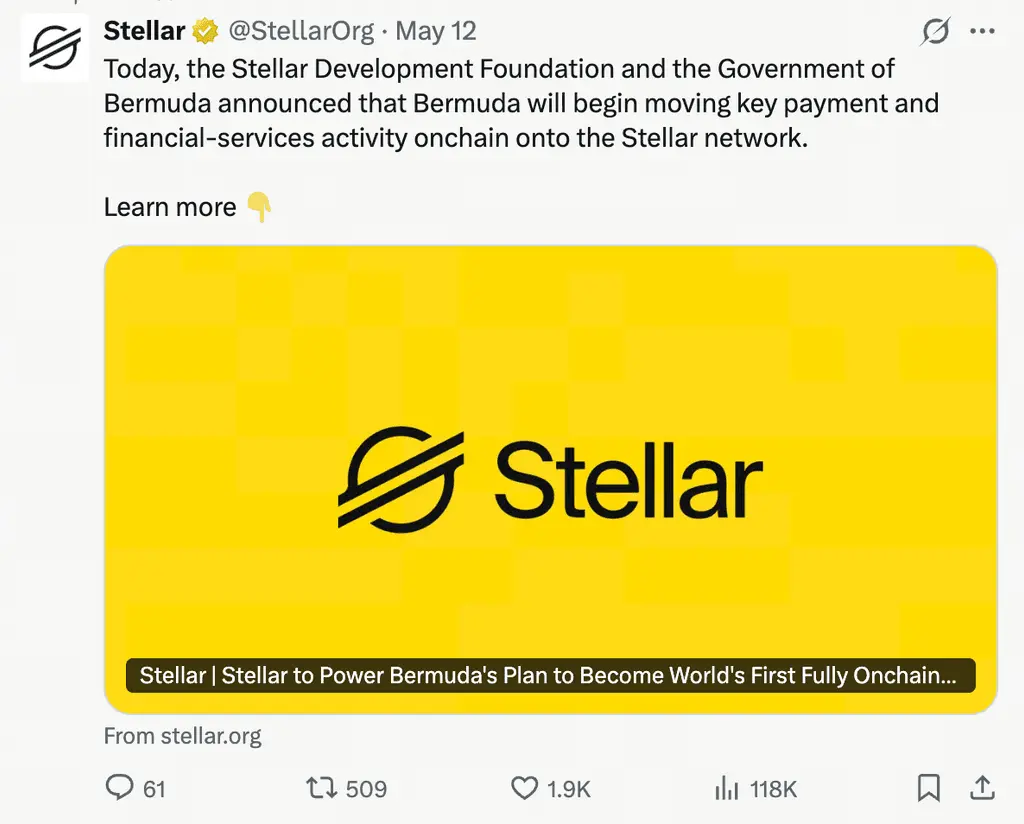
In May 2026, Stellar (XLM) announced support for Bermuda's initiative to advance the "World's First Fully On-Chain Economy" plan. This news quickly sparked renewed market attention on payment public chains and stablecoin infrastructure. Compared to earlier blockchain projects still stuck in on-chain asset trading and DeFi stages, Bermuda's current push involves areas such as government payments, resident consumption, digital wallets, and real-world financial service systems.

Over the past two years, the payment track in the crypto market has lacked sufficient enthusiasm for a long time, with industry focus mainly on AI, Meme, Layer2, and highly volatile assets. But as stablecoins once again become a key topic in global financial markets, more and more capital are refocusing on public blockchain networks that truly possess real-world payment capabilities and compliant financial structures. Against this backdrop, the significance of Stellar's collaboration with Bermuda is no longer just an ordinary ecological partnership, but more like a national-level on-chain financial experiment.
## Stellar's Recent Push for Bermuda's Fully On-Chain Economy Plan
In mid-May, the Stellar Development Foundation officially announced it would assist Bermuda in advancing the "Fully Onchain Economy" plan. According to official disclosures, some financial services, payment systems, and stablecoin-related networks may gradually operate on Stellar infrastructure in the future.
Compared to the previous market where many "Web3 implementations" remained conceptual, the biggest difference with Bermuda's recent event is that it involves actual economic system fund flows. This includes resident payments, merchant settlements, government fees, and digital wallet systems, all potentially moving onto the blockchain gradually.
From recent industry changes, a more evident trend is emerging: competition between stablecoins and on-chain payments has shifted from "on-chain transfer efficiency" to "real-world financial network access capability." Many public chains previously emphasized TPS and chain performance, but now the market is refocusing on whether they support fiat on/off ramps, real-world payment scenarios, and government or institutional cooperation.
Furthermore, Stellar's long-standing structural advantages in cross-border payments and low-cost clearing are re-entering the market's view.
## Why Stablecoin Payments Are Becoming a Hot Industry Topic Again
Since 2026, discussions around stablecoins have noticeably increased, and this market shift differs from previous purely crypto trading logic.
Historically, stablecoins mainly served as transaction media, facilitating exchange flows on exchanges and on-chain arbitrage. But as global payment networks, RWA, and on-chain finance expand, stablecoins are being re-evaluated as a form of real-world payment infrastructure.
Especially in an environment of sustained high interest rates and still-high costs for traditional cross-border remittances, more institutions and regional markets are refocusing on on-chain payment efficiency. Compared to traditional financial networks, stablecoins offer lower-cost settlements, faster cross-border transfers, and stronger global liquidity, which is why recent attention from Stellar, XRP, and other payment-oriented public chains has increased.
More importantly, the focus of stablecoin competition is also changing. Previously, the industry paid more attention to "who issues stablecoins," but now the focus is shifting to "who can truly integrate stablecoins into the real economy."
The significance of Bermuda's event lies precisely in its attempt to embed stablecoins into a national-level payment network, rather than remaining within the crypto market's internal circulation.
## Super Financial Gateways Are Changing Payment Public Chain Competition Logic
In the past, the understanding of payment public chains often stayed at the stage of "low-fee transfers." But as on-chain finance matures, the competition logic among payment public chains is also evolving.
More users now focus not just on transfer speed but on the entire financial entry capability. Stablecoin payments, fiat on/off ramps, digital wallets, on-chain storage, and cross-border consumption are gradually forming a unified network.
From the current market structure, a clear change is that payment public chains are shifting from "underlying chain competition" to "financial network competition." Future long-term competitive public chains may need not only chain performance but also compliance capabilities, regional financial resources, stablecoin ecosystems, and real-world payment networks.
The direction Stellar is currently strengthening aligns with this structure. Especially after the Bermuda event, the market is increasingly aware that the core of future payment public chain competition may not be who has higher TPS, but who can truly integrate into the real economy.
## Changes in Stellar Ecosystem Payments and RWA Directions
Beyond payment networks, Stellar has recently continued to strengthen its focus on RWA and on-chain finance.
Since 2026, Stellar has repeatedly released content on tokenized securities, on-chain government bonds, and real asset financial structures, emphasizing that the network will focus on supporting compliant financial assets and global payment systems in the future.
This shift also reflects that the entire industry is entering a new stage of competition. Previously, many public chains relied on Meme hype, short-term speculation, and high-volatility assets to maintain market attention. But as institutional capital enters, more long-term funds are refocusing on stable yields, compliant structures, and real financial infrastructure.
From recent market behavior, a clear change is that the boundary between payment chains and RWA chains is gradually blurring. In the future, many on-chain financial networks may serve multiple roles, including payments, clearing, asset issuance, and stablecoin circulation.
This is also why recent industry discussions are increasingly placing Stellar back into the "financial infrastructure chain" category.
## Changes in User Behavior in Emerging Markets
As stablecoins and on-chain payments heat up again, user behavior in emerging markets is also changing.
In the past, many users entered crypto mainly for trading and speculation. But now, more regional markets are using stablecoins as stores of value, cross-border payment tools, and low-cost USD substitutes.
Especially in countries with significant local currency volatility, demand for stablecoins is rapidly increasing, raising the importance of payment-oriented public chains.
From current industry trends, an increasingly obvious change is that the growth logic of Web3 users is shifting from "trade-driven" to "financial service-driven." Previously, users entered crypto for trading; now, more users are entering on-chain financial systems for remittances, payments, savings, and global asset allocation.
This shift will further reinforce the importance of payment and stablecoin networks.
## Why Payment Public Chain Competition Is Re-entering the Real Financial Stage
The competition among payment public chains in 2026 is already markedly different from the previous market cycle.
Earlier, industry competition focused more on TPS, gas fees, and public chain narratives. Now, more projects are refocusing on real-world financial implementation capabilities. Especially as global regulation becomes clearer, market attention to "real financial scenarios" is increasing.
Future long-term viable payment public chains may need not only technical capabilities but also:
- Compliance structures
- Cooperation with banks and institutions
- Stablecoin circulation networks
The Bermuda event's significance lies in its representing a new industry direction: on-chain finance is no longer just an internal crypto market cycle but is beginning to attempt integration into the real economy.
Stellar's collaboration indicates that the competition among payment public chains is gradually entering the "national-level financial infrastructure" stage.
## What Market Variables Stellar Still Needs to Address
Although Stellar has recently regained market attention, challenges remain in the payment and on-chain finance sectors.
First, global stablecoin regulation is still evolving, with differing policies across regions regarding on-chain payments and digital asset circulation. For payment public chains to truly enter the global financial network, long-term compliance efforts are necessary.
Second, competition in payment infrastructure is intensifying. Besides Stellar, XRP, XDC, and some stablecoin networks are also strengthening in payments and RWA directions. Industry competition is shifting toward long-term resource and financial network battles.
Additionally, the expansion speed of real-world payment networks often lags behind crypto market sentiment shifts. Although the Bermuda event has generated high discussion, integrating on-chain finance into the real economy still requires a lengthy development process.
For Stellar, the key to its long-term value will be whether it can continue expanding its stablecoin network, deepen government cooperation, and cover real-world payment scenarios.
## Summary
Following Bermuda's promotion of the "Fully Onchain Economy" plan, Stellar has once again become a focus of market attention. This event also reflects that the competition among payment public chains is entering a new phase. As stablecoins, RWA, and on-chain finance continue to expand, the market is increasingly paying attention to infrastructure networks with genuine real-world financial capabilities.
From a long-term industry perspective, future competition among payment public chains may no longer focus solely on chain performance but on who can truly connect to the real financial system, stablecoin networks, and global payment structures. Stellar's involvement in a national-level on-chain economic experiment also indicates that on-chain finance is gradually entering the stage of real-world application.
## FAQ
### What is the core significance of Stellar's collaboration with Bermuda?
The core significance lies in its attempt to genuinely integrate on-chain payments, stablecoins, and the real financial system, promoting some national-level financial services onto the blockchain.
### Why has stablecoin payment recently regained market attention?
This is mainly due to increased global cross-border payment demand, expansion of RWA, and the integration of real financial scenarios into on-chain systems.
### What directions is Stellar currently strengthening?
Stellar is mainly focusing on stablecoin payments, RWA, cross-border finance, and real-world payment networks, while also advancing its Soroban smart contract ecosystem and on-chain financial infrastructure.
### Why is the competition among payment public chains changing?
Because the market is shifting focus from chain performance and transfer speed to the ability to implement real-world financial use cases.
### What will determine Stellar's long-term value moving forward?
Its long-term value will mainly depend on its ability to expand the stablecoin network, deepen government cooperation, and cover real-world payment scenarios.