
Futures
Access hundreds of perpetual contracts
CFD
Gold
One platform for global traditional assets
Options
Hot
Trade European-style vanilla options
Unified Account
Maximize your capital efficiency
Demo Trading
Introduction to Futures Trading
Learn the basics of futures trading
Futures Events
Join events to earn rewards
Demo Trading
Use virtual funds to practice risk-free trading
CFD
U.S. stock CFD derivatives
US Stocks
Access real US stocks and ETFs
HK Stocks
Trade quality Hong Kong-listed stocks
Korean Stocks
SK Hynix
Real Korean stocks and top assets
Stock Futures
High leverage, 24/7 trading
Tokenized Stocks
Backed by real stock assets
IPO Access
Unlock full access to global stock IPOs
GUSD
Mint GUSD for Treasury RWA yields
Stocks Activities
Trade Popular Stocks and Unlock Generous Airdrops
Launch
CandyDrop
Collect candies to earn airdrops
Launchpool
Quick staking, earn potential new tokens
HODLer Airdrop
Hold GT and get massive airdrops for free
IPO Access
Unlock full access to global stock IPOs
Alpha Points
Trade on-chain assets and earn airdrops
Futures Points
Earn futures points and claim airdrop rewards


Promotions
AI
Gate AI
Your all-in-one conversational AI partner
Gate AI Bot
Use Gate AI directly in your social App
GateClaw
Gate Blue Lobster, ready to go
Gate for AI Agent
AI infrastructure, Gate MCP, Skills, and CLI
Gate Skills Hub
10K+ Skills
From office tasks to trading, the all-in-one skill hub makes AI even more useful.


The more it drops, the more you buy! Cardano "whale" quietly accumulates, controlling 67% of the circulating supply, reaching a four-year high.
Cardano (ADA) has recently been playing out a highly contradictory drama: on one hand, the tokens are highly concentrated among a few "whale" large holders, and on the other hand, the on-chain ecosystem is increasingly depleted. Data shows that well-funded whales have quietly accumulated coins for up to 2 years, now controlling nearly 70% of the total ADA circulation on the network.
On-chain data analysis firm Santiment revealed that whale wallets holding at least 1 million ADA currently hold a total of 25.09 billion tokens, accounting for 67.47% of the current circulating supply, with the concentration of large holdings reaching its highest since July 2020, and this accumulation trend has never stopped since December 2023.
🤑 Cardano’s key stakeholders have slowly but surely accumulated, consistently adding more and more of the existing supply to their bags, dating back to December, 2023.
🐳 Wallets with at least 1M tokens now hold 25.09B $ADA, which translates to 67.47% of the current existing… pic.twitter.com/knuSbfYtaE
— Santiment Intelligence (@SantimentData) May 13, 2026
Price Halved, Large Holders Continue to Add Contrasting sharply with the frenzy of whale accumulation is ADA’s bleak price and the shrinking ecosystem. Over the past 9 months, ADA’s market cap has shrunk by 71%, indicating that major holders are adopting a "buy more as prices fall" left-side trading strategy.
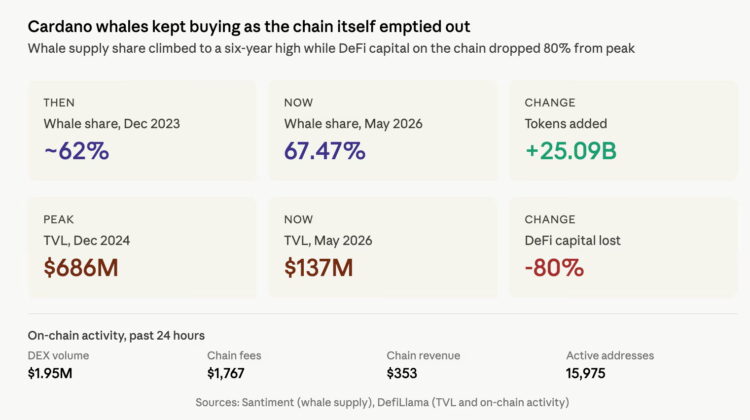
Meanwhile, Cardano’s DeFi ecosystem is accelerating its decline. According to DeFiLlama data, the total value locked (TVL) on Cardano is now only $137 million, down from a peak of about $686 million in December 2024, a collapse of nearly 80%.
Less than $2,000 in 24-hour transaction fees Overall on-chain activity has also noticeably cooled. Data shows that the daily trading volume on Cardano’s DEXes is only about $1.95 million. In the past 24 hours, on-chain fees totaled just $1,767, far below the market cap leaders Ethereum and Solana. Additionally, Cardano’s on-chain revenue in the past day was only $353, and the number of active addresses is just 15,975.
This set of data paints a strange picture: although whales are frantically buying ADA, they mostly see it as a "long-term accumulation" investment rather than participating in Cardano’s ecosystem for practical applications and arbitrage opportunities.
As of May 15 during Asian trading hours, ADA’s price was around $0.267, with a market cap of approximately $9.87 billion. Since the crypto market peaked at the end of 2024, ADA has undoubtedly been one of the weakest performers among the top 10 cryptocurrencies.