Meta Platforms was founded in 2004, when Mark Zuckerberg created the Facebook social network from his Harvard dormitory with the core mission of connecting global users. As mobile internet adoption surged, Facebook rapidly became one of the world's largest social platforms, and through its acquisitions of Instagram (2012) and WhatsApp (2014), it built a comprehensive social ecosystem serving diverse user segments.
2026-11-04 08:14:38
The fundamental reason Meta Platforms has made AI a core strategic priority is that its business model is, at its core, an "algorithm-driven attention economy." Platform value hinges on user dwell time and content-matching efficiency — and AI is the key technology for improving both.
2026-11-04 08:14:38
Verifiable AI is a technical mechanism that authenticates the actual execution of AI reasoning, ensures the trustworthiness of output results, and enables independent verification. Nesa embeds Verifiable AI as a core network capability, using cryptographic proofs, distributed execution, and result verification to not only complete AI inference computations but also to prove that the reasoning process meets expectations, thereby strengthening developers' confidence in AI-generated outputs.
2026-11-04 08:14:37
Nesa's AI inference process is the end-to-end execution workflow for an AI request: from submission and task scheduling to distributed inference, result verification, and final output delivery. By integrating the MetaInf scheduling system, private inference technology, and verification mechanisms, the process enhances data privacy and result trustworthiness while performing AI inference.
2026-11-04 08:14:37
Custom ASICs are application-specific integrated circuits tailored for targeted use cases. Their core advantage lies in deeply optimizing computational paths at the hardware level, delivering higher performance efficiency and lower energy consumption than general-purpose chips. As demand for AI large model training and inference accelerates, computing power is no longer about simply being "more powerful" — it is undergoing a structural shift toward "greater efficiency and specialization."
2026-11-04 08:14:37
Marvell Technology (MRVL) is a global semiconductor company specializing in data infrastructure chip design. Its core operations span high-speed interconnect chips, custom ASICs, optical communications, and data center networking solutions — positioning it as a critical "connectivity layer" in AI data center architectures.
2026-11-04 08:14:37
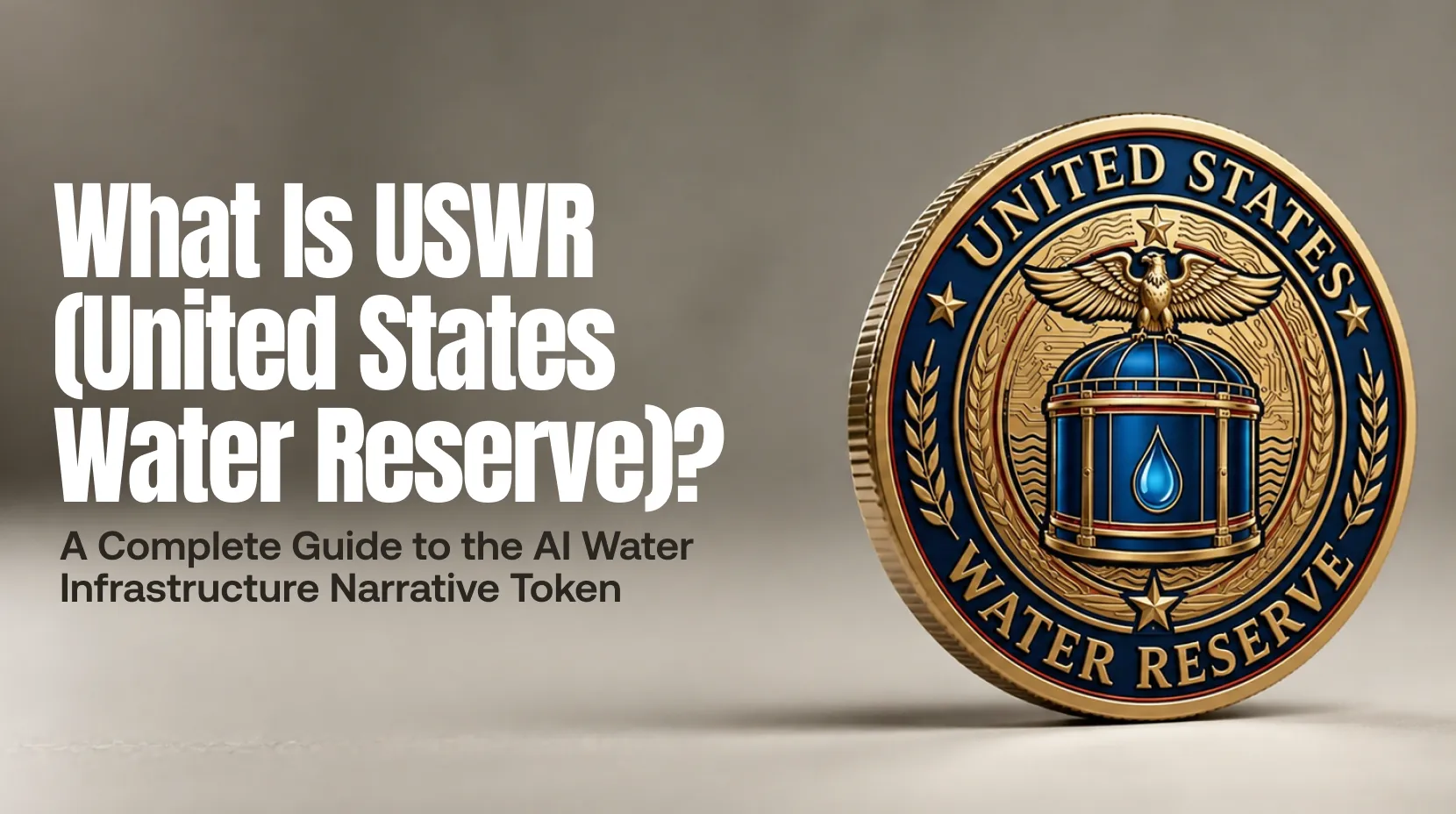
Why does AI infrastructure focus on water resources? USWR (United States Water Reserve) is an on-chain narrative token constructed around the intersection of “AI computing infrastructure” and “water resource constraints.” Its core logic converts the indispensable cooling water demand of data center operations into a digital asset narrative framework that the market can articulate. Through this approach, water resources become not merely natural resources, but a critical variable within the cost structure of AI system operations.
2026-11-04 08:14:36
USWR (United States Water Reserve) is a Solana-based crypto asset project built around the macro narrative of "Water Resources × AI Infrastructure." By leveraging on-chain tokens and data-driven modeling, it converts the strategic value of water in the AI era into a tradable digital asset. According to its official website, USWR positions water as a critical constraint in the operation of AI infrastructure, seeking to financially map this resource scarcity through on-chain mechanisms and market dynamics.
2026-11-04 08:14:36
BLESS is the native token of the Bless network, serving as a unified value medium for resource settlement, node incentives, and ecosystem governance by connecting computing resource demanders with providers. Unlike digital assets used solely for Operar, BLESS is designed to sustain the continuous operation of the decentralized computing network.
2026-11-04 08:14:35
Bless and AWS both provide computing power to developers, but they operate on fundamentally different infrastructure models. Bless aggregates globally distributed CPU, GPU, and other resources via a decentralized edge computing network, whereas AWS relies on Amazon-built and -operated data centers to deliver cloud computing services.
2026-11-04 08:14:35
Bless is designed to do more than provide computing resources—it enables developers to flexibly leverage distributed hashrate worldwide to meet diverse business needs. Unlike traditional centralized deployment, this architecture brings computing tasks closer to end users and is better equipped to handle the growing computational demands of AI and real-time applications.
2026-11-04 08:14:35
The core difference between MAGIC and gMAGIC lies in their respective functions: MAGIC is the freely tradable native ERC-20 token in the Treasure Network ecosystem, fulfilling utility roles including payment for Agent hashrate, in-app economy, and on-chain transfers; gMAGIC (Governance MAGIC) is a unit of governance voting power, created only when users stake MAGIC or deposit it into designated liquidity pools, and is used to vote on TIP proposals during the Snapshot phase. Holding liquid MAGIC does not automatically confer DAO voting rights.
2026-11-04 08:14:34
MAGIC tokenomics constitute the economic mechanism system built by Treasure Network around its native token MAGIC, encompassing total supply design, distribution release, halving emissions, farming output, Agent consumption, and governance Poner en staking. Issued via a fair launch in 2021, MAGIC is an ERC-20 token on Arbitrum One, serving a dual function of ecosystem utility and DAO governance.
2026-11-04 08:14:34
Treasure Network (MAGIC) is a decentralized AI entertainment ecosystem powered by its native token, MAGIC, and governed by the Treasure DAO community. It is committed to building an "Agent Civilization" centered around AI-native digital and physical collectibles and interactive IP. The ecosystem's core components include the Neurochimp AI Agent framework, the Mastermind large-scale orchestration backend, the Agent Creator one-click agent-building tool, and proprietary applications such as Smolworld and Bridgeworld Canopy. MAGIC functions as the unified value medium for Agent Hashrate, on-chain services, and governance voting.
2026-11-04 08:14:34
Bless (BLESS) is a decentralized edge computing network designed for AI and Web3 applications. By aggregating globally distributed CPU, GPU, and other computing resources, it creates an on-demand Shared Computer, delivering open computing infrastructure for AI inference, machine learning, high-performance computing, and similar use cases.
2026-11-04 08:14:34