As AI is increasingly applied to enterprise knowledge management, financial risk control, medical analysis, AI Agents, and other scenarios, obtaining inference results alone no longer satisfies business needs. Developers now focus more on whether AI executes as intended, whether the reasoning process is transparent, and whether results can be independently verified.
Verifiable AI, combined with decentralized AI network, Private Inference, and distributed execution, constitutes the core infrastructure of Nesa. This enables the network to balance data security, computational efficiency, and result trustworthiness.
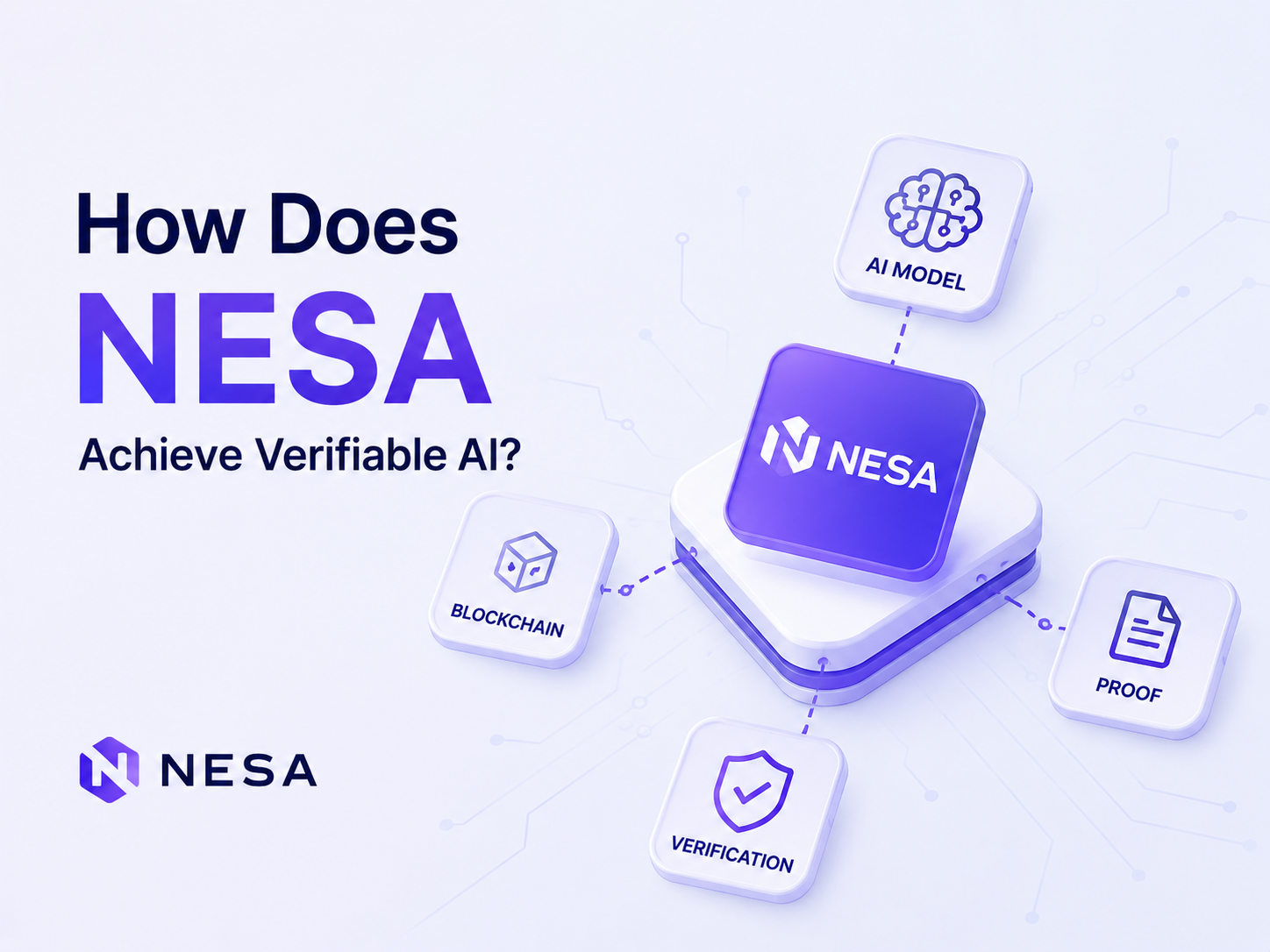
What Is Verifiable AI
Verifiable AI is an execution model that proves AI inference was genuinely executed, results were not tampered with, and can be independently verified by a third party. Unlike traditional AI services that only return inference results, Verifiable AI emphasizes the transparency of the reasoning process and the credibility of the result source.
Traditional AI platforms typically handle the entire inference pipeline and return results directly to developers. While developers can quickly leverage AI capabilities, they usually cannot confirm whether the model executed as expected or verify if anomalies occurred during inference.
Nesa integrates Verifiable AI into a decentralized execution network, aiming to generate corresponding verification data for every AI inference. This allows developers not only to obtain inference results but also to confirm that those results come from a real, complete execution process that adheres to network rules.
Why AI Output Needs Verification
AI output needs verification because an increasing number of AI applications are involved in automated decision-making, not just generating text or answering questions.
For example, in enterprise knowledge management systems, AI analyzes internal documents; in financial risk control, AI participates in risk assessment; in medical auxiliary analysis, AI inference results may influence subsequent diagnostic workflows. If you cannot confirm whether the reasoning process was actually executed, relying solely on the final results may fail to meet security, compliance, and audit requirements.
On the other hand, traditional AI APIs emphasize model capability and service stability, with the reasoning process typically managed uniformly by the platform. For businesses requiring high-trust AI, trusting only the service provider cannot cover all scenarios, so additional verification capabilities are needed to enhance credibility.
| AI Inference Challenges |
Value of Verifiable AI |
| Cannot confirm reasoning process |
Provides verifiable execution proof |
| Hard to detect anomalous computations |
Enhances result trustworthiness |
| Lacks audit capability |
Supports process verification and traceability |
| High platform dependency |
Reduces trust reliance on a single provider |
Verifiable AI does not change the model itself; it adds a layer of trusted verification to the entire AI inference pipeline.
How Nesa Proves Inference Results Are Trustworthy
Nesa uses distributed execution, cryptographic proofs, and result verification mechanisms to prove that AI inference results come from a real, complete execution process that follows network rules.
After a user submits an AI request, the network handles task scheduling, then execution nodes perform model inference. After inference, the verification layer checks whether the entire execution flow complies with network rules and confirms the returned results come from the correct computation process, not from errors or anomalous nodes.
This mechanism shifts trust from platform reputation to the verification process. Developers can not only obtain AI output but also confirm whether the reasoning actually occurred, increasing transparency across the entire AI service.
| Inference Stage |
Verification Focus |
Main Role |
| Request Submission |
Whether the request is complete |
Ensures the task enters the network correctly |
| Task Scheduling |
Whether scheduling follows rules |
Ensures reasonable task allocation |
| Node Execution |
Whether inference is genuinely completed |
Guarantees trustworthy computation |
| Result Verification |
Whether output meets verification rules |
Increases result trustworthiness |
| Result Return |
Returns verified inference results |
Enhances transparency and auditability |
Rather than focusing only on the final output, Nesa emphasizes whether the entire AI inference process can be verified and proven. This is why Verifiable AI can establish a trusted execution environment.
The Role of Cryptographic Proofs in the Inference Process
Cryptographic proofs are a key technology for Nesa to achieve Verifiable AI. Their core role is to provide credible proof for the AI inference process while protecting data privacy.
Nesa introduces cryptographic mechanisms such as Equivariant Encryption (EE) and HSS-EE in its official solution. This allows the network to perform inference while protecting input data and model parameters, and provides a trustworthy foundation for subsequent verification.
By combining cryptographic technology with distributed execution, nodes in the network can jointly complete inference tasks without any single node holding the complete model or input data, further reducing the risk of data leakage.
Cryptographic proofs, together with Equivariant Encryption and Private Inference, form Nesa's trusted computing system. This enables data protection and result verification to be achieved simultaneously, rather than being trade-offs.
How This Differs From Traditional AI API Verification
The main difference between Nesa and traditional AI APIs is whether inference verification is part of the AI service.
Traditional AI APIs typically have the platform complete model inference and return results directly. Developers rely on the platform's model capabilities, security systems, and service stability, without separately verifying the inference process.
Nesa integrates verification into the entire inference flow. The network confirms that inference complies with rules through distributed execution and cryptographic proofs, then returns verified results to developers, making the AI service more transparent and trustworthy.
| Comparison Dimension |
Nesa |
Traditional AI API |
| Inference Mode |
Distributed execution |
Centralized execution |
| Trust Method |
Verify execution process |
Trust the platform |
| Result Verification |
Supports independent verification |
Typically not provided |
| Data Protection |
Supports Private Inference |
Relies on platform security |
| Applicable Scenarios |
High-trust AI, enterprise AI |
General AI services |
The two models suit different needs. Traditional AI APIs emphasize development efficiency and mature models, while Nesa focuses on trusted execution, data control, and verifiable inference.
Applications That Need Verifiable AI Most
Verifiable AI is ideal for applications requiring trusted inference, auditability, and data security.
Enterprise knowledge management needs to confirm AI processes internal data per rules; financial risk control needs to verify automated decisions; medical analysis needs transparent inference results. These scenarios care about both model performance and trust in the inference process.
With the rise of AI Agents and on-chain AI applications, Verifiable AI also helps autonomous systems establish trusted collaboration, reduce trust costs in automated execution, and provide a reliable foundation for complex AI workflows.
Verifiable AI does not replace traditional AI services—it offers a more reliable execution model for enterprise-grade AI, sensitive data, and high-trust applications.
Conclusion
Verifiable AI is a key capability of Nesa's decentralized AI network. Using cryptographic proofs, distributed execution, and result verification, it enhances the transparency, trustworthiness, and auditability of the AI inference process. Unlike traditional AI APIs that rely on platform reputation, Nesa aims to make AI inference results provable and verifiable, providing a more reliable infrastructure for enterprise AI, AI Agents, and other high-trust applications.
FAQ
What is Verifiable AI?
Verifiable AI is a technical mechanism that proves the AI inference process was genuinely executed, results are trustworthy, and can be independently verified. Its core goal is to increase transparency and credibility of AI output.
Why does Nesa emphasize Verifiable AI?
Nesa emphasizes Verifiable AI to reduce developers' reliance on centralized platforms and to improve the trustworthiness of the inference process and results through distributed execution and verification mechanisms.
What role do cryptographic proofs play in Nesa?
Cryptographic proofs support Nesa's data protection and result verification mechanisms. They provide credible proof for AI inference while protecting input data and model parameters.
How is Verifiable AI different from traditional AI APIs?
Verifiable AI can verify whether the inference process was actually executed and follows network rules. Traditional AI APIs typically return results directly, and developers trust the platform's service credibility.
Which applications are suitable for Verifiable AI?
Enterprise knowledge management, financial risk control, medical analysis, AI Agents, and other applications that require trusted and auditable inference are best suited for development with Verifiable AI.