In an ecosystem where AI Agent and on-chain games coexist, the token must simultaneously serve historical mining incentives, Agent Hashrate consumption, and long-term governance commitments. By implementing a fixed supply cap, annual halving, and staking-weighted governance (gMAGIC), Treasure achieves a structural equilibrium for MAGIC across Bridgeworld output, Agent consumption, and DAO decision-making—preventing any single use case from dominating token circulation.
From a Treasure Network perspective, understanding MAGIC tokenomics is the key to grasping Agent fueling costs, Bridgeworld entry barriers, and governance access pathways. The interplay of supply rhythm, burn mechanisms, and gMAGIC conversion rules ultimately determines MAGIC’s long-term role within the ecosystem.
What Is MAGIC Tokenomics?
MAGIC tokenomics defines MAGIC’s supply cap, category allocation, emission schedule, mining and burn mechanisms, and its utility rules across Agents, games, and governance. MAGIC currently serves two core functions: as a utility token, it powers AI Agents by paying for hashrate and on-chain services and circulates in applications like Smolworld and Bridgeworld Canopy; as the foundational layer for governance, holders obtain gMAGIC through staking or liquidity provision, enabling them to vote on emission policies and protocol upgrades.
The MAGIC mainnet contract is deployed on Arbitrum One (address available in the Contracts section of Treasure’s developer docs). It can also be bridged between Ethereum, Arbitrum One, and Treasure L2 via the Treasure Bridge. The tokenomics are designed to reduce new emissions as ecosystem complexity grows, while establishing a two-way supply-demand dynamic via Bridgeworld mining and Agent consumption.
How Does the 347.7 Million Cap and Annual Halving Work?
MAGIC has a total supply cap of 347,714,007 tokens, with an emission curve inspired by Bitcoin's halving—but the halving occurs annually, not every four years. Treasure’s annual halving triggers on September 1 at 00:00 UTC each year, starting from September 1, 2021, progressively reducing new emissions and approaching the supply cap.
This mechanism systematically increases the difficulty of acquiring MAGIC over time, giving early adopters and long-term stakers a structural advantage. When assessing MAGIC’s circulating supply, it’s essential to factor in released tokens, post-halving emissions, Bridgeworld mining output, and Agent-side consumption—rather than relying solely on a static cap.
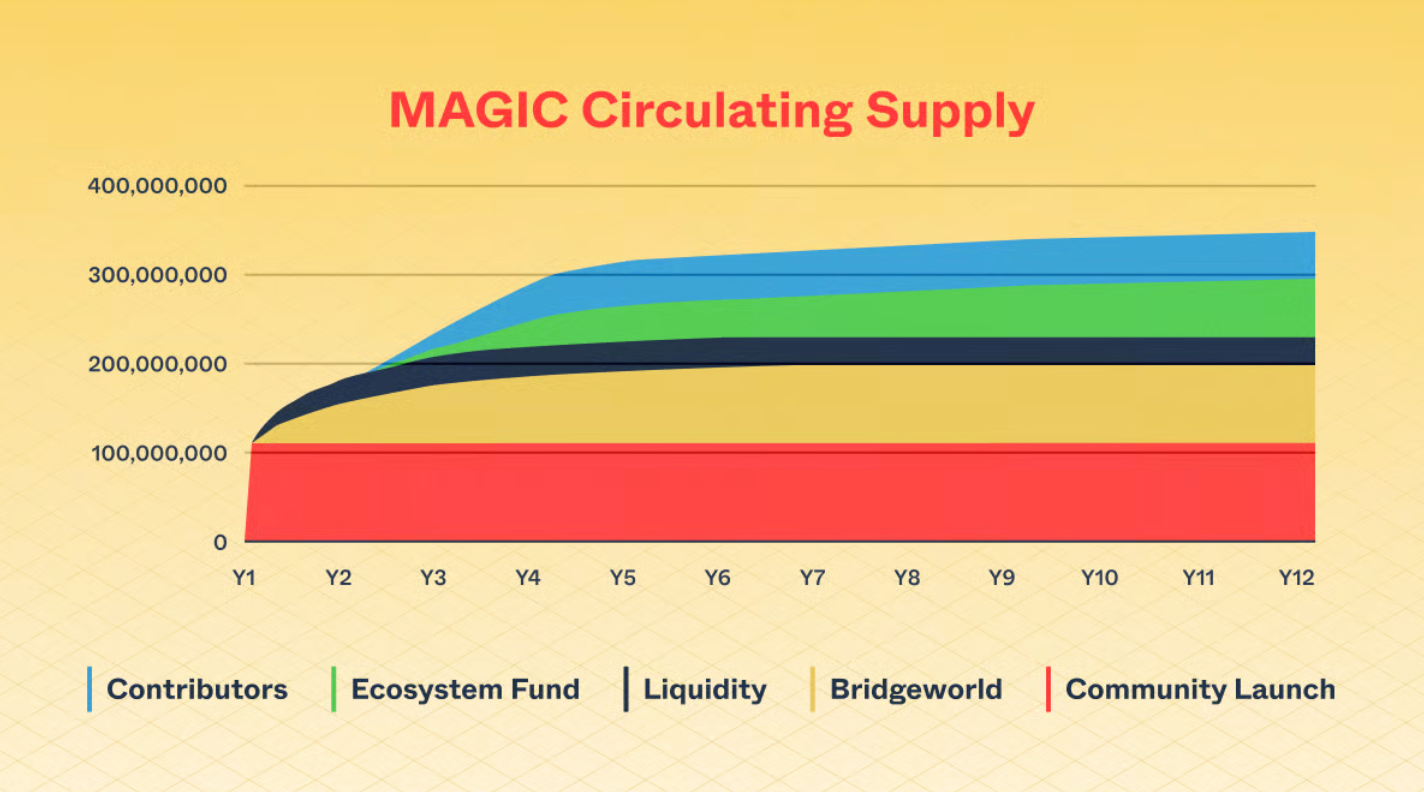 Figure 1. MAGIC annual halvening emission curve approaching the 347,714,007 max supply cap.
Genesis Allocation: How Are the Five Categories Divided?
MAGIC’s genesis supply is allocated across five static categories, each serving a distinct ecosystem function. The allocation structure, per public sources, is as follows:
| Allocation Category |
Percentage |
Approximate Quantity (Tokens) |
Main Purpose |
| Treasure Farm (Farm Mining) |
33% |
114,736,724 |
Staking mining during the fair launch phase |
| Mining (Bridgeworld Mining) |
25% |
86,921,761 |
Output from Atlas Mine, Harvester, etc. |
| Staking / Liquidity |
17% |
59,106,797 |
LP incentives and liquidity bootstrapping |
| Ecosystem Fund |
15% |
52,153,056 |
Ecosystem development and partner incentives |
| Team |
10% |
34,768,704 |
Long-term incentives for core contributors |
The farm mining category corresponds to the 2021 fair launch: users staked assets like Treasure, Loot, and AGLD to earn MAGIC at a fixed daily rate, accounting for roughly one-third of the total supply. The mining category is dedicated to long-term emissions from Atlas Mine and Harvester within Bridgeworld, expected to unlock gradually over approximately ten years. The staking/liquidity category bootstraps depth for pairs like MAGIC-ETH; the Ecosystem Fund supports partners and public goods; the Team allocation is typically subject to lock-ups and linear vesting to mitigate short-term supply shocks.
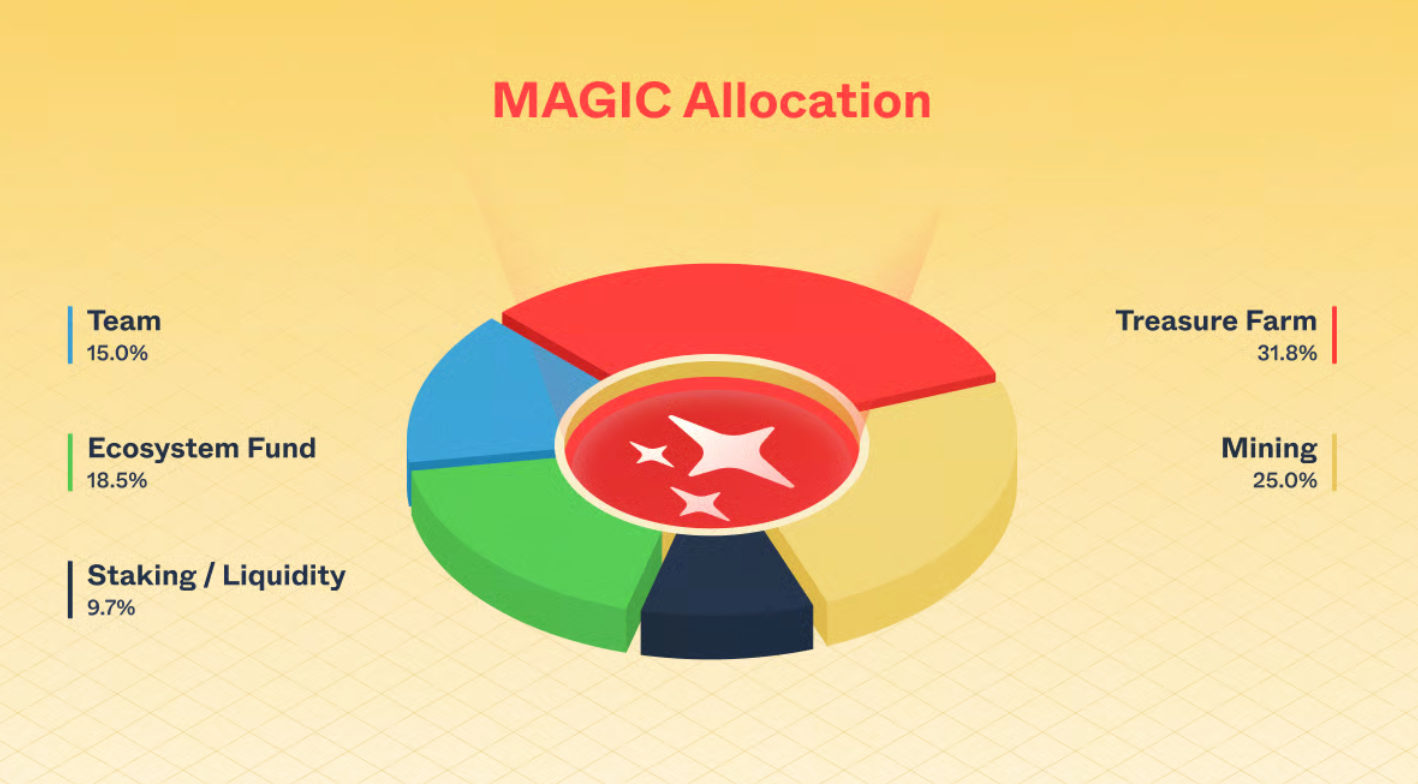 Figure 2. MAGIC genesis supply allocation: Farm 33%, Mining 25%, Staking/Liquidity 17%, Ecosystem Fund 15%, Team 10%.
How Are the Genesis Mine and Long-Term Lock-Ups Designed?
The Genesis Mine was MAGIC’s early cold-start mechanism, lasting about 90 days and producing roughly 20 million MAGIC (approximately 5.7% of the cap). Its design rewarded users willing to lock up MAGIC long-term with significantly higher rewards than regular mining, in exchange for bootstrapping liquidity and demonstrating community confidence. The longer the lock-up period, the greater the incentive alignment with long-term supporters.
After the Genesis Mine ended, Atlas Mine and Harvester within Bridgeworld became the primary channels for ongoing MAGIC emissions. Harvester is designed as the most efficient MAGIC mining tool in Bridgeworld, requiring players to hold and operate specific game assets. Atlas Mine releases its share over a longer cycle. Both mechanisms tie MAGIC output to on-chain game activity, linking token acquisition directly to ecosystem engagement.
How Do Atlas Mine and Harvester Produce MAGIC?
Bridgeworld is the core hub for MAGIC mining. Atlas Mine releases the mining category allocation over roughly ten years, with emissions decreasing with each annual halving. Harvester, as a high-efficiency mining tool, requires players to hold and manage specific game assets, offering higher output than the basic mining route. The mining mechanism follows a proof-of-work logic—users invest game assets and time to extract MAGIC from a finite emission pool.
Certain Bridgeworld mechanisms also involve burning or consuming MAGIC (e.g., specific "summoning" or alchemy processes), creating token sinks that encourage staking and long-term holding. Mining output, Agent consumption, and burn mechanisms together form a dynamic balance between MAGIC’s supply and demand.
| Output Channel |
Mechanism Features |
Participation Threshold |
Relationship with Halving |
| Genesis Mine |
Early high incentives, long-term lock-up |
Ended |
One-time/bootstrap |
| Atlas Mine |
Long-cycle basic mining |
Bridgeworld asset investment |
Decrease with annual halving |
| Harvester |
High-efficiency mining tool |
In-game assets and operations |
Decrease with annual halving |
| Farm Mining |
Fair launch staking |
Ended |
Fixed proportion already released |
What Are the Utility Scenarios for MAGIC in the Ecosystem?
MAGIC’s utility spans three layers: the Agent economy, application-layer consumption, and governance. On the Agent layer, autonomous Agents under the Neurochimp framework use MAGIC to pay for hashrate, upgrades, and on-chain services; users continuously fuel Agents via Agent Creator to keep them running. On the application layer, Smolworld and Bridgeworld Canopy use MAGIC as the ecosystem’s native value medium for character development, resource management, and game economics. On the governance layer, liquid MAGIC itself cannot vote—it must be converted into gMAGIC to participate in TIP proposal voting on Snapshot.
| Utility Dimension |
Specific Scenario |
Consumption/Lock Method |
| Agent Hashrate |
Neurochimp Agent operation, upgrades |
Continuous MAGIC fueling |
| Game Economy |
Bridgeworld summoning, resource operations |
On-chain consumption or staking |
| In-App Circulation |
Smolworld, AI Agent Marketplace |
In-app trading and incentives |
| Governance Weight |
TIP proposal voting |
Staking/LP converted into gMAGIC |
The key distinction between MAGIC and gMAGIC is that MAGIC serves as liquid utility and a source of governance eligibility, while gMAGIC is the unit of voting power. Only gMAGIC holders are entitled to vote during the Snapshot phase.
How Does the Deflationary Design and Supply Balance Work?
MAGIC’s economic model incorporates deflationary features: annual halving systematically reduces new emissions; certain Bridgeworld mechanisms require burning MAGIC to acquire game assets or perform "summoning" actions, creating deflationary pressure; and the participation costs of Harvester and Atlas Mine (game asset investment and time) act as implicit sinks, effectively reducing circulating supply.
Supply balance must be understood across three dimensions: the static cap of 347 million tokens sets a long-term ceiling; dynamic emissions decline with each halving cycle; and demand fluctuates with Agent ecosystem expansion, game participation, and governance staking. The DAO treasury holds MAGIC and ecosystem fund allocations; quarterly reports (TIP-26) disclose treasury balances, revenue conversion, and operational expenses, providing the community with transparency on supply management.
What Are the Advantages and Risks of MAGIC Tokenomics?
MAGIC tokenomics stands out in three dimensions: fair launch, predictable halving, and weighted governance. No centralized VC pre-sale distribution occurred—early participants earned tokens through gameplay and staking. The annual halving offers a verifiable path of declining emissions. gMAGIC tilts governance power toward long-term stakers and liquidity providers.
Limitations include: Bridgeworld mining gives early participants a time advantage, making token acquisition progressively costlier for new users; the unlock schedules of the Ecosystem Fund and Team shares may create phased supply pressure; and Agent hashrate demand has not yet reached a fully determined equilibrium with emissions, making utility reliant on product adoption.
Associated risks include smart contract and mining contract vulnerabilities, counterfeit MAGIC tokens, cross-chain bridge state risks and the interoperability protocols underlying Treasure Bridge, as well as potential supply impacts from DAO treasury management and Ecosystem Fund release strategies. These explanations are mechanism-level analyses and do not constitute investment advice.
Summary
MAGIC tokenomics is built on a 347,714,007 token cap and annual halving, with an initial structure divided into five allocation categories: farm mining, Bridgeworld mining, staking/liquidity, Ecosystem Fund, and Team. The Genesis Mine completed the cold-start phase, while Atlas Mine and Harvester sustain ongoing emissions. Agent Hashrate consumption and certain in-game burn mechanisms drive demand. Staking MAGIC to obtain gMAGIC enables governance participation, creating a closed loop among token output, consumption, and protocol decision-making. Understanding allocation, halving, mining, and utility is essential for grasping MAGIC’s role in the Treasure Network.
FAQ
What is MAGIC tokenomics?
MAGIC tokenomics refers to the economic system that governs MAGIC, the native token of Treasure Network. It encompasses supply cap, distribution, halving emissions, Bridgeworld mining, Agent consumption, and gMAGIC governance. MAGIC has a fixed cap of 347,714,007 tokens and follows an annual halving schedule.
What is the total supply of MAGIC and how is it allocated?
The total supply of MAGIC is capped at 347,714,007 tokens. The primary allocation is: Farm Mining 33%, Bridgeworld Mining 25%, Staking/Liquidity 17%, Ecosystem Fund 15%, and Team 10%. The fair launch and Bridgeworld mining have historically been the main acquisition channels.
When does the MAGIC annual halving occur?
Treasure’s annual halving occurs on September 1 at 00:00 UTC each year, starting from 2021. Every year, new emissions are halved, gradually approaching the supply cap. The emission curve mirrors Bitcoin’s halving logic but at an annual frequency.
What was the Genesis Mine?
The Genesis Mine was an early cold-start mining mechanism that ran for approximately 90 days, producing about 20 million MAGIC. It offered high rewards to users willing to lock up tokens long-term and has since concluded. Ongoing emissions now come from Atlas Mine and Harvester.
How is MAGIC used in the Agent ecosystem?
AI Agents running on the Neurochimp framework use MAGIC to pay for hashrate and on-chain services. Users continuously fuel their Agents via Agent Creator to maintain activities like cross-chain gaming, trading, and learning. Agent consumption is a significant source of demand for MAGIC.
Does holding MAGIC grant governance rights?
No. Only gMAGIC holders have voting rights during Snapshot proposals. To obtain gMAGIC, MAGIC must be staked in Bridgeworld Harvesters, Governance Staking, or designated LP pools. Unstaked, liquid MAGIC does not count toward voting weight.