In the Bless network, developers need computing resources for AI inference and other computational tasks, while nodes contribute CPU, GPU, and other hashrate to complete them. As the network’s incentive mechanism, BLESS rewards resource contributors and establishes a self-sustaining economic cycle for the entire computing ecosystem.
What Is the BLESS Token
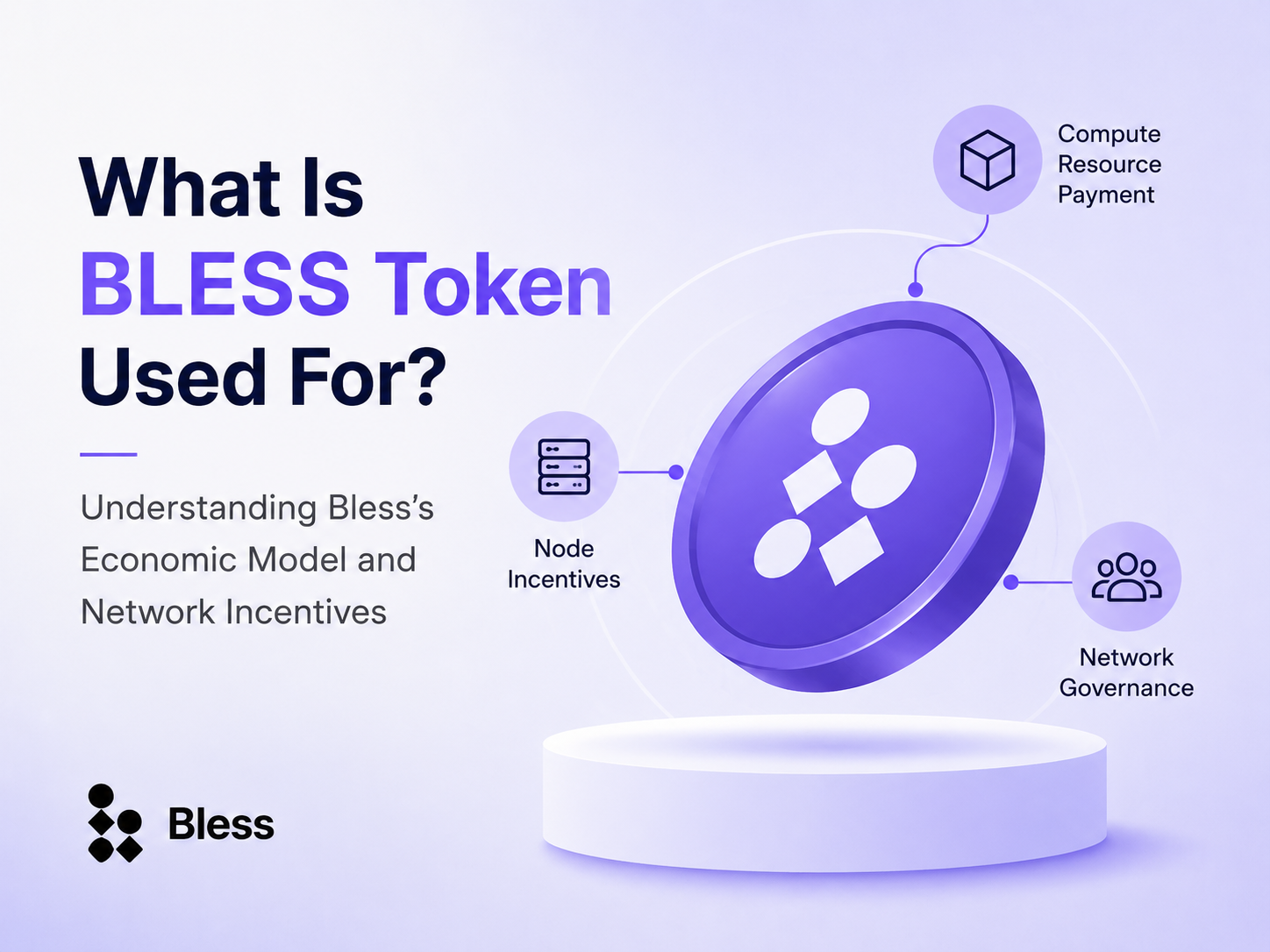
As a core functional component of the Bless network, the BLESS token is responsible for facilitating resource exchange and network incentives. For developers, it functions as the settlement medium for accessing computing resources. For node operators, it is the primary reward for contributing computational power. According to the official whitepaper, its design goal is to coordinate resource allocation among developers, node operators, and the protocol — not to serve strictly as a store of value or payment instrument.
A decentralized computing network cannot sustain itself on technical architecture alone. It also requires a robust incentive mechanism that continually attracts nodes to contribute resources. BLESS delivers on this by connecting computing demand with hashrate supply, enabling the network to scale its computational capacity.
| Core Positioning of BLESS |
Description |
| Network Role |
Native functional token of the Bless network |
| Primary Uses |
Resource settlement, node incentives, network governance |
| Target Users |
Developers, node operators, ecosystem participants |
| Design Objective |
Support network resource circulation and long-term operation |
Thus, understanding BLESS is not about the token itself — it’s about how it drives the continuous flow of computing resources across the Bless network.
What Functions Does BLESS Serve in the Network
First and foremost, BLESS handles the settlement of computing resources. When developers tap into CPUs or GPUs on the Bless network to complete tasks, they must pay the corresponding resource fees in BLESS, thereby creating a complete resource transaction mechanism.
Beyond resource payment, BLESS is a cornerstone of node incentives. Nodes that provide computing resources, complete tasks, and pass network verification receive token rewards according to protocol rules. This encourages more computing resources to join the network, boosting overall computational capacity.
Per the official roadmap, BLESS will also enable network governance in the future, allowing the community to participate in decisions regarding protocol parameters and ecosystem development.
| Network Function |
Role of BLESS |
| Computing Resource Settlement |
Pay network computing fees |
| Node Incentives |
Reward nodes that contribute hashrate |
| Network Governance |
Enable community participation in protocol governance (planned) |
Unlike traditional cloud platforms that rely on centralized billing and resource management, Bless delegates resource settlement and incentives to the network itself, allowing computing resources to circulate more flexibly within an open ecosystem.
How Do Nodes Earn BLESS Rewards
Nodes on the Bless network must contribute available computing resources to participate in task execution. After a developer submits a computing request, the network schedules tasks based on resource requirements and node status, then assigns execution to eligible nodes.
Once a node completes a task and passes network verification, the protocol distributes rewards according to established rules. In this model, earnings are directly linked to resource contributions and task completion, rather than simply online time or node count.
This incentive mechanism continually attracts new computing resources while encouraging existing nodes to remain stable, thereby improving the availability and resource supply capacity of the entire Shared Computer.
How Do Developers Use BLESS to Pay for Computing Resources
On the Bless network, developers can submit AI inference, machine learning, or other computing tasks and pay for the required resources using BLESS. For developers, the token acts more as a settlement tool for network resources than a traditional medium of exchange.
When a task is initiated, the network schedules resources based on task type, demand, and node status, then calculates the corresponding resource consumption. After the developer pays, eligible nodes execute the task and return results, forming a complete resource access cycle.
| Computing Resource Access Process |
Description |
| Submit Task |
Developer sends a computing request to the Bless network |
| Resource Scheduling |
Network automatically matches qualified nodes |
| Pay Resource Fee |
Settlement of computing resources using BLESS |
| Execute Computation |
Node completes the task and returns results |
| Node Receives Reward |
Network distributes rewards to nodes according to rules |
This mechanism lets developers avoid managing underlying computing infrastructure — they simply draw on network hashrate as needed. It also allows resource costs to adjust dynamically with task demand.
How Do Network Incentives Drive Ecosystem Operation
A decentralized computing network needs more than just computing resources; it requires an incentive mechanism that sustains resource supply over the long term. Bless connects computing demand, node contributions, and token incentives, creating a collaborative dynamic among developers, node operators, and the protocol.
As developers continuously use network resources, settlement needs arise. Nodes earn BLESS rewards by providing stable computing power. As more nodes join, the network’s overall capacity increases, which in turn attracts more developers to deploy applications. This supply-demand cycle is a cornerstone of the Bless network’s ongoing growth.
From a design perspective, BLESS is not merely a reward token — it is a coordination tool for resource circulation across the network, enabling more efficient allocation of computing resources in an open ecosystem and driving the continued development of the Shared Computer.
| Participant Role |
Primary Action |
Contribution to the Network |
| Developer |
Pay computing resource fees |
Provide network demand |
| Node Operator |
Provide CPU and GPU hashrate |
Provide network supply |
| Bless Network |
Schedule resources and complete settlement |
Coordinate resource flow |
| BLESS Token |
Facilitate incentives and settlement |
Connect supply and demand |
This incentive model reflects the essence of a decentralized computing network: growth depends not on a single service provider but on the continuous use of resources by developers, the consistent contribution of hashrate by nodes, and the ongoing optimization of resource scheduling by the protocol — all working together to drive the ecosystem.
Summary
BLESS is a vital component of the Bless network. Its core role is not simply that of a digital asset — it handles computing resource settlement, node incentives, and network governance. Through a unified incentive mechanism, BLESS connects developers, node operators, and the protocol, enabling the network to continuously attract computing resources and support AI applications.
For developers, BLESS provides a settlement method for accessing distributed computing resources. For node operators, contributing computational power yields corresponding rewards. As the Bless network expands, this economic model centered on resource demand and supply will further underpin the sustained operation of the Shared Computer.
FAQ
What is the main purpose of the BLESS token?
BLESS is primarily used on the Bless network for computing resource settlement, node incentives, and network governance. It is an essential functional token that links developers with node operators.
Why does the Bless network need the BLESS token?
The Bless network requires BLESS to establish a unified resource settlement and incentive mechanism, enabling developers to pay for computing resources and nodes to earn rewards for contributing hashrate — thereby sustaining the network over the long term.
How do nodes earn BLESS rewards?
Nodes provide CPUs, GPUs, and other computing resources to the Bless network. After completing assigned tasks and passing verification, they receive BLESS rewards according to protocol rules.
Why do developers need to use BLESS to pay for computing resources?
Developers use BLESS to pay for computing resources so they can access distributed hashrate on demand from the Bless network, without having to build or maintain their own infrastructure.
Has BLESS already released its complete tokenomics?
As of now, the official Bless team has not fully disclosed the total supply, token distribution, or issuance mechanism of BLESS. All relevant information should be based on the official whitepaper and subsequent announcements.
What drives the value of BLESS?
From an official design standpoint, the primary value of BLESS derives from resource circulation and ecosystem activity within the network. Its functions are closely tied to computing resource demand, node contributions, and network usage.