The core design goal of this process is to enhance privacy protection and boost result reliability throughout the AI inference pipeline. Unlike traditional AI APIs that directly call centralized servers, Nesa aims to make inference more transparent, verifiable, and give users stronger data control.
What Steps Does an AI Request Go Through?
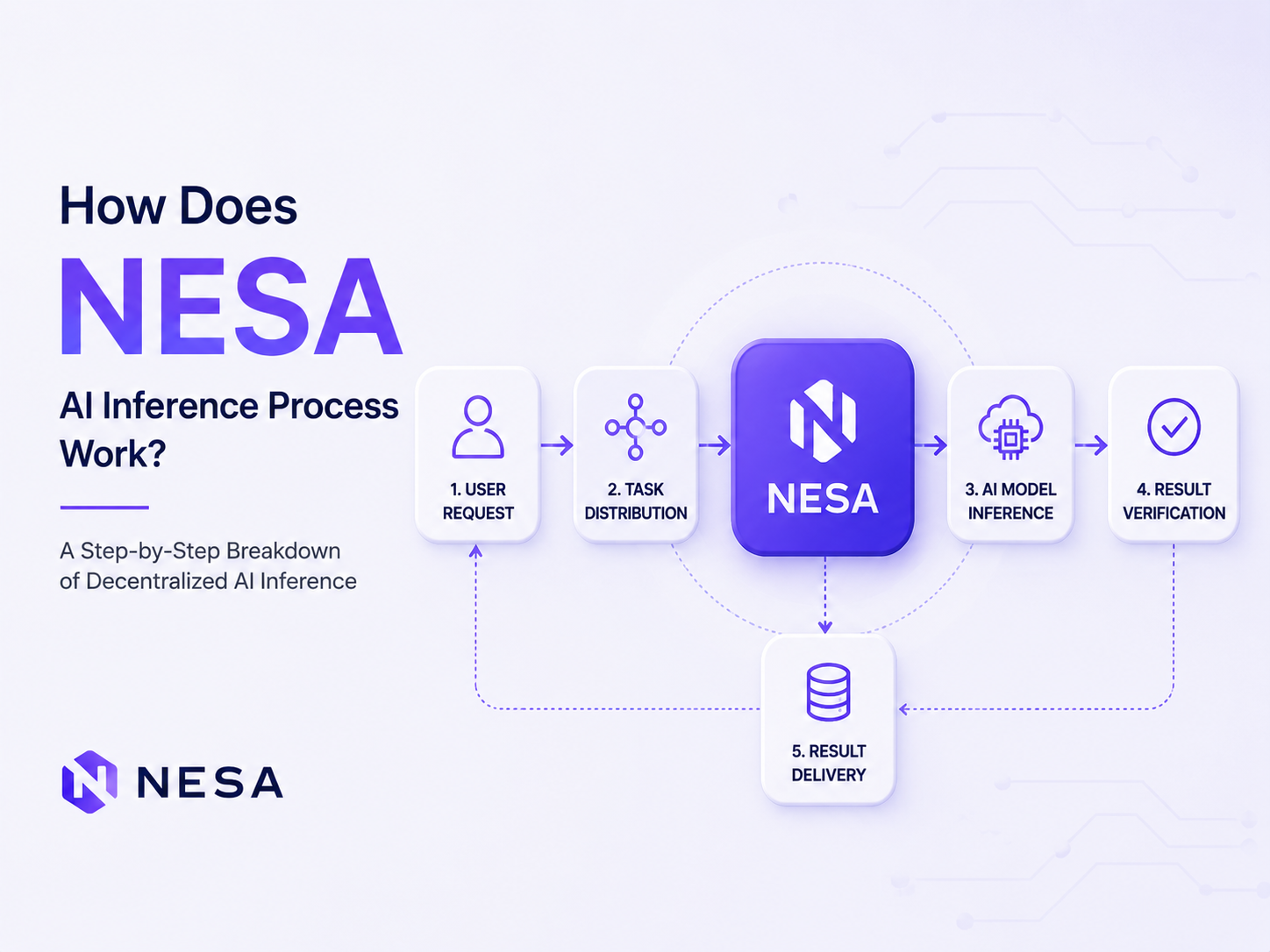
Nesa's AI inference process starts with a user submitting a request and ends with the return of a verified result. It involves multiple phases, including task assignment, inference execution, and result verification.
When an app or developer sends a request to the Nesa network, the network first receives the input data and generates a corresponding inference task based on the model's needs. Unlike traditional AI APIs, which send requests straight to a single server, Nesa routes the task into its scheduling system.
The MetaInf scheduling system then selects the best nodes for the job based on status, hardware capabilities, and network load. Some models may even be split across multiple nodes for collaborative processing, which strengthens privacy protections.
After inference, the verification layer checks that the result matches the expected process. Only then is the output returned to the application or end user.
| Phase |
Execution Module |
Primary Task |
Output |
| Request Submission |
Application/API |
Receive inference request |
Inference task |
| Task Scheduling |
MetaInf |
Allocate computing resources |
Node task |
| Inference Execution |
Network Node |
Complete model computation |
Inference result |
| Result Verification |
Verification Layer |
Verify execution process |
Verified result |
| Return Result |
API |
Return final output |
AI response |
This framework forms the operational backbone of the Nesa AI inference network.
How Does Nesa Allocate Inference Tasks?
Nesa uses its MetaInf scheduling system to allocate inference tasks. MetaInf's core job is to find the best available resources for each task across the network.
When a new inference request arrives, the scheduler evaluates each node's computing power, availability, and current load. Since different models have different needs for GPU, CPU, and memory, tasks are never assigned at random.
For complex models, MetaInf can split computations across multiple nodes. This reduces reliance on any single point and boosts privacy, because no one node sees the full inference process.
After task completion, the scheduler also organizes result aggregation and verification to ensure consistency and traceability throughout.
What Responsibilities Do Nodes Have in the Inference Process?
Nodes in the Nesa network are the computing resource providers that actually execute inference tasks. They receive assignments from the scheduler and run model computations according to defined rules.
In private inference scenarios, nodes typically see only part of the task. Thanks to model splitting and encryption, no node can access the complete input data or full model parameters.
Different node types take on different responsibilities. Some focus on running the inference, while others handle verification and result confirmation.
This separation of duties reduces the risk of malicious nodes compromising the network and boosts the credibility and security of the inference process.
| Node Type |
Primary Responsibility |
| Execution Node |
Complete inference computation |
| Verification Node |
Check result correctness |
| Scheduling Node |
Allocate and coordinate tasks |
| Network Participation Node |
Maintain network operation |
By dividing roles, Nesa can handle complex AI inference tasks in an open network environment.
How Are Results Verified and Confirmed?
Nesa's verification layer confirms that an inference result truly comes from the expected execution process, not from a faulty calculation or fabricated data.
In traditional AI services, users have to simply trust that the returned result is correct. In the Nesa network, results go through extra verification before being accepted.
The verification mechanism checks execution logs, task status, and proof-of-computation data to ensure the process followed network rules. Only verified results are formally confirmed and sent back to the application layer.
This changes AI inference from a "trust-based" model to a "verification-based" one. For use cases like financial analysis, enterprise automation, and AI agents, verifiability directly improves transparency and trust.
How Can Developers Connect to the Nesa Network?
Nesa gives developers tools to deploy models and connect to the network, letting them build decentralized AI applications.
Developers start by selecting or uploading a model, then deploying it using Nesa's SDK. Once deployed, they can send inference requests to the network via standard APIs.
During calls, developers don't need to manage node resources directly. Task scheduling, node selection, and verification are all handled automatically by the network.
This feels like a traditional cloud service, but the underlying execution environment runs on a distributed network instead of a single provider's servers. Developers get the same ease of use, plus extra privacy and trusted execution.
What Are the Differences from Traditional AI API Calls?
The biggest difference between Nesa and traditional AI APIs is in how execution works and how trust is established.
Traditional AI APIs follow a simple flow: request in, server executes, result out. The whole process is controlled by the service provider, and users can't verify details.
Nesa adds steps like task scheduling, distributed computing, and result verification between execution and the final output. This makes the process more complex, but also delivers much stronger data protection and result reliability.
From a developer's perspective, both models work via API calls. But architecturally, Nesa is more like a decentralized AI infrastructure, while traditional APIs are closer to centralized cloud services.
For applications that need privacy, verifiable computation, and an open execution environment, Nesa offers a fundamentally different solution than traditional AI services.
Summary
Nesa's AI inference process includes multiple stages: request submission, task scheduling, node execution, result verification, and result return. By combining the MetaInf scheduling system, a distributed node network, and verification mechanisms, Nesa delivers trustworthy AI inference in an open environment.
Compared to traditional AI APIs, Nesa adds privacy protection and result verification, making the inference process not only computationally complete but also more transparent and credible. This execution model is a key component of Nesa's decentralized AI infrastructure.
FAQ
What steps are included in Nesa's AI inference process?
Nesa's AI inference process typically includes five phases: request submission, task scheduling, node execution, result verification, and result return. Each phase is handled by different modules working together.
MetaInf is Nesa's task scheduling system. It allocates inference tasks based on node status, hardware resources, and network load, and coordinates the entire execution flow.
Why does Nesa need a result verification mechanism?
Nesa uses verification to ensure inference results come from a correct execution process, reducing the impact of errors or malicious behavior on the network.
How is Nesa's inference process different from traditional AI APIs?
Traditional AI APIs rely on a single centralized server for inference. Nesa uses distributed nodes, task scheduling, and verification mechanisms to run inference tasks.
Do developers need to manage underlying nodes?
No. Developers interact with the network solely through APIs. The Nesa network handles node scheduling, task execution, and verification automatically.