For investors comparing crypto tax free countries or other crypto friendly countries, the practical test is therefore the total tax and compliance position rather than the headline rate. That means checking whether crypto-to-crypto swaps trigger tax, how short term gains and long-term holdings are treated, whether foreign income or passive income is taxable, how tax residents are defined, and whether tax authorities require detailed reporting of crypto assets and crypto profits. Residency fees, economic-substance requirements, platform restrictions, banking access, cost of living, and obligations to a home country's tax authority can also outweigh the apparent tax benefits of a 0% regime. In practice, a well-defined low-tax tax regime can sometimes be more suitable than a nominal crypto tax haven if it gives individual investors greater certainty over what they will actually pay in taxes.
Key Takeaways
-
Zero tax does not automatically mean zero tax burden. Income tax, annual wealth tax, business taxes, residency expenses and obligations to a home country's tax authority may still apply.
-
Low-tax jurisdictions can be more attractive when their rules are clearer. Long-term holding exemptions, defined tax rates and established regulatory frameworks can make future liabilities easier to estimate.
-
The type of crypto transaction matters. Selling to fiat currency, crypto-to-crypto trading, staking, mining and business activity may receive different tax treatment.
-
Changing residence is not the same as changing tax residency. Investors need to understand residence tests, treaty rules and continuing obligations in their former country.
-
International reporting is becoming harder to ignore. The OECD's Crypto-Asset Reporting Framework, or CARF, is moving participating jurisdictions toward automatic exchange of crypto tax information from 2027.
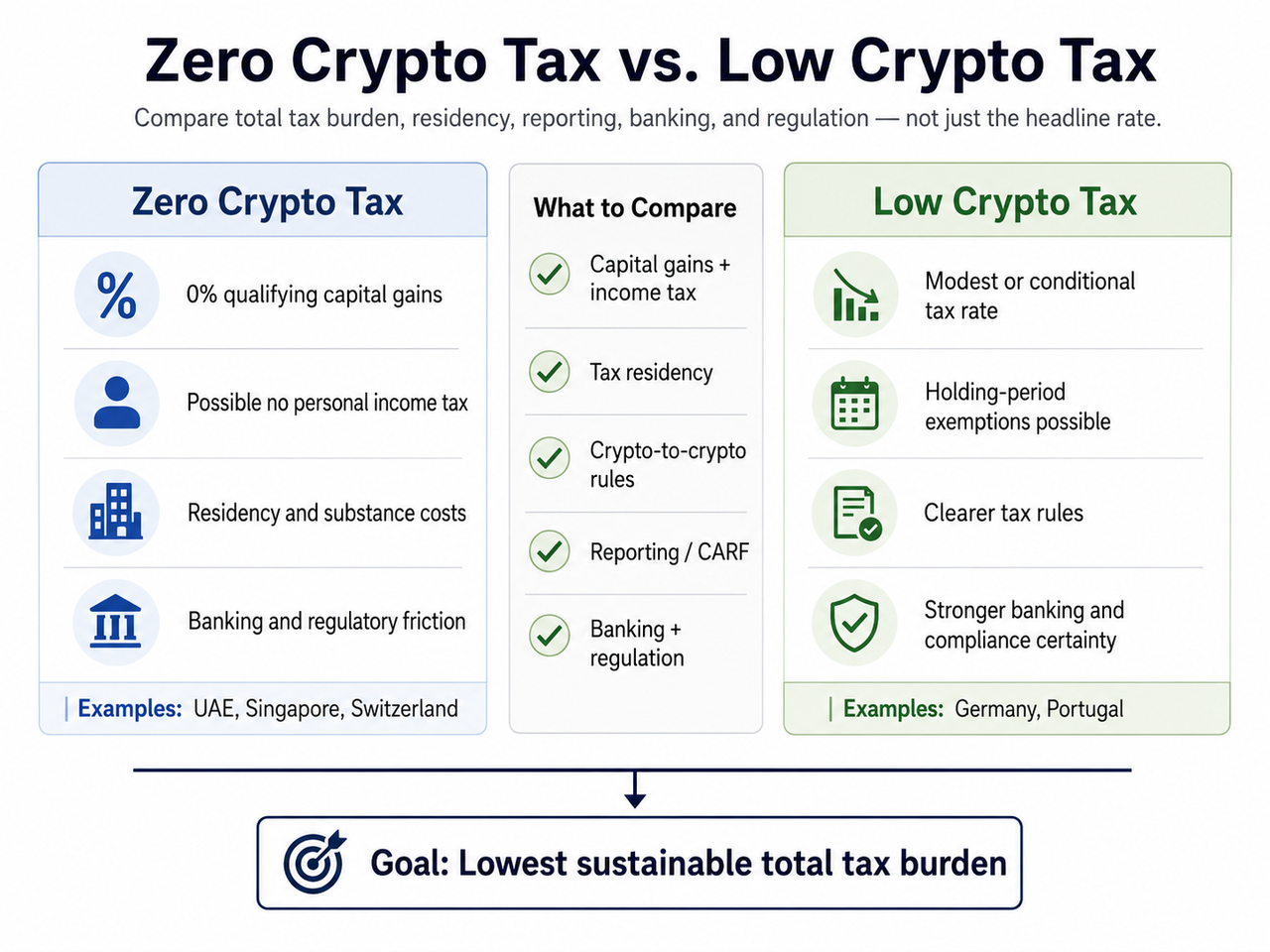
Zero Crypto Tax vs Low Crypto Tax: The Main Difference
A zero-tax jurisdiction generally does not impose capital gains tax on qualifying personal investment gains, and some also have no conventional personal income tax. A low-tax jurisdiction instead may charge a relatively modest rate, create exemptions after a defined holding period, or defer tax until a particular event occurs.
Those categories overlap.
Singapore, for example, has no capital gains tax. Profits from digital tokens held as personal investments are generally treated as capital rather than taxable income, but gains arising from business-like trading can still be taxable. Switzerland similarly provides favorable treatment for private investors, while professional trading and cantonal wealth tax can change the result.
Germany and Portugal take another approach. They can reward long-term holding instead of applying an unconditional zero rate to every crypto transaction. The broader differences between these systems are visible when comparing countries with no crypto capital gains tax: "crypto tax free" can describe several very different legal structures.
| Factor |
Zero-tax jurisdiction |
Low or conditional-tax jurisdiction |
| Qualifying personal capital gains |
Often 0% |
Often reduced, deferred or exempt under conditions |
| Income from crypto |
May still be taxable |
Usually governed by explicit income rules |
| Holding-period benefit |
Not always necessary |
Often important |
| Wealth tax |
Possible in some jurisdictions |
Possible |
| Reporting |
May still be extensive |
Usually extensive |
| Regulatory certainty |
Varies widely |
Often more developed |
| Residency costs |
Can be significant |
Varies by programme |
| Banking access |
Depends on jurisdiction and source of funds |
Often stronger in established financial centres |
| Best fit |
Investors satisfying residency and classification rules |
Investors valuing certainty or conditional exemptions |
This is why a useful crypto tax jurisdiction comparison should start with classification and residency rather than the tax rate displayed in a headline.
Capital Gains Tax Is Only One Part of Crypto Taxes
Capital gains tax usually becomes relevant when a crypto asset held as a capital asset is disposed of for more than its cost basis. Yet individual jurisdictions disagree on what counts as a disposal and whether the gain belongs under capital gains, ordinary income, business income or another category.
The United States illustrates the difference clearly. The IRS treats digital assets as property, so exchanging one cryptocurrency for another is a disposal that can create a taxable gain or loss. Digital assets received through activities such as work, mining or certain rewards can instead generate ordinary income based on fair market value.
France follows a substantially different system for qualifying private crypto portfolios. Crypto-to-crypto exchanges are generally not the point at which the individual tax charge is triggered; conversion into fiat or certain uses outside crypto can create the taxable event.
Portugal also generally defers recognition during qualifying crypto-to-crypto swaps. Short-term qualifying gains from crypto held for fewer than 365 days are generally taxed at 28%, while qualifying assets held for at least 365 days can receive long-term exclusion treatment.
These differences explain why the basic mechanics of crypto capital gains tax matter before comparing countries. Two investors making the same Bitcoin-to-Ether swap could face completely different immediate tax consequences depending on their tax residency.
Crypto Tax Free Countries Still Need a Tax Residency Test
Moving assets does not normally move a person's tax residence.
Someone can hold crypto through an overseas exchange, maintain a foreign bank account or obtain a residence permit without necessarily terminating tax residency in their previous country. Tax authorities commonly examine factors such as days present, permanent homes, family connections, business interests and the location of a person's economic life.
That distinction is especially important for citizens or former residents of countries that retain broad taxation rights. Investors should establish when their original tax residency ends, when the new one starts, and whether a tax treaty affects the transition.
A passport is not a substitute for this analysis. CARF itself is built heavily around tax residency information rather than nationality alone; Gate Learn's overview of the Crypto-Asset Reporting Framework makes the same practical distinction.
Residency programmes also have their own economic requirements. The UAE's Golden Residency can provide a ten-year route for qualifying public-investment or real-estate investors, with specified routes involving assets of at least AED 2 million.
Singapore's Global Investor Programme is much more capital-intensive: one route requires at least S$10 million in a qualifying Singapore business, while another requires S$25 million in a GIP-select fund.
Portugal's residence-by-investment system also has several qualifying routes rather than a single universal "Golden Visa price." Treating immigration eligibility and tax residency as the same thing can therefore produce an expensive mistake.
When Low Tax Crypto Countries Can Beat a Zero-Tax Rate
A modest tax can sometimes buy something valuable: predictability.
Germany is a useful example. Qualifying crypto held as private assets can generally receive tax-exempt treatment after the required holding period, while shorter-term disposals can be taxable. Portugal similarly distinguishes between short- and long-term holdings.
An investor who intends to hold assets for several years may therefore care less about whether a country markets itself as a crypto tax haven and more about whether its holding-period rule is stable, understandable and supported by established tax administration.
This is also where crypto tax exemptions become more useful than a simple country ranking. Exemptions normally depend on legal conditions such as holding period, asset classification, transaction type or investor status rather than applying universally.
A 10% tax under clear rules can, in some circumstances, be easier to plan around than a theoretical 0% treatment that depends on uncertain classification, expensive residency arrangements or a regulator changing its interpretation.
Compare Personal Income Tax, Business Income and Wealth Tax
Investors should next ask what happens if the activity is not classified as a private capital gain.
Someone buying crypto occasionally as a personal investment can receive different tax treatment from a person trading systematically as a business. Mining, staking, consulting paid in crypto, employment compensation and commercial trading can also create taxable income even where personal capital gains are exempt.
Singapore demonstrates this distinction. Personal investment gains from financial instruments including digital tokens are generally not taxable, while businesses trading digital tokens in the ordinary course of business are taxed on their profits.
Switzerland adds another variable: private capital gains may be tax free, but cryptocurrency held as private wealth can form part of the base for cantonal wealth taxation, while professional activity can be treated as taxable income.
The UAE takes a different route. It does not operate a conventional federal personal income tax system, and qualifying personal investment income can fall outside the scope of corporate tax rules for natural persons. Business activity, however, requires a separate analysis.
The important calculation is therefore not:
crypto capital gains tax rate = total crypto tax bill
It is closer to:
capital-gain treatment + income classification + wealth/property taxes + business taxes + residency costs + compliance costs = effective tax burden
That framework helps explain why global crypto hubs are increasingly judged on regulation, banking and infrastructure alongside favorable taxation.
Crypto-to-Crypto Trading Can Change the Comparison
Transaction rules can have an outsized effect on active traders.
Suppose an investor buys BTC for the equivalent of $40,000 and later swaps it for ETH when the BTC has a fair market value of $60,000.
Under U.S. rules, exchanging property for another digital asset generally creates a disposition, so the $20,000 appreciation can form part of the capital gain calculation even though no fiat currency was received.
Portugal generally defers the tax impact of a qualifying crypto-to-crypto swap until a later event, while France also generally avoids immediate taxation on crypto-to-crypto exchanges for qualifying private investors.
For frequent traders, that difference can matter more than the nominal tax rate.
Accurate records remain necessary either way. Someone trading through Gate.com, for example, can download transaction and trade history and reconcile timestamps, quantities and transactions rather than trying to reconstruct an entire tax year from wallet balances.
When fair market value at a trade date is needed, historical exchange records and market data such as the BTC/USDT market on Gate.com can also help document the market context, although the taxpayer's required valuation method ultimately depends on local rules.
Reporting Duties Are Expanding Even Where Crypto Gains Are Tax Free
A zero tax bill and a zero reporting obligation are two different things.
The OECD created CARF to facilitate automatic exchange of tax-relevant information about crypto assets. First international exchanges under the framework are expected to begin in 2027.
Implementation is already moving beyond policy commitments. As of June 23, 2026, Jersey's government reported that 46 jurisdictions had committed to implement CARF for the 2026 reporting period, with additional jurisdictions entering in later periods.
Reporting crypto-asset service providers can be required to collect identifying and tax-residency information and report relevant transactions. Singapore's Inland Revenue Authority, for example, describes CARF as an automatic exchange system for tax-relevant crypto information and notes that major financial centres are participating from 2027 or 2028.
For investors, the practical consequence is simple: locating assets in a low- or zero-tax jurisdiction should not be confused with anonymity from tax authorities.
Tax efficiency matters only if the surrounding financial system works.
An investor may eventually need to convert digital assets into fiat currency, buy property, document a source of funds or send significant amounts through a bank. Financial institutions can request transaction histories, wallet evidence, acquisition records and tax documentation before accepting large crypto-linked transfers.
Platform access also varies geographically. A residence that creates attractive tax treatment does not guarantee access to every crypto exchange, stablecoin, banking partner or investment service.
Established financial centres can have an advantage here. Their taxes may not always be the absolute lowest, but mature licensing regimes, established tax authorities and formal digital-asset regulation can reduce operational uncertainty.
That broader framework is one reason a list of the most crypto-friendly countries does not perfectly match a ranking based purely on capital gains tax.
Hidden Costs Can Erase a Zero-Tax Advantage
A jurisdiction charging zero capital gains tax can still be expensive.
Potential costs include residence applications, qualifying investments, housing, health insurance, company administration, professional advisers, banking fees, wealth taxes and the overall cost of living. Investors operating companies may also face economic-substance requirements requiring genuine local activities rather than a paper entity.
Consider an investor expecting $50,000 of annual taxable crypto gains. Moving solely to save a 10% tax would theoretically save $5,000 before accounting for relocation and compliance costs. If maintaining the new residence costs $20,000 more each year, the headline tax advantage does not create an economic saving.
Large portfolios can produce the opposite result. A significant difference in tax treatment may outweigh relocation costs, but only after residency, exit taxes, business classification and home-country obligations have been examined.
For individual investors, the most useful comparison is therefore the total annual cost of legally obtaining and maintaining the intended tax treatment, not merely the statutory capital gains rate.
A Practical Crypto Tax Jurisdiction Comparison
Before choosing between zero and low crypto tax, compare each jurisdiction across the same questions:
-
Tax residency: What legally makes you a tax resident, and can your previous country continue taxing you?
-
Capital gains: Are personal crypto gains taxed, conditionally exempt or completely outside capital gains tax?
-
Holding period: Does holding for 12 months or another period materially change the tax treatment?
-
Crypto swaps: Does exchanging BTC for ETH create an immediate taxable event?
-
Income: How are staking, mining, airdrops, salary and self-employment paid in crypto treated?
-
Investor classification: Could frequent crypto trading turn personal investment gains into business income?
-
Other taxes: Is there wealth tax, corporate tax, VAT/GST or another levy?
-
Reporting: Which transactions and foreign accounts must be declared?
-
CARF: Will crypto service-provider information be exchanged with another tax authority?
-
Residency cost: What investment, physical-presence and renewal conditions apply?
-
Financial access: Can local banks and regulated platforms support the intended transactions?
-
Legal certainty: Are the crypto regulations and tax rules established enough to support long-term planning?
The same framework also helps individual investors distinguish their situation from professional trading. The tax treatment of a long-term holder can differ materially from someone generating regular income through digital assets, as reflected in the broader rules governing crypto capital gains tax for investors.
Risks of Choosing a Jurisdiction Only for Zero Tax
Tax laws can change, and crypto regulations remain especially dynamic.
A country can introduce specific crypto tax legislation, change residency requirements, tighten reporting, redefine professional trading or alter how a particular digital asset is classified. International reporting standards such as CARF add another layer of change heading into 2027.
Regulatory reputation matters too. Offshore structures and zero-tax jurisdictions can face additional scrutiny from banks, counterparties or foreign tax authorities, particularly where beneficial ownership or economic substance is unclear.
Investors should also avoid assuming that moving shortly before selling appreciated crypto automatically eliminates the tax bill. Exit-tax rules, temporary non-residence provisions, source rules or continuing residency can preserve taxation rights in the former jurisdiction.
A qualified tax professional familiar with both the departure country and the destination country is therefore more useful than comparing tax rates in isolation.
Conclusion
The zero crypto tax vs low crypto tax choice is ultimately a comparison between effective tax burden and legal practicality.
A genuine 0% rate can be highly valuable when an investor qualifies for it, establishes valid tax residency and can use the local financial system without creating another taxable classification. But a low or conditional tax regime may be more attractive when it provides clear holding-period exemptions, reliable banking, established crypto regulations and predictable reporting rules.
Crypto investors should compare capital gains tax, personal income tax, wealth tax, crypto-to-crypto treatment, tax residency, reporting, CARF participation, regulatory quality, banking access and living costs together. The jurisdiction with the lowest advertised rate is not necessarily the jurisdiction that leaves an investor with the lowest cost, least uncertainty or strongest long-term position.
FAQs
What should investors compare between zero crypto tax and low crypto tax?
Investors should compare more than whether they must pay taxes on capital gains. Key factors include the personal income tax rate, treatment of digital asset profits, crypto-to-crypto trades, self-employment tax, wealth taxes, reporting duties, residency costs, banking access and legal certainty. A low-tax jurisdiction can sometimes be more practical than a nominal zero-tax regime.
Are crypto-to-crypto swaps taxable?
It depends on the jurisdiction. The US generally treats crypto-to-crypto trades as taxable disposals, while Portugal generally defers tax on qualifying crypto-to-crypto swaps and France generally does not tax qualifying private crypto-to-crypto exchanges until conversion out of crypto, such as into fiat.
Which countries have favorable crypto taxation?
The United Arab Emirates has no conventional federal personal income tax and can provide favorable treatment for personal crypto investments. Singapore has no capital gains tax, Switzerland generally exempts private capital gains, and Germany can exempt qualifying crypto gains after a one-year holding period. Different activities, including mining, staking, business trading and miscellaneous income, can still be taxed differently.
Is paying capital gains tax sometimes better than moving to a zero-tax jurisdiction?
Yes. Paying capital gains tax at a predictable low rate may be preferable if a zero-tax jurisdiction has expensive residency requirements, economic-substance rules, higher living costs or weaker banking access. Regulatory quality and legal certainty can be as important as the headline tax rate.
How does residency affect crypto tax benefits?
Residence permits and tax residency are not the same. Programs such as the UAE Golden Residency or Singapore Global Investor Programme can provide immigration routes, but investors must separately satisfy tax-residency rules. The same caution applies to Puerto Rico, where its territorial tax system interacts with US federal rules and specific bona fide residence requirements.
Does legal tender status make crypto tax free?
No. Legal tender status does not automatically determine crypto taxation. Tax treatment depends on local tax law, investor status and transaction type. Malta's Virtual Financial Assets Act, for example, regulates parts of the digital-asset sector but does not by itself determine an individual's tax bill.
How will CARF affect crypto investors?
The OECD's Crypto-Asset Reporting Framework, or CARF, is designed to increase international tax-information exchange, with first exchanges beginning from 2027 in participating jurisdictions. Crypto service providers may need to collect user, tax-residency and transaction data for reporting to a relevant national tax service or other tax authority.
Can other costs erase the benefit of zero crypto tax?
Yes. Non-crypto taxes, residency fees, economic-substance requirements, banking restrictions and higher living costs can reduce or eliminate the benefit of a zero rate. Foreign investors should compare total annual costs, regulatory stability and access to financial services before choosing among the most crypto friendly countries.
Disclaimer: This material is for educational purposes only and does not constitute tax, legal or investment advice. Crypto tax rules, tax residency tests and immigration requirements vary by jurisdiction and can change. Investors should confirm their circumstances with qualified tax and legal professionals in the relevant countries.







