A useful comparison therefore has to look beyond capital gains tax. Tax residency, licensing rules, investor protection, market liquidity, banking relationships and the availability of regulated crypto businesses or crypto activities can matter just as much as headline tax advantages in crypto-friendly best countries.
A practical comparison therefore needs to weigh tax treatment alongside licensing, regulatory certainty, banking access, exchange availability, market liquidity, and investor access to show why different jurisdictions are emerging as global crypto hubs.
Key Takeaways
-
The UAE is one of the strongest all-round global crypto hubs, combining favorable personal tax treatment with active licensing, institutional participation and substantial crypto activity.
-
Switzerland remains a major blockchain-business hub, supported by Crypto Valley, FINMA oversight and generally tax-free private capital gains, although wealth and income taxes can still apply.
-
Singapore and Hong Kong pair strong financial infrastructure with relatively favorable capital-gains treatment, but active trading or business activity may generate taxable income.
-
The Cayman Islands and Bermuda combine tax advantages with dedicated digital-asset licensing, making them important jurisdictions for crypto companies rather than simply crypto tax havens.
-
Tax alone is a weak selection method: regulation, legal certainty, exchange availability, banking access and reporting obligations can determine whether a country is genuinely crypto friendly.
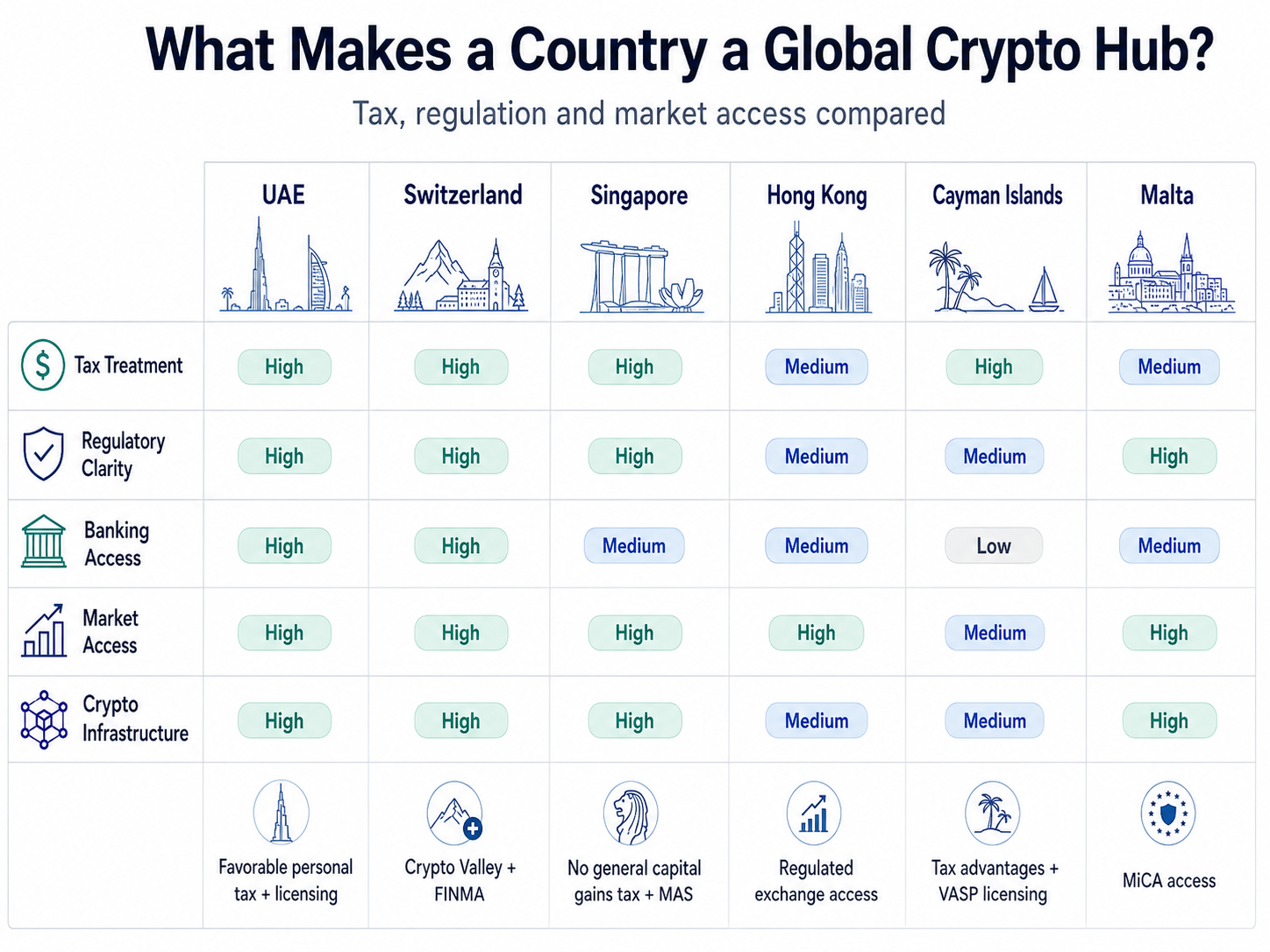
What Makes Certain Countries Global Crypto Hubs?
A crypto hub needs more than low crypto taxes. The strongest crypto-friendly jurisdictions combine several parts of the digital-asset economy in one regulatory environment.
The main factors are:
| Factor |
Why It Matters |
| Tax treatment |
Determines whether cryptocurrency gains, income and business profits are taxed |
| Regulatory clarity |
Gives investors and crypto companies clearer legal obligations |
| Licensing |
Determines which exchanges, custodians and digital asset businesses may operate |
| Banking access |
Makes fiat deposits, withdrawals, payroll and corporate operations easier |
| Market access |
Determines which investors can use exchanges, tokens and regulated services |
| Infrastructure |
Includes blockchain startups, funds, developers, custody and institutional services |
| Investor protection |
Licensing, custody and disclosure rules can reduce certain operational risks |
| Political stability |
Helps businesses assess whether regulations and tax rules are likely to remain predictable |
This distinction matters because a crypto tax-free jurisdiction can still have weak banking access or limited licensed exchanges. Conversely, a country with some crypto taxes may become a larger crypto hub because its legal and financial infrastructure makes businesses operating there easier to scale.
The mechanics of taxable disposals, cost basis and different approaches to crypto capital gains tax are therefore only one part of the comparison.
UAE: A Crypto-Friendly Country Combining Tax and Market Access
The United Arab Emirates has become one of the clearest examples of governments competing for digital asset capital through tax policy, regulation and market infrastructure.
For natural persons, UAE corporate tax rules exclude qualifying personal investment income from the scope of business activity. The Federal Tax Authority also states that individuals are not subject to UAE corporate tax on capital gains and other income earned from securities held in their personal capacity. This creates an unusually favorable tax perspective for qualifying personal investment, although crypto entrepreneurs carrying on a business activity must consider separate corporate-tax rules.
Dubai adds a dedicated virtual-asset regulatory layer. Its Virtual Assets Regulatory Authority, or VARA, requires firms conducting regulated virtual asset activities in or from Dubai outside the DIFC to obtain the appropriate authorization. Exchange, custody, broker-dealer, lending, management and transfer activities are among the regulated categories.
The market is already substantial. Chainalysis reported that the UAE received more than $30 billion in crypto between July 2023 and June 2024, while activity grew across different transaction-size categories.
That combination of zero personal income tax, specialized regulation, licensed crypto exchanges, free zones and institutional infrastructure gives the UAE a stronger claim to crypto-hub status than tax benefits alone. Dubai’s regulatory development can also be viewed within the global virtual asset regulatory landscape.
Switzerland: Crypto Valley, FINMA and Private Crypto Investments
Switzerland remains one of Europe’s most established crypto-friendly countries because regulation, capital markets and blockchain infrastructure developed alongside each other.
Zug and the surrounding region became known as Crypto Valley, attracting blockchain startups, foundations, protocol developers and digital asset companies. At the federal level, FINMA provides established regulatory paths for activities including fintech services and DLT trading facilities. In January 2026, FINMA also issued specific guidance addressing custody risks for crypto-based assets, reflecting the deeper integration of crypto services into Switzerland’s regulated financial sector.
Tax treatment is favorable for many private investors, but the common claim that Switzerland simply provides a “0% crypto tax after one year” is misleading. Private capital gains can generally be exempt from income tax when the activity remains private asset management; professional trading can instead generate taxable income. Crypto holdings can also be subject to cantonal wealth tax.
For long-term investors, this distinction can be more useful than a fixed holding-period exemption because classification depends on the nature of the activity rather than one universal one-year rule.
Singapore: Clear Regulation Without a General Capital Gains Tax
Singapore combines a mature financial system with structured crypto regulation and favorable treatment of genuine capital gains.
Singapore does not impose a general capital gains tax. The Inland Revenue Authority of Singapore states that profits or losses from financial instruments, including digital tokens, are generally treated as personal investments for individuals. For businesses, however, crypto bought and sold in the ordinary course of trading can generate taxable income. Purpose, transaction frequency and holding period can influence whether cryptocurrency gains are capital or revenue in nature.
That means Singapore can be highly attractive for personal crypto investments without being universally “crypto tax free.”
Its strength as a crypto hub also comes from financial infrastructure and regulated market access. This illustrates a wider pattern among the most crypto friendly countries: low capital gains tax can attract investors, but regulatory certainty and connectivity to conventional finance attract crypto businesses.
Hong Kong: Market Access With No General Capital Gains Tax
Hong Kong has rebuilt its digital-asset market around regulated access. Centralized virtual asset trading platforms operating in Hong Kong or actively marketing to Hong Kong investors must be licensed by the Securities and Futures Commission under the applicable regimes.
Hong Kong does not impose a general capital gains tax. Profits arising from the sale of capital assets are excluded from profits tax, while income generated through a trade, profession or business can be taxable. Classification therefore depends on the facts rather than the label “crypto.”
The regulatory environment has continued to develop. The Stablecoins Ordinance took effect on August 1, 2025, creating another regulated layer around digital assets.
For crypto investors, Hong Kong therefore sits between a tax-efficient investment jurisdiction and a tightly supervised financial centre. Active trading activity may receive different tax treatment from passive holding.
Cayman Islands: From Crypto Tax Haven to Licensed Crypto Jurisdiction
The Cayman Islands are often grouped with crypto tax havens because the jurisdiction is known for an absence of direct personal income and capital gains taxes. But the more important development for the crypto space is increasingly regulation rather than tax.
The Cayman Islands Monetary Authority supervises virtual asset service providers under the Virtual Asset (Service Providers) framework. From April 1, 2025, businesses providing virtual asset custody or trading-platform services in or from the Cayman Islands became subject to a licensing regime.
CIMA reported 19 registered VASPs as of July 31, 2025 and applies AML, counter-terrorist-financing and sanctions supervision to the sector.
This is an important distinction: the Cayman Islands are not attractive solely because someone may significantly reduce direct tax exposure. Crypto companies increasingly encounter formal licensing, governance and compliance requirements.
Other jurisdictions where personal crypto gains can receive unusually favorable treatment are compared in countries with no crypto capital gains tax.
Malta, Bermuda and the European Union: Crypto-Friendly Jurisdictions Built Around Rules
Malta’s earlier crypto-friendly reputation has evolved into a broader European regulatory position. The Malta Financial Services Authority now supervises crypto-asset service providers under the EU Markets in Crypto-Assets framework, and businesses seeking authorization to provide regulated crypto services must complete the CASP authorization process.
MiCA gives authorized businesses a much more standardized route into the European Union, but it also means a crypto-friendly jurisdiction can be attractive because it has more regulation rather than less.
The European Blockchain Sandbox reinforces that approach. The European Commission designed the program to support 20 blockchain projects annually, pairing selected projects with national and EU regulators to work through regulatory questions.
Bermuda follows a different model. The Bermuda Monetary Authority administers the Digital Asset Business Act 2018 and provides Test, Modified and Full digital-asset-business licences for regulated activities.
Both examples show why “crypto friendly” should not be treated as another phrase for “no regulation.”
Germany and Thailand Show How Tax Rules Can Shape Crypto Activity
Germany demonstrates how holding periods can affect cryptocurrency taxation. German Federal Ministry of Finance guidance confirms that certain private crypto sales may become non-taxable after the relevant one-year holding period under the private-sale rules.
Thailand provides an even clearer example of tax policy being used to influence market structure. A five-year personal income tax exemption applies to qualifying capital gains from digital assets for the period January 1, 2025 through December 31, 2029, but the exemption is tied to transactions conducted through licensed Thai platforms.
That condition matters. Thailand is not merely lowering crypto taxes; it is using a tax advantage to direct crypto transactions toward regulated market infrastructure. It illustrates how governments can combine tax incentives with investor protection and licensing requirements when trying to become regional crypto hubs.
Comparing the Top Crypto-Friendly Countries
| Jurisdiction |
Personal Crypto Tax Position |
Regulatory Strength |
Market / Business Access |
Main Advantage |
| UAE |
Very favorable for qualifying personal investment |
Strong, activity-based |
High |
Tax + licensing + market growth |
| Switzerland |
Private capital gains generally exempt; wealth tax may apply |
Strong |
High |
Crypto Valley + financial infrastructure |
| Singapore |
No general capital gains tax; trading income may be taxable |
Strong |
High |
Asian financial-market access |
| Hong Kong |
Capital gains generally not taxed; business trading may be |
Strong |
High |
Regulated investor access |
| Cayman Islands |
Highly favorable direct-tax environment |
Dedicated VASP regime |
Medium–High |
Funds and digital asset businesses |
| Malta |
Tax treatment depends on activity and status |
Strong under MiCA |
High across EU/EEA |
European regulatory passporting |
| Bermuda |
Favorable tax environment with business-specific considerations |
Dedicated DABA regime |
Medium |
Structured digital-asset licensing |
| Germany |
Private disposals can be tax-free after required holding period |
Strong |
High |
Clear long-term holding treatment |
The table also shows why there is no single “best country” from every perspective. A tax resident holding crypto personally has different priorities from an exchange, hedge fund, blockchain startup or professional trader.
For example, a trader comparing Bitcoin liquidity across jurisdictions may use a live BTC/USDT spot market on an exchange like Gate to observe price depth and trading activity, but exchange availability and permitted products still depend on the trader’s jurisdiction and the entity serving that market.
Tax Advantages Are Becoming More Transparent, Not More Anonymous
The old idea of a crypto tax haven based primarily on offshore opacity is becoming less relevant.
The OECD’s Crypto-Asset Reporting Framework (CARF) is designed for standardized collection and automatic exchange of tax information on crypto-asset transactions. As of 2026, 76 jurisdictions had formally committed to CARF implementation, with most preparing for automatic exchanges beginning in 2027.
This means low crypto taxes do not imply low tax transparency. A tax resident may owe no capital gains taxes on a particular transaction yet still face reporting, recordkeeping or information-sharing requirements.
The United States illustrates the broader move toward regulatory clarity as well. The GENIUS Act should no longer be described as a proposal “aiming” to clarify the market by 2026: it became Public Law 119-27 on July 18, 2025, establishing a federal framework for payment stablecoins.
How to Choose Between Crypto-Friendly Countries
Crypto investors and crypto entrepreneurs should evaluate relevant jurisdictions in a fixed order rather than looking only at the headline tax rate.
First, determine tax residency. A country having no capital gains tax does not automatically remove liabilities created by residence, citizenship or another jurisdiction’s tax rules.
Second, classify the activity. Holding crypto as a personal investment can receive very different tax treatment from mining, staking, running a crypto business or trading cryptocurrencies professionally.
Third, verify market access. Check whether regulated crypto exchanges can legally serve residents, whether required crypto assets are available and whether banks support transfers involving digital asset businesses.
Fourth, inspect licensing and investor protection. Exchange licensing, custody standards, capital requirements and AML controls matter when evaluating counterparty and regulatory risks. A broader checklist for assessing a venue includes verifying the entity, regulatory disclosures and withdrawal controls rather than relying solely on trading volume.
Finally, consider stability. Tax advantages can be temporary, as Thailand’s 2025–2029 exemption demonstrates. Political stability, regulatory clarity and a durable business environment can matter more than a short-lived low tax rate.
Risks and Limitations of Choosing a Crypto Hub
No country is universally crypto friendly for every investor or business.
Tax authorities can distinguish long-term investment from professional or business activity, meaning frequent trading crypto transactions may lose favorable personal tax treatment. Corporate tax, VAT/GST, wealth tax, staking income, mining income and payroll obligations can also remain relevant even where capital gains are exempt.
Regulations change independently of tax rules. Licensed exchanges may restrict particular tokens or products, while banking relationships can change even when the underlying crypto activity remains legal.
Cross-border investors face another layer of complexity because tax residency, source-of-income rules and reporting frameworks can connect more than one jurisdiction to the same crypto investments. The vast majority of international investors therefore cannot determine their final liability simply from a country-level capital gains rate.
Conclusion
The strongest global crypto hubs are increasingly jurisdictions that combine tax competitiveness with regulatory clarity, market access and financial infrastructure. The UAE offers perhaps the clearest all-round combination; Switzerland remains deeply established through Crypto Valley and its regulated financial system; Singapore and Hong Kong provide strong Asian market access; while the Cayman Islands, Malta and Bermuda have developed specialized frameworks for digital asset businesses.
For long-term investors, favorable capital gains treatment can matter substantially. For crypto companies and active traders, licensing, banking, compliance costs and legal certainty can matter even more. A low tax regime is therefore best treated as one part of a wider jurisdictional assessment, not as a standalone reason to move assets, establish a company or become tax resident.
FAQ
Which country is the most crypto friendly?
There is no universally most crypto-friendly country. The UAE scores strongly across personal tax treatment, licensing, market access and digital asset infrastructure, while Switzerland, Singapore and Hong Kong offer different combinations of tax advantages and regulatory certainty.
Which countries have no capital gains tax on crypto?
Singapore generally does not impose capital gains tax, while Hong Kong excludes genuine capital gains from profits tax. Switzerland generally exempts private capital gains, and the UAE provides favorable treatment for qualifying personal investment. Classification and tax residency remain important.
Are the Cayman Islands crypto tax free?
The Cayman Islands have a highly favorable direct-tax environment, but crypto businesses are not regulation free. Custodians and virtual asset trading platforms operating in or from the jurisdiction are subject to CIMA licensing requirements.
Is Switzerland better than Germany for long-term crypto investors?
Their systems work differently. Switzerland generally exempts genuine private capital gains but imposes cantonal wealth tax, while Germany can treat qualifying private crypto disposals as non-taxable after the applicable one-year holding period. Individual circumstances can change the result.
Does Singapore tax cryptocurrency trading?
Singapore does not impose a general capital gains tax, but profits can be taxable when crypto activity is classified as trading or business income. IRAS considers factors such as purpose, frequency and holding period.
Does being in a crypto tax haven prevent tax reporting?
No. Tax liability and tax reporting are separate issues. The OECD Crypto-Asset Reporting Framework is expanding automatic information exchange between participating tax authorities, so a low-tax jurisdiction should not be assumed to provide anonymity.
Disclaimer
Cryptocurrency taxation depends on residence, activity, asset classification and individual circumstances, while regulations can change. Consult qualified tax or legal professionals in the relevant jurisdictions before making cross-border investment or business decisions.







