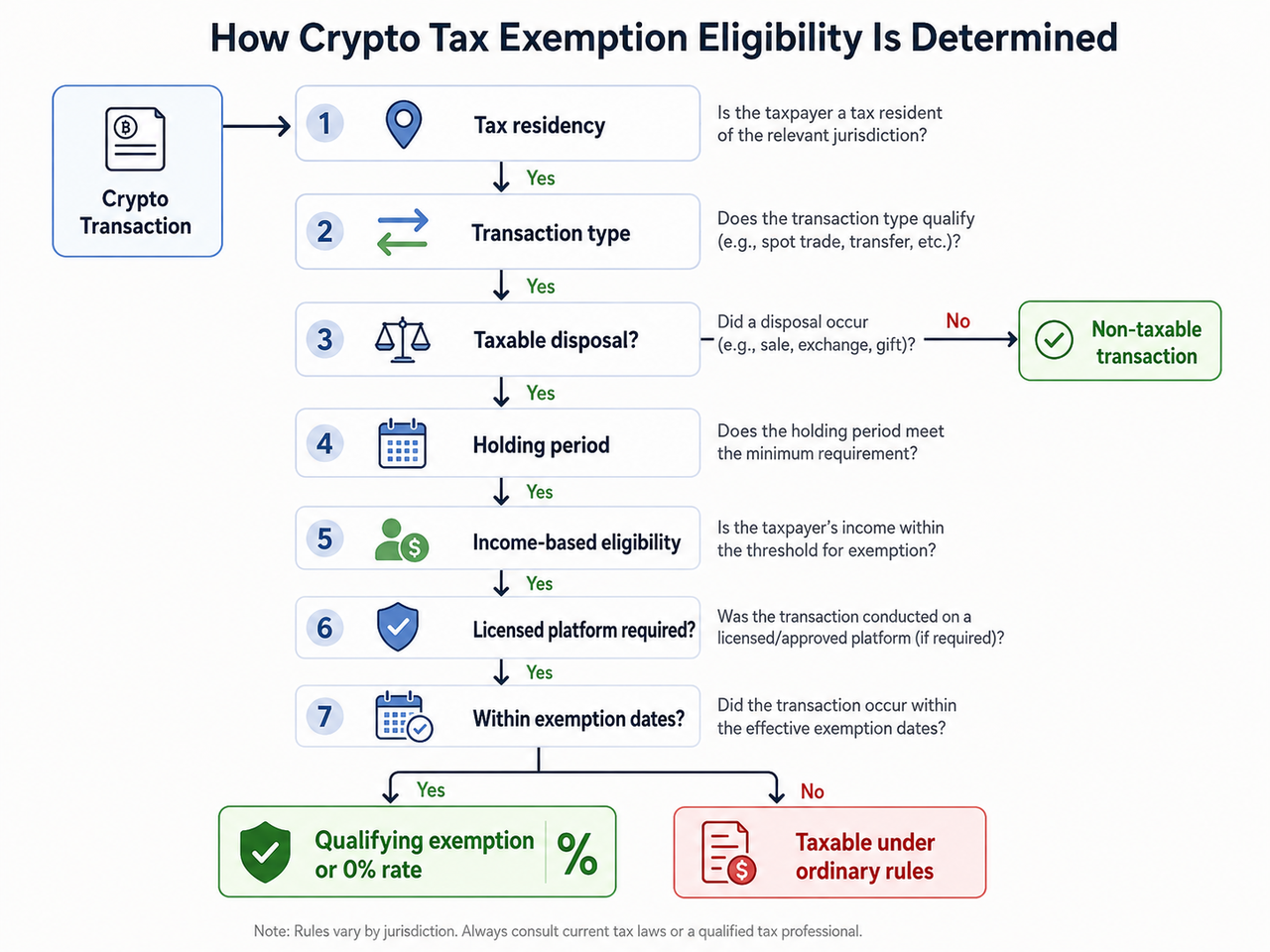
Crypto tax exemptions apply when specific legal conditions are met, such as a qualifying transaction, holding period, income level, account structure, residency status, or licensed trading channel. A crypto profit is not automatically tax-free, and eligibility can differ substantially between capital gains, mining or staking income, gifts, charitable contributions, and other crypto transactions.
The key is determining which activities qualify, what eligibility requirements apply, and how long an exemption remains available. For investors, traders, miners, stakers, and people receiving digital assets, this means examining residency rules, taxable events, holding periods, income thresholds, licensed-platform requirements, reporting obligations, and temporary versus permanent exemptions before assuming that a transaction receives favorable tax treatment.
Key Takeaways
A crypto tax exemption may come from a specific transaction rule, a 0% capital gains tax rate, a tax-advantaged account, a charitable contribution, or a jurisdiction-specific exemption.
Buying cryptocurrency with fiat and simply holding it are generally not taxable events in the United States, but selling, swapping, or spending crypto can create a capital gain or loss.
U.S. digital assets held for more than one year may qualify for long-term capital gains treatment. For tax year 2026, the 0% federal rate extends to taxable income of up to $49,450 for most single filers.
Thailand provides a temporary personal income tax exemption for qualifying crypto and digital-token capital gains from January 1, 2025 through December 31, 2029, but transactions must pass through specified licensed digital-asset businesses.
An exemption from tax does not necessarily remove cryptocurrency tax reporting or recordkeeping requirements.
How Crypto Tax Exemptions Work: Eligibility Comes Before the Tax Rate
A crypto tax exemption removes or reduces tax only when its legal conditions are satisfied. Those conditions can be based on who owns the crypto assets, how long they were held, where the taxpayer is resident, how the transaction occurred, or what happened to the assets.
That makes an exemption different from a transaction that never created taxable income in the first place. Under current U.S. rules, buying digital assets with U.S. dollars or another real currency and continuing to hold them does not by itself create a taxable event. Transferring crypto between wallets or accounts that you own is also generally non-taxable, although paying a transfer fee with crypto can itself constitute a digital-asset transaction.
By contrast, selling cryptocurrency for fiat, exchanging cryptocurrency for another digital asset, or using crypto to purchase goods or services can create tax consequences. The basic crypto capital gains tax framework therefore starts with disposal value, cost basis, holding period, and the resulting gain or loss rather than assuming every movement of virtual currency is taxable.
Capital Gains and Long Term Capital Gains Eligibility
In the United States, cryptocurrency held for investment is generally treated as property rather than foreign currency. When a capital asset is sold or otherwise disposed of, capital gains are generally calculated from the fair market value received minus the asset's adjusted cost basis.
The holding period then matters. A digital asset held for one year or less generally generates a short-term capital gain or loss when disposed of. An asset held for more than one year can generate a long-term capital gain or loss.
This distinction can produce a 0% federal long-term capital gains rate for some taxpayers, but it is an income-based rate rather than a special crypto exemption. For the 2026 tax year, the maximum taxable-income amount within the 0% capital-gains bracket is $49,450 for most single filers, $98,900 for married couples filing jointly, and $66,200 for heads of household. The often-cited $48,350 single-filer threshold applies to 2025, not 2026.
A taxpayer therefore cannot assume that holding Bitcoin for 12 months automatically eliminates capital gains tax. Total taxable income and filing status still determine how much long-term gain falls into the 0%, 15%, or potentially higher applicable rate bands.
Fair Market Value and Tax Treatment of Digital Assets
Fair market value connects the acquisition, receipt, and disposal sides of crypto tax reporting. The IRS generally requires values to be measured in U.S. dollars when cryptocurrency transactions create taxable income or a capital gain or loss.
For example, suppose an investor purchases BTC for $20,000 and eventually sells it for $28,000. Ignoring fees and other basis adjustments, the potential capital gain is $8,000. Whether that gain receives short-term, long-term, 0% rate, or another tax treatment depends on the holding period and the taxpayer's circumstances.
Transaction records should therefore preserve the purchase price, acquisition date, disposal date, units transferred, transaction information, cost basis, and fair market value. A contemporaneous BTC/USDT market chart can help reconstruct market context, while the actual transaction record remains the primary evidence needed for tax purposes.
This becomes especially important when trades span several cryptocurrency exchanges. Different inventory-selection and crypto tax accounting methods can affect which units and cost basis are assigned to a disposal, subject to the tax rules applicable in the taxpayer's jurisdiction.
Licensed Crypto Exchange Tax Exemption: Thailand Case Study
Thailand demonstrates how zero crypto tax eligibility can depend on the trading channel rather than simply the asset being traded.
Ministerial Regulation No. 399 was published in Thailand's Royal Gazette on September 5, 2025. It provides a personal income tax exemption for qualifying capital gains from transfers of cryptocurrency or digital tokens from January 1, 2025 through December 31, 2029.
The licensed-platform requirement is central. Qualifying transfers must occur through a digital asset exchange, licensed digital asset broker, or licensed digital asset dealer operating under the applicable Thai digital-asset laws. A transaction does not qualify merely because the same cryptocurrency could also be traded on an offshore or unlicensed crypto platform.
Requirement
Thailand's 2025–2029 Rule
Covered asset
Cryptocurrency or digital tokens
Tax benefit
Personal income tax exemption on qualifying capital gains
Start
January 1, 2025
End
December 31, 2029
Trading requirement
Qualifying licensed exchange, broker, or dealer
Automatic for every crypto activity?
No
The rule illustrates three separate eligibility tests: transaction type, licensed platform, and time period. Mining, staking rewards, payments for services, offshore activity, or another form of crypto income should not automatically be treated as exempt merely because Thailand provides favorable tax treatment for qualifying trades.
Thailand's broader digital-asset regulatory framework also shows why licensing can become part of tax policy: governments can use tax incentives to direct crypto transactions toward supervised operators.
Gifting Crypto and Charitable Organization Tax Treatment
Gifting crypto is another area where “tax-free” can be misunderstood. In the United States, transferring appreciated cryptocurrency as a bona fide gift generally does not make the giver recognize the embedded capital gain at the time of the gift. The recipient generally does not recognize ordinary income merely for receiving the gift, although basis rules can affect the eventual gain or loss when the recipient sells it.
For 2026, the federal annual gift-tax exclusion remains $19,000 per recipient. Going above that amount does not necessarily mean the giver immediately owes taxes; it can instead create Form 709 reporting and interact with the lifetime estate-and-gift tax exemption.
Charitable contributions can create different tax benefits. Donating cryptocurrency to a qualifying charitable organization may support a charitable deduction when the applicable requirements are satisfied. Larger noncash donations carry documentation requirements, and the IRS has specifically stated that a qualified appraisal is generally required when a cryptocurrency charitable deduction exceeds $5,000.
Crypto Assets in Tax-Deferred Accounts
Tax-advantaged accounts are better understood as account-level tax treatment, not a blanket crypto tax exemption.
In a traditional IRA, investment earnings and gains generally are not taxed while they remain inside the account; taxation is generally deferred until distributions. Roth IRA earnings also remain untaxed inside the account, while qualified Roth distributions can be tax-free if statutory requirements are met.
This does not mean any brokerage account holding crypto automatically receives tax-deferred treatment. The account must itself qualify under the relevant tax laws, and custody, prohibited-transaction, contribution, and distribution rules can materially affect the outcome.
What Crypto Transactions Are Not Exempt for Tax Purposes?
The United States has no general exemption that makes cryptocurrency profits tax-free simply because the asset is digital. The IRS treats digital assets as property for federal tax purposes, and longstanding tax principles generally apply to cryptocurrency transactions.
Receiving cryptocurrency as payment for performing services generally creates ordinary income measured at fair market value when received. For an independent contractor, that amount can also constitute self-employment income subject to self-employment tax. Crypto paid as wages can be subject to federal income tax withholding and employment taxes.
Mining rewards and staking rewards can likewise create taxable income upon receipt or when the taxpayer obtains dominion and control, depending on the activity and facts. Selling those crypto assets later can create a second calculation—a capital gain or loss measured from the established basis.
Capital losses can offset capital gains. Under current U.S. general capital-loss rules, if losses exceed gains, an individual can generally deduct up to $3,000 of excess net capital loss against other income, with additional qualifying losses carried forward.
The treatment of theft, scams, casualty losses, worthless crypto, and similar losses is more restrictive and fact-specific. They should not be treated as a universal crypto tax deduction or exemption.
Cryptocurrency Tax Reporting Still Matters
A 0% rate or exemption does not automatically eliminate transaction reporting.
For U.S. federal returns, taxpayers generally report disposals of digital assets held as capital assets using Form 8949, with capital gains and deductible capital losses summarized on Schedule D. Income from staking, mining, and similar activities can require different tax forms.
Form 1099-DA reporting began for broker transactions effected on or after January 1, 2025. Broker reporting is being phased in: gross proceeds reporting began with 2025 transactions, while basis reporting applies to certain transactions from 2026. A taxpayer must still report required digital-asset income, gains, and losses even if no Form 1099-DA is received.
As transaction reporting expands internationally, the Crypto-Asset Reporting Framework also illustrates the broader movement toward standardized exchange and transaction information rather than anonymous tax treatment.
Risks and Limitations of Crypto Tax Exemptions
The largest risk is assuming that “tax-free crypto” applies more broadly than the law allows. Residency can change which tax laws apply, a licensed crypto platform requirement can exclude otherwise identical transactions, and temporary exemptions can expire.
Tax status can also change according to the activity. Buying and holding an asset may be non-taxable, receiving the same asset for performing services can create taxable income, and eventually selling it can produce a capital gain or loss.
Countries also structure exemptions differently. Some impose no general personal capital gains tax, while others exempt only particular assets, taxpayers, holding periods, or regulated transactions. The distinction between countries with no crypto capital gains tax and conditional exemptions is therefore fundamental, while global crypto hubs can combine tax incentives with licensing, banking access, reporting, and other regulatory requirements.
Conclusion
Crypto tax exemptions work through defined legal conditions rather than through a universal rule for digital assets. Eligibility may depend on tax residency, income, holding period, transaction type, charitable use, account structure, platform licensing, or an exemption's effective dates.
For investors and traders, the strongest approach is to separate non-taxable transactions, 0% tax rates, tax deferral, deductions, and true statutory exemptions rather than treating them as interchangeable. Thailand's licensed-platform exemption demonstrates how narrowly a tax incentive can be designed, while U.S. rules show that even a 0% long-term capital gains rate can still require cost-basis calculations and cryptocurrency tax reporting.
FAQ
Is buying cryptocurrency tax-free?
Buying cryptocurrency with fiat currency and holding it generally does not create a taxable event under U.S. federal rules. Tax consequences can arise later when the crypto is sold, exchanged, spent, or otherwise disposed of.
Can I pay zero capital gains tax if I hold crypto for more than one year?
Possibly, but a holding period of more than one year only establishes potential long-term capital gains treatment. For 2026, a single U.S. filer can fall within the 0% long-term capital gains bracket when taxable income remains within the applicable $49,450 threshold; other filing statuses have different limits.
Is gifting cryptocurrency taxable?
A bona fide crypto gift generally does not trigger capital gain to the donor merely because the asset is transferred, and the recipient generally does not recognize income simply upon receipt. Gift-tax reporting rules can still apply, including the $19,000 annual exclusion per recipient for 2026.
Are crypto donations tax deductible?
A qualifying cryptocurrency donation to an eligible charitable organization may support a charitable deduction, subject to applicable limits and documentation. A qualified appraisal is generally required when claiming a cryptocurrency charitable contribution deduction above $5,000.
Does Thailand have zero crypto capital gains tax?
Thailand currently exempts qualifying personal income tax on cryptocurrency and digital-token capital gains from January 1, 2025 through December 31, 2029. Transactions must satisfy the rule's licensed exchange, broker, or dealer requirement; the exemption is not a blanket exemption for every crypto activity or platform.
Do I report crypto if I did not receive Form 1099-DA?
Yes. U.S. taxpayers must report required digital-asset income, gains, and losses even when they do not receive Form 1099-DA or another information return.
Disclaimer:This content is for educational purposes only and does not constitute tax, legal, accounting, or investment advice. Cryptocurrency tax treatment depends on jurisdiction and individual circumstances, and laws, thresholds, exemptions, and reporting requirements can change. Consult a qualified tax professional or relevant tax authority before making tax-related investment decisions.
Author: Jared
Disclaimer
* The information is not intended to be and does not constitute financial advice or any other recommendation of any sort offered or endorsed by Gate.
* This article may not be reproduced, transmitted or copied without referencing Gate. Contravention is an infringement of Copyright Act and may be subject to legal action.
Stablecoins were originally designed as dollar substitutes within exchanges, primarily used for asset pricing and trade settlement. As on-chain financial ecosystems have matured, their role has expanded beyond simple payments to include collateral assets, cross-chain liquidity mediums, and unified settlement units. In particular, as AI systems and automated agents begin to participate directly in economic activity, demand has risen sharply for programmable value units capable of instant settlement. This shift is pushing stablecoins toward the role of foundational financial infrastructure.
PAXG (Pax Gold) is a tokenized asset backed by physical gold, issued by the fintech company Paxos and traded on the Ethereum blockchain as an ERC-20 token. The core concept is to tokenize physical gold on-chain, with each PAXG token representing ownership of a certain amount of gold. This structure enables investors to hold and trade gold in the form of a digital asset.
In the competition for DeFi liquidity, high-inflation mining alone is no longer enough to build lasting advantages. Aerodrome applies the ve(3,3) economic model to redesign token emissions, voting mechanisms, and revenue distribution, creating a liquidity flywheel centered on governance and cash flow. This article examines AERO tokenomics, the veAERO locking mechanism, and protocol revenue models to explain how Aerodrome builds a sustainable DeFi economic system.
PAXG (Pax Gold) is a tokenized asset backed by physical gold reserves, launched by fintech firm Paxos and issued as an ERC-20 token on the Ethereum blockchain. The core concept is to digitally represent real-world gold assets, allowing investors to hold and trade gold via the blockchain network. Because each PAXG token corresponds to a specific quantity of physical gold, its price is theoretically expected to closely track the global gold market.
AERO is the native token of Aerodrome Finance, a core decentralized exchange and liquidity protocol in the Base ecosystem. It is primarily used for liquidity incentives and ecosystem operations. veAERO is a governance NFT that users receive by locking AERO, representing both voting power and the right to share protocol revenue. Through a dual track structure of AERO as a utility token and veAERO as a governance credential, Aerodrome separates liquidity usage value from long term governance power, allowing participants to act as liquidity providers, governance decision makers, and revenue sharers within the same system.
In the early stages of the crypto market, traditional stablecoins mainly relied on single-reserve or single-collateral models. Their primary focus was price stability and payment convenience, which allowed them to become foundational tools for on-chain trading and capital flows. As the market has entered a more mature financial phase, however, this structure has begun to reveal limitations, including high concentration risk and the difficulty of balancing liquidity with yield. These constraints have driven the evolution toward multi-layer collateral and portfolio-based designs, such as the dual-layer hybrid collateral architecture proposed by United Stables, which seeks to redefine the underlying logic of stable assets.