For people using Bitcoin ATMs to buy or sell digital assets, the practical point is that there is no universal Bitcoin ATM KYC limit. The same customer can encounter different verification requirements, daily limits, and withdrawal limits at machines operated by different companies or located across a state or national border. Understanding those differences matters before arriving with cash, especially because cryptocurrency transactions sent to the wrong crypto wallet are generally difficult or impossible to reverse.
For people using Bitcoin ATMs to buy or sell digital assets, there is no universal Bitcoin ATM KYC limit. Verification requirements, daily limits, and withdrawal limits can change by operator, jurisdiction, transaction size, and customer risk. The sections ahead explain how Know Your Customer (KYC), anti-money laundering (AML) regulations, financial regulations, and operator security measures affect purchasing Bitcoin or using a kiosk to convert cash, helping operators ensure compliance, protect users, and reduce fraud.
Key Takeaways
-
Local regulations establish the baseline. Federal rules, state laws, provincial requirements, and national AML regimes can all affect customer verification and transaction limits.
-
Verification tiers often rise with transaction size. Phone verification may be sufficient at one level, while larger transactions can trigger government ID, document checks, or additional customer verification.
-
Operators can be stricter than the law. Internal risk controls, suspicious transaction monitoring, scam prevention, and source-of-funds concerns can produce tighter limits.
-
Fraud prevention increasingly affects daily limits. Regulators have focused particularly on cryptocurrency kiosk scams involving government impersonation and older users.
-
Bitcoin ATM withdrawal limits can also reflect cash availability. Two-way kiosks cannot dispense more physical cash than the operator can safely stock and manage.
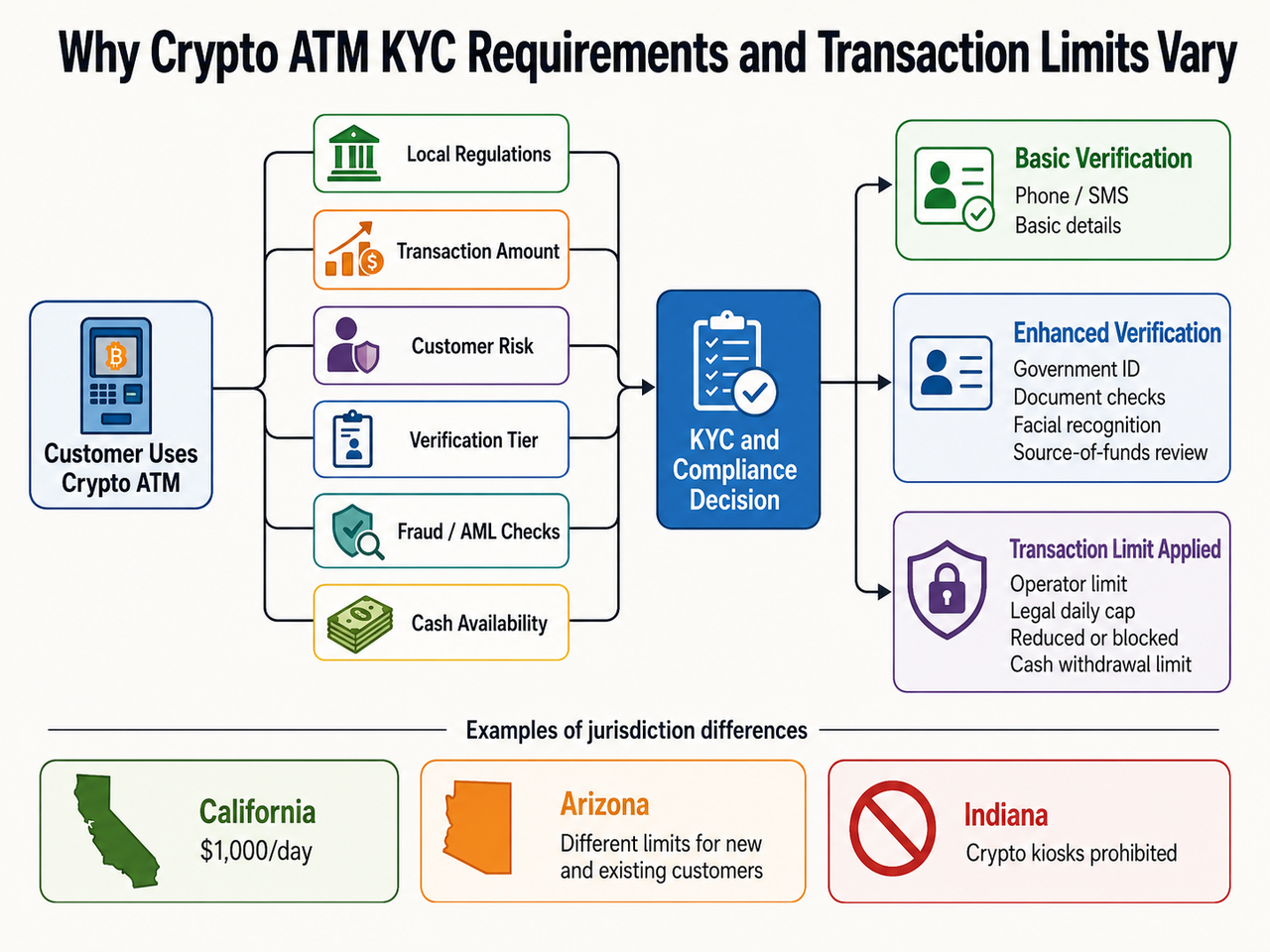
Why Do Crypto ATM KYC Requirements and Transaction Limits Vary?
There are four main variables: jurisdiction, customer risk, transaction size, and operator policy.
A regulator may prescribe specific identity verification or reporting obligations. The Bitcoin ATM operator then builds its own compliance system around those legal requirements. That system can divide customers into verification tiers based on factors such as transaction amount, whether they are new or existing customers, transaction patterns, wallet risk, or previous activity.
The distinction between regulation and operator policy is important. A legal threshold does not necessarily mean that every transaction below it can be conducted anonymously. An operator may require identity verification earlier because of its risk model, licensing obligations, banking relationships, fraud-prevention policy, or suspicious-activity controls.
This is part of the wider framework governing crypto ATM regulation, where money-transmission rules, licensing, consumer protection, AML requirements, and operational controls can overlap.
How Identity Verification at Bitcoin ATMs Works
A typical verification process starts before the machine sends Bitcoin to the wallet QR code supplied by the customer.
Depending on the operator and jurisdiction, the process may request:
-
a mobile number and SMS code;
-
name and date of birth;
-
residential or other identifying information;
-
a government-issued ID such as a driver's license or passport;
-
a photograph or selfie for identity matching;
-
additional information for higher-risk or larger transactions.
Some operators structure these steps as formal verification tiers. CoinFlip, for example, states that its U.S. customers can face progressively stronger checks as transaction size increases, moving from basic identifying information to government-issued photo ID and additional verification for higher tiers.
Bitcoin Depot similarly describes tiered KYC in which basic identifying information may support smaller purchases while government-issued identification and further checks apply as transaction size rises.
This explains why statements such as “Bitcoin ATMs require ID over $250” should not be treated as a universal rule. Specific operators can set low verification thresholds, but there is no worldwide $250 government-ID threshold applying to most Bitcoin ATMs. Requirements vary depending on operator policies and local regulations.
Why Larger Transactions Trigger Enhanced Verification
Increasing a transaction from a few hundred dollars to several thousand dollars changes the operator's exposure.
A larger cash transaction can justify more scrutiny of:
-
the customer's verified identity;
-
document authenticity;
-
the destination wallet;
-
unusual transaction patterns;
-
repeated transactions across several kiosks;
-
possible structuring intended to avoid thresholds;
-
source of funds;
-
potential scam indicators.
Enhanced verification may therefore involve more than scanning a driver's license. Depending on the compliance system, it can include facial recognition, manual review, additional customer questions, or escalation to a compliance team.
This risk-based approach also explains why an existing customer with a verified history may have different daily limits from someone completing a first Bitcoin ATM transaction.
Bitcoin ATM Operators Must Follow AML Rules
In the United States, a business accepting and transmitting convertible virtual currency can qualify as a money transmitter under the Bank Secrecy Act framework. FinCEN states that covered CVC money transmitters must register as Money Services Businesses and maintain AML programs, recordkeeping, monitoring, and reporting controls, including Suspicious Activity Reports and Currency Transaction Reports where applicable.
That federal layer does not eliminate state regulation. A Bitcoin ATM operator can therefore face federal anti-money laundering requirements plus separate state licensing, consumer-protection, fee, disclosure, refund, or transaction-limit rules.
The operational result is a compliance stack rather than one national Bitcoin ATM rule.
The same principle appears outside the United States. In Canada, businesses dealing in virtual currency can fall within the MSB framework and must register with FINTRAC when applicable. Canadian rules also contain specific identity-verification triggers; for example, FINTRAC states that identity must be verified when remitting virtual currency worth C$1,000 or more to a beneficiary.
That does not mean every Canadian Bitcoin ATM has exactly the same C$1,000 customer experience. Operator risk policies can still impose additional checks.
Bitcoin ATM Daily Limits Can Be Set by Law
One of the clearest reasons limits vary is that lawmakers have started setting kiosk-specific maximum amounts.
California illustrates the point. State rules prohibit a kiosk operator from accepting or dispensing more than $1,000 per customer per day, a limit effective from January 1, 2024. California regulators have subsequently taken enforcement action involving operators accused of exceeding that ceiling.
Arizona uses a different model. Under legislation signed in 2025, a cryptocurrency kiosk operator may accept no more than $2,000 per day from a new customer, while an existing customer may transact up to $10,500 per day through one or more kiosks, subject to the law's requirements. The same framework requires anti-fraud measures and blockchain analytics.
Indiana went much further. House Bill 1116 became law in March 2026 and prohibits the operation of virtual-currency kiosks in the state.
These three examples show why “Bitcoin ATM daily limits” cannot be answered with one number. A transaction acceptable under one state's rules may exceed another state's maximum amount or be unavailable because kiosks themselves are prohibited.
| Example |
Regulatory approach |
Practical effect |
| California |
$1,000 per customer per day |
Legal ceiling overrides a higher operator limit |
| Arizona |
$2,000 new customer; $10,500 existing customer per day |
Customer status directly affects the maximum |
| Indiana |
Cryptocurrency kiosks prohibited |
No kiosk transaction is permitted |
| Canada |
Federal MSB/KYC framework with defined verification triggers |
Identity checks depend on regulated activity and amount |
Operator Policies Can Create Tighter Daily Limits
The legal maximum is only one ceiling.
Bitcoin ATM operators also set limits based on their own compliance policies. A company may conclude that certain transaction amounts, transaction patterns, locations, or customer profiles create greater risk than it wants to accept.
For example, an operator might allow higher limits after full identity verification but maintain tighter limits for newly registered users. Another may require manual approval before larger transactions.
This is why publicly advertised Bitcoin ATM limits can range from relatively low amounts into several thousand dollars and, with sufficiently high verification, potentially higher levels. The actual maximum can vary depending on the operator, state, transaction direction, customer tier, and machine.
A kiosk screen or operator's current terms should therefore be treated as the relevant source for the specific transaction rather than assuming a limit found for another Bitcoin ATM network applies universally.
Transaction Monitoring Can Override a Customer's Nominal Limit
Completing KYC does not guarantee that every transaction below a stated daily maximum will be processed.
Modern AML programs also examine behavior.
Consider a verified customer who repeatedly purchases amounts just below an operator's internal threshold across several machines. Although each transaction may fall below the displayed maximum amount, the overall pattern can warrant additional review.
Operators may look for indicators including:
-
rapid repeated cash transactions;
-
sudden increases in transaction value;
-
multiple destination wallets;
-
wallets associated with suspicious activity;
-
unusual behavior for an existing customer;
-
attempts to divide a larger transaction into smaller ones.
The resulting action can include enhanced verification, a temporary limit, additional source-of-funds questions, rejection of the transaction, or escalation for regulatory reporting.
This is where KYC connects with crypto ATM transaction monitoring and AML compliance: verified identities are only one part of detecting suspicious transactions and reducing financial-crime exposure.
Fraud Prevention Is Driving Tighter Limits
Transaction limits increasingly serve a second function beyond traditional anti-money laundering controls: limiting how much a scam victim can lose before intervention becomes possible.
Crypto kiosks are particularly useful to scammers because a victim can convert physical cash into digital currency and send it directly to a wallet QR code provided by the criminal.
The FTC has described scams in which criminals impersonate banks, technology companies, or government officials, persuade victims that their money is in danger, and instruct them to withdraw cash and deposit it into a Bitcoin ATM. Once the victim scans the scammer's QR code, the cryptocurrency is transferred to a wallet controlled by the criminal.
Older users have been disproportionately affected. FTC data covering the first half of 2024 found that people aged 60 and older were more than three times as likely as younger adults to report losing money through a Bitcoin ATM, while more than two-thirds of reported dollars lost through these machines came from older adults.
FinCEN subsequently warned financial institutions in August 2025 about scam payments and other illicit activity involving convertible virtual currency kiosks, highlighting fraud, cybercrime, money laundering risk, and scams affecting older adults.
For operators and regulators, daily transaction limits can create friction at exactly the point where a scammer wants the victim to move a large amount quickly.
Why Identity Checks Alone Cannot Prevent Fraud
A scam victim can be completely genuine.
Their driver's license may be real. The phone verification may succeed. Facial recognition may match. The cash may come from their own bank account.
Yet the destination wallet can still belong to a scammer.
That is why effective fraud prevention goes beyond proving that the customer is who they claim to be. Operators increasingly combine identity checks with warning screens, transaction monitoring, blockchain wallet screening, customer-service intervention, cooling-off mechanisms, and limits for new customers.
This distinction matters for elderly users in particular. Stronger KYC identifies the sender; it does not automatically tell the operator whether that verified person is being manipulated by someone on the phone.
Australia's Cryptolink Suspension Shows Why Reporting Controls Matter
A recent Australian enforcement action provides a useful real-world example.
On August 10, 2026, AUSTRAC announced that it had suspended Cryptolink's registration for three months, preventing the company from operating its 96 crypto ATMs during the suspension. AUSTRAC cited continuing concerns about management of high-risk transactions and said the operator had failed to meet reporting obligations, particularly threshold transaction reporting.
The case demonstrates that regulatory compliance is not finished once a machine collects identification.
An operator must also maintain the systems behind the kiosk: customer risk assessment, transaction monitoring, required reporting, suspicious-activity controls, and responses to regulator requests. Failures at that level can affect whether an entire ATM network is allowed to continue operating.
Bitcoin ATM Withdrawal Limits Also Depend on Physical Cash
Compliance is not the only constraint.
Two-way Bitcoin ATMs that allow selling Bitcoin and withdrawing cash have a physical inventory problem that online exchanges do not. A machine can dispense only the notes loaded inside it.
Operators therefore have to consider:
-
how much cash a kiosk can physically hold;
-
how often cash is replenished or collected;
-
demand at the location;
-
theft and security risks;
-
insurance and cash-management costs;
-
expected buy-versus-sell activity.
A machine may consequently have a Bitcoin ATM withdrawal limit below the customer's KYC allowance.
For example, a fully verified user might technically qualify for a higher transaction tier but still be unable to withdraw that amount because the kiosk does not have enough cash available. Operator documentation also notes that purchase and cash-out limits can differ by machine and available liquidity.
A Practical Way to Read Bitcoin ATM KYC Limits
When using Bitcoin ATMs, treat the displayed limit as the result of several overlapping controls rather than a single KYC rule.
A useful sequence is:
Local legal maximum → operator maximum → verification tier → customer risk checks → transaction monitoring → machine cash availability
The lowest applicable constraint usually determines what can actually be completed.
A customer may therefore face a $1,000 legal limit even though the operator normally allows $5,000 elsewhere. In another location, the law may permit substantially more, but the operator could still set a lower limit for new customers. A fully verified customer attempting an unusual transaction may also be stopped even when the amount sits below both limits.
That is why crypto ATM KYC requirements and transaction limits vary so noticeably between machines.
Risks and Limitations
KYC reduces anonymity and gives operators verified identities they can associate with cryptocurrency transactions, but it does not eliminate money laundering, fraud, or criminal activity.
Identity documents can be misused. Fraud victims can willingly complete verification while following a scammer's instructions. A wallet can initially appear ordinary and later become associated with suspicious activity. Biometric data and government ID collection also create privacy and data-security responsibilities for operators.
Transaction limits have similar limitations. Tighter limits can reduce the size of an individual loss, but criminals may try to split transactions, use multiple victims, move between operators, or shift to other payment methods.
For legitimate customers, stricter limits can also make a convenient kiosk less practical for larger transactions. Operators and regulators therefore have to balance ease of access against financial-crime prevention and consumer protection.
Conclusion
Crypto ATM KYC requirements and transaction limits vary because there is no single global rule governing every kiosk. Local law establishes part of the framework, while transaction size, verification level, customer history, source-of-funds concerns, fraud indicators, operator policies, and physical cash availability can all change the amount a customer is permitted to buy or withdraw.
The most useful distinction is between legal limits and operational limits. A jurisdiction can impose a hard maximum, but Bitcoin ATM operators may choose tighter limits or stronger identity verification when their risk assessment demands it.
For anyone buying Bitcoin or selling crypto through a kiosk, the applicable limit should be checked at the specific operator and location. Completing KYC may qualify a customer for higher limits, but it does not override state regulations, transaction monitoring, fraud controls, or cash availability.
FAQ
Do all Bitcoin ATMs require identity verification?
Bitcoin ATM identity verification depends on the jurisdiction, operator, transaction amount, and account status. Some transactions may begin with phone verification and basic customer information, while larger transactions can require a government-issued ID or enhanced verification.
Why do Bitcoin ATM KYC limits increase after verification?
Higher verification tiers give an operator more information about the customer's identity and allow stronger customer due diligence. Operators may consequently permit higher limits, although legal transaction caps still apply.
Is there a universal amount at which a Bitcoin ATM requires government ID?
No. Claims that every Bitcoin ATM requires ID above a particular amount, such as $250, should not be treated as universal. Operator policies and legal requirements differ substantially; Canada, for example, has specific regulated identity-verification triggers tied to certain virtual-currency activities at C$1,000 or more.
Why are Bitcoin ATM daily limits different from withdrawal limits?
A daily transaction limit controls how much a customer can transact during a defined period. A withdrawal limit can also depend on whether a two-way ATM has enough physical cash available to complete a sale of Bitcoin for cash.
Can a Bitcoin ATM operator set limits below what the law allows?
Yes. A statutory limit is generally a ceiling, not an obligation to let every customer transact up to that amount. Operator policies can impose tighter limits based on KYC level, fraud prevention, transaction monitoring, customer risk, or operational considerations.
Why are new customers sometimes given tighter limits?
A new customer has little or no transaction history for the operator to assess. Lower initial limits can reduce exposure while identity verification, fraud screening, and customer behavior are established. Arizona's kiosk rules provide a clear legal example, with a $2,000 daily limit for new customers compared with $10,500 for existing customers.
Disclaimer
This content is provided for educational purposes only and does not constitute legal, financial, tax, or compliance advice. Crypto ATM rules differ by jurisdiction and can change. Users and operators should confirm current requirements with the relevant regulator and service provider.