For compliance teams, crypto ATM businesses and users trying to understand why a machine asks for additional information, the important point is that AML doesn't end after customer identification. Effective controls follow the transaction from cash input to destination wallet and continue through ongoing monitoring. The exact requirements still vary by jurisdiction, operator and transaction type.
Key Takeaways
-
Customer identification and customer due diligence establish who is using the crypto ATM and what activity would normally make sense for that customer.
-
Crypto ATM transaction monitoring searches for patterns such as multiple smaller transactions, rapid increases in volume, activity across multiple ATMs and transfers involving high-risk wallets.
-
Blockchain analytics adds wallet-level information, including potential exposure to scams, sanctioned entities, darknet markets and other illicit activity.
-
Enhanced due diligence, transaction limits and scam warnings provide additional controls when a customer or transaction is high risk.
-
Suspicious activity can require further review and regulatory reporting, but an AML alert by itself doesn't prove money laundering.
Why AML Compliance Matters for Crypto ATMs
Crypto ATMs connect physical cash with digital assets. A customer can insert fiat currency, provide a wallet address and receive cryptocurrency without first moving money through a conventional bank account. That makes the machines useful for legitimate cash-to-crypto access, but it also creates a distinct financial crime problem.
Cash can provide limited transaction context, while virtual assets can move rapidly through multiple wallets after leaving a machine. A bad actor may try to exploit that combination for money laundering, fraud, sanctions evasion or terrorism financing.
The regulatory framework for crypto ATMs therefore goes beyond whether a machine is legally installed. Operators may face licensing requirements, customer due diligence, recordkeeping, transaction monitoring and reporting obligations depending on the jurisdiction.
In the United States, FinCEN treats businesses accepting and transmitting convertible virtual currency as money transmitters when the relevant regulatory definition is met. Such businesses generally need to register as a money services business (MSB) and comply with applicable Bank Secrecy Act requirements, including an AML program, reporting and recordkeeping. FinCEN specifically warned in August 2025 that failure by convertible virtual currency kiosk operators to meet BSA obligations increases the risk that machines will be used for scams and other illicit activity.
The broader principles are familiar across the crypto industry. Anti-money laundering controls combine identification, risk assessment, monitoring and internal controls rather than relying on one verification step.
Customer Identification Starts the Bitcoin ATM AML Process
Customer identification establishes who is transacting, but it doesn't establish whether the transaction itself is legitimate.
Crypto ATM operators can use tiered Know Your Customer procedures built into the kiosk or connected compliance system. Depending on regulatory requirements, risk and transaction amount, new customers may be asked for a phone number, government-issued identification, facial verification or other customer information before cryptocurrency is dispensed or sent.
Higher transaction tiers can require stronger checks.
This matters because some machines have historically allowed relatively large daily volumes, while current state rules increasingly impose much lower caps. For example, Colorado's 2025 Virtual Currency Kiosk Act established a $2,000 daily transaction limit. Operator limits can therefore differ substantially from one jurisdiction to another.
Customer identification is only the first layer. Someone can provide valid identification and still be engaged in suspicious activity. Alternatively, an older customer may be fully verified but unknowingly following instructions from a scammer.
That is where customer due diligence becomes more important.
Customer Due Diligence Creates a Risk Profile
Customer due diligence asks what level of activity reasonably fits the customer.
Operators can consider risk factors such as location, expected transaction volume, transaction history, source of funds and intended use. Business accounts may require additional checks around business activity and beneficial ownership where relevant rules apply.
The operator can then assign varying levels of risk.
Consider two customers. One purchases $200 of Bitcoin every few months. The other is a new customer who makes several large cash transactions in one day, visits multiple ATMs and sends funds to multiple wallets.
Both may have passed KYC. Their risk profiles aren't the same.
A risk-based approach allows operators to apply additional controls where exposure is higher instead of treating every transaction identically. KYC standards used across financial institutions follow the same broad logic: establish identity, understand customer activity and assess the money-laundering risk associated with the relationship.
Where the risk becomes significantly higher, the operator may move to enhanced due diligence.
How Crypto ATM Transaction Monitoring Detects Suspicious Activity
Crypto ATM transaction monitoring compares what a customer actually does with expected behavior, historical activity and predefined risk rules.
Automated systems can monitor transactions across customer accounts, locations and time periods rather than viewing every ATM visit in isolation.
Common red flags can include:
-
multiple smaller transactions that appear designed to avoid detection;
-
rapid increases in transaction volume;
-
activity spread across multiple ATMs;
-
repeated transactions from new customers;
-
multiple accounts associated with similar activity;
-
rapid movement through multiple wallets;
-
transactions lacking a clear economic rationale;
-
connections with high-risk jurisdictions;
-
wallets associated with sanctioned entities;
-
exposure to scams, criminal activities or darknet markets.
Structuring is a useful example. A customer who wants to send $12,000 may make six $2,000 transactions instead of one large transaction in an attempt to remain below a particular control or reporting threshold. Individually, those transactions may not appear remarkable. Together, they can create a behavioral signal.
The same applies to repeated cash activity. What matters is the pattern and the customer's profile, not simply whether one transaction crosses a fixed number.
An automated alert should generally lead to further review, not an automatic conclusion of financial crime. Legitimate customers can change wallets, make larger purchases or alter their transaction habits.
Blockchain Analytics Adds Wallet-Level Risk Screening
Traditional AML monitoring can show who used a machine and how much cash moved. Blockchain analytics adds information about where the digital assets are going.
Operators can screen a destination wallet address before completing a transaction and continue monitoring relevant blockchain activity afterward. Analytics systems may identify exposure to known scams, stolen assets, ransomware, sanctioned entities, darknet markets or other addresses associated with illicit activity.
Modern crypto transaction-monitoring systems can assess the risk of incoming and outgoing transfers and examine the source or destination of funds. That gives compliance teams another signal alongside customer information and cash behavior.
The difference between traditional account controls and crypto wallet blacklisting matters here because blockchain screening focuses on address exposure and transaction history rather than only an individual's conventional financial account.
Still, blockchain analytics isn't perfect. A risk score can reflect indirect exposure, incomplete attribution or assumptions about related addresses. It should support a decision, not replace human due diligence.
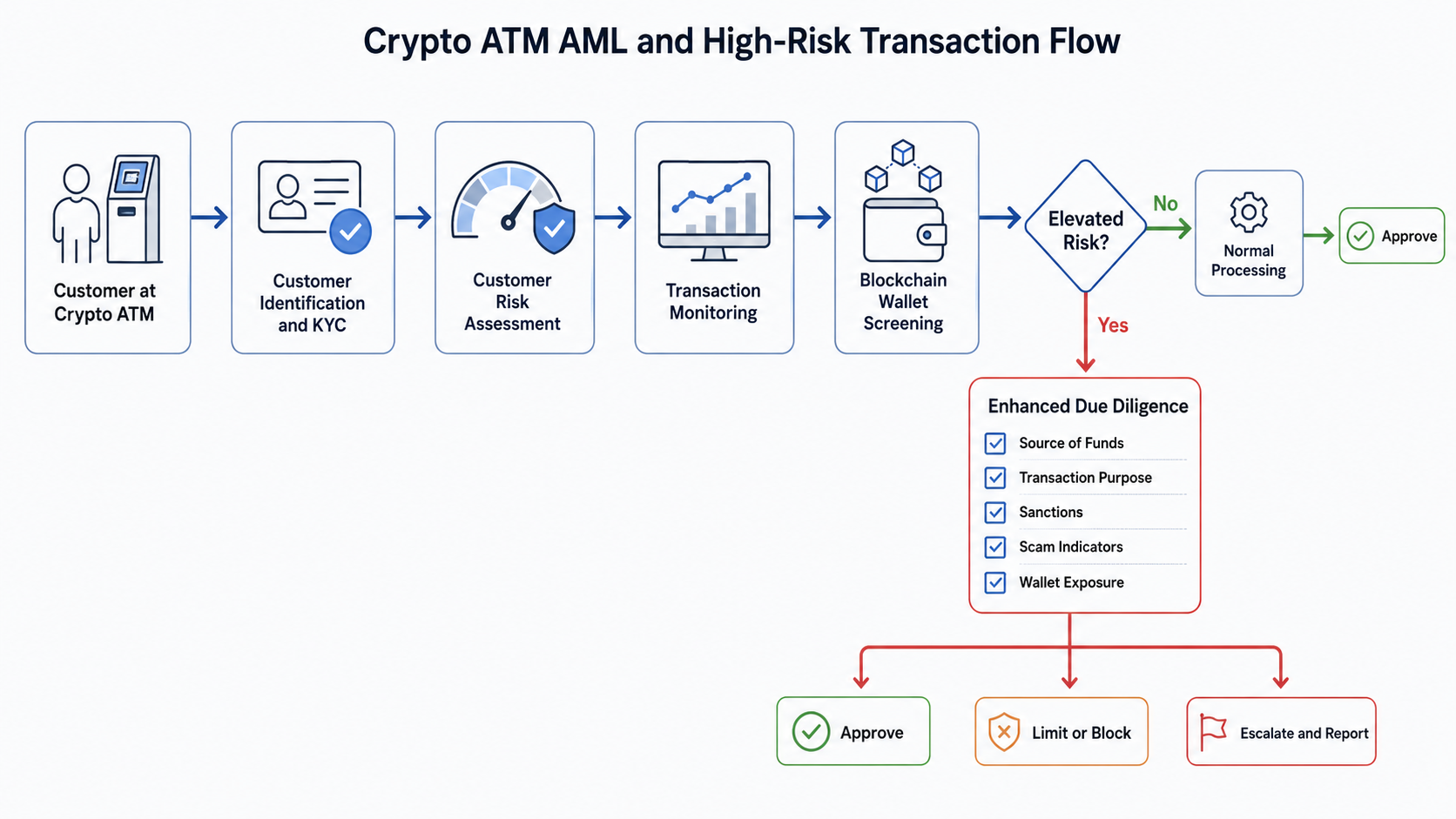
Enhanced Due Diligence for High-Risk Transactions
Enhanced due diligence applies additional scrutiny when ordinary KYC and monitoring don't adequately explain the risk.
An operator may request more information about the source of funds, purpose of the transfer, relationship with the wallet owner or economic rationale behind a complex transaction. Adverse media, high-risk jurisdictions or unusual blockchain exposure can also influence the decision.
Risk often becomes meaningful when several signals appear together.
For example, imagine a first-time customer attempting a large cash transaction while speaking to someone continuously on the phone. The customer can't clearly explain who controls the wallet, says a government official demanded payment immediately and the destination address has high-risk exposure.
No single factor proves criminal activity. Together, they create a strong reason to stop and investigate.
Depending on applicable rules and internal controls, the operator might request additional due diligence, lower the transaction limit, place the transaction into manual review or decline it.
Bitcoin ATM Scams Have Changed What “High Risk” Means
A major challenge in Bitcoin ATM AML is that the person at the machine may be the victim rather than the criminal.
Scammers impersonating banks, technology companies, law enforcement or government officials can convince victims to withdraw cash, visit Bitcoin ATMs and send funds to QR-coded wallet addresses.
This problem became more visible in 2025. According to the FBI's Internet Crime Complaint Center, more than 13,400 cryptocurrency-kiosk complaints were reported in 2025, with losses exceeding $388 million. More than half of those complaints involved people over 50, and losses among that group exceeded $302 million.
That corrects a common date mix-up: the often-cited figure of roughly $247 million relates to earlier reporting, while the FBI's current 2025 kiosk figure is above $388 million.
The growing risk explains why operators and lawmakers increasingly use prominent scam warnings and strict transaction limits to protect consumers. A warning might ask whether someone claiming to be a government official, bank employee or investment adviser instructed the customer to send funds.
The customer may technically be sending their own money voluntarily. From a scam-prevention perspective, however, the transaction can still be high risk.
Older Customers and Bitcoin ATM Scams
Older customers aren't inherently suspicious, but scam indicators combined with age-related vulnerability can justify additional review.
The FBI's 2025 data show why. People over 50 accounted for more than half of reported cryptocurrency-kiosk complaints and more than $302 million of the reported losses.
A 2025 District of Columbia lawsuit against Athena Bitcoin made the issue even more striking. The D.C. Attorney General alleged that 93% of deposits into Athena Bitcoin machines in the District during the period examined were connected with scams targeting vulnerable residents and seniors. This is an allegation concerning Athena's D.C. operations, not evidence that 93% of all Bitcoin ATM transactions are fraudulent.
That distinction matters. Fraud statistics should help shape controls, not be stretched into claims they don't support.
Suspicious Activity Reporting and the Bank Secrecy Act
When monitoring identifies suspicious crypto transactions, compliance staff usually examine the wider pattern before deciding whether reporting obligations are triggered.
The review can include customer information, transaction amounts, multiple accounts, activity across multiple ATMs, wallet exposure, sanctions results and the explanation supplied by the customer.
In the U.S., virtual currency money transmitters subject to the Bank Secrecy Act must maintain applicable reporting and recordkeeping controls, including Suspicious Activity Reports and Currency Transaction Reports. FinCEN has specifically described SAR and CTR obligations as part of the compliance responsibilities of virtual currency money transmitters.
For cash transactions, covered businesses also need records capable of identifying transactions that meet applicable CTR requirements, including aggregation where required.
The important point is that behavioral analytics produces an alert; the compliance investigation determines what the alert means.
The Travel Rule Extends AML Beyond One Crypto ATM
AML compliance doesn't necessarily stop when cryptocurrency leaves the machine.
FATF's Travel Rule requires qualifying virtual asset transfers involving regulated virtual asset service providers to include specified originator and beneficiary information. The principle resembles information-sharing requirements used elsewhere in the financial system.
Within the EU, Regulation (EU) 2023/1113 extends traceability requirements to transfers of crypto-assets conducted by covered crypto-asset service providers. The EU framework explicitly links these requirements to preventing, detecting and investigating money laundering and terrorist financing.
MiCA, or MiCAR, operates alongside these AML rules. Saying that European operators have “KYC/AML obligations under MiCA” is therefore shorthand; in practice, crypto-asset service providers operate within a wider EU package that includes MiCA, transfer-information requirements and AML legislation.
Regulatory Scrutiny: Cryptolink as a Real-World Example
Australia provides a recent example of what happens when regulators believe the controls aren't working.
In August, 2026, AUSTRAC announced that Cryptolink's registration had been suspended for three months. The company operated 96 cryptocurrency ATMs, and AUSTRAC cited ongoing concerns about its ability to manage high-risk transactions and meet AML/CTF obligations.
The case matters because it shifts the conversation from having an AML policy to proving that the policy works in practice.
Risk assessments have to influence customer checks. Alerts have to receive attention. Transaction monitoring needs to reflect actual business activity. Reporting requirements need to be met.
The regulatory trend is also broader than Australia. U.S. states have continued introducing kiosk-specific rules involving warnings, limits, fees and refunds. However, the claim that 30 states passed crypto ATM laws in 2025 alone is not supported by current tracking. AARP reported that 30 states had enacted crypto-kiosk legislation since 2023, including 13 laws passed in 2026.
Practical Example: From Cash Deposit to AML Decision
Suppose a customer wants to convert $5,000 in cash into Bitcoin.
At an ATM, the operator may first verify identity and compare the amount with account history and transaction limits. Monitoring software then looks at behavior across previous transactions and machines. The destination wallet undergoes sanctions and blockchain-risk screening.
If everything fits the customer's profile, the transaction may proceed.
If the customer instead made several smaller deposits across multiple ATMs, supplied a wallet associated with suspicious activity and couldn't explain why the funds were being sent, the transaction could move into enhanced due diligence.
An account-based crypto exchange creates a somewhat different data trail. Gate.com, for example, operates through identified customer accounts rather than anonymous cash interaction. A market such as the BTC/USDT trading pair illustrates the account-based route for acquiring or trading digital assets, where transaction activity can be associated with an ongoing account relationship.
Neither model removes AML risk. They simply produce different compliance signals.
Risks and Limitations of Crypto ATM AML Compliance
AML systems can reduce risk, but they can't eliminate it.
False positives are unavoidable. A person using multiple wallets isn't necessarily laundering money. Blockchain exposure can be indirect. Customers may have legitimate reasons for unusual transaction volume, and risk models can become outdated as criminal behavior changes.
The opposite problem also exists. Criminals deliberately adapt their behavior to avoid detection, including using multiple smaller transactions, multiple accounts or rapid movement between wallets.
Scam victims create another limitation because standard AML models were historically designed to identify suspicious customers, not customers being manipulated by someone else.
Operators therefore need periodic reviews of their risk models, transaction rules, blockchain analytics thresholds and scam controls. Regulatory requirements also differ across jurisdictions, so a process that satisfies one country's licensing requirements may not be sufficient elsewhere.
Conclusion
Crypto ATM operators manage AML and high-risk transactions through a layered process: customer identification establishes who is transacting, customer due diligence establishes expected behavior, transaction monitoring identifies unusual patterns, and blockchain analytics adds wallet-level risk information. When those signals indicate elevated risk, enhanced due diligence, transaction limits, manual review and regulatory reporting provide additional controls.
The strongest AML programs don't rely on a single threshold or wallet score. They look at how customer behavior, cash activity and blockchain movement fit together.
That approach matters even more as Bitcoin ATM scams blur the traditional line between offender and victim. A verified customer can still be laundering illicit funds, but they can also be an older customer being manipulated into sending legitimate savings to a scammer.
Crypto ATM AML compliance therefore works best as an ongoing, risk-based process. It can reduce exposure to suspicious activity and financial crime, but it can't determine intent perfectly and shouldn't be used as a substitute for human review or jurisdiction-specific regulatory requirements.
FAQs
What is crypto ATM AML compliance?
Crypto ATM AML compliance refers to the policies and controls operators use to identify customers, assess risk, monitor transactions and respond to suspicious activity. Depending on jurisdiction, it can include KYC, sanctions screening, blockchain analytics, enhanced due diligence, recordkeeping and regulatory reporting.
How do crypto ATM operators identify suspicious transactions?
Operators look for patterns such as multiple smaller transactions, unusual transaction volume, activity across multiple ATMs, rapid movement through multiple wallets or transfers involving high-risk wallet addresses. A red flag usually prompts further review rather than automatically proving money laundering.
Why do Bitcoin ATMs require customer identification?
Customer identification helps operators comply with applicable KYC and anti-money laundering requirements and connect transactions with a known customer profile. Verification requirements can increase with transaction amount or risk and vary by operator and jurisdiction.
How does blockchain analytics help with Bitcoin ATM AML?
Blockchain analytics can screen destination wallet addresses for exposure to sanctions, scams, stolen funds, darknet markets and other high-risk activity. Operators can combine this information with customer and transaction data when deciding whether additional due diligence is needed.
What happens when a crypto ATM transaction is high risk?
The operator may request additional customer information, investigate the source or purpose of funds, lower the permitted amount, conduct manual review or decline the transaction. Where applicable reporting criteria are met, suspicious activity may also need to be reported to the relevant authority.
Are older customers automatically treated as high risk?
No. Age alone doesn't establish suspicious activity. However, regulators and law-enforcement data show substantial crypto ATM scam losses among older people, so age combined with first-time use, urgency, third-party instructions or other scam indicators can justify additional consumer-protection checks.
Disclaimer: This content is for educational purposes only and does not constitute legal, compliance, financial or investment advice. Crypto ATM licensing, KYC, AML and reporting requirements vary by jurisdiction and can change over time.