Rules have also moved beyond preventing money laundering and terrorist financing. Regulators increasingly focus on scam payments, transaction caps, warnings, refunds, wallet screening and whether operators maintain enough transaction records to investigate suspicious activity. This makes Bitcoin ATM regulation especially important because a cash-to-crypto transaction can become difficult to reverse once assets reach an external wallet.
Key Takeaways
-
Crypto ATM regulation usually combines licensing or registration with AML, KYC, recordkeeping and suspicious-transaction reporting.
-
In the United States, FinCEN generally treats convertible virtual currency kiosk operators conducting money transmission as Money Services Businesses (MSBs) subject to the Bank Secrecy Act.
-
Regulators increasingly treat fraud prevention as a core compliance issue, adding scam warnings, transaction limits, blockchain analytics and, in some jurisdictions, refund requirements.
-
Rules differ significantly: the UK does not currently permit unregistered crypto ATM activity, while U.S. states can impose additional kiosk-specific requirements on top of federal law.
-
Compliance does not make a transaction risk-free. Users still need to verify the recipient wallet, fees and purpose before sending cryptocurrency.
What Is Crypto ATM Regulation?
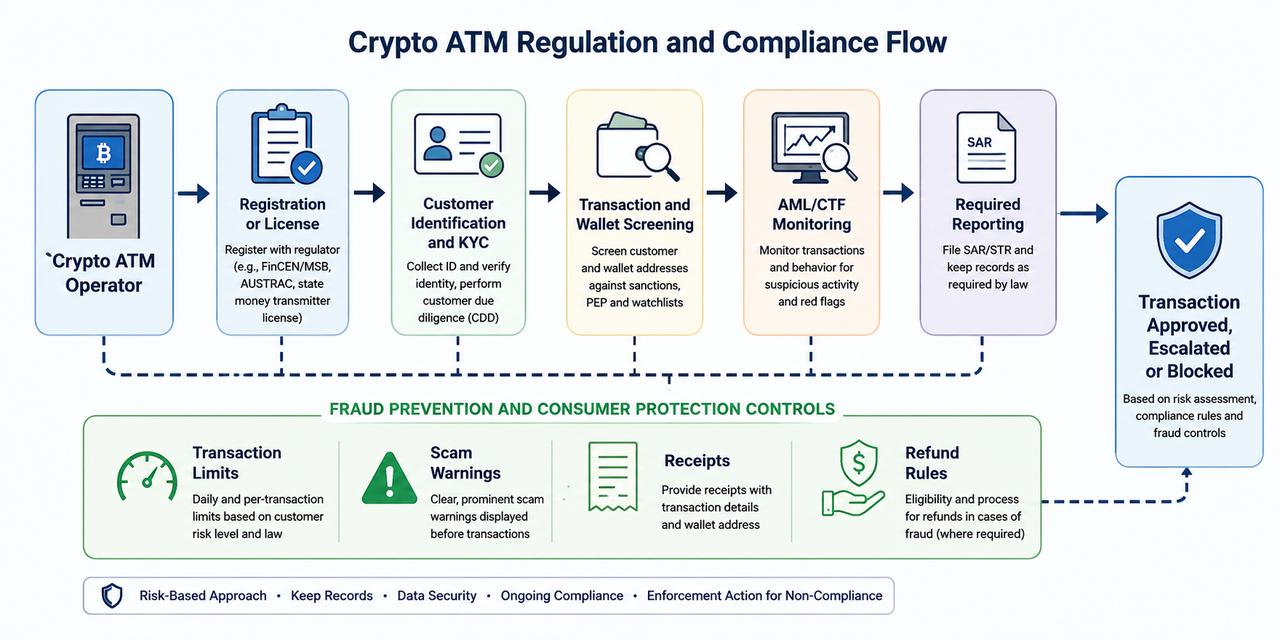
Crypto ATM regulation determines who may operate cryptocurrency kiosks, how customers must be identified, which transactions must be monitored or reported, and what safeguards must exist against financial crime and consumer fraud.
A cryptocurrency ATM, also called a Bitcoin ATM, crypto kiosk or convertible virtual currency kiosk, can allow customers to exchange cash for Bitcoin or other digital assets, and some machines support crypto-to-cash withdrawals. The operational model matters because an operator may transmit value between the customer, an exchange and a cryptocurrency wallet.
In the United States, the Financial Crimes Enforcement Network (FinCEN) states that CVC kiosk operators generally facilitate money transmission or operate as CVC exchangers. When that activity meets the federal definition of money transmission, the operator is treated as an MSB and must comply with applicable Bank Secrecy Act requirements.
That framework helps explain why how crypto ATM AML compliance works is closely connected to licensing and registration rather than being a separate back-office exercise. The machine is only the customer interface; regulatory obligations apply to the business operating the transaction process.
Why Are Crypto ATMs Regulated?
Crypto ATMs combine several characteristics that attract regulatory attention: cash, rapid settlement, external wallet addresses and transactions that can become practically irreversible after confirmation.
The concern is not that every ATM transaction is suspicious. Regulators instead apply a risk-based approach because kiosks can be exploited for money laundering, scams, fraud, money-mule activity and terrorist financing. FATF standards similarly call for Virtual Asset Service Providers (VASPs) to be licensed or registered and subjected to appropriate supervision or monitoring.
Consumer fraud has become particularly important. A scammer can impersonate a bank, government agency, technical-support company or investment adviser and instruct a victim to withdraw cash, scan a QR code at a Bitcoin ATM and send cryptocurrency to a wallet controlled by the scammer. The FTC specifically warns consumers that government agencies will not direct them to move money through a Bitcoin ATM for “protection.”
As a result, modern cryptocurrency ATM regulations increasingly combine financial-crime controls with consumer-protection requirements.
Registration and Licensing Under Crypto ATM Laws
A crypto ATM operator generally needs regulatory permission appropriate to its business model before operating, although the required permission may be called registration, authorization or a money-transmitter license depending on the jurisdiction.
United States: Federal Law and State Licensing
At the federal level, an operator conducting money transmission must generally register with FinCEN as an MSB. FinCEN states that a non-exempt money transmitter must register within 180 days after beginning money-transmission activity and comply with applicable reporting, recordkeeping and transaction-monitoring obligations.
Federal registration does not automatically satisfy state law. States can separately regulate money transmitters, virtual currency businesses and cryptocurrency kiosks. This means an operator may need a state Money Transmitter License, another digital-asset authorization, or kiosk-specific registration in addition to federal MSB registration.
The details are not uniform. Arizona's 2025 cryptocurrency-kiosk law, for example, requires anti-fraud controls and establishes daily limits of $2,000 for new customers and $10,500 for existing customers. Colorado's Vending of Digital Assets Act uses the same $2,000 new-customer and $10,500 existing-customer daily limits and became effective January 1, 2026.
Florida has also enacted a kiosk framework, but key provisions take effect in 2027. Its law provides for registration of virtual currency kiosk businesses and daily limits of $2,000 for new customers and $10,000 for existing customers. Operators that actually act as money transmitters remain subject to money-services-business licensing requirements.
These differences show why crypto ATM compliance cannot be reduced to one nationwide U.S. checklist.
Anti-Money Laundering AML Requirements
An anti-money laundering program is designed to identify, assess and mitigate the risk that a crypto ATM will be used to move criminal proceeds or disguise the origin or destination of funds.
Under the Bank Secrecy Act framework, U.S. money transmitters have reporting, recordkeeping and transaction-monitoring obligations. FinCEN specifically identifies Currency Transaction Reports, Suspicious Activity Reports and general recordkeeping requirements among the obligations relevant to CVC kiosk operators.
A workable anti money laundering AML program normally requires risk-based procedures rather than simply collecting identification. Depending on the business and applicable AML regulations, controls can involve:
-
assessing the operator's money-laundering and terrorist-financing risks;
-
designating responsibility for AML compliance;
-
conducting customer identification and customer due diligence;
-
maintaining transaction records;
-
monitoring transactions and wallet destinations;
-
identifying red flags and suspicious activities;
-
escalating higher-risk customers for enhanced due diligence;
-
filing required regulatory reports; and
-
reviewing whether controls remain effective.
For a kiosk operator, ongoing monitoring can be especially important when multiple transactions are linked to the same phone number, customer identity or wallet address, or when blockchain analytics associate a destination wallet with fraud or other illicit activity. FinCEN listed these patterns among CVC-kiosk red flags in its 2025 notice.
The global scale of money laundering explains the broader policy concern: UNODC continues to cite an estimate of roughly 2–5% of global GDP, or approximately $800 billion to $2 trillion, laundered worldwide in a year. The estimate is broad and should not be interpreted as the amount involving cryptocurrency or crypto ATMs specifically.
Customer Identification Program, KYC and Customer Due Diligence
KYC compliance establishes a reasonable basis for knowing who is conducting a transaction, while customer due diligence determines the risk associated with that customer and activity.
In practice, KYC involves collecting customer information and verifying identity using reliable information or documents. Depending on applicable law and the transaction, the process may involve a name, date of birth, address, government identification, phone number or other customer information.
The U.S. USA PATRIOT Act established Customer Identification Program requirements for specified financial institutions, but the exact customer identification program CIP rules applicable to banks should not automatically be treated as identical to every crypto ATM operator's obligations. Crypto kiosk operators instead need to apply the customer-identification, AML and recordkeeping requirements relevant to their own regulatory classification.
This distinction matters because customer due diligence is broader than checking an ID. Reasonable diligence may require understanding expected activity, developing a customer risk profile, detecting suspicious transactions and applying enhanced due diligence when circumstances indicate higher risk.
For users, the practical consequence is reduced anonymity. A regulated kiosk may request personal information before completing a transaction, and larger or higher-risk activity can trigger additional verification.
Bitcoin ATM transaction procedures therefore vary by operator and jurisdiction; identification requirements and transaction limits can change according to regulatory obligations and risk controls.
Transaction Monitoring, Records and Suspicious Activity Reports
Customer identification establishes who is transacting; transaction monitoring evaluates what the customer is doing.
Crypto ATM operators need sufficient transaction records to satisfy applicable reporting and investigative requirements. Relevant records may include customer identity information, transaction value, time, wallet address, transaction hash, cash amount and other details required by the regulator.
In the United States, certain MSBs, including money transmitters, must report qualifying suspicious transactions. FinCEN states that a required Suspicious Activity Report should generally be filed within 30 days after the MSB becomes aware of the suspicious transaction.
Red flags can include transaction structuring, repeated transfers to the same external wallet, activity inconsistent with the customer's profile, multiple geographically dispersed customers paying one wallet, or blockchain analytics connecting an address with known fraud.
That is why regulatory compliance requires ongoing monitoring, not one-time KYC.
Fraud Prevention Is Becoming a Core Compliance Requirement
A major development in Bitcoin ATM regulation is the shift from traditional anti money laundering controls toward direct intervention against scams. Arizona requires fraud warnings, customer receipts, blockchain analytics and transaction limits, while also providing refund protection for certain fraudulently induced transactions involving new customers. Florida's enacted framework similarly introduces warnings, transaction caps, wallet-screening controls and conditional refunds.
These measures extend normal KYC obligations, customer due diligence and transaction monitoring by requiring operators to assess fraud indicators on a risk basis, establish a reasonable belief about the customer's identity and activity, maintain security and transaction records, and identify when suspicious activity should be escalated.
The broader AML framework remains important because the Financial Crimes Enforcement Network classifies qualifying crypto ATM operators as Money Services Businesses, requiring them to maintain AML programs, monitor relevant customer relationships and report suspicious transactions under federal law. FinCEN reported that more than 20 million Bank Secrecy Act reports were filed by U.S. financial institutions in fiscal 2019, illustrating the scale of the financial system's reporting infrastructure rather than crypto ATM reporting alone.
Serious AML failures can also produce substantial civil penalties, although there is no universal "$250,000 per violation" or "$500,000 AML penalty" applicable to every kiosk violation; the amount depends on the particular statutory breach and enforcement action.
Australia provides a current enforcement example. After AUSTRAC introduced a $5,000 cash transaction limit, enhanced customer due diligence and mandatory scam warnings for crypto ATMs in 2025, it suspended Cryptolink's VASP registration for three months from August 9, 2026, preventing the company from operating 96 machines. AUSTRAC cited continuing concerns about high-risk transactions as well as reporting and information-response failures.
The case illustrates an important principle of crypto ATM compliance: registration is not a one-time permission slip. Operators must continuously satisfy diligence requirements, AML laws, reporting duties and fraud controls or regulators can restrict or suspend their business relationships and operations.
European Union and UK Crypto ATM Regulation
The European Union has moved toward a harmonized crypto regulatory perimeter through the Markets in Crypto-Assets Regulation, or MiCA. MiCA establishes common requirements for crypto-asset service providers, including authorization and supervision rules, and became fully applicable from December 30, 2024, subject to applicable transitional arrangements.
MiCA does not replace every AML requirement or make crypto ATM rules identical across every EU member state. A kiosk operator still needs to determine whether its specific business model constitutes a regulated crypto-asset service and what national AML, payments, consumer-protection and registration rules apply. The MiCA licensing framework for crypto service providers provides useful context for why authorization now matters across the EU.
The UK currently takes a particularly restrictive approach. Cryptoasset exchange activity within the scope of the Money Laundering Regulations requires FCA registration, and the FCA stated in July 2025 that there were no legally operated crypto ATMs in the UK.
Globally, this creates a spectrum: some jurisdictions license and supervise kiosks, others impose strict caps and fraud safeguards, while others can effectively prevent operation unless a demanding registration standard is satisfied.
Crypto ATM Fees, Disclosures and Consumer Protection
Regulation also addresses what customers know before committing cash.
Crypto ATM pricing can include an explicit service charge plus a spread between the kiosk's quoted cryptocurrency price and the broader market price. Research cited by the Federal Reserve Bank of Kansas City has documented total costs reaching around 20% in some cases; the exact fee varies by operator and transaction. Claims that every crypto ATM charges 15–30% should therefore be treated as an overgeneralization rather than a universal rule.
For example, someone considering a Bitcoin ATM purchase can compare the kiosk's displayed exchange rate against an exchange like Gate.com's BTC/USDT spot market before confirming the transaction. The comparison does not determine whether the ATM itself is compliant, but it can make the kiosk's effective spread and fee structure easier to understand.
Disclosure rules can also require operator contact details, transaction amount, exchange rate, total fees, wallet information, transaction hashes, fraud warnings and refund policies. Those requirements make transaction records useful both to customers and enforcement authorities.
Practical Crypto ATM Compliance Framework
For an operator, achieving compliance requires treating the kiosk network as a regulated financial business rather than a collection of machines.
A practical decision sequence is:
| Compliance question |
Why it matters |
| Is the activity money transmission or a regulated crypto service? |
Determines the regulatory perimeter |
| Is national registration or authorization required? |
Operating without it may be unlawful |
| Are state or local licenses also required? |
U.S. obligations can exist at multiple levels |
| What customer identification is required? |
Establishes identity and supports risk assessment |
| What are the transaction limits? |
Limits may differ for new and existing customers |
| Which transactions require monitoring or reporting? |
Supports AML/CTF obligations |
| Are wallet-screening controls required? |
Helps detect addresses linked to fraud or crime |
| What records must be maintained? |
Supports audits, reporting and investigations |
| Are warnings, receipts or refunds mandatory? |
Addresses consumer-fraud risk |
| Can regulators inspect, restrict or suspend operations? |
Compliance remains an ongoing obligation |
This framework also separates crypto ATM regulation from broader global cryptocurrency regulation: the kiosk's physical cash interface creates specific fraud, money-transmission and recordkeeping issues that do not arise in exactly the same way for every cryptocurrency exchange or wallet service.
Risks and Limitations of Crypto ATM Regulation
Regulation can reduce risk, but it cannot eliminate scams, money laundering or operational failures.
Stricter KYC requirements reduce anonymity and increase the amount of customer identity information operators must protect. Enhanced due diligence, blockchain analytics, compliance staff, record retention and licensing can also raise operating costs, potentially making entry harder for smaller businesses.
Transaction limits can reduce the amount lost in a single scam episode, yet criminals may attempt structuring or use multiple channels. Wallet screening can identify known risk indicators but cannot prove that every unflagged wallet is legitimate.
Rules also change. A compliant business model in one jurisdiction may be prohibited or require additional authorization elsewhere. Operators therefore need to monitor federal law, state law, national AML regulations, supervisory guidance and enforcement actions rather than treating a previous registration approval as permanent compliance.
For customers, KYC is similarly not proof that a kiosk transaction is safe. If a stranger, supposed government official, bank employee or technical-support agent instructs someone to deposit cash into a crypto ATM and send it to a specified wallet, that instruction itself is a major fraud warning sign.
Conclusion
Crypto ATM regulation governs who may operate cryptocurrency kiosks and how those businesses must identify customers, prevent money laundering, monitor transactions, maintain records, report suspicious activity and protect consumers from fraud.
The regulatory model increasingly combines traditional AML/CTF controls with transaction limits, blockchain analytics, scam warnings, receipts and other consumer safeguards. For operators, the strongest compliance approach is continuous and risk-based: registration or licensing is only the starting point. For users, regulation improves accountability but does not guarantee that a transaction or recipient wallet is legitimate.
The most important limitation is jurisdictional variation. U.S. federal requirements can overlap with state rules, European operators face MiCA and other applicable AML requirements, the UK maintains a restrictive registration perimeter, and jurisdictions such as Australia can impose additional conditions or suspend operators when compliance breaks down.
FAQ
Are Bitcoin ATMs legal?
Bitcoin ATMs are legal only where the operator and activity comply with applicable national, state or local rules. Some jurisdictions allow regulated operation, while others effectively prohibit crypto ATMs unless specific registration requirements are met.
Do crypto ATMs require KYC?
Regulated crypto ATMs may require customer identification and verification according to applicable AML rules, transaction size and risk. KYC requirements are therefore not identical across every jurisdiction or operator.
Are crypto ATM operators Money Services Businesses?
In the United States, FinCEN generally treats CVC kiosk operators conducting money transmission as MSBs. Other countries may instead classify them under concepts such as Virtual Asset Service Providers or crypto-asset service providers.
Can a crypto ATM transaction be anonymous?
Regulated transactions should not be assumed to be anonymous. Operators may collect customer identity and transaction information, while blockchain transfers create records associated with wallet addresses.
Why do states impose crypto ATM transaction limits?
Transaction limits are increasingly used as fraud-prevention controls because scammers can pressure victims into sending large cash amounts through cryptocurrency kiosks. Arizona and Colorado, for example, impose lower daily limits for new customers than established customers.
Can regulators shut down a crypto ATM operator?
Yes. Regulators can take enforcement action when an operator lacks required registration or fails to comply with continuing obligations. AUSTRAC's August 2026 suspension of Cryptolink's registration, which stopped 96 machines from operating for three months, is a current example.
Disclaimer: This material is for educational purposes and does not constitute legal, compliance, financial or investment advice. Crypto ATM laws vary by jurisdiction and change over time; operators should verify requirements with the relevant regulator and qualified professional before conducting regulated activity.