The growing adoption of artificial intelligence applications is changing the demand structure for computing resources. Model training requires large amounts of centralized computing resources, while inference services place greater emphasis on continuous, flexible, and predictable access to computing power. Whether developers are calling large language model APIs or enterprises are deploying AI Agents, they must address issues such as computing costs, resource availability, service stability, and budget management.
Traditional cloud computing and AI API platforms typically charge through subscriptions, prepaid credits, or usage-based billing. Users purchase services provided by a specific platform, while computing resources are centrally scheduled by the platform. Users generally cannot transfer unused credits independently, and resources are difficult to circulate directly among different participants. With the development of blockchain infrastructure and tokenization mechanisms, the market has begun exploring another approach: Can the right to use computing power or computing credits be converted into on-chain identifiable assets, so that resources are no longer limited to a single account or platform?
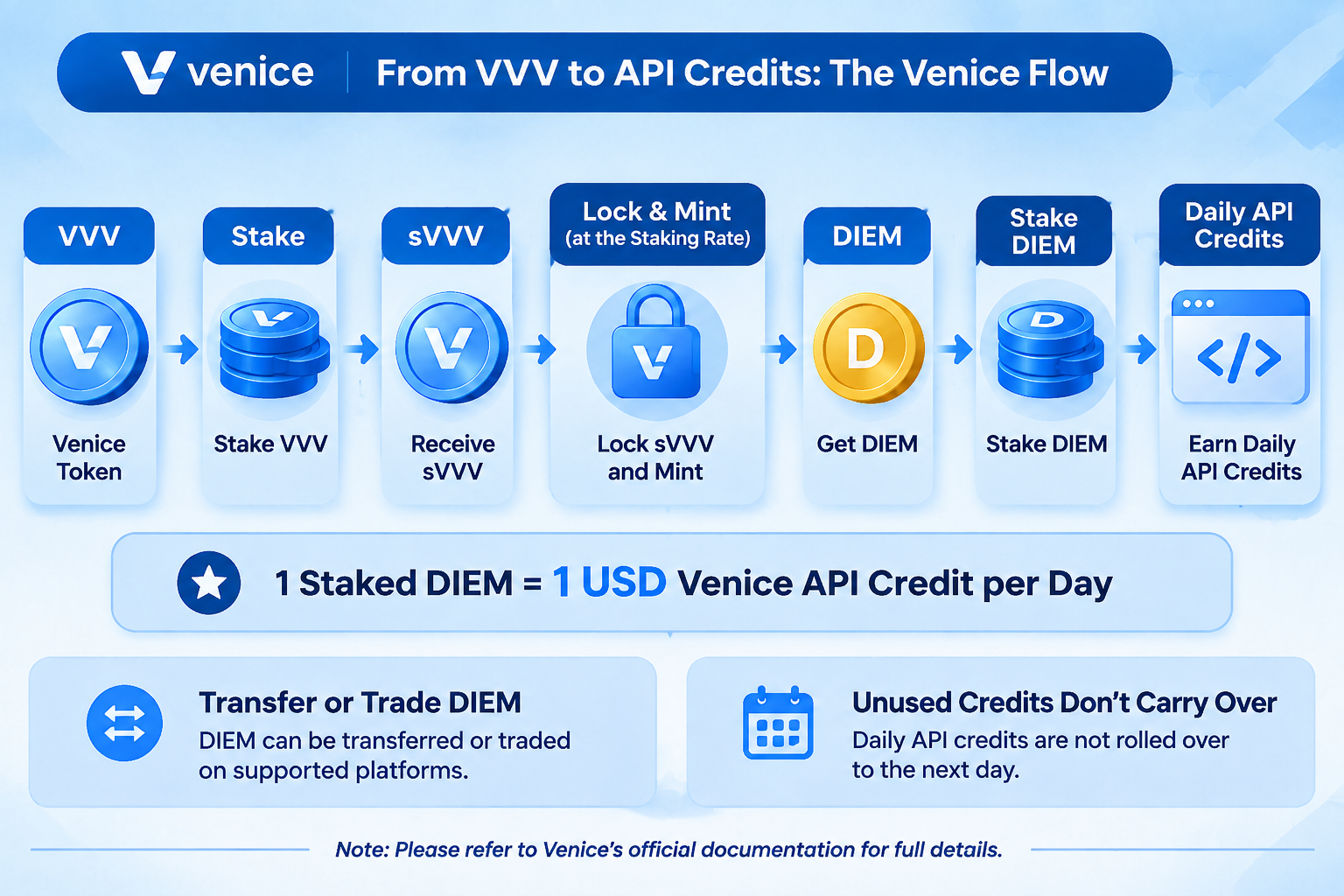
Tokenized Compute has consequently emerged as an area of exploration at the intersection of AI and crypto. This does not mean moving GPUs or servers onto the blockchain in their entirety. Instead, it attempts to use tokens to record resource rights, usage credits, or service access rights. Venice's VVV and DIEM mechanisms provide a specific example: Users can stake VVV to obtain sVVV, then lock it to mint DIEM. After staking DIEM, users can receive a corresponding amount of daily Venice API credits. This mechanism demonstrates one way to connect on-chain assets with AI computing services.
Key Points
-
The core of Tokenized Compute is the on-chain representation of resource rights. The tokenized object may be computing credits, service usage rights, or the right to use computing power during a specific period. It does not necessarily represent ownership of physical equipment such as GPUs or servers.
-
Tokenization does not mean that computing power itself is placed on-chain. Actual computing is still performed by cloud platforms, data centers, or AI service providers. Blockchain primarily records assets, rights, and related settlement relationships.
-
The way resources are measured determines the practical use of the tokens. Measuring resources by dollar-denominated credits, number of calls, computing time, or other metrics can result in different usage rules and economic models.
-
Transferability may improve the flexibility of resource allocation. If computing credits can be transferred or traded among participants, users may adjust the amount of resources they hold as their needs change.
-
Tokenized Compute still depends on off-chain service capabilities. Whether resources are actually available, how service quality is maintained, and how credits are settled all require support from off-chain infrastructure and operating rules.
-
Venice's DIEM is a specific implementation, not an industry standard. Official documentation defines it as a unit of Tokenized Compute, with 1 DIEM corresponding to $1 of daily Venice API credits.
What Exactly Is Tokenized Compute?
Computing power generally refers to the ability of computing equipment to process data and execute computational tasks. In AI scenarios, computing power may be represented by GPU resources, model inference capabilities, computing time, or API credits. Different service providers use different measurement methods, such as charging by token count, number of model calls, GPU usage time, or prepaid service credits.
The key to Tokenized Compute is converting one of these resource rights into a digital asset that can be identified and managed on-chain. The token may not represent a GPU or ownership of a server. Instead, it may represent a specific usage right—for example, the right to call a certain amount of computing services within a specified period or receive a fixed amount of API credits. As long as the rights, measurement method, and redemption rules are sufficiently clear, tokens can be used to record their ownership and transfer.
Therefore, Tokenized Compute is not a completely standardized technology. Different projects may tokenize computing supply, computing service credits, GPU leasing rights, or API usage rights. To determine whether a project genuinely has Tokenized Compute characteristics, it is first necessary to understand the specific rights represented by the token rather than simply checking whether the project has issued a token related to AI or GPUs.
Tokenized Compute must also be distinguished from traditional cloud computing points. Traditional points are generally recorded by service providers in internal account systems, with their usage scope, transfer permissions, and expiration determined by the platform. On-chain tokens may offer features such as public verifiability, transferability, or tradability, but these capabilities do not automatically guarantee that the underlying computing services can be redeemed at any time. Ultimately, users must assess whether the issuer has sufficient computing resources, clear redemption rules, and a reliable operating system.
How Are Computing Resources Converted Into On-Chain Assets?
Tokenized Compute typically involves resource providers, token issuance or management mechanisms, users, and underlying computing services. Resource providers supply GPUs, servers, model inference, or API services. The tokenization mechanism defines the resource rights and records their quantity, ownership, and usage rules. Users obtain computing services by holding, purchasing, or staking the relevant tokens.
In a typical design, the service provider first determines the computing resources available for allocation and selects an appropriate unit of measurement. For example, a project may map a certain amount of API credits to tokens or represent the right to use GPUs during a specific period as an on-chain asset. The system then uses smart contracts or an off-chain account system to record token issuance, transfers, staking, and burning. When users need to use computing power, they convert the tokens or related rights into service credits according to the project's rules.
This process can be divided into several stages:
-
Resource Definition: Specify whether the token represents GPU time, API credits, inference capabilities, or another computing right
-
Rights Measurement: Establish a verifiable unit for the resource, such as dollar-denominated credits, computing time, or a call quota
-
On-Chain Recording: Record the issuance, ownership, and transfer of the rights through tokens or smart contracts
-
Service Redemption: Connect the rights held by users to a specific platform or computing network to obtain the corresponding services
-
Usage Settlement: Complete settlement based on actual usage, time, or credit deduction rules
It is important to note that on-chain records and the actual delivery of computing power are not the same thing. A smart contract can record whether a token has been transferred, but it cannot independently prove that a specific GPU is operating properly or determine whether a model inference meets the agreed quality standard. Tokenized Compute projects still require reliable off-chain execution, data feedback, and dispute resolution mechanisms.
Why Tokenize Computing Rights?
First, tokenization may improve the liquidity of computing resources. Traditional service credits are often tied to a specific user account, and users can only use purchased credits within the scope permitted by the platform. If a computing right can be transferred, holders may transfer unused rights to other users when their own demand declines, reducing idle resources.
Second, tokenization mechanisms may provide a more flexible way for computing supply and demand to coordinate. Computing resource providers can attract funding or users by issuing rights, while demand-side users can purchase resources based on their budgets and task sizes. For developers who need to call AI models continuously, clearly defined computing credits can also help them plan operating costs.
Third, on-chain assets can provide a public basis for recording and settling resource rights. Token issuance, ownership distribution, transfer records, and some contract operations can be queried on-chain. This transparency can help participants understand how resource rights circulate, but it does not mean that off-chain service quality and resource reserves can be verified automatically.
Finally, Tokenized Compute may be combined with on-chain financial mechanisms such as DeFi. For example, some projects allow users to stake relevant assets to obtain service credits or transfer resource rights to other participants. This provides a new way to organize computing resources, but may also introduce financial risks such as collateralization ratios, liquidity, liquidation, and price volatility.
Venice's VVV and DIEM: One Implementation of Tokenized Compute
Venice's VVV and DIEM Mechanism demonstrates how on-chain assets can be connected to AI API credits. According to Venice's official documentation, VVV is the native token deployed on the Base network. Users can stake VVV to obtain sVVV, then lock sVVV and mint DIEM based on the current Mint Rate.
Venice defines DIEM as a unit of Tokenized Compute. Each staked DIEM corresponds to $1 of daily Venice API credits. Users can transfer DIEM to other wallets or trade it subject to market conditions. If users stake DIEM on the Venice platform, they can receive daily refreshed API credits.
This design connects several different layers of rights: VVV, as the native token, participates in staking and ecosystem mechanisms; sVVV represents the rights obtained after staking; and DIEM corresponds to computing credits that can be used for AI API services. Rather than simply renaming VVV as a computing token, the design connects the native token with service usage rights through different assets and operational steps.
However, DIEM credits are subject to specific usage rules. Daily credits refresh on a fixed cycle, and unused credits do not automatically carry over to the next cycle. The API account must meet the minimum staking threshold before DIEM credits can be used. The amount of sVVV that must be locked to mint DIEM is also affected by the current Mint Rate. Users should refer to Venice's official documentation and the rules displayed in the actual interface before participating.
What Are the Potential Use Cases for Tokenized Compute?
AI API Services are an Application Scenario that makes Tokenized Compute relatively easy to understand. Developers typically need to call models continuously, and costs change with user volume, task complexity, and model selection. If computing credits can be clearly measured and transferred under certain conditions, developers may be able to manage their budgets and resources more flexibly.
GPU leasing and distributed computing also offer opportunities for tokenization. Data centers in different regions, independent GPU providers, or computing resource networks can use unified rights certificates to organize supply, allowing users to obtain computing resources based on their task requirements. However, these scenarios must address differences in equipment performance, task scheduling, network latency, service availability, and result verification. Issuing tokens alone is not enough to establish a trustworthy market.
Enterprise computing procurement may also benefit from clearer management of resource rights. Enterprises can allocate computing credits according to project timelines and track rights transfers and settlement through on-chain records. However, enterprise procurement often also involves service-level agreements, data compliance, privacy protection, and supplier responsibilities. Tokenization mechanisms must work alongside existing contracts and enterprise management systems.
In addition, computing rights may become underlying assets or collateral for on-chain financial products. However, such financial designs have a practical foundation only when the service rights represented by the tokens can be continuously verified and redeemed. If computing supply is insufficient, the rights cannot be transferred, or the service provider ceases operations, the token's market liquidity may become disconnected from the value of the underlying resources.
What Risks and Limitations Does Tokenized Compute Face?
The most fundamental risk is a potential disconnect between on-chain rights and off-chain resources. The number of tokens may be publicly visible on the blockchain, but users still need to confirm whether the issuer has sufficient GPUs, servers, or API service capacity. If the underlying resources are insufficient or the service provider cannot continue providing services, the rights represented by the tokens may be difficult to redeem.
The second category of risk comes from measurement and pricing. The costs of different models, GPUs, and inference tasks vary significantly. Using dollar-denominated credits alone cannot fully reflect the performance, latency, or availability of computing resources. If a project does not clearly explain the service standards corresponding to its tokens, users may find it difficult to compare the actual value of different computing assets.
The third category of risk is liquidity and price volatility. The ability to transfer or trade a token does not mean that sufficient buyers will always be present in the market. If holders sell in large numbers or demand for the project declines, the token's price may deviate from the actual value of the service rights it represents. If the token also supports staking, lending, or other financial functions, its risk structure becomes more complex.
Other factors that require consideration include smart contract security, the authenticity of oracle or off-chain data, service provider concentration, privacy, and regulatory requirements. In AI scenarios especially, computing tasks may involve user inputs, business data, or personal information. Tokenizing resources does not automatically resolve data security and privacy issues.
How Can You Determine Whether a Tokenized Compute Project Has Practical Value?
When evaluating this type of project, first identify the specific rights represented by the token. Does it represent usable API credits, GPU rental time, inference services, or merely governance or incentive rights within the project's ecosystem? If there is no clear exchange relationship between the token and actual computing services, it should not simply be treated as a computing asset.
Next, examine the resource supply and redemption mechanism. Does the project disclose its resource providers, computing resource scale, service availability, and failure-handling procedures? How can users check their remaining credits, initiate service calls, or handle undelivered services? This information is more indicative of the project's actual operating capabilities than the token issuance volume alone.
Third, analyze the token's economic model. Must the token be staked to obtain service credits? Do minting and redemption involve fees, waiting periods, or quantity limits? Can the token be transferred, and do the service rights transfer along with it? These rules directly affect the user experience and asset liquidity.
Finally, continue monitoring actual demand. The number of developers, API call volume, paid user retention, resource utilization, and service costs can help determine whether the project has established a sustainable supply-and-demand relationship. For Tokenized Compute, what truly matters is not whether the token carries an AI label, but whether it can continuously connect real computing demand with reliable resource delivery.
Gate and Tokenized Compute: From an Industry Concept to Crypto Asset Monitoring
Tokenized Compute lies at the intersection of AI infrastructure and crypto assets. Participants need to understand both the practical uses of computing resources and the issuance, circulation, and market risks of tokens. For users following this ecosystem, research into a project's technical mechanisms and token economic model should be conducted separately from monitoring market prices and liquidity.
Gate Learn has published an overview of the relationship between Venice Minds, Mind Market, and the VVV token economy. It can serve as Further Reading for users seeking to understand the mechanisms of Venice ecosystem products. Users can also follow market information about relevant tokens through Gate's crypto asset markets. However, they should note that trading tokens on an exchange does not mean obtaining the corresponding AI API credits, nor does it mean that holders automatically acquire ownership of the underlying GPUs or computing services.
Therefore, when researching Tokenized Compute, users can use Gate as an entry point for monitoring crypto asset markets and accessing industry educational content, while referring back to the project's official documentation to verify the actual rights represented by the token, usage conditions, and risks. For specific cases such as VVV and DIEM, it is particularly important to distinguish among the native token, staking receipt, and service credits.
FAQ
What Is Tokenized Compute?
Tokenized Compute refers to mapping computing resources, the right to use computing power, or computing service credits to on-chain digital assets, allowing them to be measured and recorded and, where permitted by the rules, transferred or traded.
Does Tokenized Compute Mean Owning a GPU?
Not necessarily. Many projects tokenize the right to use computing power or API credits rather than ownership of physical equipment such as GPUs or servers. Users must refer to the project's rights description to determine what the token represents.
Why Is DIEM Called Tokenized Compute?
Venice officially defines DIEM as a unit of Tokenized Compute. Each staked DIEM corresponds to $1 of daily Venice API credits, which users can use to obtain inference service credits on the platform.
What Is the Difference Between VVV, sVVV, and DIEM?
VVV is Venice's native token. sVVV is the rights certificate obtained after staking VVV. DIEM is a unit of Tokenized Compute minted by locking sVVV and used to obtain daily Venice API credits.
Can Tokenized Compute Always Be Freely Traded?
Not necessarily. Whether a token can be transferred or traded depends on the token standard, smart contract, and project rules. Even if a token can be traded, this does not mean that the corresponding computing services can be redeemed on any platform or at any time.
What Are the Main Risks of Tokenized Compute?
The main risks include the inability to redeem the underlying resources, unclear measurement standards, service provider operational risks, insufficient token liquidity, price volatility, smart contract vulnerabilities, and data privacy issues.