AI applications are evolving from one-time conversation tools into continuously running software services. Chatbots, AI Agents, automated research tools, and multimodal applications may repeatedly call models, search tools, image generation services, or other computing services in the background. As task complexity increases, computing power is no longer merely an infrastructure concern for model developers. It is also becoming a day-to-day operating cost for application developers.
Traditional AI services typically provide computing capacity through API billing, subscription plans, or prepaid credits. Users pay based on usage or service plans, while platforms handle model and underlying hardware allocation. This approach is relatively straightforward, but resource rights are generally tied to platform accounts, limiting users' ability to transfer, split, or allocate credits across accounts.
Tokenized Computing Power offers another way to organize resources: converting rights to a particular computing service into on-chain tokens, giving computing credits measurable, transferable, or tradable properties. Venice's DIEM mechanism is one example. It connects on-chain tokens with daily API usage credits. Understanding this model requires starting with the cost structure of AI inference and then examining how computing power is measured, allocated, and delivered.
Key Takeaways
-
AI inference creates an ongoing resource demand: Model calls consume computing resources, and costs are affected by the model type, input and output size, and task complexity
-
API usage credits are one traditional way to charge for computing power: Users purchase or receive a certain amount of service credits, which are deducted based on actual usage prices
-
Tokenized computing power changes how rights are organized: It attempts to give computing rights on-chain records and liquidity, but does not mean that the actual computing process takes place on the blockchain
-
DIEM demonstrates a path toward tokenizing credits: Each staked DIEM corresponds to $1 of daily Venice API usage credits
-
AI Agents may increase the complexity of computing demand: Multistep tasks, tool calls, and collaboration among sub-Agents may all create additional inference costs
-
Tokenization cannot replace infrastructure: Model performance, GPU supply, network stability, privacy, and service quality still determine the user experience
Why Is AI Computing Power Becoming an Important Cost for Application Developers?
AI model training and inference require different types of computing resources. Training usually takes place during model development and involves large-scale data processing and parameter optimization. Inference occurs after a model is deployed. Each time a user submits a request, the server must allocate computing resources to generate a result. For applications that continuously provide services to users, inference costs continue to accrue as usage increases.
The computing costs of different AI tasks vary. Simple text-based question answering, long-context analysis, code generation, image generation, and video processing place different demands on model size, hardware resources, and computing time. Even when using the same model, input length, output length, and request complexity may change the actual cost. Developers therefore typically plan their API budgets based on model pricing and expected usage.
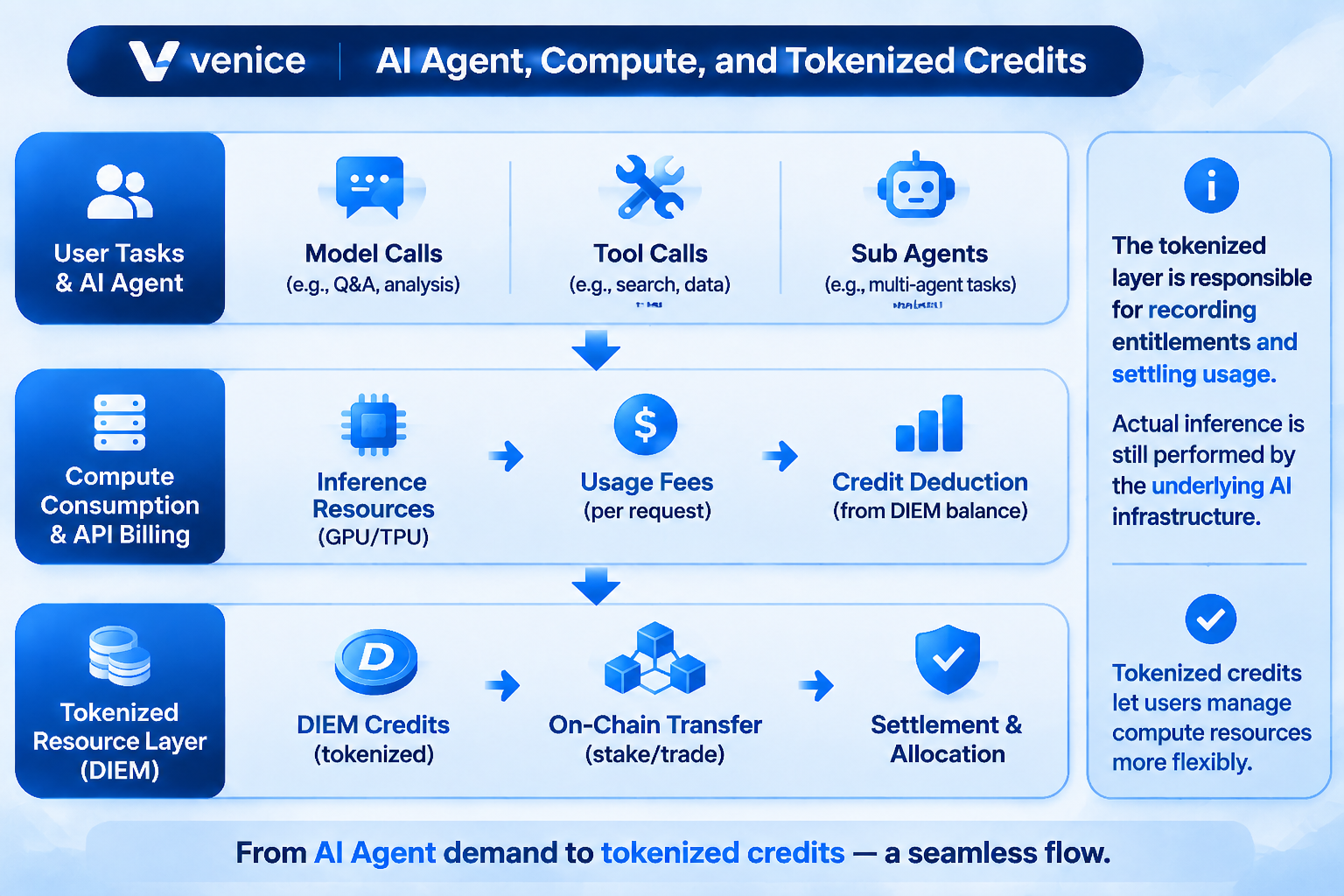
The development of AI Agents further increases the complexity of managing computing resources. A traditional chat interaction may consist primarily of one model request and one response. An Agent, however, can perform multiple steps around a goal—for example, searching for information, reading webpages, calling external tools, organizing the information, and then generating a final result. Each step may generate model or tool costs, and complex tasks may also involve collaboration among multiple sub-Agents.
As a result, AI application business models must consider not only how much users are willing to pay, but also the inference resources required to complete tasks. Managing computing costs is gradually becoming an important factor affecting AI service margins, pricing strategies, and user experience.
What Are the Characteristics of Traditional Resource Allocation Methods, from API Billing to Computing Credits?
Common AI API billing methods currently include usage-based billing, subscription plans, and prepaid credits. Usage-based billing typically charges according to input and output tokens, the number of images generated, or other units of measurement. It is suitable for users whose usage varies significantly. Subscription plans provide certain service permissions or credits, making it easier for individuals and teams to manage their budgets.
Prepaid credits convert the value of services into an internal platform balance. Users purchase a certain amount of credits, which are deducted according to model pricing when they call an API. This approach can simplify payment and billing management, but credits are generally subject to the platform's account system. Whether they can be transferred, refunded, or used across accounts depends on the service provider's rules.
These models share a common feature: Computing resources are allocated centrally by the service platform. Users purchase services provided by the platform rather than direct ownership of the underlying GPUs. Users can access the services, but generally cannot independently dispose of unused credits or easily transfer service rights to other users or markets.
For developers with stable usage, prepaid credits may be sufficiently convenient. For projects with highly variable resource needs, however, fixed plans or account-bound balances may lack flexibility. Tokenized computing power attempts to add on-chain transferability to this model, making computing credits less dependent on an internal platform account.
How Does Tokenized Computing Power Change the Organization of AI Resources?
Tokenized computing power does not directly change the underlying computing process of model inference. Instead, it changes how computing rights are represented and allocated. A project can map a certain amount of service credits, computing time, or resource usage rights to tokens, and then use smart contracts to record the issuance, ownership, and transfer of those tokens.
In an API service context, a token may represent a certain amount of API usage credits. After receiving the tokens, users may stake them or connect them to an account according to the project's rules to obtain the corresponding services. If the tokens are transferable, users may also transfer temporarily unused credits to other participants or obtain the resources they need from the market.
In a GPU rental context, tokenized rights may correspond to the right to use a GPU for a certain period or to a standardized computing service. Resource providers can publish available resources over a network, while users select resources based on their task requirements and complete settlement. However, GPU models, memory, bandwidth, operating environments, and service levels differ. Sufficiently clear resource standards are therefore necessary for tokens to be comparable.
The key to tokenized computing power is not issuing a token related to AI, but establishing a verifiable connection between resource rights and actual services. If a token cannot correspond to clearly defined computing resources or service credits, it is closer to a general ecosystem token than to a computing right that can be directly used for resource allocation.
How Does Venice DIEM Convert AI API Credits into On-Chain Rights?
Venice's VVV and DIEM Mechanism provides an example of tokenized API credits. Users can stake VVV to obtain sVVV and then lock sVVV to mint DIEM according to the current Mint Rate. DIEM is an ERC-20 token deployed on the Base network, and the project officially defines it as a unit of tokenized computing power.
Each staked DIEM corresponds to $1 of daily Venice API usage credits. After connecting a wallet to a Venice account, users can access the relevant credits through an API Key. API fees are deducted from the account balance according to the order specified by the platform, with DIEM credits used before other credits and dollar balances.
This design connects on-chain assets with actual AI services. Users can transfer or trade their DIEM, while staked DIEM continues to provide daily API credits. For developers, this means that a budget for computing services can be represented through on-chain rights rather than only as prepaid credits in a platform account.
However, DIEM credits are not an indefinitely accumulating stored-value balance. According to the official rules, unused daily credits do not roll over, and the credits refresh on a fixed schedule. Users must also meet minimum staking requirements and follow the waiting periods for unstaking and unlocking sVVV. The actual service value of DIEM therefore depends on whether users can use the credits in practice and whether their API usage matches the daily allocation.
How Might AI Agents Affect Demand for Tokenized Computing Power?
AI Agents operate differently from simple question-and-answer systems. An Agent usually consists of task instructions, a model, and tools, and can perform operations step by step based on a task objective. It may call web search, read materials, generate images or videos, or divide complex work among multiple sub-Agents. The more complex the task, the more model calls and tool uses it may require.
This change may expand computing demand from the cost of a single request to the ongoing cost of task execution. For applications such as research assistants, coding agents, and automated operations tools, developers need to estimate the average number of calls per task, model costs, and user frequency. If a service charges a fixed subscription fee without controlling the resource consumption of complex tasks, costs may exceed revenue.
Venice Minds demonstrates one way to combine AI Agents with a platform economic mechanism. Users can create purpose-specific Minds through natural language, configure models, tools, and sub-Agents, and choose whether to publish them to the Mind Market. Other users can discover and use these Agents, while creators can set a markup on top of the base inference price.
According to Venice's official explanation, creators can receive 90% of the markup as platform credits, while the remaining 10% is used by the platform to buy back and burn VVV. The calculation is based on the markup set by the creator, not the user's total payment. This design connects paid Agent usage with VVV buybacks and burns, but its actual scale still depends on paid usage and markup levels.
What Does Tokenized Computing Power Mean for AI Developers and Users?
For AI developers, tokenized computing power may provide a more flexible way to allocate budgets. If computing credits can be transferred, developers can adjust the amount of resources they hold based on the project's stage instead of relying entirely on a fixed balance in a particular account. For cross-team projects, on-chain records may also help participants track the allocation and use of resource rights.
For AI service users, tokenized computing power may lower the barrier to accessing computing resources. Users can select credits suited to the scale of their tasks without directly purchasing or managing underlying hardware. If different service providers adopt standardized measurement methods, users may also be able to compare the prices and service terms of different resources.
For computing power providers, tokenization may create a new channel for resource allocation. Data centers, GPU providers, and AI platforms can standardize portions of their service rights, allowing users to obtain resources through a market. To achieve this, however, providers must still demonstrate resource availability and establish clear rules for service levels, settlement, and incident handling.
These potential advantages do not arise automatically. Tokenization may add complexity related to wallet management, on-chain transactions, smart contracts, and price volatility. If users simply need stable and straightforward API services, traditional usage-based billing may remain more suitable. Whether to adopt tokenized computing power should depend on resource needs, transfer requirements, and risk tolerance.
Can Tokenized Computing Power Become an Important Part of AI Infrastructure?
The long-term development of tokenized computing power depends first on the reliability of the underlying resource supply. AI inference requires real models, GPUs, networks, and data centers. Tokens can record rights, but they cannot create computing capacity on their own. If resource providers cannot fulfill their obligations consistently, tokenization will struggle to support a stable service market.
Second, resource measurement standards must be sufficiently clear. API usage credits, GPU hours, the number of inference tokens, and the number of model calls are not fully equivalent units. Prices and performance vary significantly among models. Users need to understand the specific services represented by a token before they can assess its actual value.
Third, the market needs sustained supply and demand. Only when developers are willing to purchase and use computing resources over the long term will resource providers have an incentive to continue providing services. Simply increasing token trading volume does not demonstrate that a genuine demand for the AI computing market has formed.
Finally, privacy, security, and regulation will also affect the scope of tokenized computing power. Enterprise data and user inputs may contain sensitive information, and computing services must comply with applicable data protection requirements. Cross-platform resource trading may also involve payment, service liability, and compliance issues across different jurisdictions.
Tokenized computing power is therefore better understood as an exploration of resource organization and settlement for AI infrastructure, rather than an immediate replacement for traditional cloud computing. Its long-term value must be validated through resource delivery, user retention, cost efficiency, and service quality.
Gate and AI Computing Tokens: How Can Users Follow Ecosystem Developments?
Research into AI computing tokens requires observing both technical applications and crypto markets. On the technology side, users should focus on model services, API billing, computing supply, and actual usage. On the asset side, they should analyze token utility, issuance mechanisms, liquidity, and price volatility. These two categories of information are related, but neither can replace the other.
Gate Learn has published a related overview of Venice Minds and VVV tokenomics, which can serve as additional material for understanding the commercialization of AI Agents and token mechanisms. Users can also observe the market performance and trading activity of related tokens through Gate's crypto asset markets. However, trading a related token does not automatically grant users API usage credits, GPU usage rights, or other computing service rights.
For developers, AI services should be selected primarily based on model capabilities, stability, privacy requirements, and actual costs. For crypto asset participants, the utility, circulation rules, and risks of each token should be verified separately. Evaluating technology use and asset trading independently makes it possible to understand the development potential of tokenized computing power more accurately.
FAQ
Why Does AI Computing Power Need to Be Tokenized?
Tokenized computing power attempts to give computing resource rights or service credits on-chain records and transferability, improving how resource rights are measured, allocated, and transferred. It is not a model that every AI service must adopt.
What Is the Difference Between API Usage Credits and Tokenized Computing Power?
API usage credits are generally recorded by a service platform in its internal account system, and their use and transfer are subject to the platform's rules. Tokenized computing power may represent service rights through on-chain tokens, which can be transferred or traded when permitted by the relevant rules.
Is DIEM an AI Computing Token?
Venice officially defines DIEM as a unit of tokenized computing power. Each staked DIEM corresponds to $1 of daily Venice API usage credits, but it does not represent a fixed number of GPU hours or a fixed number of calls to a particular model.
Why Might AI Agents Increase Demand for Computing Power?
AI Agents can perform multistep tasks and call models, search tools, image generation services, and other tools. Compared with a single question-and-answer interaction, complex tasks may generate more model calls and tool costs.
Can Tokenized Computing Power Replace Cloud Computing Platforms?
This cannot be determined so simply at present. Actual computing still depends on data centers, GPUs, model services, and network infrastructure. Tokenization mainly changes how resource rights are represented and transferred; it does not replace the underlying computing infrastructure.
What Are the Core Risks of Tokenized Computing Power?
Key risks include the inability to deliver promised computing capacity, unstable service quality, inconsistent resource measurement standards, insufficient token liquidity, smart contract vulnerabilities, and data privacy risks.