In November 2026, Venice launched Venice Minds and Mind Market, allowing paid users to create AI agents with specific capabilities and publish them on the marketplace for other users. Creators can set a markup on top of the base inference cost. Of this markup, 90% is awarded to creators as platform Credits, while the remaining 10% is used by Venice to buy back and burn VVV. This mechanism links demand for AI Agent usage with token buybacks, extending Venice's product ecosystem beyond model services to include agent creation, distribution, and usage.
However, the commercial value of an AI agent marketplace depends not only on the number of creators or the scale of token burns. It also requires monitoring actual usage frequency, users' willingness to pay, and whether the platform's economic model can operate sustainably. This article examines the significance of this new product for the AI Agent economic model by focusing on Venice Minds' product features, Mind Market's pricing mechanism, VVV buyback and burn rules, and potential risks.
Key Takeaways
-
Venice launched Venice Minds and Mind Market in November 2026, supporting the creation, configuration, publication, and use of AI agents.
-
Venice Minds provides a natural-language creation method that allows users to configure models, knowledge resources, tools, and sub-agents.
-
Creators can set a markup on the base inference price and receive 90% of the markup as Venice Credits. The remaining 10% is used to buy back and burn VVV.
-
Platform Credits differ from cash or freely tradable tokens. Credit rewards should not be interpreted as realized cash income.
-
Mind Market introduces a new source of VVV buybacks and burns linked to AI Agent usage, but the actual scale depends on paid usage and markup levels.
-
VVV's market performance is also affected by token issuance, staking, liquidity, and market demand. Buybacks and burns do not guarantee price increases.
Why Did Venice Launch Venice Minds and Mind Market?
Generative AI platforms initially focused primarily on model-based conversations. Users entered prompts to obtain text, code, images, or other content. As AI tools have become more capable, however, some users have begun seeking ways to integrate frequently used prompts, knowledge resources, and tool calls into reusable agents.
For example, a market researcher may need an AI Agent that can retrieve information, organize materials, and generate reports. A content creator may want to build an agent with a fixed writing style, image-processing capabilities, and a defined workflow. Compared with entering complex instructions from scratch each time, preconfigured agents can reduce the cost of repetitive operations.
Venice Minds was launched to address this need. Users can describe the agent they want to create in natural language. The platform then generates an initial configuration, which users can adjust based on their specific use case.
Mind Market handles agent distribution. Creators can publish fully configured Minds on the marketplace, where other users can select them based on their task requirements.
This product structure means Venice is no longer simply providing an entry point for AI model calls. It is also attempting to build an application ecosystem involving the platform, creators, and users.
For Venice, an agent marketplace could increase user activity and encourage different creators to develop applications for specific tasks. However, whether the marketplace can generate sustained demand will still depend on agent performance, usage costs, and user experience.
How Does Venice Minds Create and Run AI Agents?
Venice Minds uses a low-barrier creation process. Users can describe an agent's purpose in natural language—for example, creating a research assistant dedicated to organizing market news or designing a content tool that can assist with image processing.
Based on this description, the platform can generate the agent's name, basic instructions, tool configuration, and appearance. Users can then continue modifying the relevant settings.
At the feature level, Venice Minds supports more than standard text interactions. Depending on its configuration, an agent can use web search, web content retrieval, image search, image generation, image editing, video generation, market data queries, and calculation tools.
Some complex tasks can also use a sub-agent mechanism to distribute different tasks among multiple Agents. For example, a research agent can separately handle information retrieval, material organization, and results compilation before combining the outputs into a final report.
This design highlights the difference between AI Agents and standard chatbots. Standard conversations mainly revolve around user input and model responses. An agent, by contrast, can select tools based on the task objective, perform multiple steps, and use preconfigured knowledge and instructions to complete the work.
However, greater tool-calling capabilities can also result in higher inference and tool usage costs. Tasks that require repeated searches, image generation, or complex reasoning may cost significantly more than simple text conversations.
Therefore, the value of Venice Minds depends not only on the number of tools an agent can use but also on whether the agent can complete tasks reliably at a reasonable cost.
How Does Mind Market Establish an Incentive Mechanism for AI Agent Creators?
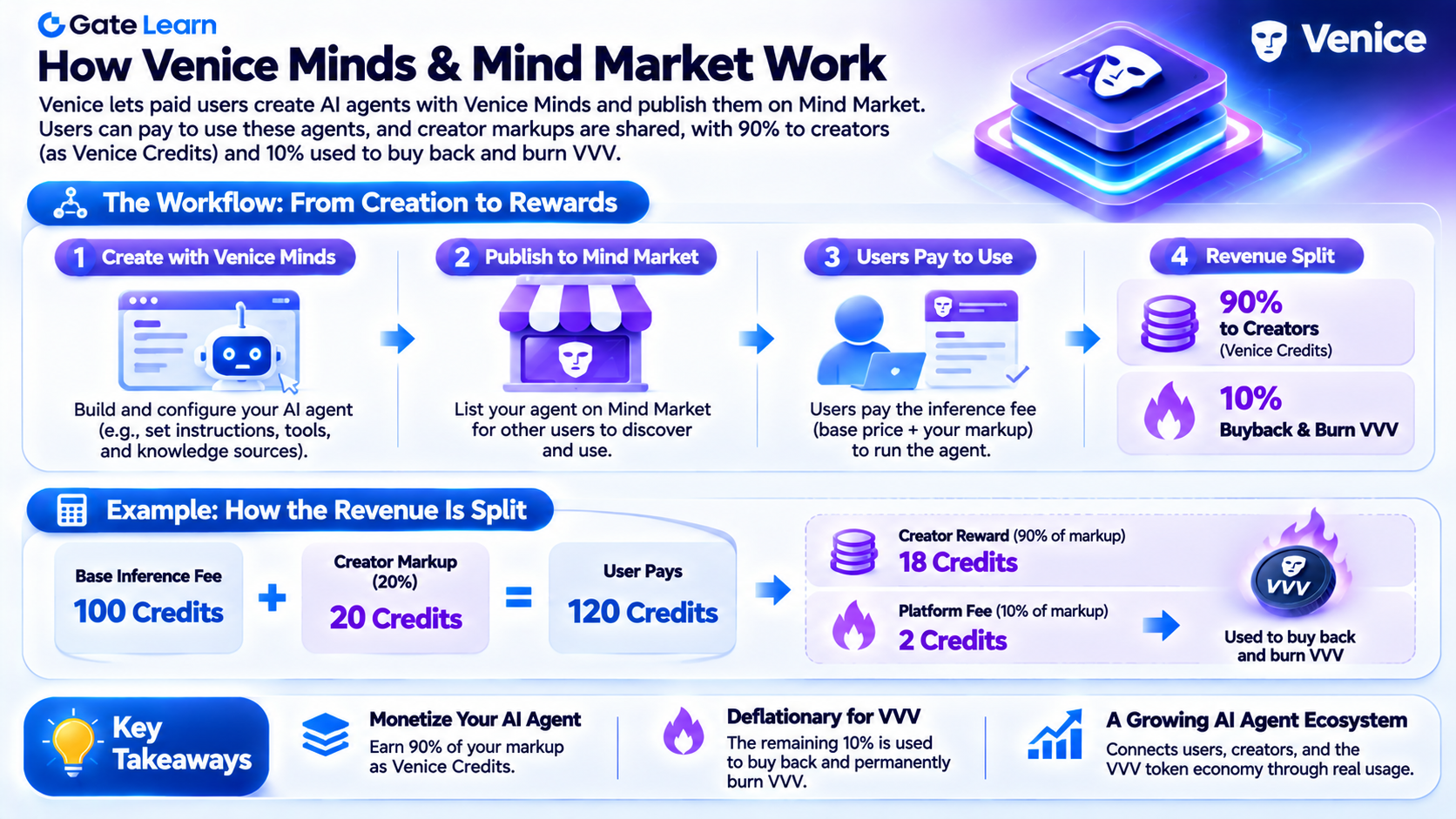
Mind Market's core mechanism allows creators to set a markup on Venice's base inference price. When users use a published Mind, they must pay the applicable base usage fee plus the additional fee set by the creator. The markup is distributed according to a predetermined ratio: 90% goes to the creator, while Venice receives the remaining 10% and uses it to buy back and burn VVV.
For example, suppose the base cost of an agent call is 100 Credits and the creator sets a 20% markup. The final usage price would be 120 Credits.
In this transaction, 100 Credits represents the base usage fee, while the additional 20 Credits represents the markup to be distributed. The creator receives 18 Credits, and the remaining 2 Credits represent the platform fee and are used for VVV buybacks and burns.
| Item |
Credits |
| Base Inference Fee |
100 |
| Creator Markup |
20 |
| User's Final Payment |
120 |
| Creator's Share |
18 |
| Share Used for VVV Buybacks and Burns |
2 |
It is important to note that creators receive rewards in Venice platform Credits, not cash, USDT, or VVV directly.
Platform Credits can help creators offset or support their subsequent use within the Venice ecosystem, but their economic characteristics differ from freely withdrawable income. Public product pages do not clearly provide a mechanism for directly converting these creator rewards into cash or crypto assets. Therefore, they should not be described as creator earnings that can already be freely withdrawn.
In addition, creators can receive corresponding rewards only when other users actually pay to use their Minds. Creating an agent or publishing it on the marketplace does not automatically generate ongoing income.
Therefore, Mind Market is closer to a creator incentive system based on platform usage credits than to a revenue protocol that directly distributes on-chain tokens to developers.
How Does Mind Market's 10% Share Affect VVV Buybacks and Burns?
VVV is the native token of the Venice ecosystem and is deployed on the Base network. Its functions include access to AI services, staking, and related tokenized computing resource mechanisms.
Before Mind Market launched, Venice had already established VVV buyback and burn arrangements related to its platform business. For example, some paid subscription revenue triggers automatic buybacks and burns, while API Credits purchases are also subject to corresponding burn rules.
In April 2026, Venice launched a programmatic buyback and burn mechanism tied to new subscriptions. New Pro, Pro+, and Max subscriptions each correspond to different amounts of VVV buybacks and burns. The platform later added a buyback mechanism triggered by API Credits purchases, using $5 from every $100 in Credits purchased to buy back and burn VVV.
Mind Market further introduces a source of buybacks linked to agent usage.
Unlike fixed subscription fees, the scale of these buybacks depends on actual paid agent usage and the markup levels set by creators. If a large number of Minds receive frequent usage, the related platform fees may increase accordingly.
However, it is important to emphasize that the amount used for buybacks and burns through Mind Market is not the total revenue from agent usage. It is 10% of the creator markup.
Therefore, even if overall Mind Market usage increases, the expected VVV buyback amount cannot simply be calculated by multiplying total transaction volume by 10%.
From an economic perspective, Venice is attempting to link part of the revenue or fees generated by different business activities to VVV supply management. However, whether the buyback scale will have long-term significance still depends on actual business activity and changes in token supply.
Do VVV Buybacks and Burns Mean the Token Price Will Definitely Increase?
Buybacks and burns generally involve purchasing a certain amount of tokens on the market and then sending them to a burn address that cannot be used normally, thereby reducing the available supply of those tokens.
In theory, all else being equal, a reduction in token supply may affect the relationship between supply and demand. However, actual market prices also depend on circulating supply, trading demand, investor expectations, and overall crypto market conditions.
-
The buyback amount must be distinguished from the number of tokens. A buyback of the same dollar amount can purchase different quantities of VVV at different market prices. Therefore, an increase in the buyback amount does not necessarily mean that the number of tokens burned will increase proportionally.
-
VVV continues to have staking rewards and token issuance mechanisms. Determining whether the token supply is decreasing over time requires monitoring both new issuance and actual burns, rather than focusing only on the cumulative number of tokens burned.
-
Mind Market's buyback source depends on creator markups. If users primarily choose free or low-markup agents, or if overall marketplace usage is limited, the incremental buyback scale may also be small.
-
Token prices may be affected by macro liquidity, risk appetite, and trading activity. Even if the platform's business continues to develop, VVV may still experience significant price volatility.
Therefore, Mind Market's significance lies in adding a buyback and burn pathway linked to actual product usage, not in establishing a price mechanism that guarantees token appreciation.
How Does Venice Minds Link AI Agent Usage Demand to the Token Economy?
Traditional AI application platforms primarily generate revenue through subscription fees, API usage fees, or enterprise service contracts. After users pay, the funds are mainly used for model inference, infrastructure, and platform operations.
Venice Minds and Mind Market build on this model by adding a creator markup mechanism, allowing the additional fees generated when users use a particular agent to be distributed between the creator and the platform.
This structure creates three interconnected relationships among participants.
-
For users, Mind Market provides task-specific AI tools that can be used directly, reducing the need to configure prompts and workflows themselves.
-
For creators, the platform provides creation and distribution channels, allowing them to accumulate Venice Credits through actual agent usage and continue using them for AI services on the platform.
-
For the VVV ecosystem, the fees Venice receives from creator markups are used to buy back and burn tokens, linking some product activity to token supply management.
However, this relationship does not mean that all users must hold VVV to use Minds. Nor does it mean that tokens are burned at a fixed percentage of the total cost for every AI call.
More accurately, Venice's model adds creator incentives and a token buyback mechanism to its existing AI service pricing system.
Whether this design can create a sustainable cycle depends on whether agents provide sufficient practical value and whether costs are allocated reasonably among creators, users, and the platform.
What Commercialization and Ecosystem Development Challenges Does Mind Market Face?
The long-term development of an AI Agent marketplace first requires solving the problem of matching agent quality with user demand. As the barrier to creation falls, the marketplace may see a large number of agents with similar features. For users, what truly matters is not how many Minds the marketplace has but whether they can quickly find tools that are reliable, accurate, and reasonably priced.
The creator markup mechanism may also create competition. Agents with higher markups need to offer sufficiently clear functional advantages. Otherwise, users may switch to lower-priced alternatives.
Platform Credit rewards may also affect creators' willingness to participate. Credits have practical value for developers who frequently use Venice services. However, they may be less attractive to creators who want withdrawable cash income.
Privacy and security remain important for AI Agents. Venice emphasizes conversation privacy and states that creators cannot view other users' chats with their Minds. However, different models, tools, and external services may have different data-handling practices. Users should still review the specific configurations and privacy terms.
Venice allows users to increase a Mind's visibility on the marketplace by burning VVV. This may provide agents with an additional exposure channel, but it also means that marketplace rankings may be influenced by content quality, user demand, and promotional spending.
Therefore, Mind Market's long-term competitiveness must be validated through actual paid usage, user retention, continued creator participation, and agent execution quality.
How Should Investors Assess the Long-Term Impact of Venice Minds on the VVV Ecosystem?
Assessing the long-term value of Venice Minds and Mind Market requires observing product growth and token economics separately.
At the product level, investors can monitor the number of actively used Minds, the number of paid calls, repeat usage rates, and continued creator participation on the marketplace. These metrics can help determine whether the marketplace has generated genuine demand.
At the revenue level, investors should monitor base inference fees, the scale of creator markups, and the fees actually received by the platform. Increased Mind Market usage does not necessarily mean that buyback and burn amounts will increase at the same rate, because markup levels may vary among agents.
At the token level, investors should observe actual VVV buyback amounts, the number of tokens burned, new issuance, and changes in circulating supply. Only by considering these metrics together can investors assess the extent to which the buyback mechanism affects overall token supply.
In addition, Venice's AI services involve model inference costs, tool usage fees, and platform operating expenses. Even if the user base continues to grow, an increase in related costs may not improve overall profitability.
For investors, the launch of Venice Minds can be viewed as an attempt to expand the application scenarios of the VVV ecosystem. However, its commercial value still needs to be validated by subsequent usage data and the performance of its token economy.
Conclusion
The launch of Venice Minds and Mind Market expands Venice from an AI model services platform into a marketplace for agent creation and distribution. Through natural-language creation, tool configuration, and marketplace publication features, users can build AI Agents for specific tasks and make them available for direct use by others.
From an economic perspective, Mind Market allows creators to set a markup on inference fees. It rewards creators with 90% of the markup in platform Credits and uses the remaining 10% to buy back and burn VVV. This design establishes a new link between platform usage and the token economy. However, Credit rewards are not equivalent to withdrawable income, and buybacks and burns do not mean that the token price will necessarily increase.
In the long term, whether Venice Minds can create sustained value for the VVV ecosystem will depend on genuine demand for AI Agents, the effectiveness of creator incentives, platform cost control, and the actual scale at which the buyback and burn mechanism operates. Compared with short-term token price movements, the sustainability of product usage and the economic model deserves greater attention.
FAQ
What Is Venice Minds?
Venice Minds is an AI agent creation feature launched by Venice. It allows users to configure models, instructions, knowledge, and tools through natural language to build AI Agents for specific tasks.
What Is the Purpose of Mind Market?
Mind Market is Venice's AI agent marketplace. Users can discover and use Minds published by other creators, while creators can receive platform Credit rewards from paid usage.
How Much of the Revenue Can Venice Minds Creators Receive?
Creators can receive 90% of the markup they set on the inference fee. The remaining 10% is used by the platform to buy back and burn VVV. This 90% does not represent 90% of the user's total payment.
Do Creators Receive VVV as Rewards?
No. The public mechanism indicates that creators receive Venice Credits rather than VVV or cash directly.
How Does Mind Market Affect VVV?
Venice uses 10% of the creator markup to buy back and burn VVV, adding a buyback source linked to paid AI Agent usage.
Will VVV Buybacks and Burns Drive the Price Higher?
Not necessarily. Token prices are also affected by market demand, circulating supply, new issuance, and overall market conditions. Price trends cannot be predicted based solely on the buyback and burn mechanism.