The commercialization of AI services depends not only on model capabilities, but also on how computing resources are measured and charged. For developers who need to make continuous model calls, pay-per-use, prepaid API credits, and subscription services each have their own advantages and disadvantages. If computing credits can be acquired, transferred, or traded through on-chain assets, users may have more flexible ways to allocate resources.
Venice's VVV and DIEM Mechanism is a practical implementation of this concept. VVV is the base token of the Venice ecosystem. Users can stake VVV to receive sVVV, then lock sVVV to mint DIEM. DIEM is defined as a tokenized computing unit. Once staked, it provides a daily refreshed Venice API usage allowance.
This mechanism can easily be oversimplified as "holding VVV gives you access to AI computing power," but the actual process is more complex. VVV, sVVV, and DIEM each serve different functions and involve operations such as staking, locking, minting, using credits, and unstaking. Understanding these steps and their limitations is essential for determining what rights the token mechanism actually provides and what costs users must bear.
Key Points
-
VVV is the base token: Users can stake VVV to receive sVVV and participate in Venice's token economics.
-
sVVV is a staking-rights certificate: To mint DIEM, users must lock the corresponding amount of sVVV based on the current mint rate.
-
DIEM represents computing credits: Each staked DIEM provides $1 of Venice API usage credits per day.
-
Credits refresh periodically: Unused daily credits do not automatically roll over to the next period.
-
DIEM and VVV are different assets: DIEM represents a service-credit mechanism, while VVV serves as the base token and staking asset.
-
Computing credits do not equal investment returns: Token prices, staking rewards, and the value of API usage are separate dimensions and should not be conflated.
What Do VVV, sVVV, and DIEM Represent?
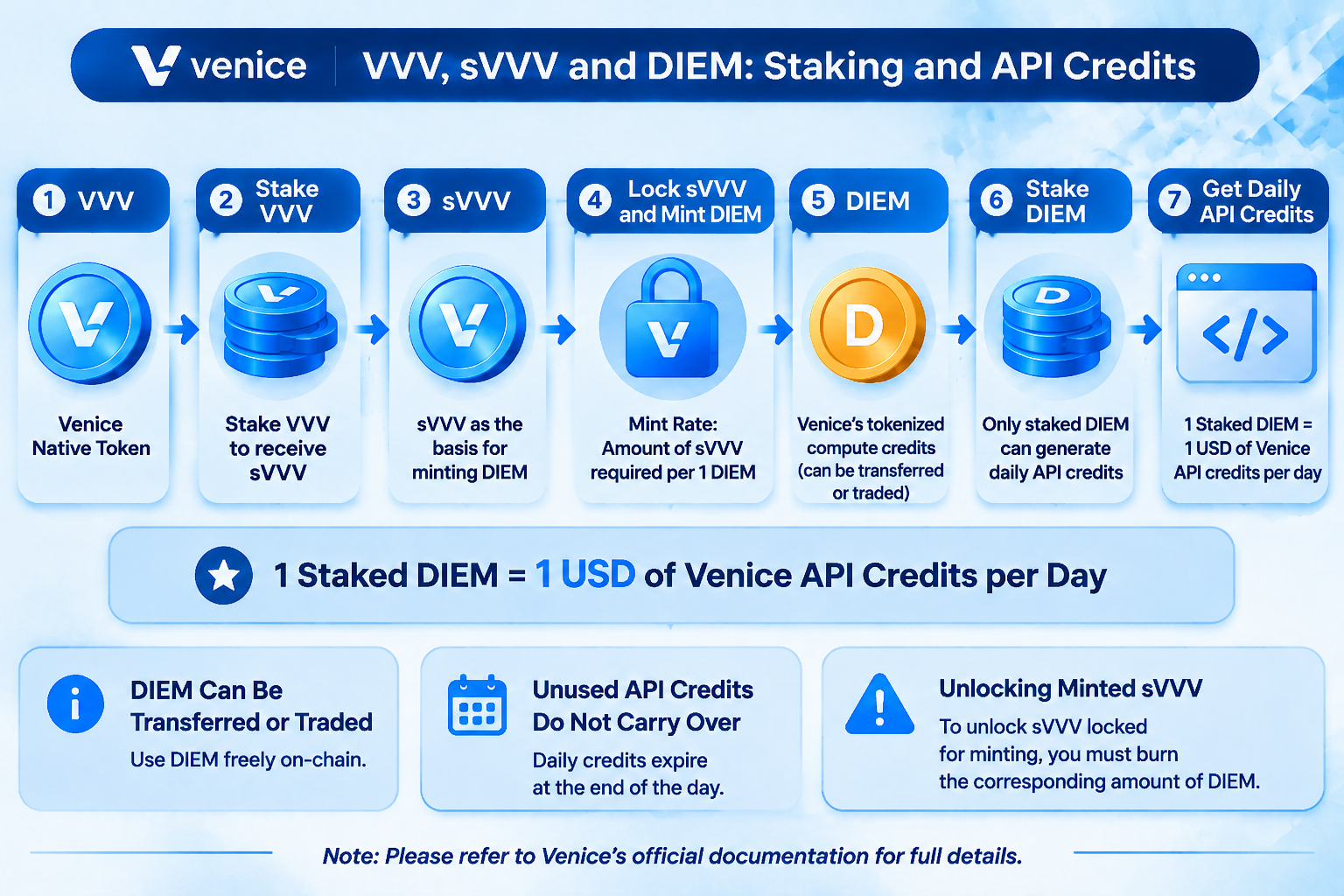
VVV is the base token of the Venice ecosystem and is deployed on Base. According to Venice's official documentation, users can stake VVV to receive sVVV. Staked VVV participates in the corresponding token issuance and staking mechanisms, while sVVV serves as a certificate of staking rights and is used in the DIEM minting process.
sVVV is not an entirely separate token unrelated to VVV. It represents the rights created when users stake VVV. To mint DIEM, users must lock a certain amount of sVVV based on the current mint rate. The mint rate determines how much sVVV must be locked to mint one DIEM and adjusts as the DIEM supply changes.
DIEM is more closely tied to computing services. Venice defines it as a tokenized computing unit. Each staked DIEM corresponds to $1 of Venice API usage credits per day. DIEM itself is an ERC-20 token deployed on Base and can be transferred or traded. However, only staked DIEM generates daily API credits.
The relationship among the three assets can therefore be summarized as follows: VVV is the base token, sVVV is the staking-rights certificate created through staking, and DIEM is a tokenized computing unit connected to API usage credits. They work together within the same ecosystem but cannot substitute for one another.
How Does the Process Work From VVV Staking to DIEM Minting?
Users must first obtain VVV and stake it through Venice's official interface. After staking, users receive sVVV. This step converts the base token into staking rights and provides the foundation for subsequently minting DIEM.
If users want to obtain DIEM, they can further lock their sVVV and mint DIEM based on the current mint rate. The mint rate is not fixed. Users should check the latest conversion ratio displayed by Venice's official calculator or interface before proceeding. After minting, DIEM is deposited into the user's wallet as an ERC-20 token, while the sVVV used for minting remains locked.
Users can then choose to stake DIEM. Each staked DIEM corresponds to $1 of Venice API usage credits per day. Users connect the same wallet to their Venice account and use the credits according to the API account rules. The system first deducts API usage fees from DIEM credits, then uses other types of credits or the dollar balance according to the account balance rules.
Several details in this process are easy to overlook. First, DIEM must be staked to generate daily credits; simply holding DIEM does not mean that the user has received that day's API credits. Second, daily credits refresh at fixed intervals, and unused credits do not roll over. Finally, users must complete staking and minting through the official process and should not send tokens directly to a contract address.
How Are DIEM's Daily API Credits Calculated and Used?
Venice's official documentation uses a simple dollar-denominated credit system to measure DIEM: Each staked DIEM corresponds to $1 of Venice API usage credits per day. Therefore, staking 10 DIEM provides $10 in API credits per credit period, while staking 100 DIEM provides $100 in daily credits.
This mechanism converts a computing-service budget into measurable on-chain rights. Instead of purchasing prepaid credits separately for each API request, developers can stake DIEM to receive daily credits that refresh continuously. For applications with relatively stable usage, this approach can help with advance API spending plans.
However, daily credits do not equal a fixed number of tokens, requests, or GPU hours. API prices may vary across models and services, so the volume of calls supported by the same dollar-denominated credit amount may also vary. DIEM is therefore measured in API credits, not in a fixed number of inferences for a particular model.
Unused credits also do not accumulate into the next period. If an account has low usage on a given day, the remaining credits do not automatically become available for future use. For developers with fluctuating usage, this directly affects capital efficiency, so the staking amount should be evaluated against their usage patterns.
What Do DIEM Transfers and Trading Mean?
DIEM is an ERC-20 token on the Base network. According to the official documentation, it can be transferred, traded, or staked. This means DIEM is not only an internal API credit within the platform but also has the basic circulation characteristics of an on-chain asset.
Transferability allows holders to send DIEM to other wallets or trade it in markets that support the asset. For users who already hold DIEM but do not temporarily need all of their computing credits, this may provide some flexibility in allocating resources. Developers with ongoing API needs may also obtain the DIEM they need through the market.
However, token transfers and service-credit usage are separate matters. DIEM generates corresponding daily API credits only after the Venice account connection and staking requirements are met. Transferring tokens from one wallet to another does not mean that credits already consumed by the original account are also transferred. The new holder must still complete account linking and staking according to the platform rules.
On-chain transferability also does not guarantee sufficient market liquidity. DIEM's trading price may be affected by supply and demand, market depth, and the project's development. It may not always equal the nominal value of its daily API credits. If the market price diverges from the service value, users need to evaluate its financial value and practical usage value separately.
How Do VVV's Token Economics and DIEM Demand Affect Each Other?
VVV serves as the base token of the Venice ecosystem. Staking VVV provides sVVV, and locking sVVV enables users to mint DIEM. This means that DIEM generation is connected to the VVV staking mechanism, while DIEM usage further connects the mechanism to AI API services.
From a demand perspective, if developers and users increase their demand for Venice API services, demand for DIEM may also increase. Users who want more daily credits need to hold and stake more DIEM. Since minting DIEM requires locking sVVV, this may also increase demand for VVV staking rights.
However, this relationship does not mean that increased API demand will necessarily cause the price of VVV to rise. DIEM demand may be affected by service pricing, competition among models, user retention, and other API providers. VVV's market price is also affected by token issuance, staking rewards, circulating supply, trading liquidity, and overall risk appetite in the crypto market.
When analyzing VVV's economic model, service demand, DIEM minting and usage, VVV staking, and token market performance should therefore be evaluated separately. These factors are connected by the mechanism but do not have a simple one-to-one price transmission relationship.
What Risks Should You Consider Before Participating in the VVV and DIEM Mechanism?
The first is smart contract and operational risk. Staking, locking, minting, and unstaking VVV, sVVV, and DIEM involve different contracts and platform procedures. Users should verify the official contract addresses and operation interfaces to avoid sending tokens to the wrong address. Venice's official documentation explicitly warns users not to send VVV or DIEM directly to contract addresses, as the tokens may not be recoverable.
The second is liquidity risk. DIEM can be transferred and traded, but this does not mean it can always be sold at an ideal price. If market depth is insufficient, users may face large bid-ask spreads or difficulty exiting when demand is low.
The third is credit utilization efficiency. Daily credits obtained by staking DIEM do not carry over. If actual API usage is lower than the credit amount, resources may remain idle. Users should determine the staking amount based on their actual call frequency and model costs rather than simply seeking a higher credit limit.
Finally, token prices and service value are separate. VVV's market price may fluctuate significantly, while DIEM's nominal API credits are denominated in dollars. Even if users obtain a certain amount of service credits through staking, this does not mean that the market value of their assets is stable. API credits should not be treated as risk-free investment returns.
How Can You Assess the Long-Term Sustainability of the VVV and DIEM Mechanism?
To assess the mechanism's long-term value, first examine whether Venice API has developed genuine and sustained demand. Model quality, privacy features, developer experience, price competitiveness, and service stability all affect whether users are willing to continue using the platform.
Next, observe the actual usage of DIEM. The amount staked and minted can reflect user participation in the credit mechanism, but it is more important to assess whether the credits are actually being consumed, whether API calls are continuing to grow, and whether users are willing to reuse the service. If a large amount of credits remains idle for an extended period, the resource-allocation efficiency of the tokenized mechanism should be reevaluated.
Third, monitor the dynamic relationship among VVV staking, DIEM minting, and token issuance. Changes in the mint rate, staking and unstaking waiting periods, token issuance, and circulating supply can all affect participants' costs and asset liquidity.
Finally, observe whether Venice can establish a sustainable business model across model services, infrastructure, and platform operating costs. A token mechanism can help organize resource rights, but it cannot replace product competitiveness or genuine revenue. Only if API services maintain sustained demand can DIEM's credit mechanism potentially establish a stable usage base.
Gate and VVV: How to Distinguish Token Market Observation From Computing-Right Usage
VVV is a crypto asset in the Venice ecosystem, while DIEM is connected to Venice API usage credits. When researching the ecosystem, users need to distinguish between observing or trading VVV on a trading platform and staking VVV, minting DIEM, and using API credits on the Venice platform.
The Introduction to the Venice Ecosystem in Gate Learn can help users understand the product background of VVV, Venice Minds, and Mind Market. Users can also monitor market conditions and trading information for related crypto assets through Gate's market pages. However, trading VVV alone does not automatically generate DIEM and does not mean that the user has received Venice API credits. The relevant rights must still be obtained by completing staking, locking, and minting through Venice's official process.
For investors, monitoring VVV's market price and evaluating DIEM's actual service value should be treated as separate activities. The former involves token supply and demand, liquidity, and market risk. The latter depends on API usage demand, credit rules, and service quality. Keeping these factors separate can help prevent token price performance from being misinterpreted as the commercial performance of the underlying computing service.
FAQ
What Is the Difference Among VVV, sVVV, and DIEM?
VVV is Venice's base token; sVVV is the staking-rights certificate received after staking VVV; and DIEM is a tokenized computing unit minted by locking sVVV. Once staked, DIEM provides daily API usage credits.
How Much Computing Power Does 1 DIEM Represent?
According to Venice's official rules, 1 staked DIEM corresponds to $1 of Venice API usage credits per day. It represents dollar-denominated API credits, not a fixed number of GPU hours or model calls.
Does Holding DIEM Provide API Credits?
Not necessarily. Users must stake DIEM according to Venice's rules and connect the corresponding wallet to a Venice account to receive daily refreshed API credits.
Can DIEM's Daily Credits Accumulate?
No. The official documentation states that unused daily DIEM credits do not carry over to the next period. The credits refresh at a fixed time.
Can DIEM Be Transferred or Traded?
Yes. DIEM is an ERC-20 token deployed on the Base network. According to the official documentation, it can be transferred, traded, or staked, although actual trading depends on market support and liquidity.
Does Staking VVV Mean Receiving Fixed Investment Returns?
It cannot be understood that way. VVV staking involves token issuance and ecosystem mechanisms. Specific returns, risks, and unlocking conditions are subject to the official rules. DIEM represents API usage credits, not fixed cash returns.