As artificial intelligence technology and blockchain infrastructure continue to mature, more projects are exploring how AI Agent can be applied to digital assets. As an important participant in the DeFAI sector, Singularry AI focuses not only on intelligent analysis, but also on the ability of AI Agents to execute on-chain operations. Its goal is to build an autonomous agent system that can truly participate in on-chain economic activity.
What Is Singularry AI?
As a decentralized finance platform built around AI Agents, Singularry AI aims to help users complete tasks such as asset management, yield optimization, risk control, and on-chain interaction through autonomous intelligent agents.
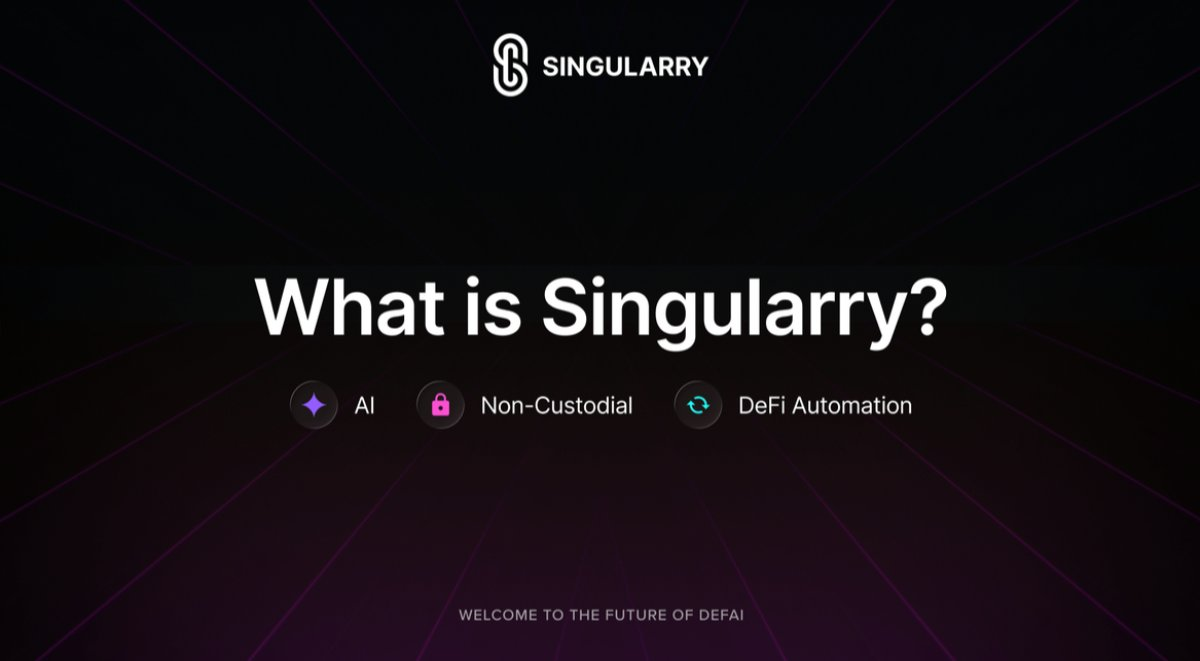
Unlike traditional DeFi platforms, which rely on users to act manually, Singularry AI integrates decision-making logic and execution capabilities into AI Agents. Users can give instructions to an Agent through natural language or preset strategies, and the Agent then carries out the corresponding on-chain operations automatically within the authorized scope.
This model is known as DeFAI, the convergence of Decentralized Finance and Artificial Intelligence. The goal of DeFAI is not to replace blockchain, but to improve the efficiency of user participation in financial activities while preserving transparency and self-custody.
How Does the Core Architecture of Singularry AI Work?
The architecture of Singularry AI mainly consists of the Agent Layer, Smart Wallet, Execution Layer, and Memory Layer.
The Agent Layer is responsible for understanding user intent and generating execution plans. For example, when a user requests yield optimization, the Agent analyzes market conditions and develops a suitable strategy.
The Smart Wallet serves as the control center for user assets. The platform uses a non-custodial design, meaning users always retain control of their assets, while the AI Agent only executes operations within the authorized scope.
The Execution Layer is responsible for interacting with on-chain protocols, including transactions, lending, staking, and liquidity management. All operations are completed through smart contracts and recorded on-chain.
The Memory Layer records user preferences, past operations, and strategy execution results, helping the Agent continuously refine its decision-making logic.
What Tasks Can Singularry AI Agent Complete?
The core value of Singularry AI Agent lies in its ability to automate complex on-chain financial activities.
In asset management scenarios, the Agent can automatically adjust the allocation of funds based on the user’s risk preferences. For users seeking stable returns, the Agent may prioritize yield protocols with relatively lower risk.
In yield optimization scenarios, the Agent can monitor changes in returns across different protocols and automatically redirect funds to improve capital efficiency.
For risk control, the Agent can track changes in collateral ratios, market volatility, and liquidity risk. When preset conditions are met, it can take corresponding actions, such as adding collateral or reducing risk exposure.
As more protocols are integrated into the ecosystem, AI Agents may take on more complex tasks in the future, such as cross-protocol coordination and multi-chain asset management.
How Does Singularry Launchpad Enable AI Token Issuance?
In addition to DeFi automation, Singularry AI has also built an AI Launchpad module.
The Launchpad allows users to quickly create token projects with AI tools and complete project parameter configuration, issuance logic design, and community launch processes.
The platform uses a Bonding Curve model for token price discovery. As more market participants join, the token price changes gradually according to a preset curve, creating a relatively transparent issuance mechanism.
After a project meets certain conditions, the system migrates liquidity to a decentralized trading platform, allowing the token to enter a more open market environment.
This mechanism lowers the technical barrier to creating and launching on-chain projects, while also providing a new practical scenario for combining AI Agents with token economies.
What Role Does the SINGULARRY Token Play in the Ecosystem?
SINGULARRY is the core utility token of the platform ecosystem.
At the governance level, holders can participate in decision-making around the ecosystem’s development direction, parameter adjustments, and future feature upgrades.
At the functional level, some advanced Agent services, strategy modules, and ecosystem features may require SINGULARRY for access or fee payment.
At the incentive level, the token also supports ecosystem rewards and community participation incentives, helping drive the continued expansion of the platform network.
As ecosystem applications continue to grow, the role of SINGULARRY within the Agent economy is expected to become even stronger.
How Is Singularry AI Different from Other AI Agent Projects?
AI Agent has become an important development direction in the crypto industry, but different projects focus on different areas.
Some AI Agent projects are mainly built around content generation, social interaction, or virtual characters, while Singularry AI focuses more on financial execution.
Compared with AI tools that only provide analytical suggestions, Singularry AI places greater emphasis on the complete path from “decision-making” to “execution,” allowing Agents to directly participate in on-chain activity.
In addition, Singularry AI integrates smart wallets, yield management, and a Launchpad into a unified ecosystem, forming a complete DeFAI infrastructure that covers both asset management and project issuance.
Advantages and Potential Challenges of Singularry AI
Singularry AI’s advantages lie in its high level of automation, transparent non-custodial design, and deep integration between AI Agents and DeFi.
For everyday users, Agents can lower the learning curve and reduce the complexity that comes with frequent manual operations.
However, DeFAI is still a relatively new development direction. The decision-making logic of AI Agents, smart contract security, and risks from underlying protocols remain ongoing concerns across the industry.
In addition, maintaining the right balance between automation and user control is an important area that future DeFAI platforms will need to keep improving.
Conclusion
As a DeFAI platform built around AI Agents, Singularry AI creates a complete on-chain financial ecosystem through intelligent agents, non-custodial wallets, automated yield strategies, and an AI Launchpad. Compared with traditional DeFi tools, Singularry AI places greater emphasis on AI’s ability to autonomously execute on-chain operations, allowing users to participate in complex digital asset activities more efficiently.
FAQs
What Is the Difference Between DeFAI and Traditional DeFi?
Traditional DeFi mainly relies on users to perform operations manually, while DeFAI introduces AI Agents into the analysis, decision-making, and execution process, improving operational efficiency and lowering the barrier to use.
Does Singularry AI Custody User Assets?
Singularry AI uses a non-custodial architecture. User assets remain in personal wallets, and the platform does not directly control user funds.
What Tasks Can Singularry AI Agent Execute?
Singularry AI Agent can execute tasks such as yield optimization, asset allocation, risk monitoring, automated lending management, and multi-protocol interaction.
What Is the SINGULARRY Token Used For?
SINGULARRY is mainly used for ecosystem governance, feature access, platform incentives, and payment for certain Agent service fees. It is an important part of the platform’s economic system.
What Is the Biggest Difference Between Singularry AI and Other AI Agent Projects?
The core feature of Singularry AI is its focus on on-chain financial execution. Compared with AI Agent projects that emphasize content generation or social interaction, Singularry AI is more focused on asset management, yield strategies, and DeFi automation scenarios.