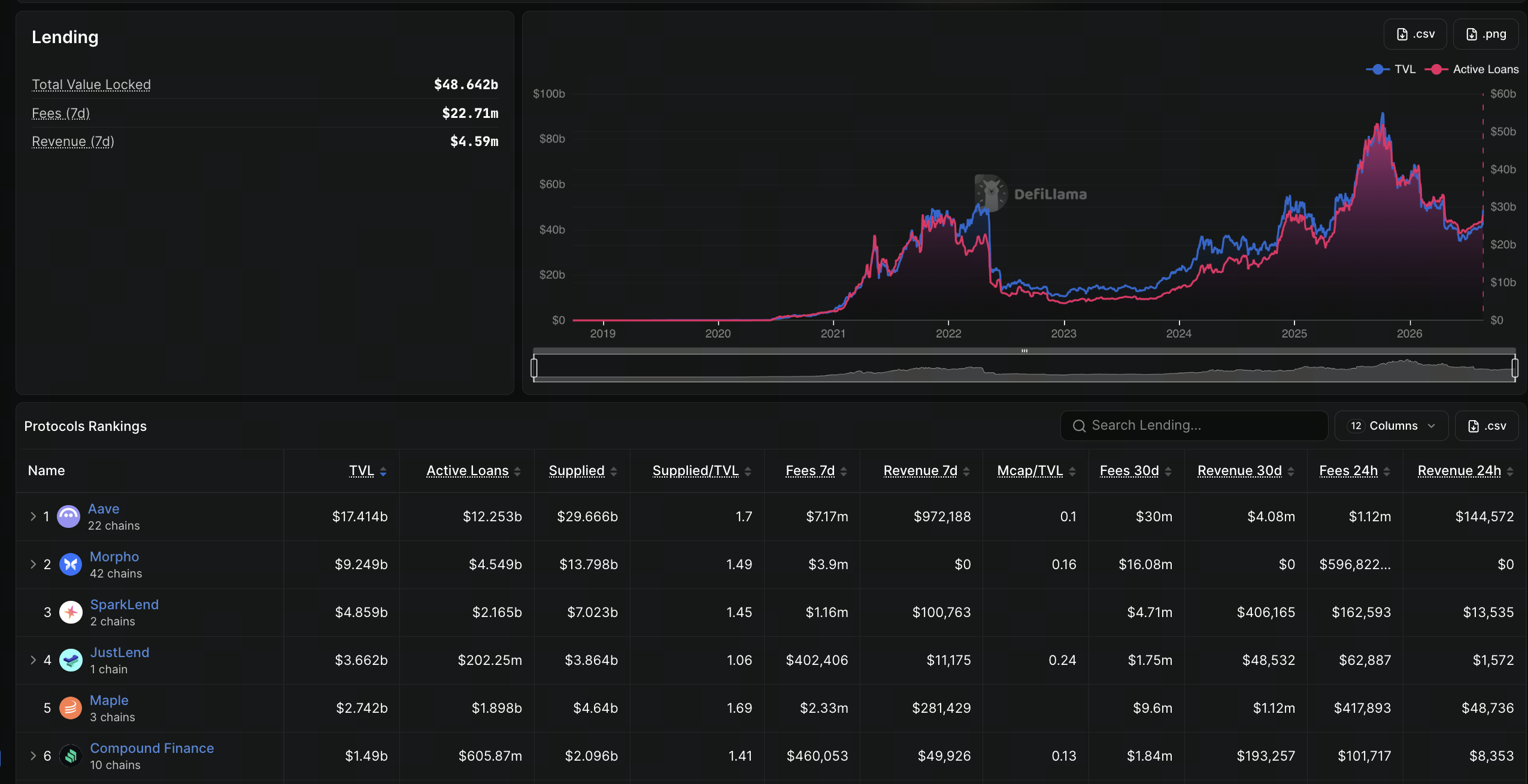
Aave, Morpho and SparkLend are the three largest crypto lending protocols by Total Value Locked (TVL) in 2026, followed by JustLend, Maple and Compound. In practice, crypto lending protocols are DeFi platforms where users supply crypto assets to earn variable yield or borrow against collateral through blockchain-based smart contracts.
For sophisticated crypto traders, investors and active DeFi users comparing where to lend or borrow, market size is only one input. As of August 2026, DefiLlama tracks approximately $48.64 billion in TVL across DeFi lending protocols, with Aave at roughly $17.4 billion, Morpho at $9.25 billion and SparkLend at $4.86 billion.
This comparison looks at the leading protocols by TVL and breaks down the details that actually change the decision: lending-market design, collateral rules, interest-rate models, governance, chain support, security considerations and risk management. DeFi lending is a core part of the onchain economy because it lets users earn yield or access liquidity without traditional intermediaries, but supplied assets still carry smart-contract, liquidity, oracle, collateral and governance risk.
Key Takeaways
Aave is currently the largest DeFi lending protocol, with approximately $17.4 billion in TVL.
Morpho has become the second-largest lending protocol through permissionless isolated markets and curated vaults.
SparkLend, JustLend, Maple, Compound, Venus, Kamino, Jupiter and Lista round out the current top 10 by TVL.
Most permissionless DeFi borrowing is overcollateralized, but collateral requirements vary widely by asset and protocol.
TVL alone does not indicate safety. Users should also evaluate liquidity, collateral rules, oracle design, smart-contract security, liquidation mechanics and yield sources.
How We Selected the Top DeFi Lending Protocols
This list primarily reflects current DefiLlama TVL rankings, supplemented by qualitative factors that affect lenders and borrowers.
TVL and Liquidity
Higher TVL can indicate deeper lending markets and greater available liquidity, although TVL should not be treated as a direct measure of safety.
For lenders, deeper liquidity may make withdrawals easier when sufficient assets remain unborrowed. For borrowers, deeper markets can support greater borrowing capacity.
Security Track Record
Relevant considerations include:
independent smart-contract audits;
bug-bounty programs;
formal verification where applicable;
historical exploits or bad-debt events;
security modules and emergency controls.
No audit guarantees that a protocol is secure.
Supported Assets and Networks
decentralized lending protocols differ substantially in supported collateral, borrowing assets, and blockchain deployments because they operate on blockchain networks using smart contracts. That structure lets users borrow and lend digital assets without centralized intermediaries, with blockchain technology replacing much of the traditional operational layer.
Aave and Morpho have broad multi-chain footprints, while Kamino and Jupiter focus primarily on Solana and JustLend is concentrated on TRON.
Interest-Rate Design
Many pooled lending protocols use dynamic, algorithmic interest rates in liquidity pools that adjust with supply, demand, and utilization as more borrowed assets are taken from the pool, which can raise borrowing costs.
However, rate structures are not universal. Maple, for example, combines on-chain infrastructure with professionally underwritten institutional loans and other managed strategies. Many DeFi lending protocols determine interest rates algorithmically rather than setting them manually.
Risk Management
Important features include:
maximum loan-to-value ratios;
liquidation thresholds;
isolated markets;
supply and borrow caps;
oracle design;
collateral concentration limits.
In pooled markets, over collateralization is typically required to secure loans from liquidity pools.
Collateral requirements vary widely. There is no universal rule that borrowers must provide 1.5–3 times the value of their loan, but protocols do set collateral ratios to protect lenders against market volatility, and the liquidation process begins if collateral value falls below protocol thresholds.
Governance
Governance determines how parameters, markets and incentives may change.
Some protocols rely heavily on token-holder governance, while others deliberately limit governance powers or delegate risk management to external curators.
Composability
Lending protocols often integrate with:
decentralized exchanges;
yield vaults;
liquid-staking protocols;
leverage products;
aggregators;
stablecoin ecosystems.
These integrations can improve capital efficiency but also introduce additional dependencies.
1. Aave
Aave is the largest DeFi lending protocol by TVL, with approximately $17.4 billion locked and more than $12 billion in active loans at the time of writing.
Users supply assets into Aave’s liquidity pools and can borrow supported assets against collateral while maintaining self-custody through smart-contract interactions.
Aave V3 includes Efficiency Mode, isolated collateral configurations and various risk-management controls designed to improve capital efficiency.
Aave also pioneered flash loans, which allow assets to be borrowed without upfront collateral as long as the borrowing and repayment occur within the same transaction and the funds are used and repay within that same execution.
Its newer Umbrella system is an upgraded version of the legacy Safety Module. Users can stake selected aTokens or GHO and earn incentives while accepting the possibility of slashing if a covered Aave market experiences a deficit.
Why Aave Stands Out
largest current lending TVL;
deep borrowing liquidity;
deployment across 22 chains according to DefiLlama;
flash-loan infrastructure;
established governance and risk-management systems.
Aave’s size does not eliminate liquidation, smart-contract, oracle or collateral risk.
2. Morpho
Morpho is currently the second-largest lending protocol by TVL, with roughly $9.25 billion locked. Unlike traditional lending, these onchain markets let anyone with an internet connection access crypto lending protocols, access liquidity, and use crypto loans if they can use the network and post collateral.
Morpho’s current architecture centers on permissionless isolated lending markets rather than the peer-to-peer optimizer model associated with earlier versions of Morpho.
Each market defines parameters such as:
loan asset;
collateral asset;
oracle;
liquidation loan-to-value ratio;
interest-rate model.
Morpho also supports Vaults, which can allocate deposited assets across selected lending markets according to curator-defined risk controls.
Why Morpho Stands Out
permissionless market creation;
isolated lending-market design;
curated vault strategies;
modular infrastructure;
MORPHO-based governance.
Morpho’s governance is deliberately limited in scope, while individual vault risk management may be delegated to curators and allocators.
3. SparkLend
SparkLend is a major lending market within the Spark and Sky ecosystem, with approximately $4.86 billion in TVL.
Spark currently consists of three major product categories:
Spark Savings;
SparkLend;
Spark Liquidity Layer.
SparkLend receives stablecoin liquidity directly from the broader Sky ecosystem and provides borrowing and lending markets with a strong focus on stablecoins. Its pooled liquidity is supported by supplied liquidity from users and ecosystem sources, and interest rates in decentralized lending adjust based on liquidity pool utilization, so SparkLend’s borrowing and lending rates still move with utilization in its markets even with strong stablecoin supply.
Why SparkLend Stands Out
deep stablecoin liquidity;
close integration with Sky;
connection to Spark Savings and the Liquidity Layer;
large TVL relative to its relatively limited chain footprint.
4. JustLend
JustLend is the largest lending protocol on TRON, with approximately $3.66 billion in TVL.
Users can supply supported TRON-based assets and borrow against collateral through pooled lending markets.
TRON’s large USDT footprint makes JustLend particularly important for stablecoin liquidity within that ecosystem.
JustLend also offers TRON-specific services such as Energy Rental, allowing users to obtain energy resources used for network transactions.
Why JustLend Stands Out
largest TRON lending protocol;
deep integration with TRX and TRON assets;
significant USDT-related liquidity;
TRON Energy Rental services.
5. Maple Finance
Maple is an on-chain credit platform focused largely on institutional lending and professionally managed credit strategies.
Its structure differs substantially from purely automated lending markets such as Aave.
Maple Direct underwrites and manages loans to crypto-native institutional borrowers. Maple’s syrupUSDC and syrupUSDT products provide access to lending strategies that primarily include overcollateralized institutional loans, alongside strategies such as futures basis trading and selected DeFi liquidity deployments.
Why Maple Stands Out
institutional underwriting;
professionally managed lending;
secured lending strategies;
transparent on-chain monitoring;
syrupUSDC and syrupUSDT integrations across DeFi.
Maple introduces credit and underwriting risk in addition to standard smart-contract and liquidity risks. Its own documentation explicitly notes default and loss risks.
6. Compound Finance
Compound is one of the earliest major DeFi lending protocols and currently has approximately $1.49 billion in TVL.
Compound III, also known as Comet, uses individual markets centered around a single base borrowing asset, with liquidity pools facilitating automated lending and borrowing through smart contracts around that core asset.
Current Compound III deployments include markets based on assets such as:
USDC;
USDS;
USDT;
WBTC;
WETH;
wstETH;
USDe.
These markets operate across Ethereum and several EVM-compatible networks.
Venus is one of the largest lending protocols associated with the BNB Chain ecosystem, with approximately $1.25 billion in aggregate TVL across eight chains.
Users can supply collateral, borrow supported assets and participate in isolated markets.
The XVS token supports Venus governance.
Why Venus Stands Out
strong BNB Chain liquidity;
broad collateral support;
isolated lending markets;
multi-chain expansion.
Historical bad-debt and security events remain relevant when assessing Venus’s risk profile.
8. Kamino Lend
Kamino Lend is one of Solana’s largest lending protocols, with approximately $1.17 billion in TVL and almost $1 billion in active loans according to DefiLlama.
Kamino combines lending with leverage and capital-efficiency tools tailored to the Solana ecosystem.
Why Kamino Stands Out
large Solana lending market;
integrated borrowing and leverage;
capital-efficient lending design;
close integration with Solana DeFi.
9. Jupiter Lend
Jupiter Lend has become another major Solana lending venue, with approximately $1.06 billion in TVL and roughly $892 million in active loans.
Its Earn product allows users to supply assets into lending pools, while Borrow and Multiply use that liquidity for collateralized borrowing and leverage.
Jupiter also uses features such as:
partial liquidations;
dynamic borrow and withdrawal limits;
isolated vaults;
cross-asset borrowing;
Multiply and pre-built leveraged strategies.
Why Jupiter Lend Stands Out
integration with Jupiter’s wider Solana ecosystem;
shared lending-liquidity infrastructure;
partial-liquidation design;
integrated leverage products.
10. Lista Lending
Lista Lending currently ranks tenth among lending protocols by DefiLlama TVL, with approximately $823 million locked.
Lista operates primarily within the BNB Chain ecosystem and combines collateralized lending with Lista’s broader stablecoin and liquid-staking infrastructure.
Why Lista Lending Stands Out
significant BNB Chain liquidity;
integration with Lista’s broader ecosystem;
collateralized lending markets;
current top-10 lending TVL.
How to Compare DeFi Lending Protocols
Factor
Why It Matters
TVL and available liquidity
Indicates capital scale and available borrowing or withdrawal liquidity
Active loans
Shows actual borrowing demand
Collateral design
Determines borrowing capacity and liquidation exposure, since the borrowed amount is tied to collateral and borrowers face liquidation risk when collateral value moves against borrowed assets during volatility
Interest-rate model
Determines lender yield and borrowing costs as rates adjust with utilization
Oracle design
Incorrect prices can trigger liquidations or bad debt
Smart-contract security
Vulnerabilities can lead to partial or total losses
Market isolation
Can limit the impact of risky collateral on other markets
Governance
Determines how protocol parameters can change
Chain exposure
Networks, bridges and sequencers introduce additional dependencies
Yield source
Yield may come from borrowers, incentives or managed credit strategies
What Are the Risks of DeFi Lending?
DeFi lending is not equivalent to depositing money in a bank account.
Smart-Contract Risk
Smart contracts can contain vulnerabilities or behave unexpectedly, and those flaws can lead to significant financial losses when users deposit funds into a protocol.
Liquidation Risk
Borrowers can lose collateral when its value falls below a protocol threshold, especially during market volatility and collateral drops; these liquidation mechanisms are designed to cover debt before losses spread to lenders.
Oracle Risk
Incorrect or delayed price feeds can cause positions to be valued incorrectly.
Liquidity Risk
If a large percentage of supplied liquidity is borrowed, withdrawal pressure can rise because a large share of user deposits may already be lent out, so users may temporarily be unable to withdraw their full deposit.
Collateral and Stablecoin Risk
A sharp collateral decline or stablecoin depeg can create liquidations or protocol bad debt, and liquidation occurs when collateral value drops below protocol thresholds after a sharp move or depeg, creating greater risk for loans backed by other assets.
Governance and Operational Risk
Governance decisions, curators, administrators or risk managers may change protocol parameters. Changing global regulations can also affect how some lending platforms operate, even when core activity remains onchain.
Credit Risk
Protocols such as Maple introduce institutional borrower and underwriting risk in addition to standard DeFi risks.
Which DeFi Lending Protocol Is the Largest?
Aave is currently the largest DeFi lending protocol by TVL.
As of August 2026, DefiLlama reports approximately:
Aave: $17.41B
Morpho: $9.25B
SparkLend: $4.86B
JustLend: $3.66B
Maple: $2.74B
The largest protocol is not necessarily the most suitable for every user. Different platforms specialize in different chains, collateral types, lending models and risk profiles.
Final Thoughts
Crypto lending protocols are a core component of DeFi, allowing users to supply assets for yield or borrow against crypto collateral through smart contracts. Aave currently leads the sector by TVL, while Morpho, SparkLend, Maple and newer Solana lenders illustrate how quickly lending-market design continues to evolve.
There is no universally “safest” or “best” DeFi lending protocol. A protocol’s size and audit history are useful considerations, but users should also evaluate the specific market they intend to use, its collateral requirements, oracle design, withdrawal liquidity, liquidation rules and source of yield.
DeFi lending also differs from centralized earning products. Platforms such as Gate offer products including Simple Earn and staking through a centralized platform, while DeFi lending involves direct interaction with blockchain-based protocols and smart contracts. These models carry different operational, custody, smart-contract and counterparty risks and should be evaluated separately.
Author: Ggio
Translator: Sonia
Reviewer(s): KOWEI、Piccolo、Elisa、Jayne
Translation Reviewer(s): Ashely、Joyce
Disclaimer
* The information is not intended to be and does not constitute financial advice or any other recommendation of any sort offered or endorsed by Gate.
* This article may not be reproduced, transmitted or copied without referencing Gate. Contravention is an infringement of Copyright Act and may be subject to legal action.
Yala is a modular Bitcoin DeFi infrastructure that connects BTC liquidity with multi-chain ecosystems through its YU stablecoin and MetaMint protocol. It enables Bitcoin holders to earn native DeFi yields across EVM and non-EVM networks securely and seamlessly.
Sui is a PoS L1 blockchain with a novel architecture whose object-centric model enables parallelization of transactions through verifier level scaling. In this research paper the unique features of the Sui blockchain will be introduced, the economic prospects of SUI tokens will be presented, and it will be explained how investors can learn about which dApps are driving the use of the chain through the Sui application campaign.
Hyperliquid's vision is to develop an on-chain open financial system. At the core of this ecosystem is Hyperliquid L1, where every interaction, whether an order, cancellation, or settlement, is executed on-chain. Hyperliquid excels in product and marketing and has no external investors. With the launch of its second season points program, more and more people are becoming enthusiastic about on-chain trading. Hyperliquid has expanded from a trading product to building its own ecosystem.
CoW Protocol is an intent-based trading protocol that helps users swap crypto through batch auctions and competing solvers rather than direct on-chain order execution. Its design aims to improve price discovery, reduce MEV exposure, and match compatible orders through Coincidence of Wants when possible.
A stablecoin is a cryptocurrency with a stable price, which is often pegged to a legal tender in the real world. Take USDT, currently the most commonly used stablecoin, for example, USDT is pegged to the US dollar, with 1 USDT = 1 USD.