The DeFi ecosystem offers a wide range of yield opportunities and financial tools, but it also comes with a high level of operational complexity. Users often need to move between multiple protocols, continuously monitor changes in returns, manage collateral risk, and adjust asset allocation according to market conditions. This high-frequency and complex management process has become a major barrier for many users entering on-chain finance.
As an important direction of exploration in DeFAI, Decentralized Finance plus Artificial Intelligence, the Singularry Agent aims to use an AI Agent to automatically handle analysis and execution tasks. Compared with traditional automation scripts or yield aggregators, Singularry Agent can do more than execute preset instructions. It also has a certain ability to understand tasks and make decisions, making it an important piece of infrastructure that connects artificial intelligence with on-chain finance.
What Is Singularry Agent?
As an autonomous intelligent agent system within the Singularry AI ecosystem, Singularry Agent is designed to help users complete on-chain financial operations.
Unlike a standard chatbot, Singularry Agent does not simply provide information lookup services. It has actual execution capabilities. Users can express their needs in natural language, such as seeking stable returns, reducing risk exposure, or optimizing asset allocation, and the Agent will create an execution plan based on those goals.
Throughout the process, the Agent acts much like a digital asset management assistant. By analyzing market conditions and on-chain data, it helps users complete complex DeFi tasks.
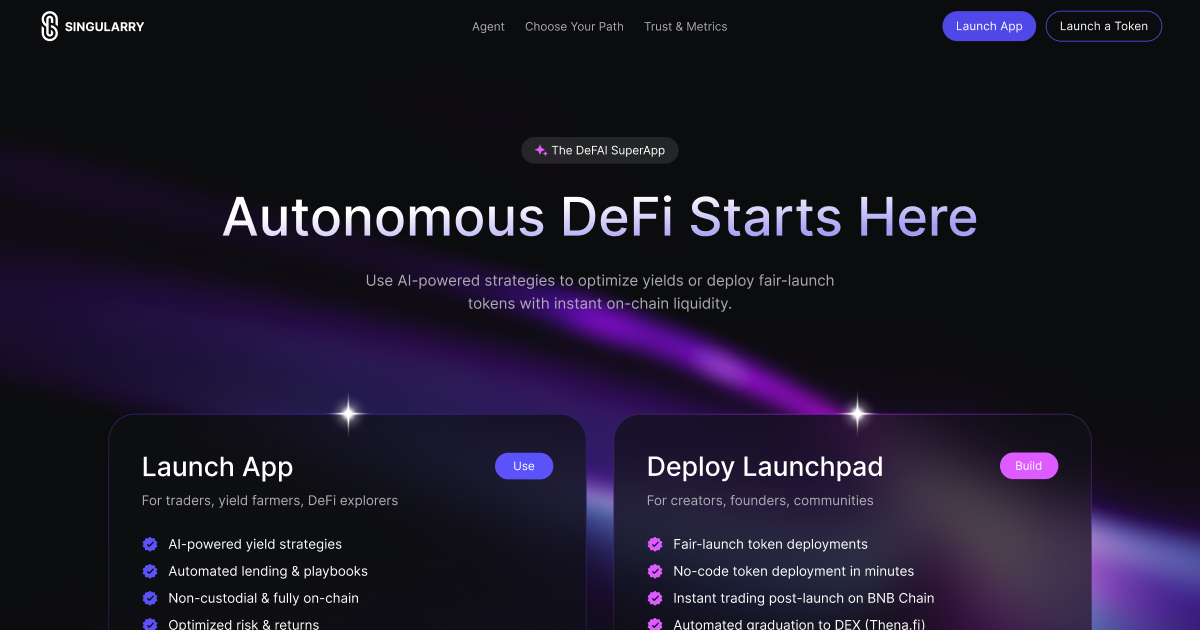
How Do Users Give Tasks to Singularry Agent?
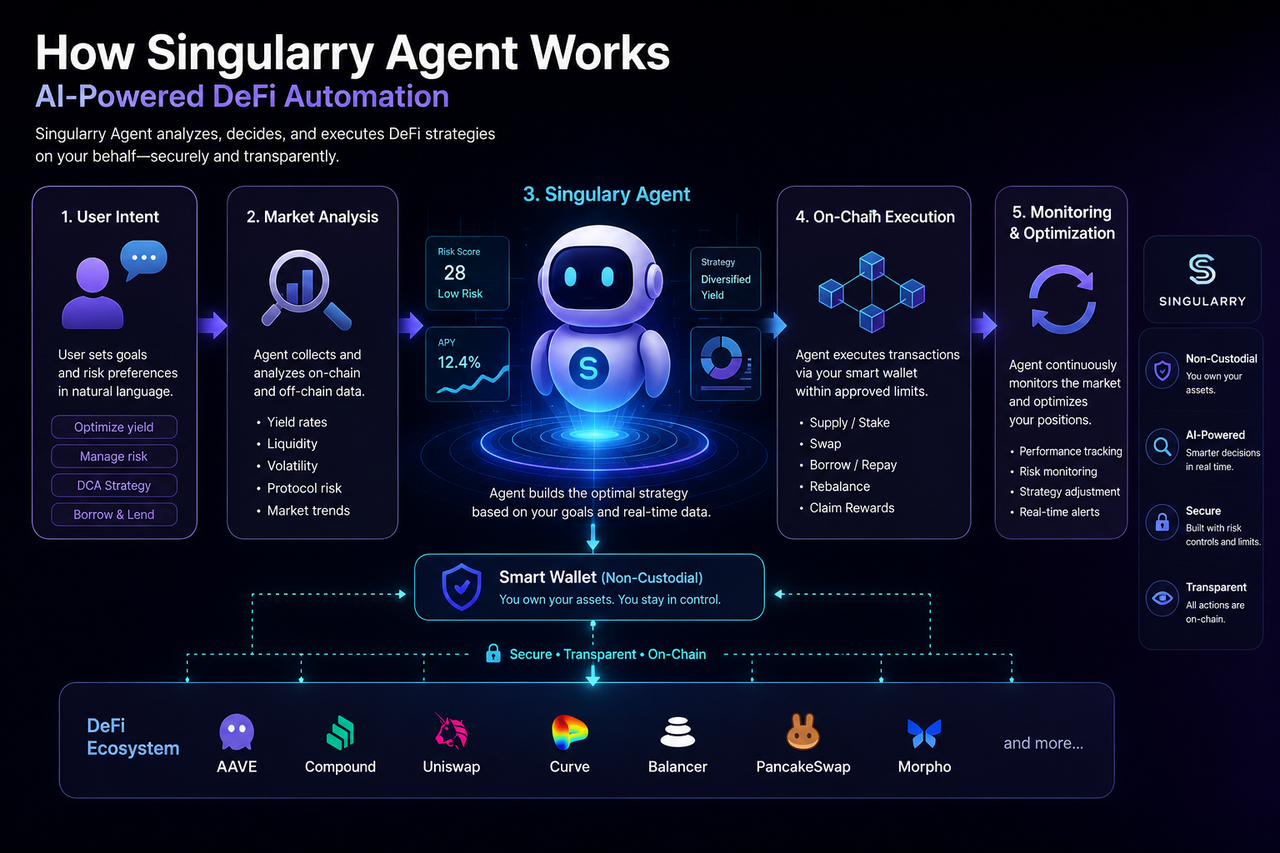
The Singularry Agent workflow begins with the user entering a goal.
Users can describe their needs in natural language, for example:
-
Find relatively stable yield strategies
-
Automatically manage lending positions
-
Make regular recurring investments
-
Control portfolio risk
The system converts these needs into structured tasks and builds an execution framework based on the user’s risk level, capital size, and asset preferences.
The core purpose of this stage is to translate human intent into goals that a machine can understand and execute.
How Does Singularry Agent Analyze the Market Environment?
After receiving a task, the Agent begins collecting and analyzing on-chain data.
This analysis usually covers DeFi protocol yields, liquidity conditions, lending market data, token price volatility, changes in collateral ratios, and risk event monitoring. The Agent then evaluates the suitability of different strategies by weighing these factors together.
For example, when the risk level of a particular yield pool rises significantly, the Agent can reassess its risk-return profile and look for alternatives.
This ability to perform continuous data analysis is one of the key differences between Singularry Agent and traditional automation tools.
How Does Singularry Agent Generate Execution Strategies?
After completing market analysis, the Agent generates a corresponding strategy based on the user’s goals.
If the user wants relatively stable returns, the Agent may prioritize lower-volatility lending protocols or stablecoin yield pools.
If the user is more focused on capital efficiency, the Agent may allocate funds to protocols with higher yields.
The strategy generation process usually takes multiple factors into account, including yield levels, risk ratings, liquidity depth, transaction costs, and historical performance. The end result is an execution plan that matches the user’s objectives.
How Does Singularry Agent Complete On-Chain Operations?
Once a strategy is confirmed, the Agent carries out the actual operations through a smart wallet and smart contracts.
The overall execution process usually includes:
Asset Allocation
The Agent moves funds from their current position to the target protocol.
Protocol Interaction
The Agent completes staking, lending, liquidity provision, or other operations.
Status Verification
The smart contract confirms that the transaction was successful and records the result.
Result Feedback
The system shows the user the execution status and the current state of their assets.
Because all operations take place on-chain, the execution process is verifiable and transparent.
How Does Singularry Agent Control Risk?
Risk control is an important part of the Agent system.
To prevent automation from introducing additional risk, Singularry Agent usually sets up multiple layers of safety mechanisms.
User Authorization Limits
The Agent can only execute operations within the scope authorized by the user.
Risk Threshold Monitoring
When market volatility reaches a preset range, the system triggers an alert or adjusts the strategy.
Collateral Ratio Management
In lending scenarios, the Agent continuously monitors liquidation risk.
Manual Confirmation Mechanism
Some high-risk operations may require the user to confirm again before execution.
Together, these mechanisms ensure that automation does not weaken the user’s control over their assets.
There are already many automated DeFi products on the market, such as yield aggregators and recurring investment bots.
However, most tools can only execute tasks according to preset rules.
The table below shows the main differences between the two models:
| Comparison Dimension |
Singularry Agent |
Traditional Automation Tools |
| User Interaction |
Natural language |
Fixed parameters |
| Task Understanding |
Supported |
Not supported |
| Strategy Adjustment |
Dynamic optimization |
Fixed rules |
| Data Analysis |
Real-time analysis |
Limited analysis |
| Execution Capability |
Multi-protocol coordination |
Single-task execution |
| Risk Management |
Intelligent monitoring |
Preset mechanisms |
In essence, traditional tools are closer to automated execution programs, while Singularry Agent is closer to a digital agent with autonomous decision-making capabilities.
Conclusion
As a core component of the Singularry AI ecosystem, Singularry Agent enables automated DeFi management through AI analysis capabilities, smart wallet authorization mechanisms, and an on-chain execution system. The entire process begins with user goal input, then moves through market analysis, strategy development, risk assessment, and on-chain execution, ultimately helping users complete complex asset management tasks.
FAQs
Does Singularry Agent directly control user funds?
No. Singularry Agent operates under a non-custodial model. User assets always remain in their personal wallets, and the Agent only executes operations within the authorized scope.
How Does Singularry Agent Choose Yield Strategies?
Singularry Agent analyzes data such as yields, liquidity, market risk, and protocol security, then combines this information with the user’s risk preferences to generate a suitable strategy plan.
What Is the Difference Between Singularry Agent and a Yield Aggregator?
Yield aggregators mainly automate operations according to preset rules, while Singularry Agent can understand user goals, dynamically analyze the market, and adjust strategies. As a result, it offers a higher degree of autonomy.
Can Singularry Agent Manage Multiple DeFi Protocols?
Yes. One of the design goals of Singularry Agent is to allocate funds and coordinate strategies across multiple protocols, thereby improving asset utilization efficiency.