As the blockchain industry transitions from a single-chain era to a multi-chain and modular one, assets and users have become scattered across different networks. While cross-chain bridges and interoperability protocols have improved connections between chains, liquidity remains trapped within individual ecosystems, creating countless isolated capital pools.
Liquidity fragmentation has become a major bottleneck for DeFi expansion. With the proliferation of Layer2 solutions, app chains, and modular blockchains, the market increasingly demands an infrastructure capable of unifying cross-chain liquidity management. Programmable liquidity emerged as a key concept in this context.
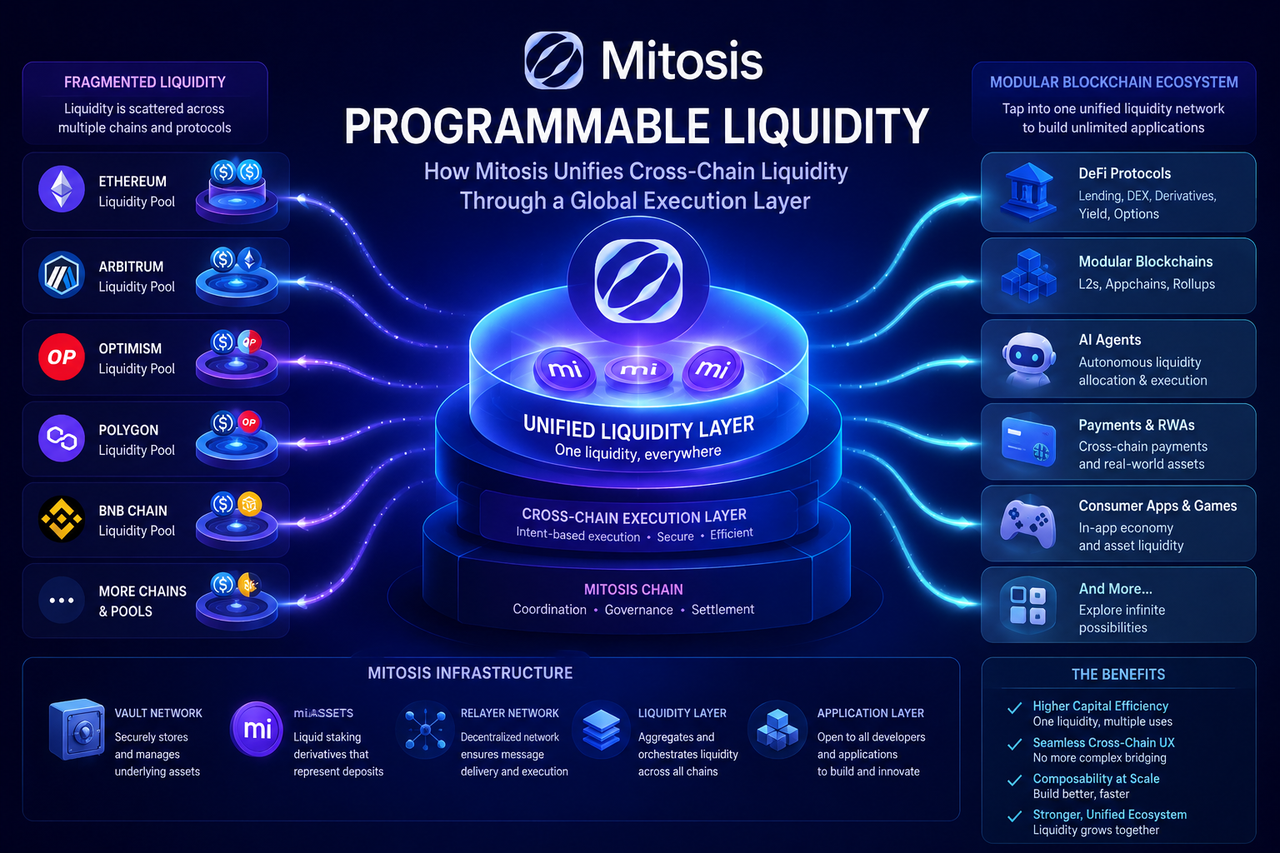
What Is Programmable Liquidity?
Programmable liquidity is a mechanism that enables liquidity resources to be dynamically orchestrated via smart contracts and cross-chain networks. Its core goal is to make liquidity as freely callable and composable as computing resources.
In traditional DeFi, liquidity is typically locked inside a specific protocol. Once assets enter a liquidity pool, their use is restricted. Even when the same asset exists on multiple networks, separate independent markets must be established for each.
Programmable liquidity treats liquidity as a shared resource that can be dynamically configured based on application needs, unlocking a higher level of resource utilization.
What Problems Does the Traditional Liquidity Model Face?
Liquidity fragmentation is one of the most widespread issues in today's DeFi market. As more blockchain ecosystems emerge, the same asset gets fragmented across numerous networks and protocols, continuously diluting market depth.
Insufficient capital utilization is another major challenge. Many assets remain idle in a single liquidity pool for extended periods, unable to support multiple application scenarios at the same time.
Moreover, users must frequently perform cross-chain operations to move funds between ecosystems, increasing both costs and operational complexity.
Why Did Mitosis Propose Programmable Liquidity?
Mitosis believes the most pressing problem in the multi-chain era is not a lack of liquidity, but the inability to utilize it in a unified way.
In the traditional model, each protocol must build its own liquidity sources independently, leading to massive duplication of effort. As ecosystems scale, the cost of acquiring and maintaining liquidity continues to rise.
Mitosis aims to create a unified liquidity layer, allowing developers to directly tap into shared capital without building their own markets from scratch.
How Does Mitosis Implement Programmable Liquidity?
Mitosis builds its liquidity network through multiple infrastructure components. Users first deposit assets into the Vault Network, which manages the underlying assets and tracks liquidity status. The system then generates corresponding miAssets to represent asset rights and liquidity shares.
The cross-chain execution layer coordinates resource allocation across different networks. When an application needs liquidity, the system automatically handles capital deployment and execution according to predefined rules.
This model transforms liquidity from a static capital pool into a dynamically callable network resource.
What Are miAssets?
miAssets are liquidity-mapping tokens within the Mitosis ecosystem, representing users' rights to the underlying assets deposited in the Vault.
When assets enter the system, corresponding miAssets are generated and serve as liquidity coordination instruments across the ecosystem. Developers and applications can further compose and invoke these assets.
Compared to traditional LP Tokens, miAssets emphasize cross-chain interoperability and programmable liquidity, boosting overall capital efficiency.
How Does Programmable Liquidity Improve Capital Efficiency?
Capital efficiency gains are the core value proposition of programmable liquidity.
In the traditional model, each unit of liquidity typically serves only one protocol. Programmable liquidity allows the same capital to be used by multiple applications simultaneously.
For developers, this means access to capital without the need to build separate liquidity markets. For users, assets can participate in more scenarios, reducing the proportion of idle capital.
This unified allocation mechanism effectively reduces capital waste across the ecosystem.
How Is Programmable Liquidity Different from Traditional Cross-Chain Bridges?
Both cross-chain bridges and programmable liquidity involve multi-chain assets, but they solve fundamentally different problems.
Cross-chain bridges aim to transfer assets from one chain to another — they are essentially asset transport tools. Users must actively initiate cross-chain operations to move funds.
Programmable liquidity focuses on how liquidity resources are managed and invoked uniformly. Its emphasis is not on moving assets, but on coordinating and utilizing existing liquidity.
In short, cross-chain bridges solve asset movement, while programmable liquidity solves liquidity utilization.
Potential Use Cases for Programmable Liquidity
Programmable liquidity can provide foundational support for a wide range of Web3 scenarios.
In DeFi, lending, trading, and yield protocols can share a unified liquidity source, improving market depth and capital efficiency.
In modular blockchain ecosystems, new chains can quickly plug into existing liquidity networks without rebuilding markets. For AI agents, on-chain asset management, and institutional capital deployment, programmable liquidity offers more flexible resource allocation.
What Challenges Does Programmable Liquidity Face?
While programmable liquidity improves capital efficiency, it also introduces greater system complexity.
Cross-chain execution involves multiple networks and nodes, requiring accurate asset state synchronization and reliable message delivery. Any execution error could affect the entire liquidity network.
Additionally, a unified liquidity layer typically involves many ecosystem participants, making governance mechanisms and security models critical for long-term protocol success.
Summary
Programmable liquidity is a new infrastructure paradigm that decouples liquidity resources from a single blockchain or protocol and orchestrates them programmatically. Its core goal is to solve liquidity fragmentation in the multi-chain era and improve capital utilization across the entire ecosystem.
Mitosis makes this concept the foundation of its protocol, building a shared liquidity network through the Vault Network, miAssets, and a cross-chain execution layer. Under this architecture, liquidity is no longer a static capital pool but a dynamically configurable network resource, powering the next generation of modular financial infrastructure.
FAQs
What is programmable liquidity?
Programmable liquidity is a mechanism that enables liquidity resources to be dynamically orchestrated, composed, and allocated via smart contracts and cross-chain networks. Its goal is to allow liquidity to be uniformly managed and invoked like computing resources.
How is programmable liquidity different from traditional liquidity pools?
Traditional liquidity pools typically serve a single protocol, while programmable liquidity can be shared across multiple protocols and blockchains. The same liquidity can support more application scenarios, thereby improving capital efficiency.
How does Mitosis implement programmable liquidity?
Mitosis manages assets through the Vault Network, represents liquidity rights with miAssets, and coordinates cross-chain resource allocation via a cross-chain execution layer, achieving unified liquidity management.
What role do miAssets play in programmable liquidity?
miAssets are liquidity-mapping tokens generated by Mitosis. They represent rights to underlying assets and provide a unified standard for cross-chain liquidity coordination.
Can programmable liquidity replace cross-chain bridges?
Programmable liquidity and cross-chain bridges are not substitutes. Cross-chain bridges handle asset transfer, while programmable liquidity handles liquidity coordination and resource management. They serve different layers of need.
Why is programmable liquidity important for the multi-chain ecosystem?
As assets become increasingly fragmented across more blockchain networks, liquidity fragmentation continues to worsen. Programmable liquidity can unify these dispersed resources, improve capital utilization, and reduce cross-chain costs for both developers and users.







