Unlike traditional cross-chain bridges that require step-by-step asset transfers, Mitosis focuses more on unified liquidity management and scheduling. Through the coordinated operation of the Vault, miAssets, Relayer Network, and Execution Layer, Mitosis consolidates liquidity scattered across different blockchains into shared resources, thereby boosting capital efficiency and reducing cross-chain interaction complexity.
As a key practitioner of the Programmable Liquidity concept, Mitosis's value lies not only in connecting different blockchains but also in enabling unified scheduling of liquidity across these chains.
Overview of Mitosis's Operational Flow
Mitosis's operational mechanism can be summarized in four phases: asset deposit, liquidity mapping, cross-chain coordination, and application execution.
First, users deposit assets into the Vault Network. The system then generates corresponding miAssets, which act as mapping certificates for the underlying liquidity. Next, the cross-chain execution layer synchronizes state information between different networks and schedules liquidity resources based on application needs. Finally, the target application invokes the unified liquidity layer to execute transactions, lending, or other on-chain operations.
Compared to traditional cross-chain solutions, Mitosis emphasizes unified liquidity utilization rather than frequent asset movement.
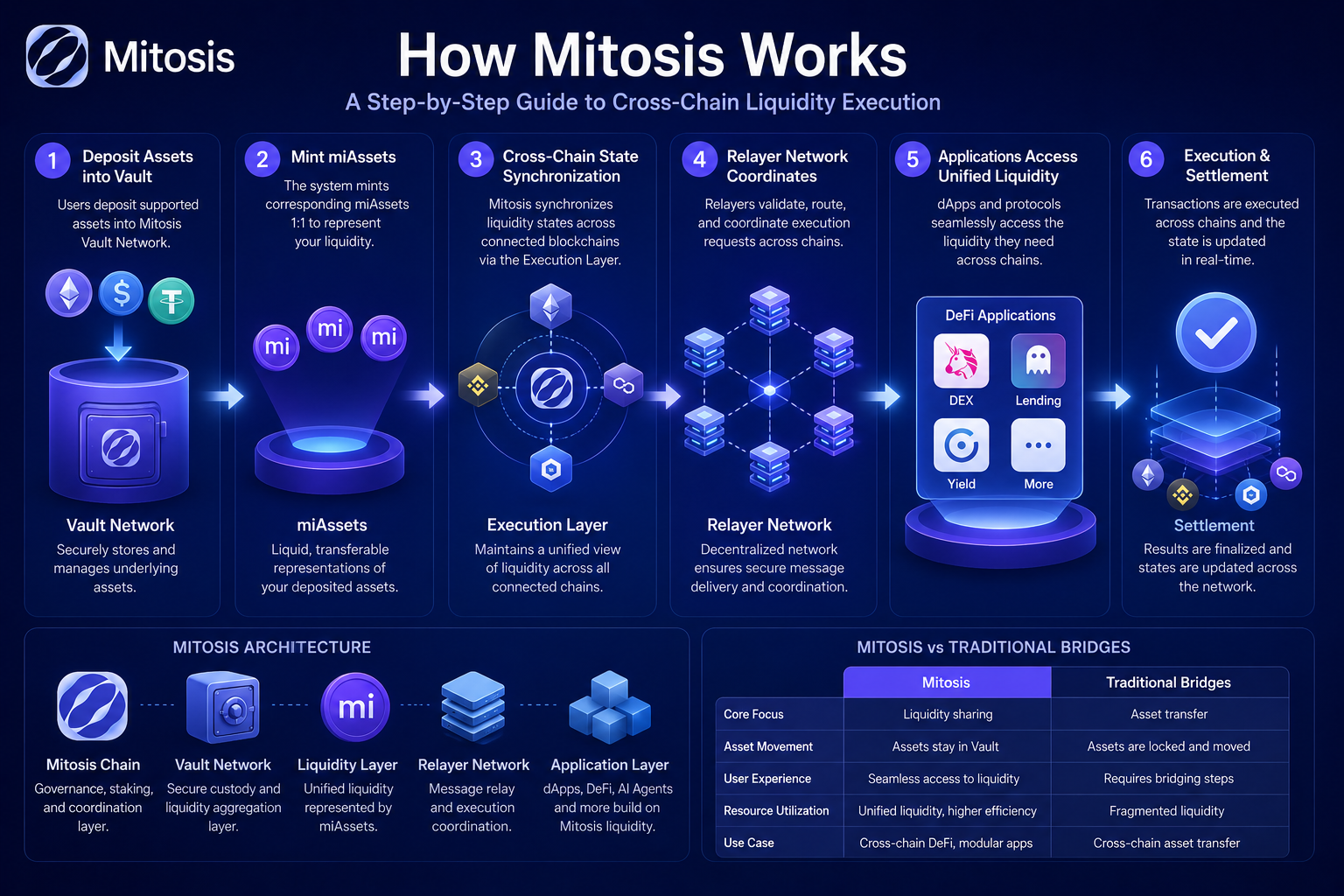
Step 1: Users Deposit Assets into the Vault Network
A Mitosis liquidity flow typically begins with asset deposits.
Users can deposit ETH, stablecoins, or other supported assets into the Vault Network. The Vault acts as a liquidity infrastructure layer, responsible for custodianship of underlying assets and recording ownership state.
When assets enter the Vault, they are not immediately transferred to multiple blockchains; rather, they are managed as part of a unified liquidity pool. This avoids the costs and risks associated with repeated bridging.
From an architectural standpoint, the Vault Network is the starting point of Mitosis's unified liquidity.
Step 2: The System Generates miAssets
After assets enter the Vault, the system generates corresponding miAssets.
miAssets are liquidity-mapping assets in the Mitosis ecosystem, representing the equity of user-deposited underlying assets. Each miAsset maintains a mapping relationship with its corresponding asset and can circulate and be used throughout the network.
This design standardizes the expression of liquidity. Applications on different chains can invoke corresponding liquidity resources through miAssets without directly accessing underlying assets.
Thus, miAssets are not only deposit certificates but also an essential component of the liquidity coordination mechanism.
Step 3: Cross-Chain Execution Layer Synchronizes Liquidity State
After generating miAssets, the system must ensure that the entire network can identify and invoke these liquidity resources.
Mitosis's cross-chain execution layer connects multiple blockchain ecosystems and synchronizes liquidity state. When user assets enter the system, relevant information is recorded and propagated to other participating nodes in the network.
This process is more than simple information transmission; it establishes a unified liquidity view. Regardless of which chain an application is deployed on, it can perceive and invoke the same set of liquidity resources.
This mechanism enables Mitosis to overcome single-chain liquidity limitations.
Step 4: Relayer Network Coordinates Execution Requests
When an application needs to invoke liquidity, execution requests are sent to the Relayer Network.
Relayer nodes receive requests, verify state, and coordinate cross-chain execution. They act as a scheduling center within the network, ensuring that different chains allocate resources according to uniform rules.
For example, when a lending protocol deployed on Layer2 needs to invoke liquidity from another chain, the Relayer coordinates the corresponding resources and triggers subsequent execution logic.
The entire process is completed automatically by protocol rules, requiring no manual user intervention.
Step 5: Applications Invoke the Unified Liquidity Network
After state verification, applications can invoke the corresponding liquidity resources.
For developers, Mitosis provides a unified liquidity interface rather than multiple independent pools. Applications simply connect to the Mitosis network to access liquidity support from multiple ecosystems.
This means new protocols do not need to build liquidity markets from scratch or establish separate connections with multiple chains.
The unified liquidity network lowers the development barrier while increasing market depth.
Step 6: Execution Results Return and Settlement Completes
After on-chain operations execute, results are returned to the corresponding network and the overall system state is updated.
Whether it is lending, trading, or yield strategy execution, the final results are synchronized to the Vault Network and the execution layer, ensuring consistency of liquidity state.
The entire process forms a closed loop, ensuring that subsequent applications can continue invoking the latest state of liquidity resources.
This design enables Mitosis to maintain a unified ledger view and execution logic in a multi-chain environment.
A Typical Mitosis Liquidity Execution Example
Suppose a user deposits ETH into the Mitosis Vault.
The system first generates corresponding miETH and records related equity information. Then, a DeFi protocol deployed on another chain requests liquidity support from Mitosis.
After receiving the request, the Relayer Network verifies the state and coordinates liquidity invocation through the cross-chain execution layer. The protocol ultimately obtains the required funds, while the underlying ETH remains managed by the Vault.
For users, this process requires no manual asset bridging or repeated fund transfers between multiple networks.
Process Differences: Mitosis vs. Traditional Cross-Chain Bridges
The biggest difference between Mitosis and cross-chain bridges lies in execution logic.
Traditional cross-chain bridges typically follow a "lock assets — generate mapped assets — transfer to target chain" process. Each cross-chain operation requires separate asset migration.
Mitosis adopts a "unified custody — unified mapping — unified invocation" model. Assets do not need to move frequently; applications directly access shared liquidity resources.
The core differences between the two models are as follows:
| Comparison Dimension |
Mitosis |
Traditional Cross-Chain Bridge |
| Core Goal |
Liquidity sharing |
Asset transfer |
| Asset State |
Unified management |
Multi-chain dispersion |
| User Operation |
Invoke liquidity |
Manual bridging |
| Resource Utilization |
Shared liquidity pool |
Independent cross-chain assets |
| Key Problem Solved |
Liquidity fragmentation |
Inter-chain asset transfer |
Why Does This Process Improve Capital Efficiency?
Capital efficiency improvement stems from the unified utilization of liquidity.
In the traditional model, each protocol must build its own liquidity pool, often locking the same asset repeatedly across different markets.
Mitosis allows multiple applications to share the same set of liquidity resources, reducing duplication costs and improving capital utilization.
For new protocols, connecting to the unified liquidity layer means faster access to market depth; for users, assets can participate in more scenarios, reducing idle funds.
Conclusion
Mitosis's cross-chain liquidity execution process is jointly executed by the Vault Network, miAssets, Relayer Network, and cross-chain execution layer. After users deposit assets, the system generates liquidity-mapping assets and coordinates resource invocation between different blockchains through the unified execution network.
Unlike traditional cross-chain bridges that focus on asset transfer, Mitosis focuses on the unified management and shared use of liquidity. Through a programmable liquidity architecture, Mitosis integrates capital resources scattered across multiple ecosystems into a unified network, providing more efficient liquidity infrastructure for multi-chain DeFi and modular blockchains.
FAQs
What steps are involved in Mitosis's operational flow?
Mitosis's core flow includes asset deposit into the Vault, generation of miAssets, cross-chain state synchronization, Relayer coordination execution, application invocation of liquidity, and final settlement update.
What is the responsibility of the Vault Network in Mitosis?
The Vault Network is responsible for custodianship of user assets and maintaining liquidity state, serving as the foundational layer of the entire Mitosis liquidity network.
What is the role of the Relayer Network?
The Relayer Network verifies state information, coordinates cross-chain requests, and triggers execution processes, ensuring cooperative operation between different blockchains.
What is the biggest difference between Mitosis and cross-chain bridges?
Cross-chain bridges primarily address asset transfer, while Mitosis primarily addresses liquidity sharing. Mitosis allows applications to directly invoke unified liquidity resources without frequent asset bridging.
Why can Mitosis improve capital efficiency?
Mitosis enables multiple applications to share the same set of capital resources through a unified liquidity layer, reducing the need for duplicate liquidity pool construction, thereby improving capital utilization across the entire ecosystem.







