In a multi-chain ecosystem, users and liquidity are scattered across different blockchains, making it hard for applications to reach users on all chains uniformly. Traditional cross-chain bridges typically focus on single-asset transfers and often have fixed, non-customizable security models. Hyperlane positions itself as an open, modular, permissionless interoperability layer, allowing developers to independently deploy contracts, configure relayers and validators, and choose separate security modules for each message.
From a digital asset standpoint, Hyperlane decouples General Message Passing (GMP) from asset routing (Warp Route). The native HYPER token handles protocol economic security and incentive distribution. Users can perform cross-chain asset operations via the Nexus Bridge, track message status through the Explorer, and stake HYPER to receive stHYPER liquid staking certificates, contributing to the economic security of the Symbiotic vaults.
What Is Hyperlane? How Does It Relate to Cross-Chain Bridges and Interoperability Layers?
As an open interoperability framework, Hyperlane's core capability is General Message Passing (GMP)—passing arbitrary data between source and destination chains, not limited to token transfers. Cross-chain bridges typically refer specifically to transferring assets from one chain to another. An interoperability layer, on the other hand, is a broader infrastructure encompassing various cross-chain behaviors like messaging, calls, governance voting, and asset routing.
The relationship between Hyperlane and cross-chain bridges: Warp Route is a concrete application for cross-chain asset transfers built on Hyperlane, relying on Mailbox to send cross-chain messages underneath. Unlike bridges with fixed security models, Hyperlane allows each message to specify a different Interchain Security Module (ISM), enabling customizable verification logic. Hyperlane vs LayerZero vs Wormhole distinguishes Hyperlane's modularity across three architectural paths: Mailbox/ISM, Endpoint/DVN, and Guardian/VAA.
| Concept |
Positioning |
Relationship with Hyperlane |
| Cross-Chain Bridge |
Asset cross-chain transfer channel |
Warp Route handles the asset bridging function |
| Interoperability Layer |
Cross-chain communication infrastructure |
Hyperlane is a permissionless interoperability layer |
| GMP |
General cross-chain message passing |
Core messaging mechanism of Hyperlane |
| ISM |
Cross-chain security verification module |
Each message can independently configure its security model |
The table above differentiates three layers: cross-chain bridges focus on asset transfer, interoperability layers provide general communication capabilities, and GMP and ISM are technical components for Hyperlane to achieve customizable security.
How Do Mailbox and ISM Work? How Are Cross-Chain Messages Verified?
Mailbox is the core smart contract deployed by Hyperlane on each supported chain, providing an on-chain API for sending and receiving cross-chain messages. When an application calls Mailbox's dispatch function to send a message, the message is written into an incremental Merkle tree and triggers an on-chain event. The relayer on the destination chain listens to this event, then calls Mailbox's process function to submit the message and metadata.
Interchain Security Module (ISM) is a smart contract module that verifies the authenticity of cross-chain messages. Before delivering the message, Mailbox passes the message and metadata to the ISM's verify function. Upon successful verification, Mailbox calls the recipient contract's handle function to complete delivery. Hyperlane Cross-Chain Message Flow covers the repeatable four-stage path of dispatch, relayer, and process. ISM and Warp Route further analyzes ISM types like Multisig and Aggregation, along with the division of labor with Warp Route asset routing.
| Component |
Core Function |
Role |
| Mailbox (Source Chain) |
dispatch |
Encode message, write to Merkle tree, emit event |
| Relayer (Off-chain) |
— |
Listen for events, submit process call to destination chain |
| ISM (Destination Chain) |
verify |
Verify message source and integrity |
| Mailbox (Destination Chain) |
process |
Trigger ISM verification and call recipient.handle |
| Receiving Contract |
handle |
Execute cross-chain business logic |
The message header contains fields like version, nonce, sender, destination domain, and recipient, ensuring the message is uniquely identifiable and tamper-proof. The default ISM is secured economically by Hyperlane's validator set. Applications can also deploy custom ISMs to implement multisig, optimistic verification, or zero-knowledge proof modes.
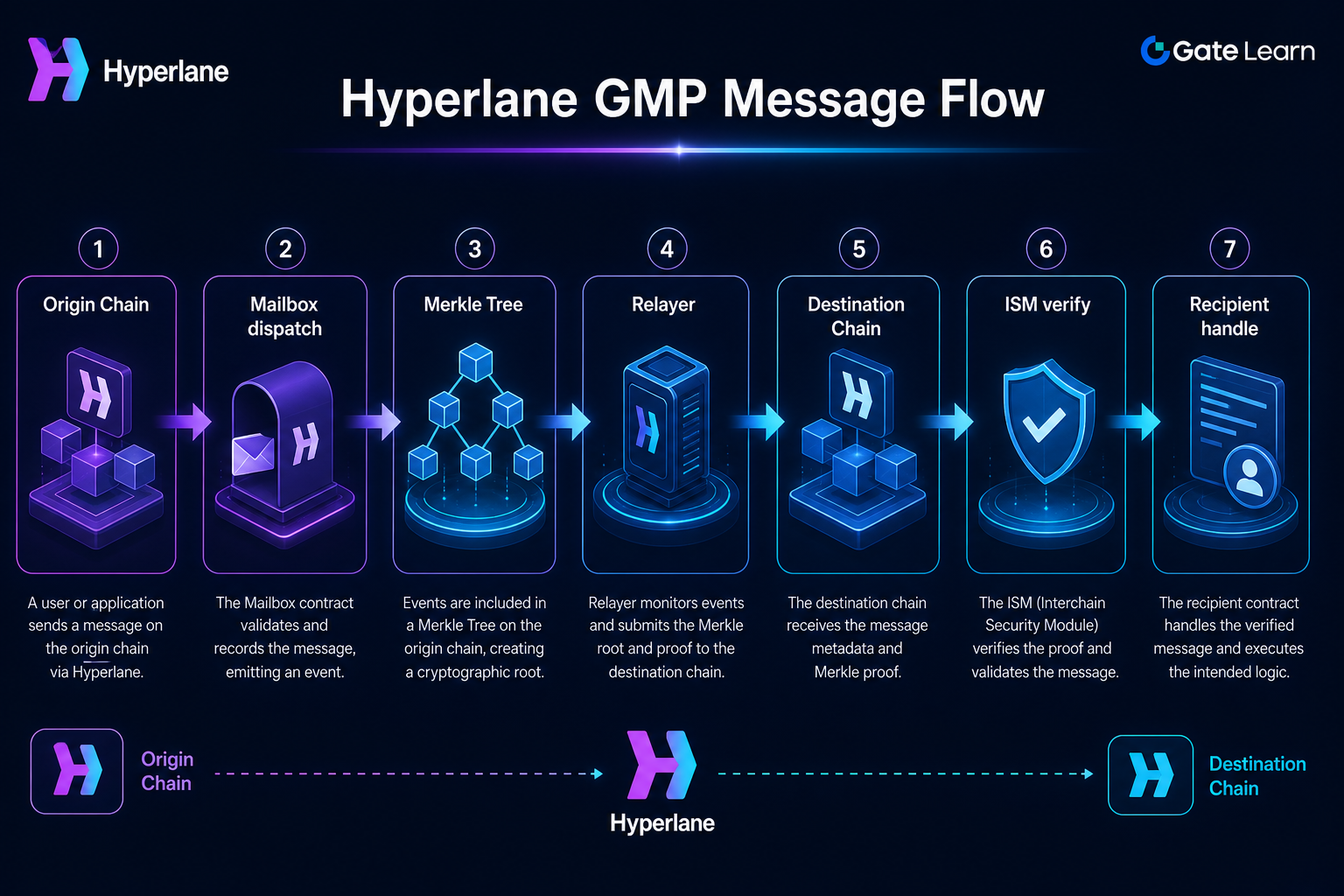 Figure 1. Hyperlane GMP message flow: Complete path from Mailbox dispatch on the source chain, through relayer and ISM verification, to recipient handle on the destination chain.
What Are Warp Route and Nexus Bridge? How Are Assets Transferred Across Chains?
Hyperlane Warp Route (HWR) is a modular cross-chain asset routing system built on Hyperlane Mailbox. Each Warp Route deploys entry/exit contracts on each participating chain, coordinating the locking, minting, burning, or release of tokens through cross-chain messaging. Common types include: collateral (lock ERC-20 on source chain, mint synthetic tokens on destination chain), native (transfer gas tokens like ETH across chains), and Warp Route 2.0 (supporting multi-chain collateral and native rebalancing).
Typical flow: Users deposit tokens into Warp Route on the source chain; the contract sends a cross-chain message via Mailbox. On the destination chain, after ISM verification, the corresponding tokens are minted or released. In reverse, synthetic tokens are burned and collateral is released. Warp Route 2.0 introduces the Rebalancer agent, which can automatically rebalance liquidity across chains.
Nexus Bridge is a cross-chain interface for end users, still using the Mailbox and ISM verification path under the hood. Explorer provides full-chain tracking of messages from dispatch to process.
What Is the HYPER Token? What Role Does It Play in the Protocol Economy?
HYPER is the native functional token of the Hyperlane protocol, used to align ecosystem incentives and support the economic security of cross-chain communication. HYPER is deployed on multiple networks including Ethereum, Base, OP Mainnet, Arbitrum One, and BSC. The Ethereum mainnet contract address is 0x93A2Db22B7c736B341C32Ff666307F4a9ED910F5.
HYPER plays three roles in the protocol economy: Staking provides economic security for the default ISM validator set. As a reward distribution medium, it distributes Staker Rewards, Validator Rewards, and Expansion Rewards to stHYPER holders, default ISM validators, and cross-chain message senders respectively. As a security penalty collateral, validator fraud may trigger slashing, with losses proportionally shared by all stakers. HYPER and stHYPER Staking explains the Symbiotic HYPER Vault, stHYPER certificate, and epoch reward distribution mechanism. HYPER itself does not generate on-chain yield; it must be staked via the Symbiotic vault to obtain stHYPER and then claim Staker Rewards.
How to Stake HYPER? How to Understand stHYPER and Symbiotic?
HYPER staking is done through the HYPER Vault on the Symbiotic platform. Users select the HYPER Vault in the Symbiotic interface and lock HYPER; the vault returns stHYPER as a liquid staking certificate. stHYPER represents the staked HYPER position and can be held on Ethereum and BSC. The Ethereum mainnet stHYPER contract address is 0xE1F23869776c82f691d9Cb34597Ab1830Fb0De58.
stHYPER acts as a Symbiotic liquid staking certificate, allowing users to participate in protocol economic security while maintaining liquidity. The HYPER Vault only delegates to the Hyperlane network and does not restake to other protocols or networks, reducing external slashing risks. Rewards are distributed according to an epoch algorithm, with epoch length matching the maximum settlement delay of the default ISM validator chain.
To unstake, users must actively initiate an unstake request and wait approximately one full epoch before finalizing the withdrawal of HYPER. HYPER in the Symbiotic vault is allocated to the corresponding validator set via the Economic Security Allocation algorithm, proportional to the economic activity of each domain (chain), providing security backing for the default ISM of each chain.
| Token |
Nature |
Deployed Networks |
Generates Rewards? |
| HYPER |
Protocol native token |
Ethereum, Base, OP, Arbitrum, BSC |
No |
| stHYPER |
Symbiotic liquid staking certificate |
Ethereum, BSC |
Yes (Staker Rewards) |
The table above compares the positioning differences between HYPER and stHYPER: HYPER is the native functional token, while stHYPER is a staking certificate with reward eligibility.
Which Chains and Virtual Machines Does Hyperlane Support? How Does the Ecosystem Expand?
The Hyperlane network covers over 150 blockchains and 7 virtual machines, including EVM, Solana (SVM), Cosmos, and custom VM architectures. A single integration provides access to assets and users on mainstream and emerging chains without needing to develop separate bridging logic for each new chain.
The ecosystem adopts permissionless deployment: developers can deploy Hyperlane contracts on new chains themselves, and Hyperlane-as-a-Service provides managed deployment acceleration. Use cases include multi-VM exchange deposits (Paradex), multi-chain stablecoin issuance (M0), and cross-chain governance voting (Aerodrome). Warp Route 2.0's multi-chain collateral and Rebalancer rebalancing lower the barrier for applications to build their own cross-chain infrastructure.
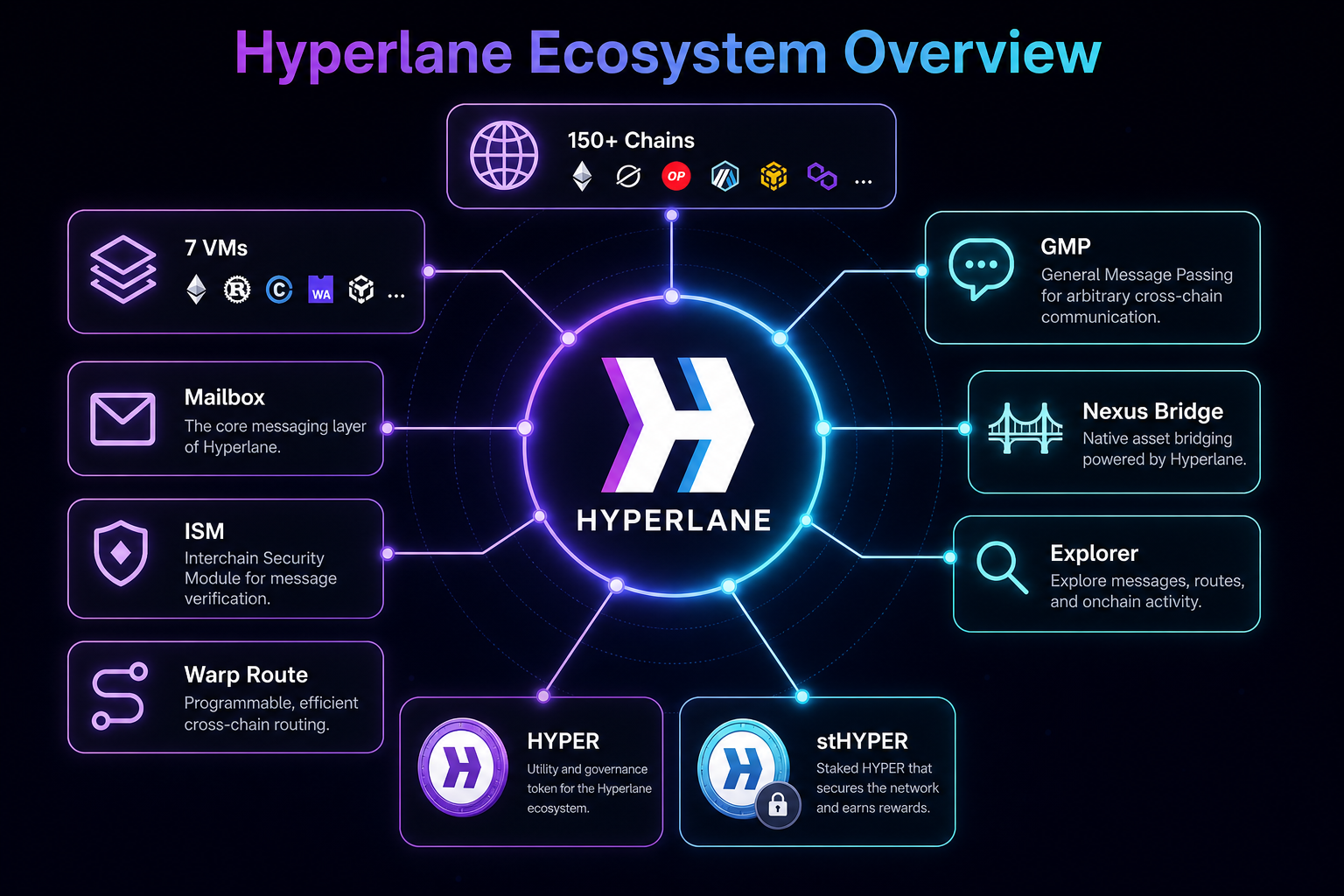 Figure 2. Hyperlane ecosystem overview: Covers 150+ chains, 7 VMs, and core components including Warp Route, Nexus Bridge, Explorer, HYPER, and stHYPER.
What Are the Advantages and Risks of Using Hyperlane or Participating in the HYPER Economy?
Advantages: Hyperlane offers permissionless deployment and modular ISM, allowing developers to customize security models autonomously. Coverage of 150+ chains and 7 VMs reduces multi-chain integration costs. The separation of Warp Route and GMP supports cross-chain governance, voting, and function calls beyond asset transfers. Liquid staking via stHYPER allows participation in economic security without fully locking liquidity.
Limitations: The default ISM validator set has an entry threshold. Unstaking HYPER requires waiting for an epoch cycle. Message delivery depends on relayers and destination chain gas. The Rebalancer is a managed service with operational dependency.
Risks: Validator fraud may trigger HYPER slashing. Improper configuration of custom ISMs may weaken verification strength. Relayer delays may result in undelivered messages. Contract vulnerabilities or counterfeit routes may lead to asset loss. Risks should be distinguished across the messaging layer, asset layer, and economic layer, and on-chain contract addresses should be verified.
Summary
Hyperlane, as a permissionless interoperability protocol, implements GMP via Mailbox, provides customizable cross-chain security via ISM, and completes cross-chain asset routing via Warp Route. HYPER serves protocol economic security and incentive functions, while stHYPER is the Symbiotic liquid staking certificate. Nexus Bridge and Explorer respectively serve user cross-chain operations and message tracking, with the network covering 150+ chains and 7 VMs.
FAQ
What Is Hyperlane?
Hyperlane is a permissionless interoperability protocol that allows developers to send arbitrary cross-chain messages across more than 150 blockchains and 7 virtual machines. Core components include Mailbox (message interface), ISM (security verification), Warp Route (asset routing), and GMP (general message passing).
What Do Mailbox and ISM Do Respectively?
Mailbox is the message sending and receiving contract on each chain. The source chain sends messages via dispatch, and the destination chain delivers them via process. ISM (Interchain Security Module) verifies the authenticity and integrity of messages before delivery. Upon verification, Mailbox calls the recipient's handle function.
What Is the Difference Between Warp Route and Nexus Bridge?
Warp Route is an on-chain cross-chain asset routing contract responsible for locking, minting, burning, or releasing tokens. Nexus Bridge is a user interface built on Warp Route, convenient for end users to perform cross-chain token transfers, still using the Hyperlane message and ISM verification path under the hood.
How Are HYPER and stHYPER Different?
HYPER is the native token of the Hyperlane protocol, with the Ethereum mainnet address at 0x93A2Db22B7c736B341C32Ff666307F4a9ED910F5. stHYPER is a liquid staking certificate obtained by staking HYPER in the Symbiotic HYPER Vault, with the Ethereum mainnet address at 0xE1F23869776c82f691d9Cb34597Ab1830Fb0De58. Holding stHYPER allows claiming Staker Rewards.
What Are the Risks of Staking HYPER?
If default ISM validators commit fraud, slashing may be triggered, with losses proportionally shared by all stakers. Unstaking requires waiting for an epoch cycle, during which liquidity is restricted. Before operating, users should verify the Symbiotic vault and stHYPER contract addresses.
Which Chains and Virtual Machines Does Hyperlane Support?
Hyperlane covers over 150 blockchains and 7 virtual machines, including EVM, Solana, Cosmos, and custom VM architectures. New chains can deploy Hyperlane contracts in a permissionless manner to join the network.







