HYPER is the native functional token of the Hyperlane protocol. Staking through the Symbiotic HYPER Vault generates stHYPER, a liquid staking certificate. stHYPER holders can claim Staker Rewards, default ISM validators can claim Validator Rewards, and cross-chain message senders can earn Expansion Rewards. In the event of validator fraud triggering slashing, losses are borne proportionally by all stakers. HyperStreak increases reward weight based on the continuous stHYPER holding duration.
The economic security of the Hyperlane (HYPER) protocol hinges on the staking and distribution mechanism of its native token, HYPER. HYPER itself does not generate on-chain yield; to participate in Staker Rewards, it must first be locked in a Symbiotic vault to receive stHYPER. Hyperlane (HYPER) outlines the overall framework of the Hyperlane interoperability layer, detailing the division of labor among the Mailbox, ISM, and HYPER's economic security.
The security of a cross-chain interoperability protocol depends not only on the verification logic of the Interchain Security Module (ISM) but also on the economic collateral backing the validator set. ISM and Warp Route explains the ISM's verify mechanism during the process phase on the destination chain, along with the configuration boundaries between the default ISM and custom ISMs. Hyperlane delegates HYPER staking to the default ISM validator set of each domain (chain), providing quantifiable economic constraints for cross-chain message verification.
HYPER serves three functions: providing economic security for the default ISM, acting as the reward distribution medium, and serving as collateral for slashing penalties. Hyperlane Cross-Chain Message Flow covers the repeatable path from dispatch to delivery, helping contextualize Expansion Rewards in relation to message-sending behavior. Rewards are distributed on an epoch-based algorithm, while the HyperStreak mechanism increases Expansion Rewards weight based on consecutive stHYPER holding duration.
What Is HYPER?
HYPER is the native functional token of the Hyperlane protocol, designed to align ecosystem incentives and underpin the economic security of cross-chain communication. It is deployed across multiple networks including Ethereum, Base, OP Mainnet, Arbitrum One, and BSC. The Ethereum mainnet contract address is 0x93A2Db22B7c736B341C32Ff666307F4a9ED910F5.
Within the protocol economy, HYPER fulfills three roles: providing economic security for the default ISM validator set, serving as the distribution medium for Staker, Validator, and Expansion rewards, and acting as collateral for slashing. Validator fraud can trigger slashing, with losses proportionally shared among all stakers.
HYPER does not automatically generate on-chain yield. To earn Staker Rewards, users must lock HYPER in the Symbiotic HYPER Vault and receive stHYPER. The HYPER Vault delegates exclusively to the Hyperlane network and does not restake to other protocols, minimizing external slashing risk.
Token
Nature
Primary Deployment Networks
Direct Reward Generation
HYPER
Protocol native functional token
Ethereum, Base, OP, Arbitrum, BSC
No
stHYPER
Symbiotic liquid staking token
Ethereum, BSC
Yes (Staker Rewards)
The table above summarizes the core differences: HYPER is the native functional token, while stHYPER is a staking certificate entitling holders to rewards. The two are not interchangeable and must be converted via the staking and unstaking process through the Symbiotic vault.
What Is stHYPER?
stHYPER is a liquid staking token (LST) obtained by locking HYPER in the Symbiotic HYPER Vault. It represents a staked HYPER position and can be held on Ethereum and BSC. The Ethereum mainnet stHYPER contract address is 0xE1F23869776c82f691d9Cb34597Ab1830Fb0De58.
As a Symbiotic liquid staking token, stHYPER allows users to participate in Hyperlane's economic security while retaining a degree of liquidity. Holding stHYPER grants eligibility for Staker Rewards, which are distributed on an epoch-based algorithm. Validator Rewards are paid to default ISM validators as commission from Staker Rewards.
When staking, HYPER is deposited into the vault and an equivalent amount of stHYPER is returned. To unstake, users must first initiate an unstake request, wait for approximately one full epoch, and then finalize the withdrawal. stHYPER can circulate in DeFi; transferring or redeeming it may affect the HyperStreak continuous holding record. HYPER in the Symbiotic vault is allocated to validator sets via the Economic Security Allocation algorithm, dynamically aligning staking resources with cross-chain activity on each domain.
How Does the Staking and Unstaking Process Work?
HYPER staking is conducted through the HYPER Vault on the Symbiotic platform. The process can be summarized as: lock HYPER → obtain stHYPER → participate in economic security allocation → claim rewards per epoch.
Staking Process: HYPER holders select the HYPER Vault on the Symbiotic interface and lock their HYPER into the vault contract. The vault returns stHYPER as a staking certificate and delegates the underlying HYPER to the default ISM validator set of each domain via the Economic Security Allocation algorithm. Once staked, stHYPER holders automatically become eligible for Staker Rewards on a per-epoch basis.
Unstaking Process: To unstake, users must actively initiate an unstake operation. After initiation, they must wait for approximately one full epoch period, the length of which matches the maximum settlement delay of the default ISM validator chain. After the waiting period ends, users must manually finalize the withdrawal on the Symbiotic interface to reclaim their HYPER. During this waiting period, the corresponding stHYPER position is locked and liquidity is restricted.
Step
Action
Result
Stake
Select HYPER Vault on Symbiotic and lock HYPER
Obtain stHYPER, participate in economic security allocation
Hold
Maintain stHYPER position
Accumulate Staker Rewards eligibility per epoch; HyperStreak consecutive days increase
Initiate Unstake
Initiate unstake on Symbiotic interface
Enter epoch waiting period
Finalize
Manually finalize after waiting period ends
Reclaim HYPER, stHYPER burned
The table above outlines the complete path for staking and unstaking. The critical point is the epoch waiting period: unstaking is not instant and requires a full epoch cycle before finalization. Before operating, users should verify the Symbiotic vault and stHYPER contract addresses to avoid interacting with counterfeit contracts.
Figure 1. HYPER staking flow: Complete path from locking HYPER in the Symbiotic HYPER Vault, receiving stHYPER, to initiating unstake and finalizing withdrawal.
How Are Staker, Validator, and Expansion Rewards Distributed?
The Hyperlane protocol distributes rewards to three participant categories, corresponding to economic security contribution, validator operations, and protocol usage promotion.
Staker Rewards: Distributed to participants who stake HYPER in the Symbiotic HYPER Vault and hold stHYPER. Rewards are issued at a fixed rate per epoch, calculated based on total stake amount and staking duration. stHYPER holders receive rewards pro-rata according to their staking ratio, minus the Validator Rewards commission.
Validator Rewards: Distributed to members of the default ISM validator set. Validators must complete a survey, register as Operators on Symbiotic, and opt in. Rewards are paid as a commission from Staker Rewards and claimed via claimRewards after obtaining a Merkle proof through the Symbiotic CLI.
Expansion Rewards: Distributed to cross-chain message senders (EOAs) that drive protocol activity. Allocation is based on the relative proportion of message fees exceeding a set threshold, assigned retroactively according to protocol usage. Eligible addresses claim rewards through a dedicated interface.
HyperStreak Mechanism: HyperStreak is a continuous holding incentive within Hyperlane's reward system, tracking the duration a user continuously holds stHYPER. For each consecutive period of holding stHYPER, HyperStreak accumulates. Transferring or redeeming stHYPER may reset the streak. HyperStreak has four levels; higher levels grant greater weight in Expansion Rewards distribution.
HyperStreak Level
Reward Bonus (B)
Distribution Weight
Level 4
0.6
1.60
Level 3
0.4
1.40
Level 2
0.3
1.30
Level 1
0.2
1.20
No Streak
0
1.00
Levels are assigned using a dynamic ranking method: users are ranked by the ratio of their streak duration to the maximum possible streak; the higher the ratio, the higher the level. The Expansion Rewards pool is distributed proportionally based on each user's weight. Users with higher weight receive a larger share, while users without a streak participate with a base weight of 1.00. HyperStreak rewards share the same pool as Expansion Rewards; long-term stHYPER holders gain higher weight in Expansion Rewards distribution.
Figure 2. Hyperlane protocol rewards and slashing structure: Distribution of Staker, Validator, and Expansion rewards and the slashing loss socialization mechanism.
How Does the Slashing Mechanism Work?
Slashing is an economic penalty mechanism used by the Hyperlane protocol to enforce honest validator participation. Stakers of HYPER bear slashing risk: if a security violation occurs within the default ISM validator set, a portion of the HYPER delegated to that chain may be slashed, with losses proportionally shared among all stakers. Hyperlane ties the economic security of the default ISM to HYPER staking, consistent with the modular ISM approach discussed in Hyperlane vs LayerZero vs Wormhole; LayerZero and Wormhole rely on DVN and Guardian networks respectively for verification.
Trigger Conditions: Slashing is triggered when validator fraud is proven on-chain. Each chain deploys the AttributeCheckpointFraud contract, which uses the attribute function to attribute four types of fraud—invalid Merkle tree for Whitelist, premature checkpoint, message ID mismatch, and invalid Merkle root—to specific validators, thereby triggering HYPER Vault slashing.
Penalty Sharing: Slashing losses are socialized among all HYPER stakers. If a certain percentage of HYPER is slashed due to a security violation, all stakers lose the corresponding value of their stHYPER positions at the same rate. This design ensures that the cost of a single validator's fraudulent behavior is borne by the entire staking pool, strengthening collective security incentives.
Execution Path: Fraud proof attribution is completed through on-chain smart contracts. The attribute function of the AttributeCheckpointFraud contract pins responsibility to specific validators based on the violation type and triggers slashing in the HYPER Vault. Slashing decisions are overseen by the Hyperlane Foundation and Security Council, with the long-term goal of fully on-chain execution through trustless ISM and other on-chain modules.
Before participating in HYPER staking, it is crucial to understand the collective risk of slashing: even if an individual does not directly validate, fraudulent behavior by default ISM validators may still result in proportional losses for all stHYPER holders. The HYPER Vault's policy of not restaking to other protocols reduces external slashing contagion risk but cannot eliminate validator fraud risk within the Hyperlane network.
Summary
HYPER, as the native functional token of the Hyperlane protocol, plays three roles: economic security, reward distribution, and security penalties. stHYPER is a Symbiotic liquid staking token whose holders can claim Staker Rewards. Staking is completed through the Symbiotic HYPER Vault, and unstaking requires waiting for an epoch period before finalizing the withdrawal. Rewards are divided into Staker, Validator, and Expansion categories. HyperStreak increases Expansion Rewards weight based on continuous stHYPER holding duration. Slashing is triggered when validator fraud is proven on-chain, with losses socialized among all stakers.
FAQ
What is the difference between HYPER and stHYPER?
HYPER is the native token of the Hyperlane protocol (Ethereum mainnet address: 0x93A2Db22B7c736B341C32Ff666307F4a9ED910F5); it does not generate on-chain rewards by itself. stHYPER is a liquid staking token obtained by staking HYPER in the Symbiotic HYPER Vault (Ethereum mainnet address: 0xE1F23869776c82f691d9Cb34597Ab1830Fb0De58); holding stHYPER allows claiming Staker Rewards.
How do I stake HYPER and obtain stHYPER?
Select the HYPER Vault on the Symbiotic interface and lock HYPER into the vault contract. The vault returns stHYPER as a staking certificate and delegates the underlying HYPER to the default ISM validator set of each domain via the Economic Security Allocation algorithm. The HYPER Vault delegates exclusively to the Hyperlane network and does not restake to other protocols.
What steps are required to unstake HYPER?
First, initiate an unstake on the Symbiotic interface, then wait for approximately one full epoch period. After the waiting period ends, manually finalize the withdrawal to reclaim HYPER. The epoch length matches the maximum settlement delay of the default ISM validator chain; liquidity is restricted during the waiting period.
Who receives Staker, Validator, and Expansion rewards respectively?
Staker Rewards are distributed to stHYPER holders, allocated per epoch and according to staking ratio. Validator Rewards are distributed to members of the default ISM validator set, paid as commission from Staker Rewards. Expansion Rewards are distributed to users and applications that generate cross-chain message fees, assigned retroactively based on the relative proportion of fees exceeding a threshold.
How does HyperStreak affect rewards?
HyperStreak tracks the duration of continuous stHYPER holding across four levels; the higher the level, the greater the weight in Expansion Rewards distribution (maximum 1.60, baseline 1.00 without a streak). Transferring or redeeming stHYPER may reset the streak. HyperStreak rewards share the same pool as Expansion Rewards.
What slashing risks exist for HYPER staking?
If a default ISM validator commits fraud that is proven on-chain, slashing may be triggered, with losses proportionally shared among all HYPER stakers. The four types of fraud include invalid Merkle tree, premature checkpoint, incorrect message ID, and invalid Merkle root. Before operating, verify the Symbiotic vault and stHYPER contract addresses.
Author: Jayne
Translator: Chanya
Disclaimer
* The information is not intended to be and does not constitute financial advice or any other recommendation of any sort offered or endorsed by Gate.
* This article may not be reproduced, transmitted or copied without referencing Gate. Contravention is an infringement of Copyright Act and may be subject to legal action.
Solana faces both opportunities and challenges in its development. Recently, severe network congestion has led to a high transaction failure rate and increased fees. Consequently, some have suggested using Layer 2 and appchain technologies to address this issue. This article explores the feasibility of this strategy.
This article introduces the technical principles, framework, and applications of Zero-Knowledge (ZK) technology, covering aspects from privacy, identity (ID), decentralized exchanges (DEX), to oracles.
Sui is a PoS L1 blockchain with a novel architecture whose object-centric model enables parallelization of transactions through verifier level scaling. In this research paper the unique features of the Sui blockchain will be introduced, the economic prospects of SUI tokens will be presented, and it will be explained how investors can learn about which dApps are driving the use of the chain through the Sui application campaign.
TronScan is the primary blockchain explorer for the TRON network. It allows users to check TRX and TRC-20 transactions, inspect wallet balances, analyze smart contracts, monitor tokens, and view network activity without logging in. By connecting a compatible wallet such as TronLink, users can also transfer assets, stake TRX, vote for Super Representatives, and interact with TRON ecosystem applications.
This article analyzes the tremendous potential for the development of the Layer 2 (L2) market and the accompanying bridging needs among various L2 solutions. It delves into the current status, potential, and risks of the cross-chain protocol Across Protocol in this market.



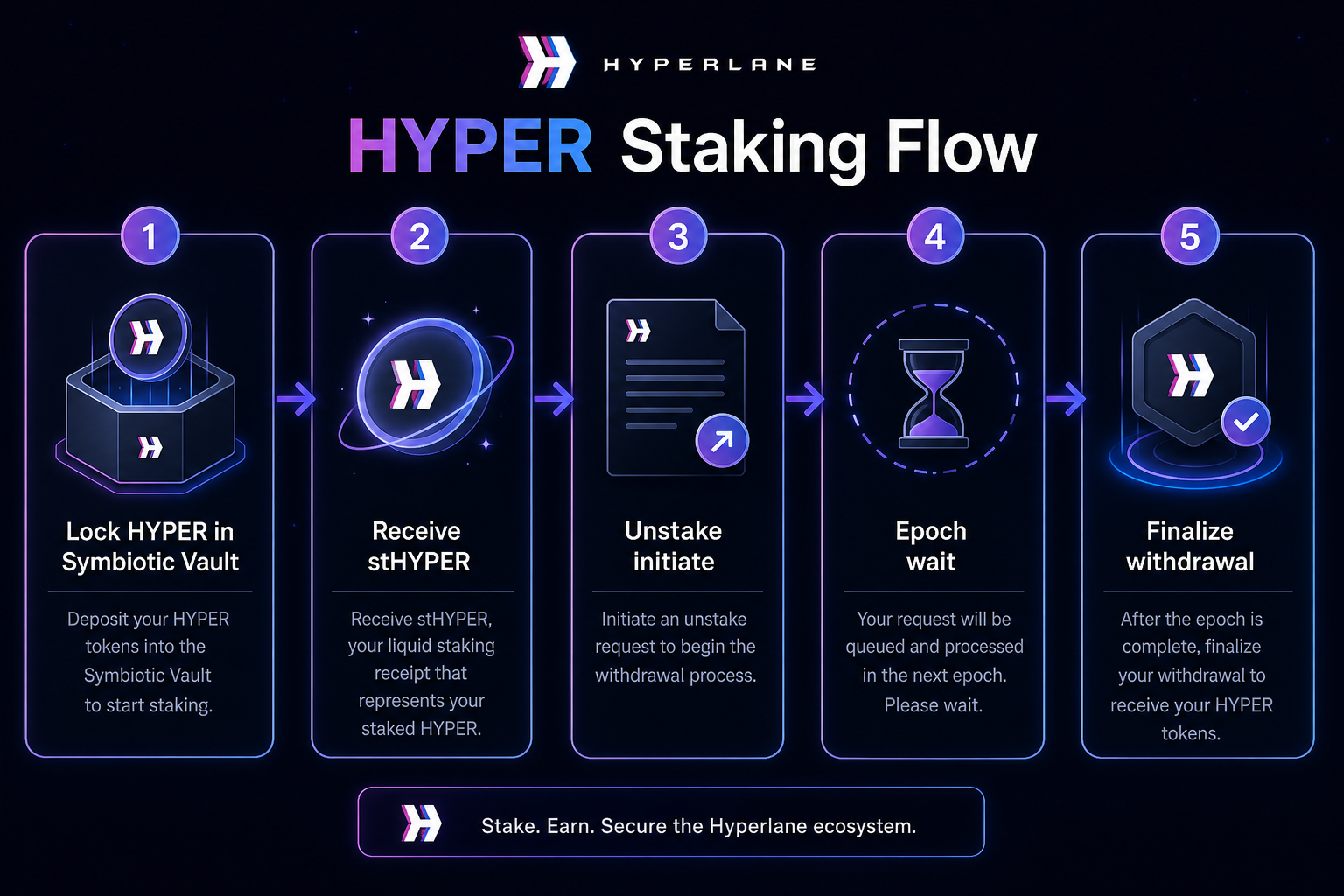 Figure 1. HYPER staking flow: Complete path from locking HYPER in the Symbiotic HYPER Vault, receiving stHYPER, to initiating unstake and finalizing withdrawal.
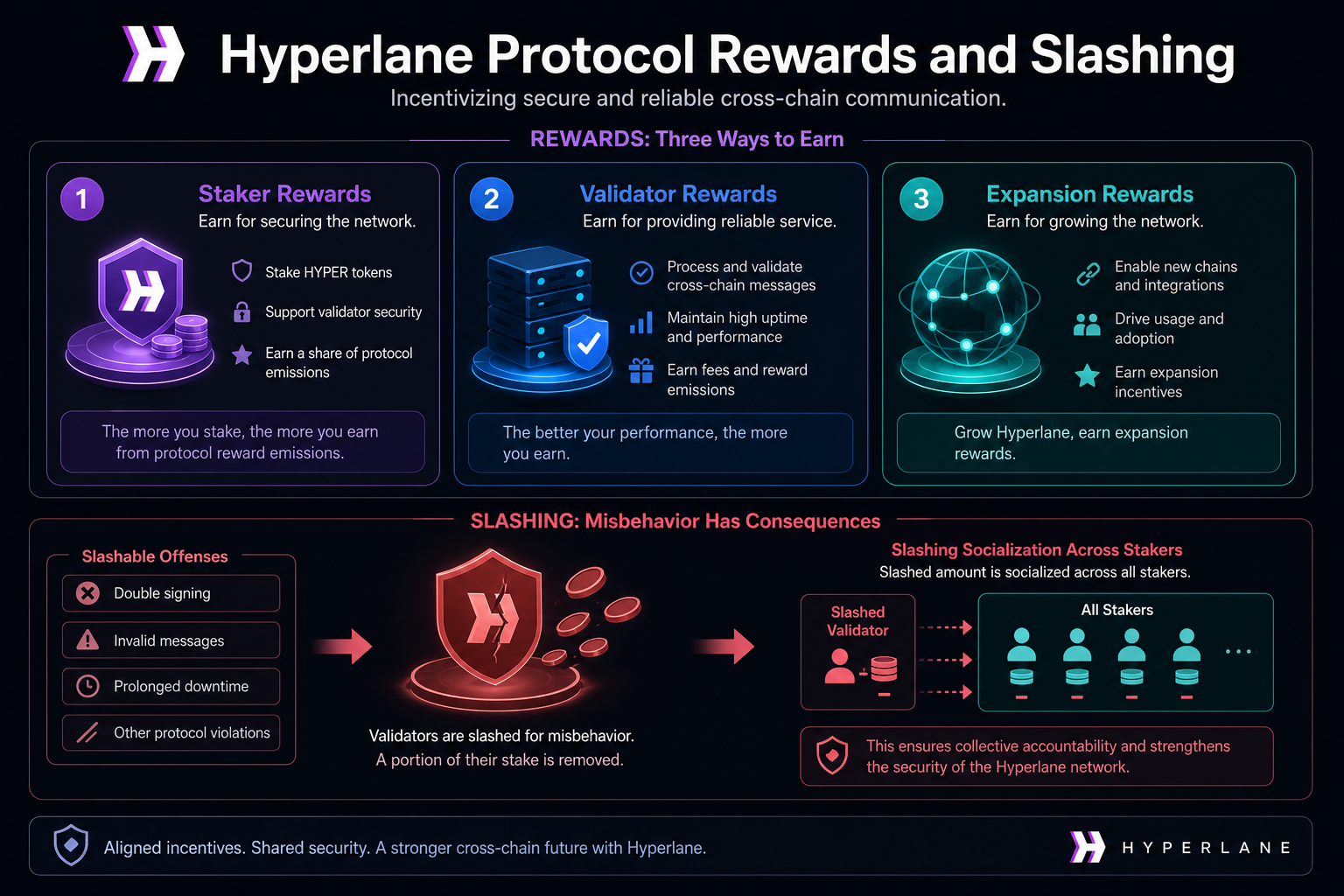 Figure 2. Hyperlane protocol rewards and slashing structure: Distribution of Staker, Validator, and Expansion rewards and the slashing loss socialization mechanism.