In multi-chain applications, cross-chain bridges often rely on fixed, immutable security models, making it difficult for developers to apply different verification strengths to high-value governance messages versus low-value data updates. Hyperlane (HYPER) modular architecture allows each message to specify its own ISM, and Warp Route deployers can configure a dedicated security stack for each asset route—matching the security model to the specific business scenario. The Hyperlane cross-chain message flow covers the repeatable path from dispatch to delivery, serving as the starting point for understanding when ISM intervenes during the process phase.
Hyperlane vs. LayerZero vs. Wormhole differentiates Hyperlane's modular approach from LayerZero and Wormhole across three architectural paths—Mailbox/ISM, Endpoint/DVN, and Guardian/VAA. This helps clarify where customizable ISM verification fits within the interoperability protocol spectrum.
What Is ISM?
An Interchain Security Module (ISM) is a smart contract module deployed on the destination chain. It verifies whether a cross-chain message intended for delivery genuinely exists on the source chain. Before the Mailbox calls the handle function of the recipient contract, it passes the message and the metadata submitted by the relayer to the ISM's verify function. If verification passes, delivery proceeds; if verification fails or the call reverts, the message is not processed.
The relationship between the ISM, Mailbox, and relayer can be summarized as follows: The source chain Mailbox writes the message via dispatch and emits an event. The relayer listens for that event, then calls the Mailbox's process function on the destination chain, submitting the message and metadata. The Mailbox subsequently calls the ISM to complete verification. If the recipient contract implements the ISpecifiesInterchainSecurityModule interface, it can specify an application-level ISM; if none is specified or the zero address is given, the Mailbox uses the default ISM.
| Component |
Chain |
Core Function |
Responsibility |
| Mailbox (Source) |
Source Chain |
dispatch |
Encode message, write to Merkle tree, trigger hooks |
| Relayer |
Off-chain |
— |
Listen for events, submit process call on destination chain |
| ISM |
Destination Chain |
verify |
Verify message source and integrity |
| Mailbox (Destination) |
Destination Chain |
process |
Call ISM for verification and trigger recipient.handle |
| Recipient Contract |
Destination Chain |
handle |
Execute cross-chain business logic |
The table above illustrates the ISM's position in the cross-chain message delivery chain: the ISM sits between the destination chain Mailbox and the recipient contract, serving as the security checkpoint that determines whether the message can ultimately be executed.
Types of Default and Custom ISMs
Hyperlane supports three ISM usage modes: Configure (using pre-built ISMs), Compose (combining multiple ISMs), and Customize (writing a new ISM). The default ISM refers to the pre-configured Multisig ISM on the Mailbox contract, which provides economic security through Hyperlane's validator set. HYPER and stHYPER staking explains the staking and slashing mechanisms behind the validator set. If an application does not specify a custom ISM, this default module is used.
Pre-built ISM types include Multisig ISM, Routing ISM, Aggregation ISM, Rate Limited ISM, and Pausable ISM, among others. The Multisig ISM uses an M-of-N validator signature model and is the default choice for most deployments. The Routing ISM routes messages to different ISMs based on the source chain domain, ideal for scenarios where security requirements vary across source chains. The Aggregation ISM requires that m out of n sub-ISMs pass verification, enabling the stacking of multiple security conditions.
The Rate Limited ISM is designed for Warp Route scenarios, limiting the total amount of tokens that can be transferred into the destination chain within a unit time window. The RateLimitedIsm contract accepts parameters such as maxCapacity and checks, during the verify phase, whether the cumulative transferred amount exceeds the window cap. If it does, verification fails and the message is not delivered. This mechanism can be paired with the source chain's RateLimitedHook to achieve bidirectional throughput control.
The Pausable ISM allows the route owner to pause message verification upon detecting anomalies, completely halting cross-chain transfers. The Aggregation ISM can nest the Rate Limited ISM with the Pausable ISM: the Rate Limited ISM limits the loss scale within an attack window, while the Pausable ISM allows the owner to completely shut down the route after confirming an event, forming a defense-in-depth strategy.
| ISM Type |
Verification Logic |
Typical Scenario |
| Multisig ISM |
M-of-N validator signatures |
Default security, community validator set |
| Routing ISM |
Route to different ISM by source domain |
Multiple source chains, differentiated security |
| Aggregation ISM |
m-of-n sub-ISMs must pass |
Multiple security model stacking |
| Rate Limited ISM |
Cap on incoming tokens per window |
Warp Route throughput control |
| Pausable ISM |
Owner can pause verification |
Incident response, emergency shutdown |
The table above compares the verification logic and typical use cases of five common ISM types. The Aggregation ISM can combine any ISMs into a security stack—for example, requiring both a Multisig ISM and a Wormhole ISM to pass, or stacking a Rate Limited ISM with a Pausable ISM on high-value messages.
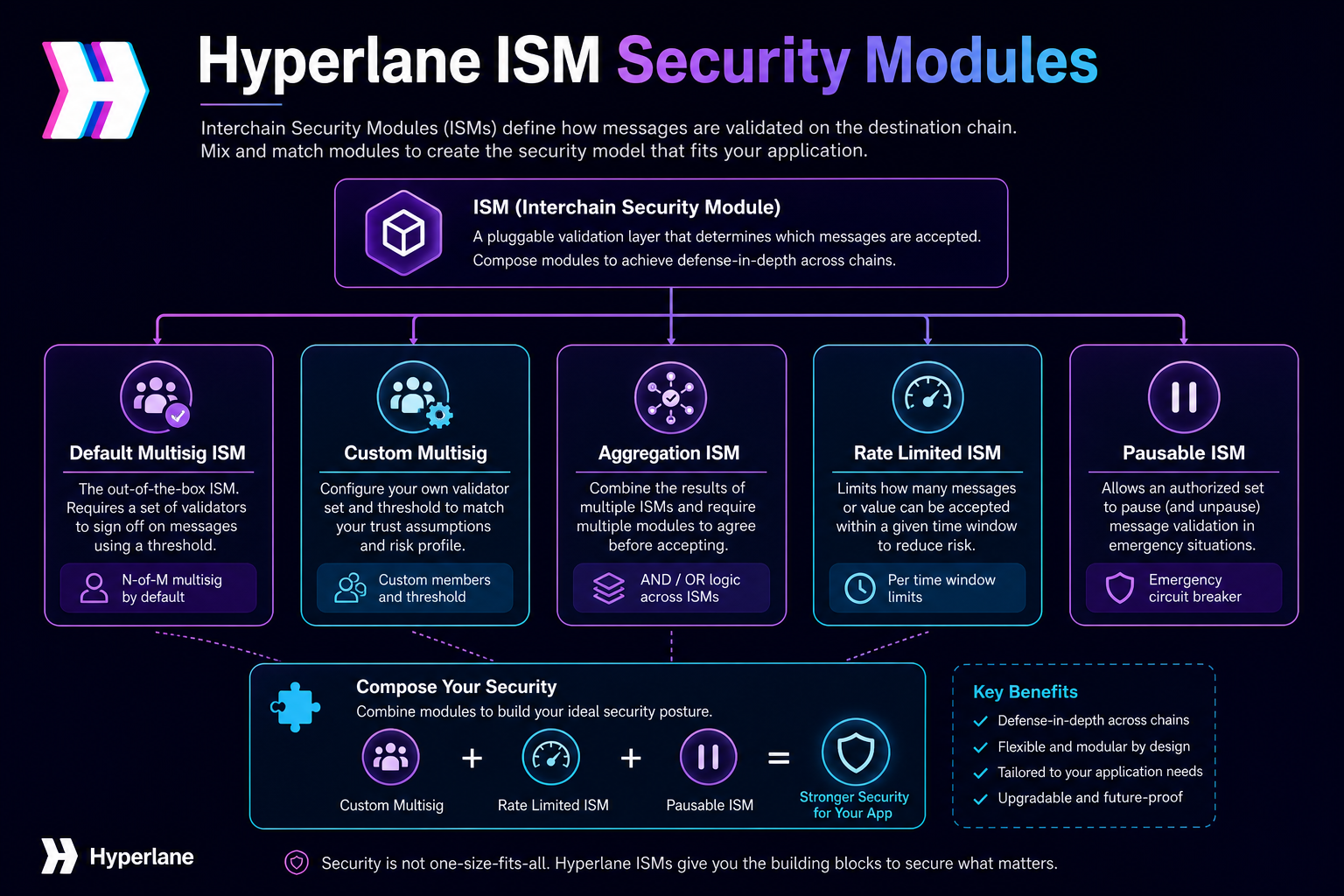 Figure 1. Hyperlane ISM security module types: combination relationships among Default Multisig, Custom Multisig, Aggregation, Rate Limited, and Pausable.
How Warp Route Works
Hyperlane Warp Route (HWR) is a modular cross-chain asset route built on the Mailbox. Each Warp Route deploys entry/exit contracts on all participating chains and coordinates token locking, minting, burning, and releasing through cross-chain messages. Unlike traditional bridges with fixed security models, HWR deployers can specify the ISM used to verify cross-chain transfer messages, allowing each route's security configuration to be set independently.
Common HWR types include: Native Token HWR (direct cross-chain transfer of native gas tokens like ETH), Collateral-Backed ERC20 (locking ERC-20 collateral on the source chain and minting synthetic tokens on the destination chain), Synthetic ERC20 (minting a synthetic version representing the original token on the destination chain), and Warp Route 2.0 (supporting multi-chain collateral and Rebalancer rebalancing). Before using a Warp Route, users should understand its ISM configuration and trust assumptions.
Typical forward flow: The user deposits tokens into the source chain Warp Route. The contract locks the collateral and calls Mailbox.dispatch to send a cross-chain message. The relayer submits the message to the destination chain via Mailbox.process. After ISM verification, the destination chain Warp Route mints or releases the corresponding tokens. Reverse flow: The user burns synthetic tokens on the destination chain. After ISM verification, the source chain releases the locked collateral tokens.
HypERC20Collateral and HypERC20 are common Warp Route contract forms on EVM chains. The former locks ERC-20 on the collateral chain and sends a message, while the latter receives the verified message on the synthetic chain and mints a 1:1 mapped synthetic token. Nexus Bridge is a user-facing cross-chain interface, but under the hood it still follows the Warp Route and ISM verification path.
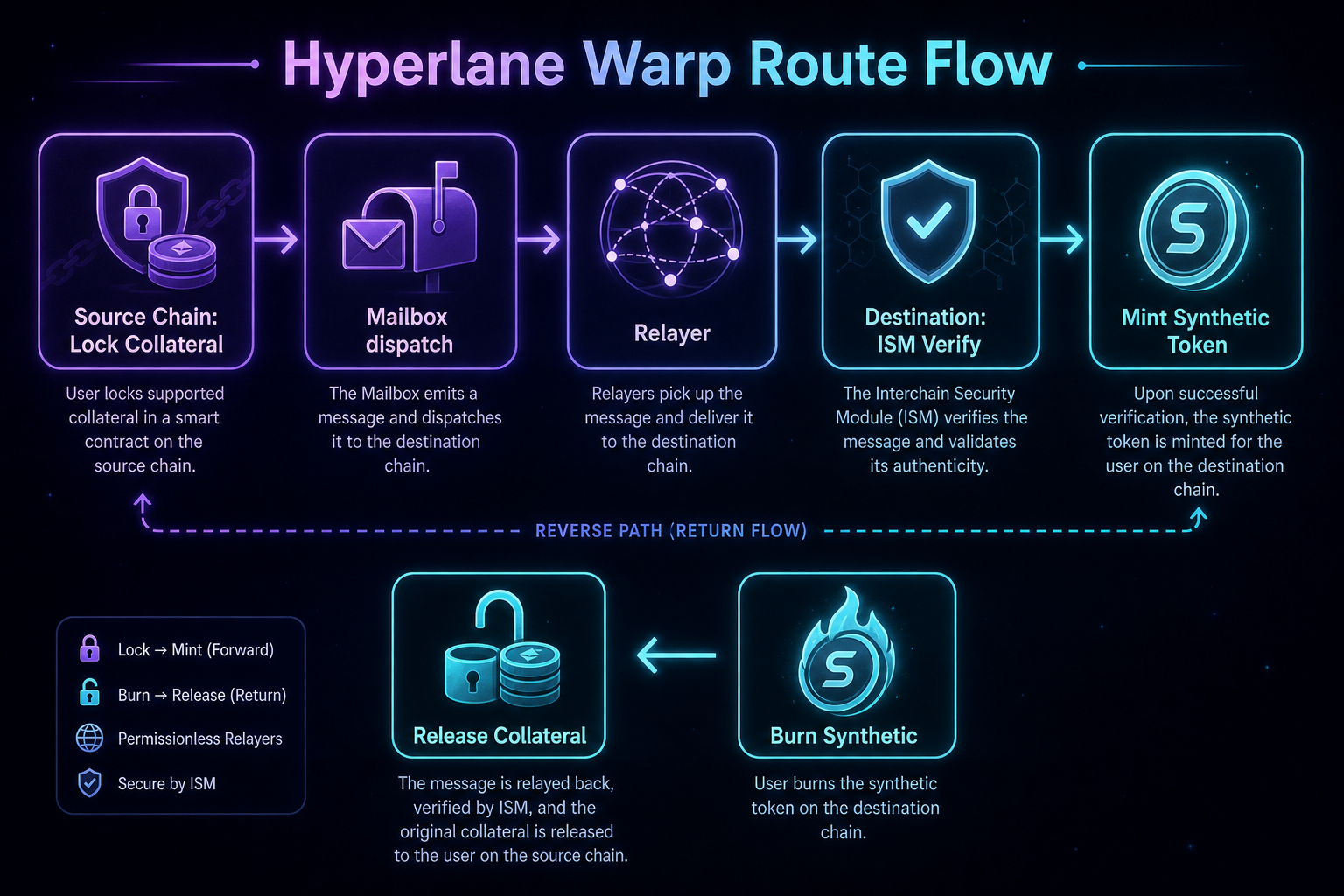 Figure 2. Hyperlane Warp Route flow: source chain locks collateral, Mailbox sends message, destination chain ISM verifies then mints synthetic tokens; reverse path involves burning and releasing.
Combining ISM and Hooks
Hooks are post-processing logic modules executed after the source chain Mailbox's dispatch. They complement the ISM on the destination chain: Hooks control behavior on the message-sending side, while ISM controls verification on the message-receiving side. The Mailbox's dispatch function calls the Hook's postDispatch function after writing the message. The Hook can collect cross-chain gas fees, write to the Merkle tree, enforce rate limits, perform pause checks, and more.
Standard Hook types include MERKLE_TREE, INTERCHAIN_GAS_PAYMASTER, PAUSABLE, and RATE_LIMITED. The RateLimitedHook is deployed on the source chain and paired with the destination chain's RateLimitedIsm. During the dispatch phase, it checks whether the outgoing amount on the source side exceeds the window cap, achieving bidirectional throughput control. The Pausable Hook allows the owner to pause message sending on the source chain, which, when combined with the Pausable ISM, can shut down routes on both ends simultaneously.
Hooks and ISM follow a "source chain Hook + destination chain ISM" pairing: the Hook executes outbound constraints in postDispatch, while the ISM performs inbound verification in verify. Custom combinations can follow the OpStackHook and OpStackIsm patterns.
When deploying a Warp Route, the interchainSecurityModule address and Hook address can be specified in the configuration. The TypeScript SDK and CLI support enumerations like IsmType.RATE_LIMITED, allowing deployers to directly write RateLimitedIsm parameters (e.g., maxCapacity, owner, recipient) into the Warp Route configuration. When nesting a Rate Limited ISM inside an Aggregation ISM, the relayer version must be agents-v2.2.0 or higher.
Risks of Customizing ISMs and Warp Routes
When customizing an ISM, the recipient contract must implement the InterchainSecurityModule interface, which includes the verify and moduleType functions. verify is the core verification logic; returning false or reverting will prevent message delivery. moduleType informs the relayer what metadata format should be attached. If the ISM is misconfigured—for example, with too few validators, a low threshold, or failure to cover all source chains—the cross-chain security strength may be weakened.
When combining sub-modules in an Aggregation ISM, the m-of-n threshold and the deployment addresses of each sub-ISM must be clearly defined. The maxCapacity of a Rate Limited ISM must be ≥ 86400 and a multiple of 86400. The owner can adjust the refill rate via setRefillRate. Pausing authority in a Pausable ISM is concentrated in the owner; improper management of the owner key could lead to malicious route shutdown or failure to respond to events in a timely manner.
When customizing Warp Routes, note that each route's ISM configuration is independent. Users should verify on-chain contract addresses and ISM types before use. Token mappings on Collateral and Synthetic chains must remain 1:1. If the Rebalancer is a managed service, there is an operational dependency. Fake Warp Route contracts could lead to asset loss; users should verify via Explorer and known deployment addresses.
The security of the default Multisig ISM is backed by HYPER stakers and the validator set. For custom ISMs, developers must independently assess validator quality, signature thresholds, and slashing coverage.
Summary
ISM is Hyperlane's security module that verifies cross-chain messages on the destination chain. Warp Route is a modular asset route based on the Mailbox. The default Multisig ISM provides economic security through Hyperlane's validator set. Developers can use Configure, Compose, or Customize to deploy ISMs such as Multisig, Routing, Aggregation, Rate Limited, and Pausable, and pair them with source chain Hooks for bidirectional rate limiting and pause control. Warp Route deployers specify an independent ISM for each route; users should understand the route's security configuration and trust assumptions before using it.
FAQ
What Is the Difference Between ISM and Default ISM?
ISM is a general term for cross-chain message verification modules. The default ISM refers to the pre-configured Multisig ISM on the Mailbox contract, which is used automatically when an application does not specify a custom ISM. An application can override the default configuration by specifying an independent ISM through the ISpecifiesInterchainSecurityModule interface.
How Does Rate Limited ISM Limit Cross-Chain Transfer Amounts?
The Rate Limited ISM checks, during the verify phase on the destination chain, whether the cumulative incoming token amount within a unit time window exceeds the maxCapacity cap. If it does, verification fails and the message is not delivered. The source chain RateLimitedHook can impose the same constraint on outgoing amounts during the dispatch phase, enabling bidirectional control. maxCapacity must be ≥ 86400 and a multiple of 86400.
How Does Aggregation ISM Combine Multiple Security Modules?
The Aggregation ISM requires that m out of its n configured sub-ISMs pass verification for the message to be delivered. For example, it can require both a Multisig ISM and a Rate Limited ISM to pass, or nest a Pausable ISM with a Rate Limited ISM to achieve rate limiting plus emergency pause. Sub-ISMs can be any deployed ISM contract address.
What Is the Relationship Between Warp Route and Nexus Bridge?
Warp Route (HWR) is an on-chain cross-chain asset routing contract responsible for locking, minting, burning, and releasing tokens, and can specify an independent ISM. Nexus Bridge is a user interface built on top of Warp Route, making it easier for end users to perform cross-chain token operations. Under the hood, it still follows the Mailbox message passing and ISM verification path.
Common Risks When Customizing a Warp Route's ISM
A validator set that is too small or has a low threshold can weaken the security of a Multisig ISM. Incorrect configuration of sub-modules in an Aggregation ISM may cause certain security conditions to be ineffective. Improper maxCapacity settings in a Rate Limited ISM may overly restrict normal transfers. Leakage of the owner key of a Pausable ISM could result in malicious route suspension. Before use, users should verify on-chain ISM contract addresses and parameters, and distinguish between the economic security of default validators and the trust assumptions of custom ISMs.
On Which Chains Do Hooks and ISM Execute?
Hooks execute postDispatch after the source chain Mailbox's dispatch, controlling outbound logic such as gas payment, Merkle tree writing, rate limiting, and pausing. ISM executes verify during the destination chain Mailbox's process phase, controlling inbound verification. RateLimitedHook and RateLimitedIsm reside on the source and destination chains respectively, paired to achieve bidirectional throughput control.







