Gate TradFi CFD trading refers to trading contracts for difference on Gate's TradFi (traditional finance) section, where the underlying references are conventional market assets rather than crypto-native tokens. A contract for difference is a derivative that mirrors the price of an underlying market; the position is opened and closed in cash, and the profit or loss equals the price difference multiplied by position size, adjusted for fees. Because no underlying asset is delivered, a CFD account can offer exposure to markets that are otherwise difficult to access through a crypto exchange, including precious metals and equity indices.
Gate introduced TradFi CFD markets to let users manage traditional-asset exposure inside the same account used for spot, futures, and options. The CFD section sits alongside Gate's existing derivatives, but it follows conventions closer to conventional leveraged trading: markets may observe traditional trading hours, financing costs apply to leveraged overnight positions, and certain jurisdictions are restricted. Understanding these mechanics is essential before using leverage on any TradFi market.
Key Takeaways
-
Gate TradFi CFD trading provides cash-settled exposure to traditional assets such as gold and stocks without physical delivery.
-
A CFD position is opened on margin and settled on the price difference between entry and exit, which amplifies both gains and losses.
-
TradFi CFDs differ from crypto perpetual futures in underlying assets, trading hours, and fee structure.
-
Leverage, market gaps, and jurisdictional restrictions are core risks that every TradFi CFD trader should understand first.
What Is a Contract for Difference (CFD) in Gate TradFi Trading?
Gate TradFi CFD trading is the trading of contracts for difference within Gate's TradFi section, where each contract references a traditional financial market instead of a cryptocurrency. A contract for difference is a financial derivative and a type of trading contract: it pays the difference between an asset's opening and closing price, so traders speculate on the underlying price of assets such as gold or stocks without owning the gold bar or share itself. Settlement is in cash rather than delivery of the underlying asset.
This structure is common in conventional online trading because it allows two-way positioning. A trader who expects a price rise opens a long CFD, while a trader who expects a decline opens a short CFD, including in falling markets. Gate applies this model to markets such as gold, silver, and selected global stocks, giving CFD traders access to parts of the stock market and broader global markets from the same crypto exchange account. Because the product lives inside a Gate account, users can move collateral between crypto and TradFi markets without a separate brokerage relationship.
The TradFi label distinguishes these markets from Gate's crypto derivatives and from other financial instruments such as futures contracts. Underlying reference prices come from traditional venues, so price discovery, trading halts, stock exchange hours, and weekend gaps follow the conventions of those markets. Gate acts as the counterparty and sets margin, leverage, and fee rules within its own risk framework, which means counterparty risk also matters: as with many cfd providers in OTC-style CFD trading, the broker's financial stability, product terms, compliance rules, and restricted-region list matter alongside market direction.
Many traders use trading CFDs as a practical way to access broader financial markets through trading contracts that track price moves rather than require traditional stock trading or physical settlement. The mechanics are straightforward: the trader opens a CFD contract at one price and closes it at another, and the difference determines profit or loss. Unlike futures contracts, CFDs typically do not require an expiry date, and unlike stock trading they do not transfer ownership rights. For sophisticated retail and institutional traders who want consolidated access to crypto and traditional assets, that convenience comes with leverage, gap risk, and regulatory constraints, so this guide explains how CFDs work on Gate, which assets are available, how they compare with crypto perpetuals and other financial instruments, what the main risks and compliance issues are, and how to get started.
How Does CFD Trading Work on Gate?
CFD trading on Gate works through margin, leverage, and cash settlement. A trader deposits collateral, chooses a market such as gold or a stock CFD, selects a position size and direction, and opens the position with a fraction of the full notional value as margin. Leverage and margin express how much larger the notional exposure is than the margin committed; higher leverage means a smaller price move can trigger liquidation. In practice, this is a form of margin trading in which traders gain market exposure on the full value of a position by posting just the margin.
When the position is closed, the platform calculates the difference between entry and exit prices, which reflect underlying price movements, multiplies it by the position size, and credits or debits the result to the account. Fees reduce net returns. Typical CFD trading costs include the spread between buy and sell quotes, with the gap between the bid price and sell price forming that spread, an overnight financing charge for leveraged positions held past a cutoff, and in some cases a commission. Because financing accrues over time, a leveraged CFD position held for many days can see trading profit eroded even if the market price moves sideways.
The way a trader opens and manages a position defines the trading outcome. To open a CFD position, the trader selects the market, checks the current price, and commits margin; to open a larger position, the trader commits more margin or accepts higher leverage. Many traders open a position only after deciding the price level at which they will close it, because an open position without an exit plan is exposed to whatever the market does next. Traders use market orders to open a position immediately at the current price, and they use the same market mechanics to close it. This open-and-close loop is the basic rhythm of CFD trading, and it applies whether the market is gold, stocks, or any other asset offered as a CFD.
Liquidation is the central mechanical risk. If the market moves against a leveraged position and account equity falls toward the maintenance margin, the platform closes the position to limit further loss. CFD margin is the percentage deposit required to open the trade, it varies by market, and a margin call can occur before forced closeout. This process is automatic and can occur during fast markets or after a price gap when a traditional market reopens. The sequence from order placement through margin usage to settlement follows how a CFD trade works end to end, and traders who understand margin, financing, and liquidation mechanics are better positioned to size trades prudently.
Every leveraged CFD position carries the possibility of losses that exceed what an unleveraged position in the same asset would produce. When the price moves in the trader's favor, the position earns a profit on the full notional exposure; when the price moves against the trader, the same leverage turns a small price change into larger losses. This is why professional traders treat position size and leverage as the main risk controls in CFD trading. A trader who opens a large position with high leverage accepts that a modest price move can wipe out the margin, while a trader who opens a smaller position with lower leverage gives the trade more room to absorb normal price swings before losses force a close. For example, a leverage ratio of 1:10 lets a trader control a position worth ten times the deposit, so potential profits and losses are based on the full position size, not just the margin. Managing these risks is not optional; it is the core discipline of trading any CFD contract.
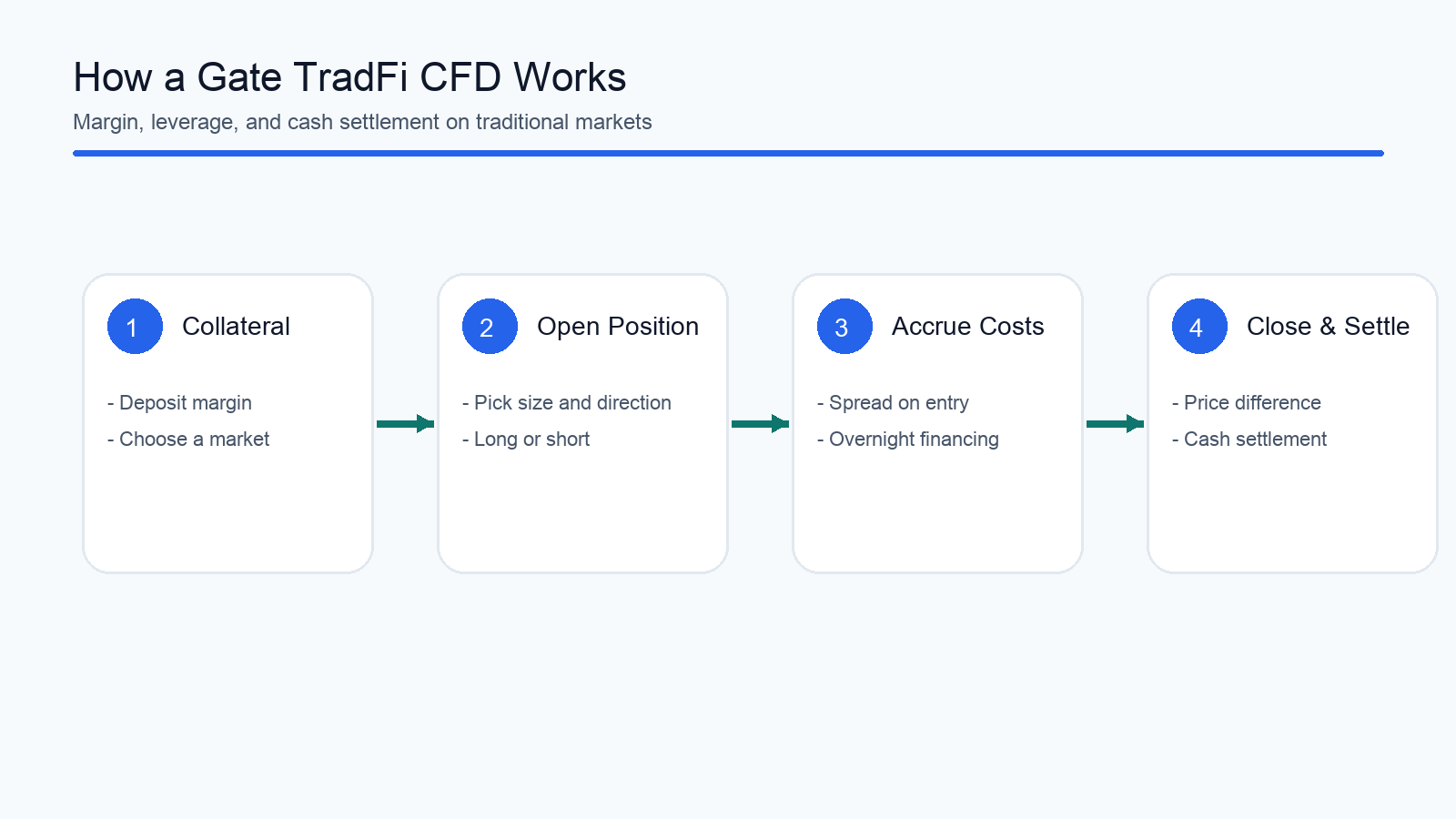
Figure 1. How a Gate TradFi CFD works: post margin to open a position, incur spread and overnight financing costs, and settle in cash on the price difference.
What Assets Can You Trade on Gate TradFi?
Gate TradFi focuses on traditional asset classes that are otherwise hard to reach through a crypto-native account. The most prominent category is precious metals, with gold quoted against a stable reference; gold CFDs are among the most liquid TradFi instruments and often serve as the entry point for users new to CFD trading. Silver and other metals may also be available depending on the product cycle. Each market has its own trading character, and traders use the gold market differently from the stocks market.
Beyond metals, Gate TradFi can include stock-related CFDs that reference individual equities or equity indices, giving users exposure to share price movement without holding the shares themselves. Index CFDs are a common way to track broad stock market moves without owning the underlying basket. Across the wider CFD market, traders use CFD contracts to access global markets, with market exposure and leverage varying by asset class. The exact list changes over time, and availability can differ by region because of local regulation. The common thread is that every instrument is a derivative referencing a conventional market, so price behavior follows that market's hours, liquidity, and event calendar.
The table below summarizes the main TradFi CFD categories and how they behave.
| Asset category |
Typical underlying reference |
Trading character |
Primary risk driver |
| Gold CFD |
Spot gold price |
High liquidity, nearly continuous weekday trading |
Macro data, real yields, dollar strength |
| Silver / metals CFD |
Spot metal prices |
More volatile than gold |
Industrial demand and macro sentiment |
| Stock CFD |
Individual shares or indices |
Follows exchange hours; gaps at open |
Earnings, corporate news, index moves |
Leverage and financing terms can differ sharply across markets and providers, so traders should check the market-specific terms shown on the Gate trading page before opening a position.
These categories share one feature: none involves delivery of the underlying. A gold CFD trader never receives a gold bar, and a stock CFD trader never receives shares; settlement is always in cash based on the reference price.
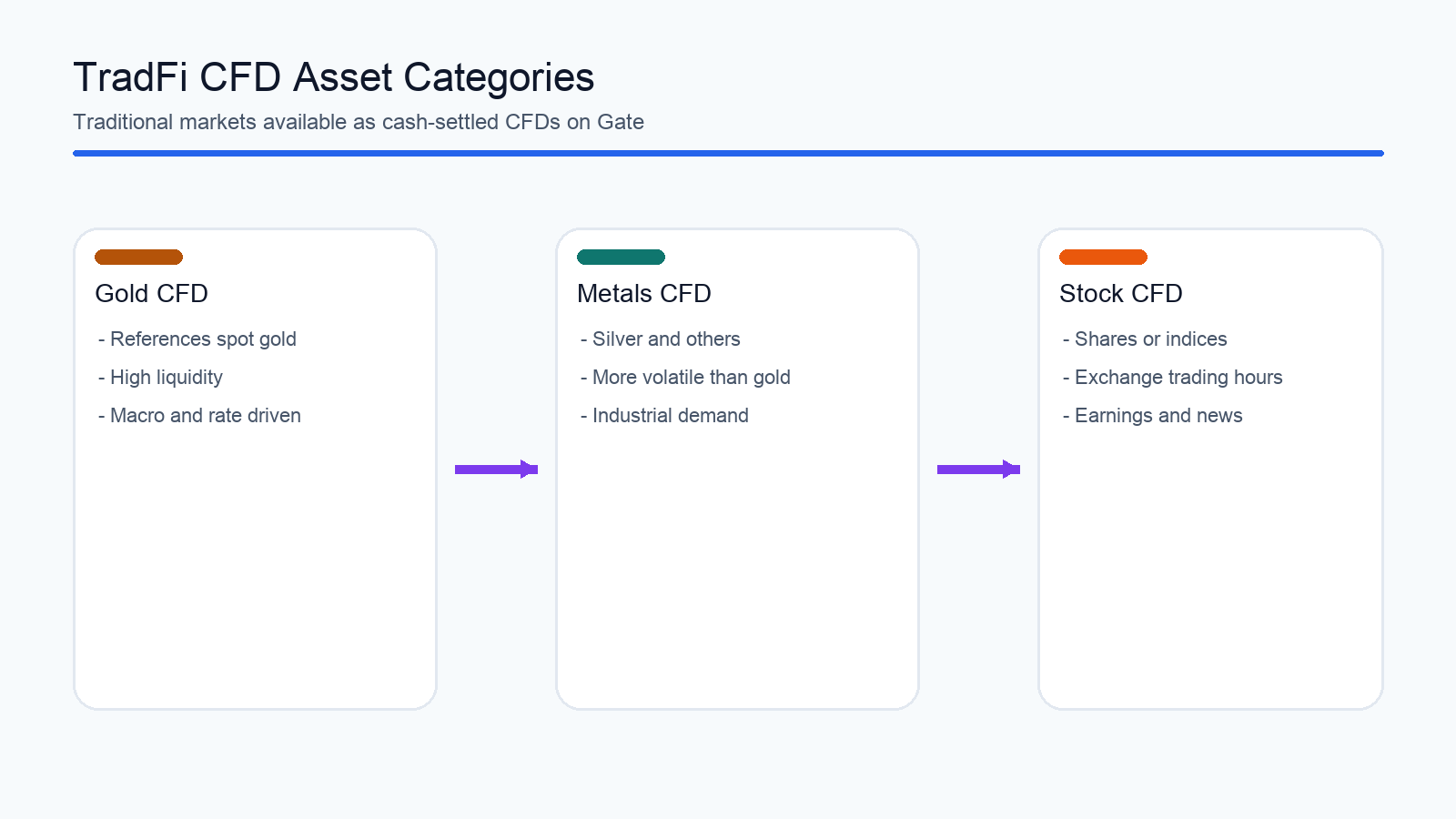
Figure 2. The main Gate TradFi CFD asset categories: gold, other metals, and stock-related CFDs, with their respective risk drivers.
Stocks and gold behave differently as underlying assets, and traders use CFDs on them for different reasons. A stock CFD references the price of a company's shares, so traders who follow earnings or sector news can take a position on that price without buying the shares, unlike traditional stock trading on a stock exchange. A gold CFD references the metal's price, so traders who follow macro data can take a position on gold without arranging custody. In both cases, the contract only tracks the underlying price, which is why the risks and the profit potential come from price movements rather than from owning the asset. That distinction matters when trading cfds through cfd providers, because many cfd providers give access to products tied to major indices, commodity CFDs, and currency pairs in the foreign exchange market. Traders who understand how stocks and gold respond to their respective drivers are better prepared to manage a CFD position on either market.
CFD vs Perpetual Futures: What Is the Difference?
CFD and perpetual futures are both leveraged derivatives, but they differ in underlying asset, trading rhythm, and cost structure. Gate offers both, so the distinction matters for users deciding where to express a view. Perpetual futures on Gate reference cryptocurrencies and trade around the clock without an expiry, using a funding-rate mechanism to keep the contract near the spot price. TradFi CFDs reference conventional markets such as gold and stocks, may observe traditional trading hours, and typically charge an overnight financing cost rather than a crypto funding rate. To understand how CFDs work, it also helps to note that unlike futures contracts and options, CFDs do not have an expiry date, while exchange-traded products usually do. Those products are other financial instruments with standardized terms, whereas CFDs are typically offered by cfd providers rather than traded the same way on a stock exchange.
The table below contrasts the two product types.
| Dimension |
TradFi CFD |
Crypto perpetual futures |
| Underlying |
Gold, stocks, other traditional assets |
Cryptocurrencies |
| Trading hours |
Follow traditional market hours |
24/7 continuous |
| Holding cost |
Overnight financing charge |
Funding rate between longs and shorts |
| Settlement |
Cash on price difference |
Cash, no expiry |
| Price gaps |
Possible when the underlying market reopens |
Less common, but possible in illiquid periods |
These differences mean that a trader choosing between a gold CFD and a Bitcoin perpetual is not just picking an asset but also a market rhythm and a cost model. A position held over a weekend in a stock CFD carries gap risk when the underlying exchange reopens, while a crypto perpetual held over the same period faces funding-rate drift. The detailed comparison, including when each instrument may be more suitable, is covered in the dedicated CFD vs perpetual futures on Gate article.
What Are the Advantages and Risks of Gate TradFi CFD Leverage?
The main advantage of Gate TradFi CFD trading is consolidated access. A user can hold crypto collateral and express a view on gold or a stock inside the same account, without opening a separate brokerage account or wiring fiat to a traditional platform. Two-way positioning allows both long and short exposure, and leverage improves capital efficiency for traders who understand the trade-off. Traders use this access to trade markets that would otherwise require a separate account, and many traders use CFDs precisely because one trading account can cover both crypto and traditional markets.
The risks are structural and should be read before any position is opened. Leverage magnifies losses as readily as gains, and a small adverse move can trigger liquidation when leverage is high. In some structures, CFD losses can exceed your initial deposit amount, which is why leverage caps, negative balance protection, and other safeguards matter. Traditional markets can gap at the open after weekends or major news, and a leveraged position held through such a gap can be liquidated at a worse price than expected. Financing costs reduce returns on positions held for extended periods. Liquidity can thin during off-hours or stressed markets, widening spreads and increasing slippage. That becomes more dangerous during market volatility, especially in volatile markets where traders may be losing money rapidly and face substantial downside risk.
These risks interact in ways that new traders often underestimate. The market risks of the underlying asset combine with the leverage risks of the CFD contract, so a trader faces both the price risk of gold or stocks and the liquidation risk of the position. Losses can arrive quickly when a market moves fast, and traders who do not use risk management tools such as stops or reduce position size to manage risk can see losses grow beyond the original plan. Understanding these risks is the difference between traders who use CFDs as a tool and traders who are forced out of the market by a single adverse move. The risks are not a reason to avoid CFD trading, but they are a reason to respect position size, leverage, and the market being traded. In practice, risk management strategies matter because effective risk management helps control exposure when prices move abruptly.
There are also compliance constraints. Gate TradFi services are restricted in certain jurisdictions, and access depends on identity verification and local rules. These restrictions are not optional; they reflect the regulatory treatment of leveraged traditional-asset products. CFDs are banned for retail investors in the US, while the FCA limits leverage to 30:1 in the UK and CySEC caps leverage at 30:1 for major forex pairs in Cyprus; individual equity CFDs are commonly limited to about 5x. ASIC mandates negative balance protection in Australia, BaFin prohibits unlimited loss exposure for retail CFD investors in Germany, and ESMA issued a warning on CFD sales to retail investors in 2016. A responsible approach also means understanding how cfd brokers handle disclosures, platform controls, and counterparty risk, including the broker's financial stability and the protections applied to retail traders.
Weighing the advantages against the risks is the practical skill in CFD trading. The profit potential of a leveraged position is real, but so are the losses, and traders who focus only on the upside tend to take position sizes that the risks do not support. Experienced traders usually decide the maximum acceptable losses before opening a position, then set the position size and leverage so that a normal adverse price move stays within that limit. This discipline applies equally to a gold CFD, a stock CFD, and any other contract, and it is the main reason some traders survive in leveraged markets while others do not. As a standing reminder of the risks involved, 64% of retail investor accounts lose money trading CFDs, so retail investors should treat sizing and execution as core parts of the trade rather than afterthoughts.
Getting started with Gate TradFi CFD trading follows a clear sequence, and the operational steps are described objectively here without any promotional framing. A user first completes identity verification on Gate, because TradFi products require a verified account. Users typically also need a dedicated cfd account, or an enabled CFD section, before they can get started trading CFDs. After verification, the user opens the TradFi or CFD section and reviews the product terms, risk disclosure, and regional eligibility before enabling the feature.
The next step is funding. The user transfers collateral into the account used for TradFi trading, chooses a market such as gold, and reviews the margin, leverage, and fee schedule shown on the trading page, because margin requirements and financing charges vary by market. Only after checking these parameters does the user select a position size and direction and place the order. The step-by-step process, including common errors and safety checks, is covered in the dedicated how to trade gold CFD on Gate guide.
Summary
Gate TradFi CFD trading brings traditional-asset exposure into a crypto exchange account through cash-settled contracts for difference. The mechanics center on margin, leverage, financing costs, and liquidation, and the product differs from crypto perpetual futures in underlying asset, trading hours, and fee structure. Gold, silver, and stock-related CFDs are the main categories, each with its own risk drivers. The same features that make CFDs capital-efficient also make them risky, so understanding leverage, gaps, and regional restrictions is a prerequisite for any trader.
FAQ
What is a CFD in trading?
A CFD, or contract for difference, is a cash-settled derivative that tracks the price of an underlying market. The trader uses it to speculate on the price movements of an underlying asset without owning it, with profit or loss coming from the difference between the entry and exit price multiplied by position size. CFDs allow both long and short positioning and are commonly offered on margin with leverage. They are financial instruments used in both rising and falling markets through long or short positions.
How is a CFD different from a future?
A CFD and futures contracts are both derivatives, but traditional futures contracts have standardized terms. They also have a fixed expiry date, while CFDs do not have an expiry date and are commonly cash-settled on the price difference when the trader closes the position. Crypto perpetual futures are closer to CFDs because they also lack expiry, but they use a funding-rate mechanism and reference crypto assets rather than traditional markets.
Is CFD trading risky?
CFD trading is risky primarily because of leverage, and leveraged trading can lead to losing money rapidly. A small adverse price move can trigger liquidation and the loss of the margin committed. Additional risks include market gaps when traditional markets reopen, overnight financing costs that erode returns, and reduced liquidity during stressed conditions. Understanding margin and position sizing is essential before trading, and strong risk management helps manage risk with risk management tools such as stop-loss planning and position sizing.
How do you trade a gold CFD?
Trading a gold CFD involves opening a verified account on a platform that offers the product, depositing collateral, selecting the gold market, choosing a position size and direction, and placing the order. Because gold CFDs use leverage, the trader should review margin, financing costs, and the liquidation level before opening a position. The full step-by-step process is described in the dedicated gold CFD guide.
What is the difference between a stock CFD and buying a stock?
Buying a stock means owning shares through traditional stock trading on a stock exchange, while a stock CFD is one of several financial instruments that provides price exposure without ownership. A stock CFD gives price exposure only, while buying shares participates more directly in the stock market through ownership rights; it can also be traded on margin and allows short positioning, but it does not confer dividends or voting rights, and it carries financing costs and liquidation risk that direct ownership does not.
What assets does Gate TradFi support?
Gate TradFi supports traditional asset classes such as precious metals, selected stock-related instruments, and, depending on current availability, index CFDs, with gold CFDs among the most prominent across financial markets. The exact list can change over time and may vary by region because of local regulation, so the current product page is the authoritative reference for available markets, available global markets, and any region-specific restrictions.