CFD and perpetual futures sit side by side in Gate's derivatives lineup, and traders often ask which one fits a given view. The short answer is that a perpetual future suits crypto exposure with continuous trading, while a TradFi CFD suits traditional-asset exposure with conventional market hours and a financing cost model. Both are leveraged and cash-settled, so neither involves delivery of the underlying, but the similarity ends there. This comparison walks through each instrument, then contrasts them across the dimensions that matter most for position planning.
Perpetual futures are the dominant crypto derivative, and Gate offers them across many tokens. TradFi CFDs are the newer addition, extending the same leveraged framework to gold, stocks, and other traditional markets. Because both live in the same account, a trader can move collateral between them, which makes understanding their structural differences a practical necessity rather than an academic exercise.
Key Takeaways
- Perpetual futures reference cryptocurrencies and trade 24/7 with a funding rate; TradFi CFDs reference gold, stocks, and similar assets with traditional hours and financing costs.
- Both are leveraged and cash-settled, with leverage and margin amplifying notional exposure on posted collateral in each, but their holding-cost mechanisms and gap-risk profiles differ.
- A perpetual future suits crypto views and continuous monitoring; a TradFi CFD suits traditional-asset views within market hours.
- Choosing between them means choosing an asset class, a trading rhythm, and a cost model, not just a direction.
What Is a CFD?
A CFD, or contract for difference, is a cash-settled derivative that tracks the price of an underlying market, and on Gate the TradFi CFD references traditional assets such as gold and stocks. The position is opened on margin, and profit or loss equals the price difference between entry and exit multiplied by size. A leveraged CFD held past a daily cutoff typically incurs an overnight financing charge, and because the underlying is a traditional market, trading follows that market's hours and can gap at the open. The broader mechanics are described in the Gate TradFi CFD trading overview.
What Is a Perpetual Future?
A perpetual future is a crypto derivative with no expiry date that tracks a cryptocurrency's price. To keep the contract price near the spot price, exchanges use a funding rate that periodically transfers value between long and short positions. Perpetual futures trade continuously, including weekends, and are the most liquid leveraged crypto instruments. Like CFDs, they are cash-settled and margined, so a trader never takes delivery of the underlying token.
CFD vs Perpetual Futures: Side-by-Side Comparison
The table below contrasts the two instruments across the dimensions that most affect a trading decision.
| Dimension |
TradFi CFD |
Crypto perpetual futures |
| Underlying asset |
Gold, stocks, traditional markets |
Cryptocurrencies |
| Expiry |
None |
None |
| Trading hours |
Follows traditional market hours |
24/7 continuous |
| Holding cost |
Overnight financing charge |
Funding rate between longs and shorts |
| Settlement |
Cash on price difference |
Cash, no delivery |
| Gap risk |
Possible when the underlying market reopens |
Less common, but possible in thin liquidity |
| Ownership rights |
None (no dividends, no voting) |
None |
The rows highlight that the instruments share a leveraged, cash-settled frame but diverge on the asset referenced, the clock they follow, and the way holding costs are computed. Those differences drive the practical choice.
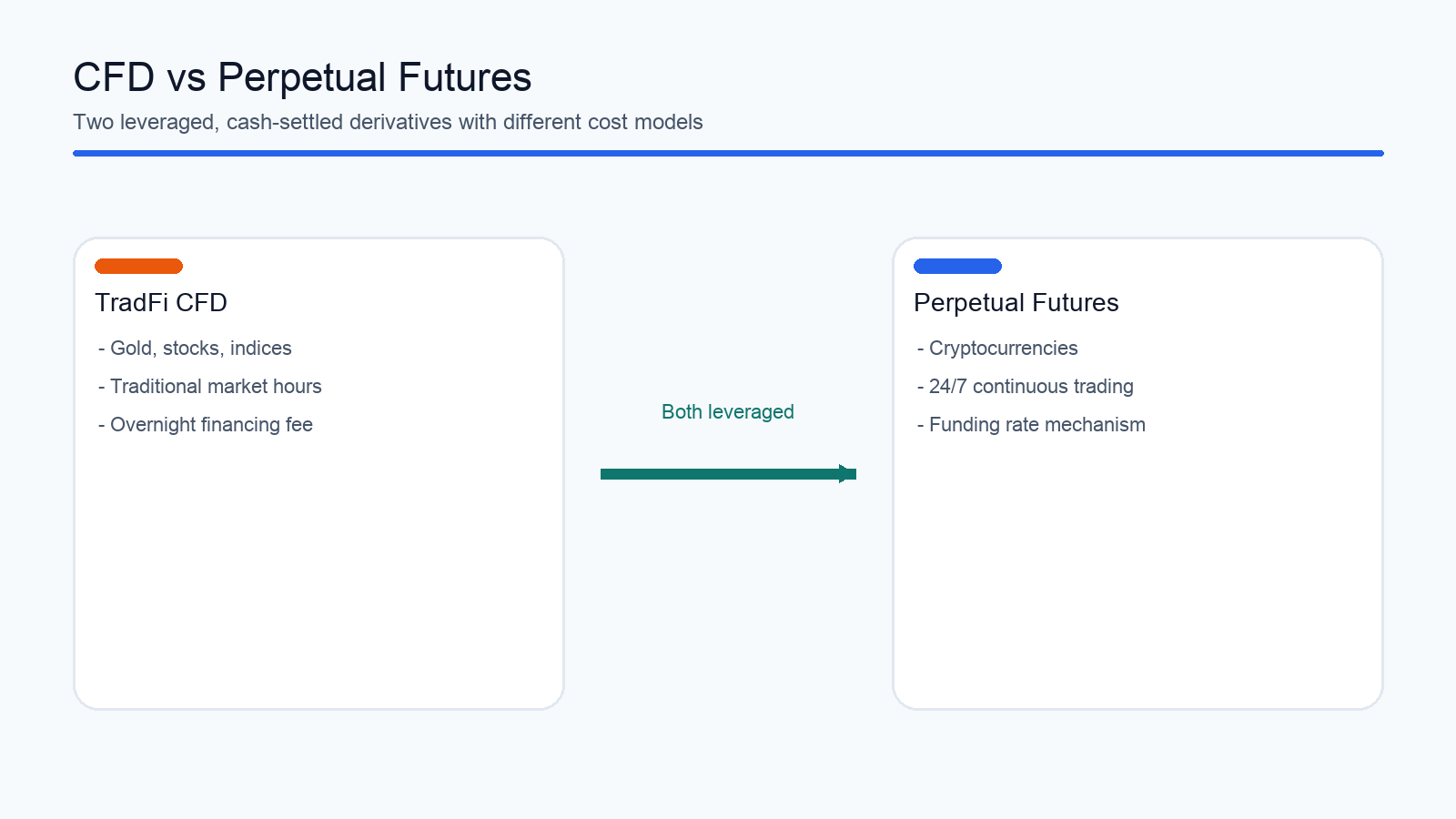
Figure 1. A side-by-side comparison of CFDs and perpetual futures across underlying assets, trading hours, and holding-cost models.
CFD vs Perpetual Futures: Underlying Asset and Market Hours
The underlying asset is the most obvious difference. A perpetual future references a cryptocurrency, so its price discovery follows crypto spot markets that never close. A TradFi CFD references a traditional market, so its price discovery follows the hours of a gold spot venue or a stock exchange. A trader who wants exposure to gold's reaction to macro data belongs in a TradFi CFD, while a trader who wants exposure to Bitcoin's weekend moves belongs in a perpetual future.
Market hours follow from the underlying. Because crypto trades continuously, a perpetual future can be opened or closed at any time, and liquidation can occur at any hour. A TradFi CFD follows the underlying market's schedule, which means there are windows when the position cannot be adjusted even though the trader's collateral remains at risk. This difference alone shapes how each instrument should be monitored.
CFD vs Perpetual Futures: Holding Costs
Holding costs work differently in the two products. A perpetual future uses a funding rate that moves between longs and shorts depending on whether the contract trades above or below spot, so a position can either pay or receive funding. A TradFi CFD typically charges an overnight financing cost on leveraged positions, which functions more like interest on the borrowed notional. Over a multi-day hold, the two cost models can produce very different net results, so a trader comparing them should look beyond the headline spread.
CFD vs Perpetual Futures: Risk Profile
Both instruments carry leverage risk, but the shape of that risk differs. A perpetual future can be liquidated at any hour because crypto trades continuously, and funding-rate drift can add or subtract from returns. A TradFi CFD carries gap risk when the underlying market reopens after a weekend or major news, and a leveraged position held through such a gap can be liquidated at a worse price than the last quoted level. Liquidity conditions also differ, with stock CFDs in particular sensitive to the underlying exchange's depth.
Which Should You Choose?
Choose a perpetual future if the goal is crypto exposure, the position needs continuous monitoring and adjustment, and the funding-rate model is acceptable. Choose a TradFi CFD if the goal is exposure to gold, stocks, or other traditional markets, the position fits within conventional market hours, and an overnight financing cost is preferable to a funding rate. Neither instrument is universally better; the right choice is the one whose asset, hours, and cost model match the trader's view and schedule.
Summary
CFD and perpetual futures are both leveraged, cash-settled derivatives, but they serve different purposes on Gate. Perpetual futures track cryptocurrencies, trade around the clock, and use a funding rate. TradFi CFDs track gold, stocks, and similar assets, follow traditional hours, and charge overnight financing. The decision between them should be driven by the desired asset class, the trader's availability to monitor the position, and the preferred holding-cost structure, with risk management applied equally to both.
FAQ
What is the main difference between a CFD and a future?
The main structural difference is that a traditional futures contract has a fixed expiry and standardized terms, while a CFD has no expiry and is settled on the price difference when the trader closes the position. Crypto perpetual futures resemble CFDs because they also lack expiry, but they reference cryptocurrencies and use a funding rate rather than an overnight financing charge.
Is a perpetual future the same as a CFD?
A perpetual future is not the same as a CFD, although both are leveraged and cash-settled with no expiry. A perpetual future references a cryptocurrency and uses a funding rate to stay near spot, trading continuously. A TradFi CFD references a traditional market, follows that market's hours, and charges overnight financing. The two instruments behave differently enough that they are not interchangeable.
Which is riskier, a CFD or a perpetual future?
Neither is inherently riskier, because both use leverage that can trigger liquidation. The risk shape differs: a perpetual future faces continuous liquidation risk and funding-rate drift, while a TradFi CFD faces gap risk when the underlying traditional market reopens. The practical risk depends on leverage, position size, and how well the trader manages margin in each product.
Can you hold a CFD long term?
A CFD can be held for an extended period because it has no expiry, but the overnight financing charge on leveraged positions accumulates over time and can significantly reduce net returns. For long holding periods, the financing cost often makes a CFD less economical than the underlying asset or an un-leveraged alternative, which is why CFDs are more commonly used for shorter horizons.