A gold CFD on Gate is a contract for difference that references the gold price, so the position tracks gold's movement without any physical delivery. It is one of the most liquid instruments in the TradFi section and often the first market new users explore, which makes a clear operational guide valuable. This article lays out the preparation, the step-by-step order process, the errors that most often trip up new traders, and the safety considerations specific to leveraged gold exposure.
The steps below are descriptive rather than promotional. They explain how the feature works and what to verify at each stage, and they assume the reader has already reviewed the mechanics in the Gate TradFi CFD trading overview. Because gold CFDs use leverage, the risk checks are not optional; they are the core of the process.
Key takeaways
- A gold CFD on Gate is a leveraged, cash-settled position on the gold price with no physical delivery.
- The process runs verification, enabling TradFi, funding, parameter checks, and then order placement.
- Margin requirement, financing cost, and liquidation level are the three checks that matter most before opening a position.
- Leverage, overnight financing, and price gaps are the main risks of trading gold CFDs.
What You'll Need Before You Start
Before placing a gold CFD order, a trader needs a verified Gate account, because TradFi products are only available after identity verification. The trader also needs to confirm that the TradFi service is available in their region, since leveraged traditional-asset products are restricted in certain jurisdictions. Finally, the trader needs collateral in the account used for TradFi trading and a clear understanding of the gold market's margin, leverage, and fee schedule, all of which are shown on the trading page.
Step 1: Complete Identity Verification and Enable TradFi
The first step is completing identity verification on Gate, which unlocks access to TradFi products. After verification, the trader opens the TradFi or CFD section and reviews the product terms, risk disclosure, and regional eligibility before enabling the feature. This review is the point where a trader confirms that the product's leverage, fees, and restrictions match their expectations, and it should happen before any funds are committed.
Step 2: Deposit Collateral and Review the Gold Market
The second step is funding. The trader transfers collateral into the account used for TradFi trading, then navigates to the gold CFD market. On the trading page, the trader reviews the current leverage options, the margin required per unit of position size, the spread between buy and sell quotes, and the overnight financing charge, with the margin and leverage settings directly determining how large a position the collateral can support. These parameters determine how large a position the collateral can support and how much it costs to hold, so they deserve careful attention before any order is placed.
Step 3: Choose Position Size and Direction
The third step is sizing and direction. The trader decides whether to go long, expecting gold to rise, or short, expecting gold to fall, and selects a position size that the collateral can support at the chosen leverage. A conservative approach keeps the position small relative to collateral so that a normal adverse move does not approach the liquidation level. This is also the point to note the liquidation price shown on the page, which is the level at which the platform will close the position automatically.
Step 4: Place and Monitor the Order
The fourth step is placing the order and monitoring the position. After confirming size, direction, and leverage, the trader submits the order, and the position opens at the prevailing quote. From that point, the trader watches the margin ratio and the financing accrual, because a leveraged gold position held overnight incurs a financing charge and a sharp move can change the margin ratio quickly. Closing the position settles the price difference in cash, and the trader can then review the net result after spread and financing.
Common Errors and How to Fix Them
The table below lists frequent mistakes new gold CFD traders make and how to correct them.
| Error |
Cause |
Fix |
| Position liquidated quickly |
Leverage too high for collateral |
Lower leverage or add collateral so the liquidation level is farther away |
| Returns eroded over days |
Ignoring overnight financing |
Factor the financing charge into the holding plan before entering |
| Surprised by a gap fill |
Holding through market close or weekend |
Reduce size or close before illiquid periods and reopen later |
| Order rejected |
Insufficient margin for requested size |
Reduce position size or deposit more collateral |
Each of these errors traces back to a skipped check, which is why the preparation steps emphasize margin, financing, and the liquidation level before any order is submitted.
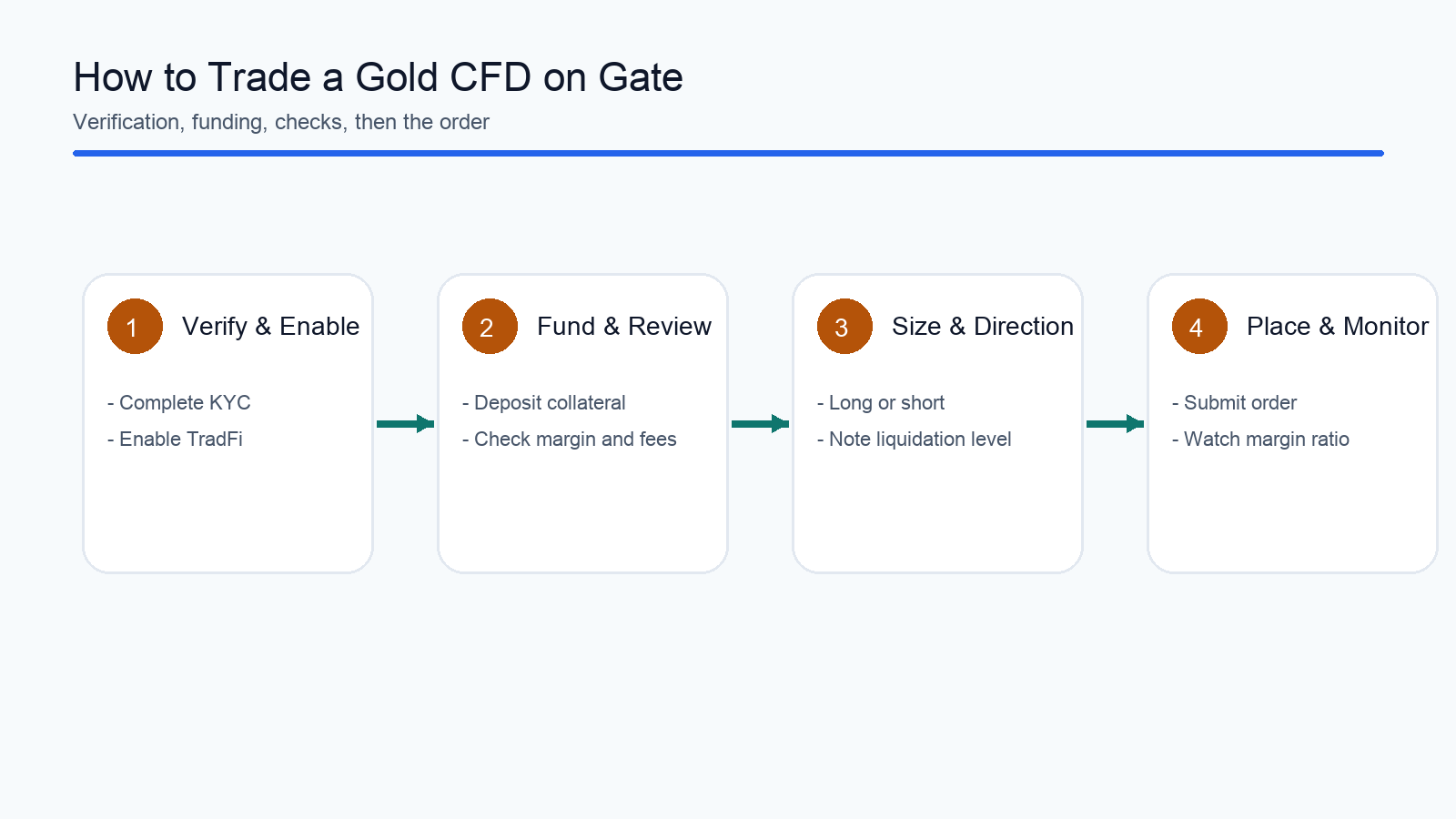
Figure 1. The four-step process for trading a gold CFD on Gate: verify and enable, fund and review parameters, choose size and direction, then place and monitor the order.
Is Trading a Gold CFD Safe?
Trading a gold CFD carries real risk, and the honest answer is that safety depends on how leverage and position size are managed. The structural risks are leverage-driven liquidation and price gaps, overnight financing costs that compound over a long hold, and price gaps when the gold market reopens after weekends or major news. Regional restrictions also matter, because TradFi access depends on jurisdiction, and the product terms and risk disclosure are part of using the feature responsibly. A trader who sizes conservatively, understands the financing cost, and respects the liquidation level is managing the risks that a gold CFD presents, but no leveraged product is without the possibility of losing the margin committed.
Summary
Trading a gold CFD on Gate follows a clear sequence: verify the account, enable TradFi, deposit collateral, review margin and fees, size the position conservatively, place the order, and monitor margin and financing while the position is open. The most common errors come from skipping the pre-trade checks, and the main risks are leverage, financing costs, and price gaps. Used with careful sizing and an understanding of the cost structure, a gold CFD provides flexible, cash-settled exposure to the gold price; used carelessly, it can liquidate a position quickly.
FAQ
What is a gold CFD?
A gold CFD is a contract for difference that references the gold price, allowing a trader to take a long or short position on gold without owning physical metal. The position is cash-settled on the price difference between entry and exit, and it is typically traded on margin with leverage, which amplifies both gains and losses.
How much money do you need to trade a gold CFD?
The amount needed depends on the position size and the leverage selected, because margin is a fraction of the full notional exposure. Higher leverage means less margin per unit of exposure but a closer liquidation level. Traders should check the margin requirement shown on the trading page and keep collateral comfortably above the maintenance level rather than funding only the minimum.
What does it cost to hold a gold CFD?
Holding a leveraged gold CFD typically incurs an overnight financing charge, which functions like interest on the borrowed notional and accrues each day the position remains open past a cutoff. There is also the spread between buy and sell quotes when opening and closing. Over a multi-day hold, these costs can materially reduce net returns even if the gold price moves in the trader's favor.
What is the difference between a gold CFD and buying gold?
Buying physical gold or a gold-backed token means owning an asset, while a gold CFD provides only price exposure with no ownership or delivery. A gold CFD can be traded on margin and allows short positioning, but it carries financing costs and liquidation risk that outright ownership does not. The two approaches serve different purposes and risk tolerances.
Is gold CFD trading available in every region?
Gold CFD trading on Gate is not available in every region, because leveraged traditional-asset products are restricted in certain jurisdictions. Access requires identity verification and depends on local rules, so the product page and regional eligibility notice are the authoritative references for whether the feature is available to a given user.