Doppler Finance is a yield and asset management protocol for XRP and other digital assets. It aims to provide digital asset yield management services through on-chain vaults, professional trading strategies, and cross-market liquidity. Unlike simply holding tokens to seek returns from price appreciation, Doppler Finance seeks to allocate idle assets to financial strategies with potential yield sources, enabling digital assets to participate in a broader range of market activities.
As the XRP Ledger (XRPL) ecosystem continues to explore stablecoins, real-world asset tokenization (RWA), and institutional financial applications, establishing sustainable yield infrastructure for assets such as XRP has increasingly become a market focus. Doppler Finance uses a CeDeFi (Centralized Decentralized Finance) architecture that combines on-chain asset management with professional institutional strategies while expanding into multichain assets and RWA. However, this model also means users must bear risks related to smart contracts, strategy execution, counterparties, and asset liquidity.
This article introduces Doppler Finance's positioning and core products, analyzes the CeDeFi architecture and how Doppler Vaults operate, and further examines the XDP token, its RWA ecosystem strategy, and the protocol's main risks to help readers develop a comprehensive understanding of Doppler Finance.
Key Takeaways
-
Doppler Finance is a yield and asset management protocol built around XRP and other digital assets. It seeks to improve capital efficiency through on-chain vaults and professional trading strategies.
-
Doppler Vaults are an important product of the protocol. Users can deposit supported assets to participate in yield strategies, but returns are not fixed and do not guarantee principal protection.
-
Doppler Finance uses a CeDeFi model that combines on-chain asset management with professional institutional strategies, balancing on-chain interaction with the liquidity and execution capabilities of off-chain financial markets.
-
Doppler Finance is expanding into RWA and multichain asset services, aiming to connect yield demand in the XRP ecosystem with the broader digital asset market.
-
XDP is the ecosystem token of Doppler Finance and relates to protocol privileges, governance, and planned safety mechanisms. Its actual utility should be based on features that have already been implemented.
What Is Doppler Finance (XDP)?
Doppler Finance is a digital asset yield protocol originating from the XRP Ledger (XRPL) ecosystem. Its core objective is to use professional asset management, institutional-grade custody, and yield strategies to transform XRP—previously reliant mainly on price movements for returns—into an asset that can participate in yield-generating activities. The project refers to this direction as XRPfi, infrastructure built around XRP for yield, lending, and other financial services.
Doppler Finance launched Doppler Vaults in February 2025, initially focusing on XRP and RLUSD yield vaults. According to the development roadmap announced by the project on September 28, 2026, Doppler is gradually expanding from an XRP yield protocol into financial infrastructure for tokenized assets, with plans to cover yield management, lending, credit, and asset tokenization. Its products serve both individual asset holders and institutional participants seeking digital asset yield and liquidity services.
From a product perspective, Doppler Finance mainly includes user-facing yield vaults, Earn integration services offered through trading platforms and wallets, and dedicated vaults designed for institutional needs. Asset custody and operational processes may vary across products, but the central concept is to connect digital assets with professional yield strategies so users do not need to execute complex trades themselves.
Why Does XRP Need Yield Infrastructure?
XRP is the native asset of the XRP Ledger and is primarily used for network transaction fees and value transfers. Unlike certain blockchains that use a Proof of Stake (PoS) mechanism, XRPL does not rely on token staking to generate block validation rewards. As a result, XRP holders cannot earn native staking rewards directly by participating in network consensus as holders of some PoS assets can.
This does not mean XRP cannot generate yield at all. Users may earn potential returns through lending, liquidity provision, trading strategies, or other financial products, but such returns come from additional financial activities rather than interest automatically paid by the XRP protocol to holders. For example, XRPL already has liquidity mechanisms such as AMMs, but providing liquidity requires users to bear market volatility, changes in trading fees, and potential liquidity losses.
Doppler Finance builds yield infrastructure to address this demand. Users can deposit supported assets into vaults, where the protocol manages funds through professional strategies and seeks to distribute returns in the original asset. For users who hold XRP long term, this provides a possibility to increase their XRP holdings without actively selling XRP. However, an increase in XRP holdings is not the same as USD-denominated returns. If XRP's market price declines, the total value of assets may still fall even when users earn XRP yield.
How Does Doppler Finance Work? Understanding the CeDeFi Architecture
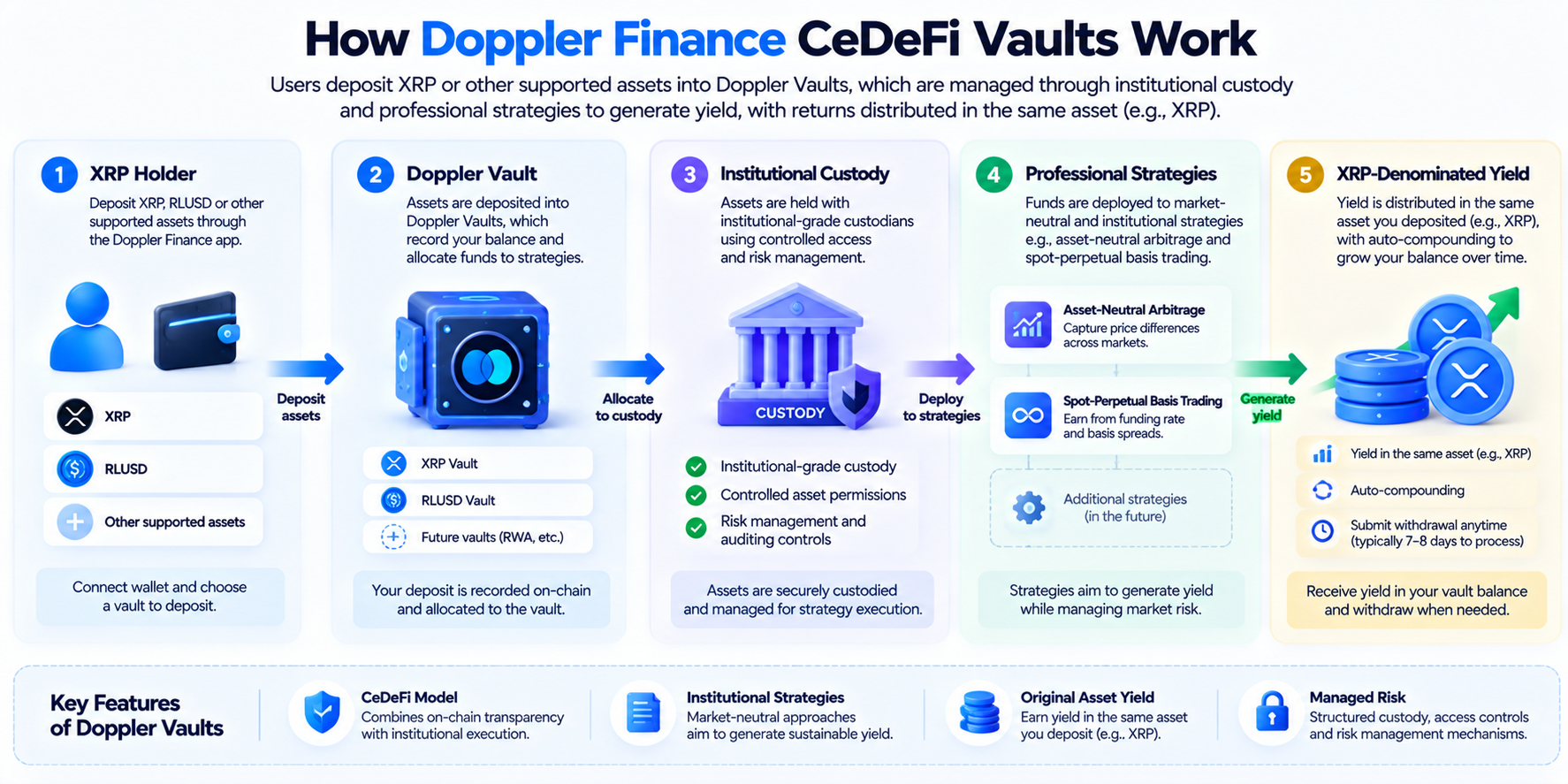
CeDeFi stands for Centralized Decentralized Finance and generally describes a model that combines the trade execution, custody, or risk management capabilities of centralized finance with the asset interaction and transparency tools of decentralized finance. Doppler Finance applies this approach by routing user assets into yield vaults and then participating in yield strategies through institutional custody and professional trading channels.
In Doppler's XRP Vault, users make deposits through XRPL. Assets enter designated custody wallets and are subsequently managed through partner custody services and asset management mechanisms. Official documentation states that the XRP Vault uses institutional custody, controlled asset authorization mechanisms, and selected centralized trading platforms to implement CeDeFi strategies. The project also provides relevant custody addresses and reserve transparency information, enabling users to verify some on-chain fund records.
The main yield strategies disclosed by Doppler in September 2026 include Asset-Neutral Arbitrage and Spot-Perpetual Basis Trading. The former seeks to capture price differences across markets, while the latter establishes relatively hedged positions based on price or funding rate differences between spot and perpetual contracts. Both strategies aim to control directional market exposure, but they may still be affected by changes in spreads, funding rate reversals, trade execution, and counterparty risk.
It is important to note that Doppler's CeDeFi model is not the same as fully on-chain, trustless DeFi. Some yield activities involve institutional custody and off-chain trade execution, so users cannot fully verify all strategy positions and real-time profit and loss solely through on-chain deposit records. Official documentation also clearly states that the XRP Vault's current yield comes from CeDeFi strategies. On-chain yield strategies remain under future development and should not be described as features already in operation.
How Do Doppler Vaults Provide Yield Opportunities for XRP Holders?
Doppler Vaults are Doppler Finance's core yield product, allowing users to deposit supported assets such as XRP and RLUSD into the corresponding vaults. According to official product information, vault returns are typically denominated in the deposited asset and accumulated through automatic compounding. For example, the XRP Vault aims to enable users to earn XRP-denominated yield rather than requiring them to first convert XRP into stablecoins to participate in strategies.
From the user's perspective, participants first enter the Doppler Finance application, connect a supported wallet, select the relevant Vault, enter the deposit amount, and confirm the transaction. After the deposit is completed, users can view their asset balance, estimated yield rate, and other relevant information through the platform interface. The protocol currently offers XRP- and RLUSD-related vaults, and yield rates, capacity, and withdrawal rules may vary by asset and network.
Yield primarily comes from professional trading strategies deployed by the protocol rather than newly issued token rewards from the XRP network itself. The Asset-Neutral Arbitrage and basis trading strategies disclosed by Doppler generally seek to generate returns from price or funding rate differences across markets. Therefore, yield rates vary with market conditions, capital utilization, and strategy execution. APR or APY displayed on the platform is only a reference at a specific point in time and does not represent a commitment to future returns.
The withdrawal mechanism is an area users should pay particular attention to. According to Doppler's official documentation, after a withdrawal request is submitted for the XRP Vault, users typically need to wait 7 days before requests are processed in batches. Taking batch processing time into account, actual receipt may take approximately 7–8 days. This means users can submit withdrawal requests at any time, but immediate fund recovery cannot be guaranteed. For users who need short-term liquidity, the withdrawal waiting period may affect their fund allocation.
How Is Doppler Finance Expanding Into RWA and the Multichain Ecosystem?
Doppler Finance's development direction is no longer limited to XRP yield products within the XRPL ecosystem. As RWA (Real-World Assets) tokenization continues to develop, the project aims to expand its existing yield vaults, institutional custody, and asset management capabilities to a broader range of digital assets and tokenized financial markets.
On July 29, 2026, Doppler Finance announced its expansion to the Base network, initially planning to support Coinbase Wrapped XRP (cbXRP) and gradually explore additional tokenized assets. cbXRP is a wrapped representation of XRP on compatible networks such as Base, which can help XRP-related liquidity enter different DeFi application scenarios. For Doppler, multichain expansion means its yield infrastructure may serve asset holders beyond XRPL, but cross-chain assets also introduce additional risks related to wrapped assets, custody, and network security.
In its roadmap published in September 2026, Doppler further proposed infrastructure for institutional lending, vault share tokenization, and financial position tokenization. For example, users' future vault deposit shares may be represented as transferable on-chain tokens and, subject to protocol rules and compliance requirements, used as collateral or for other financial activities. The project also plans to explore institutional financial networks such as Canton Network, as well as products based on XRPL lending functionality.
However, these areas are at different stages of development. Existing XRP and RLUSD yield vaults should not be conflated with future lending, credit, and tokenized financial position products. In particular, RWA business involves not only smart contracts but also legal ownership of real-world assets, custody arrangements, redemption mechanisms, and regulatory requirements. Whether these products can achieve large-scale adoption depends on the combined development of technology and traditional financial infrastructure.
What Is the XDP Token? Tokenomics and Core Utility
XDP is Doppler Finance's native utility and governance token, designed to coordinate protocol participants, ecosystem incentives, and long-term governance. Doppler formally announced XDP's token design on August 26, 2026, positioning it as an ecosystem coordination tool supporting protocol privileges, governance, and future safety modules, rather than a token used solely to distribute yield rewards.
XDP has a total supply of 10 billion tokens. Of this amount, 43% is allocated to Ecosystem & Incentives to support ecosystem growth and participant incentives, while another 1% is allocated to the Genesis Airdrop. The project has also established allocation arrangements for the team, investors, and other ecosystem purposes, and manages the circulation pace of certain tokens through lockups and gradual unlocking mechanisms.
XDP's primary functions can be divided into three areas. The first is Protocol Privileges, where holding or staking XDP may provide certain protocol privileges, such as priority access to specific vaults, strategies, or new products. The second is Governance, which is intended to support future protocol governance and related decision-making. The last is the Safety Module, which is planned to strengthen the protocol's long-term risk management capabilities through dedicated safety mechanisms.
It is important to note that some XDP functions initially announced by the official team are planned mechanisms. Their specific launch timing, participation requirements, and implementation details may change. XDP holders should also not interpret token governance rights as direct ownership of protocol revenue or vault assets. Token prices may also be affected by factors such as market liquidity, unlocking arrangements, and investor expectations, and do not necessarily have a positive relationship with the asset yield of Doppler Vaults.
How Does Doppler Finance Differ From Traditional XRP Earn Products?
For XRP holders, directly holding XRP, using centralized exchange earn products, and using Doppler Finance's CeDeFi yield vaults represent different approaches to asset management. The most notable differences among them are their sources of yield, methods of asset control, and risk structures.
Directly holding XRP does not require participation in additional financial strategies. Users primarily bear XRP's price volatility and wallet management risks. Centralized exchange earn products generally offer potential yield through lending or asset management services provided by the platform, requiring users to consider the platform's custody, use of funds, and redemption arrangements. Doppler Finance, by contrast, connects institutional custody and professional strategies through vault products, allowing users to participate in XRP yield activities through the protocol interface.
| Comparison Category |
Directly Holding XRP |
Centralized Earn Products |
Doppler Vaults |
| Primary source of returns |
XRP price movements |
Financial strategies deployed by the platform |
CeDeFi arbitrage and basis strategies |
| Additional asset yield |
No |
Depends on the product |
Targets yield denominated in the original asset |
| Asset management |
Self-custody by the user |
Usually managed by the platform |
Institutional custody and strategy management |
| Redemption method |
Transfer or sell independently |
Depends on product rules |
Processed according to the vault withdrawal cycle |
| Main risks |
Market and private key risks |
Platform, custody, and strategy risks |
Custody, counterparty, strategy, and liquidity risks |
Doppler Finance combines professional yield strategies with the needs of XRP holders, but this does not necessarily mean its risks are lower than those of traditional earn products. Particularly under the CeDeFi model, assets may involve different custodians, trading platforms, and strategy execution processes. Users should therefore understand the actual source of yield and how funds are managed and redeemed during abnormal market conditions.
What Are the Risks of Using Doppler Finance?
Doppler Finance provides digital asset yield management tools, but participating in yield vaults may still result in loss of principal. The first risk is strategy risk. Even when using Asset-Neutral Arbitrage or Spot-Perpetual Basis Trading, market exposure cannot be guaranteed to remain fully hedged at all times. Strategies may incur losses when market prices fluctuate sharply, funding rates reverse, or trading liquidity is insufficient.
The second is custody and counterparty risk. Doppler's CeDeFi architecture relies on institutional custody and external trading channels. If relevant service providers experience operational failures, asset freezes, or solvency issues, the protocol's asset management and redemption capabilities may be affected. Reserve transparency information can help users observe some fund information, but it cannot fully replace independent review of off-chain assets, liabilities, and trading exposure.
The third is liquidity and withdrawal risk. Withdrawals from Doppler Vaults typically require approximately 7–8 days, during which users may be unable to immediately adjust their asset allocation. If extreme market volatility occurs, withdrawal queues, strategy unwinding, and fund settlement may further affect fund availability. For volatile assets such as XRP, XRP-denominated yield cannot eliminate the asset's underlying price risk.
Finally, users should also consider risks related to smart contracts, cross-chain assets, protocol governance, and regulatory restrictions. As Doppler expands into Base and RWA, new products may introduce additional asset wrapping, cross-chain, and legal risks. Official XRP Vault documentation also clearly states that the relevant services are subject to regional usage restrictions, including restricted jurisdictions such as the United States.
Therefore, when evaluating Doppler Finance, users should not focus only on the APR or APY displayed on the page. They should also consider the yield strategy, asset custody, withdrawal period, risk disclosures, and their own liquidity needs.
Summary
Doppler Finance (XDP) is a digital asset yield and financial infrastructure project originating from the XRPL ecosystem. It initially offered holders access to professional financial strategies through XRP and RLUSD yield vaults. Its core model is CeDeFi, which combines on-chain asset interaction with strategies such as institutional custody, arbitrage, and basis trading in an effort to improve the capital efficiency of digital assets.
As the project expands into areas such as Base, RWA, and institutional lending, Doppler Finance is evolving from an XRP yield product into broader tokenized capital market infrastructure. XDP serves roles related to protocol privileges, ecosystem incentives, and governance coordination, though some functions still depend on subsequent implementation.
For users, the key to understanding Doppler Finance is not only how yield is generated, but also who holds the funds, how strategies are executed, how long withdrawals take, and what losses may be incurred during abnormal market conditions. Only by considering these factors together can users form a more comprehensive understanding of its CeDeFi model and long-term development potential.
FAQ
What Is Doppler Finance (XDP)?
Doppler Finance is a yield and asset management protocol for digital assets such as XRP. It primarily provides users with access to digital asset yield activities through Doppler Vaults and CeDeFi strategies. XDP is its native utility and governance token.
Where Does Doppler Finance's XRP Yield Come From?
According to official disclosures, Doppler's XRP yield primarily comes from professional strategies such as Asset-Neutral Arbitrage and Spot-Perpetual Basis Trading, rather than native staking rewards from the XRP network. Actual returns are affected by market conditions and strategy execution results.
Can I Withdraw From Doppler Vaults at Any Time?
Users can submit withdrawal requests at any time, but the XRP Vault typically requires a 7-day waiting period before the system processes requests in batches. Actual receipt may take approximately 7–8 days, so it is not an instant redemption product.
What Is the XDP Token Used For?
XDP is mainly used for protocol privileges, governance, and planned safety modules. Specific implementation details for some staking, governance, and safety mechanisms are subject to future project announcements.
Is Doppler Finance DeFi?
Doppler Finance uses a CeDeFi model that combines on-chain asset interaction, institutional custody, and professional trading strategies. Therefore, it has some characteristics of DeFi products, but not all asset management and yield execution processes are completed entirely on-chain.
Is Doppler Finance Yield Guaranteed?
No. Doppler Vaults returns are not fixed or guaranteed. Users may face strategy losses, custody risk, counterparty risk, and asset price volatility, and could lose part or all of their principal in severe circumstances.