XDP is the native utility and governance token of Doppler Finance. It aims to connect Doppler Finance users, protocol contributors, and long-term development goals through protocol privileges, governance participation, and ecosystem incentives. Unlike assets such as XRP and RLUSD used to participate in yield vaults, XDP primarily supports ecosystem coordination and protocol functions. It is not equivalent to a vault deposit receipt or a fixed-income product.
As Doppler Finance expands from XRP yield vaults into CeDeFi, RWA, and tokenized capital market infrastructure, XDP’s token design has become an important part of understanding the project’s long-term development model. For crypto asset protocols, token supply, allocation percentages, unlock mechanisms, and actual use cases all influence a token’s role in the ecosystem. However, growth in the protocol’s business does not necessarily translate into a higher token price. A key consideration is whether the token has clear, sustainable sources of demand.
This article analyzes XDP’s tokenomics, covering its supply and allocation structure, Protocol Privileges, governance, and Safety Module design. It also examines token unlocks, ecosystem incentives, and market risks to help readers distinguish XDP’s actual functions from expectations for its future development.
Key Takeaways
-
XDP is the native utility and governance token of Doppler Finance, primarily supporting protocol privileges, ecosystem participation, governance, and planned safety mechanisms.
-
According to the tokenomics published by Doppler Finance, XDP has a total supply of 10 billion tokens, with 43% allocated to Ecosystem & Incentives and 1% to the Genesis Airdrop.
-
XDP differs from the yield mechanisms of Doppler Vaults. Vault yields primarily come from financial trading strategies, while XDP’s value depends on token demand, actual utility, and market supply and demand.
-
Protocol Privileges, Governance, and Safety Module are XDP’s three main design areas. However, some functions remain in the planning stage, so future privileges should not be treated as services already available.
-
Evaluating XDP requires looking beyond total supply to analyze circulating supply, token unlocks, incentive spending, governance authority, and growth in the protocol’s business.
What Is the XDP Token, and Why Does Doppler Finance Need a Native Token?
XDP is the native token Doppler Finance designed for protocol participation, ecosystem incentives, and long-term governance. According to the project’s official introduction published on August 26, 2026, XDP is intended not simply to distribute rewards to users, but to serve as a coordination tool connecting protocol users, developers, liquidity providers, and ecosystem partners. Its core functions include Protocol Privileges, Governance, and the future Safety Module.
Doppler Finance initially focused on XRP and RLUSD yield vaults as its core products. Users deposit digital assets to participate in institutional trading strategies, earning potential yields denominated in the deposited assets. As the protocol expands into multichain assets, RWA, lending, and tokenized financial infrastructure, the number of participants and types of business requiring coordination also increases. Risk parameters for different vaults, ecosystem incentive budgets, and product access rules may involve multiple stakeholders. The project therefore aims to use XDP to establish a governance framework that gradually opens participation.
It is important to distinguish that XDP is not the source of XRP Vault yields. Doppler Vaults primarily rely on professional trading strategies to generate yield, while XDP focuses on protocol access, governance participation, and ecosystem coordination. Even if Doppler Finance’s assets under management increase, XDP holders do not automatically receive a share of protocol revenue. Whether a sustainable economic connection exists between the two still depends on the implementation of specific token functions and governance mechanisms.
What Is XDP’s Total Supply, and How Are the Tokens Allocated?
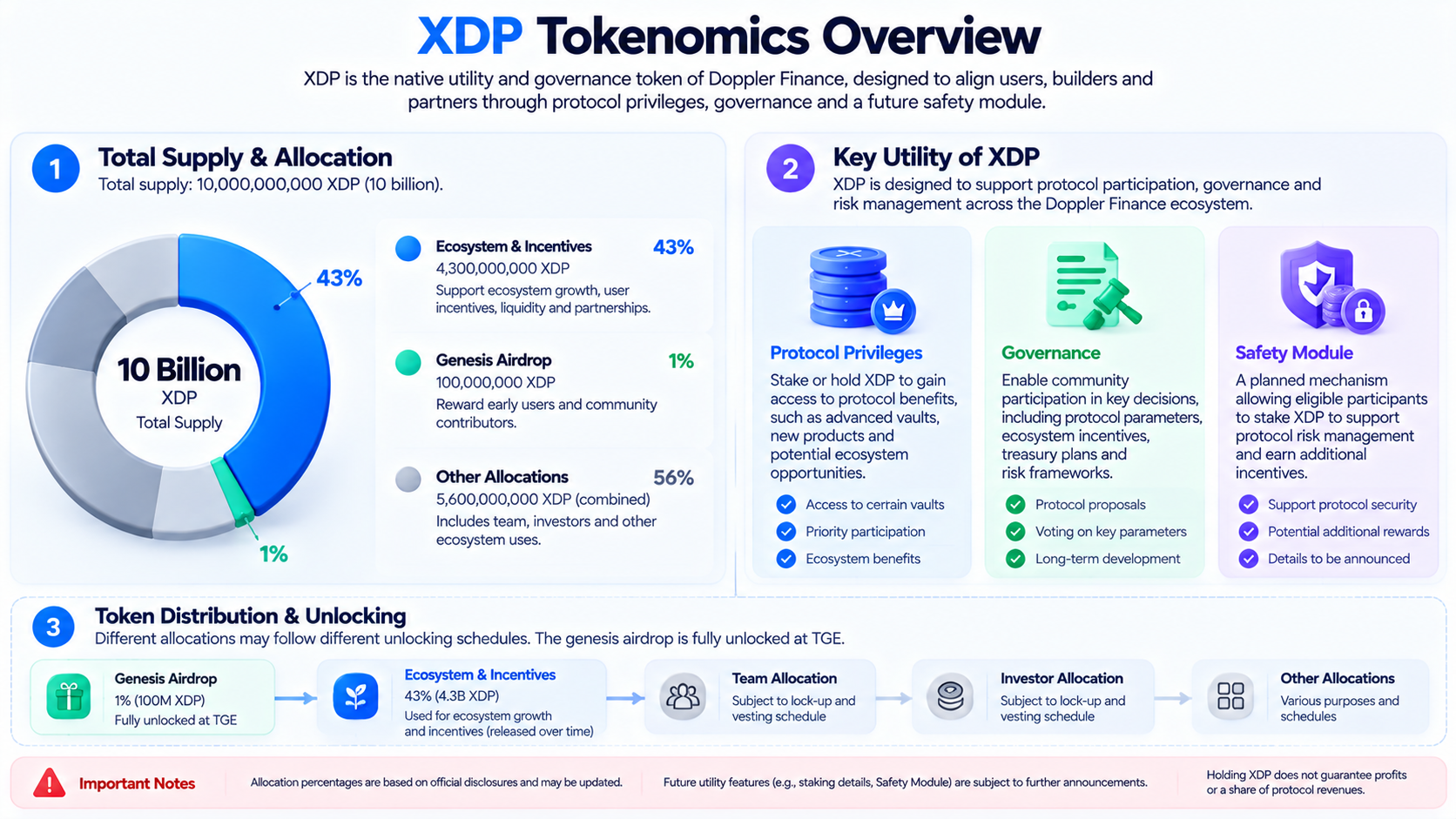
According to Doppler Finance’s official tokenomics, XDP has a total supply of 10 billion tokens. The project allocates a substantial share of the tokens to ecosystem development, incentives, and long-term growth to support protocol user growth, product expansion, and community participation. Ecosystem & Incentives accounts for 43% of the total supply, while the Genesis Airdrop accounts for 1%.
The ecosystem and incentive allocation primarily supports Doppler Finance’s long-term development, including community participation, product incentives, liquidity development, and future ecosystem activities. A relatively high ecosystem allocation gives the protocol substantial resources for long-term incentives. However, how these tokens are released, which participants receive them, and whether they generate genuine demand for product use will directly affect incentive effectiveness.
The Genesis Airdrop rewards early participants, including eligible Doppler Points (DP) Season 1 and Season 2 users and other ecosystem contributors. According to the official explanation, this allocation unlocks in full at the TGE (Token Generation Event). Unlike incentive tokens released over an extended period, the Genesis Airdrop may create a more immediate source of market supply when the token first enters circulation.
For investors, total supply is only the starting point for analyzing tokenomics. Other factors that affect market supply and demand include current circulating supply, lockup arrangements for team and investor tokens, the pace of ecosystem incentive releases, and new supply at different stages. XDP’s price level or valuation therefore cannot be assessed solely from its total supply of 10 billion tokens.
What Are Protocol Privileges, and What Benefits Can Staking XDP Provide?
Protocol Privileges is one of the main utility features Doppler Finance has designed for XDP. According to the direction outlined in official disclosures, eligible users may be able to stake XDP in the future to receive certain protocol privileges, such as access to advanced yield vaults and strategies, priority participation in new products, and access to specific ecosystem activities.
The core idea behind this mechanism is to connect token ownership or staking with protocol services. For regular Doppler Finance users, if XDP provides access to products they actually need, token demand may come partly from protocol usage rather than solely from short-term market trading. For example, if an advanced vault requires XDP staking, participants who want to use that product may need to hold a certain amount of XDP.
However, protocol privileges should not be interpreted as fixed returns. Staking XDP does not necessarily provide steady XDP rewards, guarantee access to all vaults, or ensure higher investment returns. Different privileges may come with requirements concerning staking amounts, lockup periods, user eligibility, and product capacity limits.
In its initial token description, Doppler stated that specific details about XDP Staking would be announced separately. Analysis of this feature therefore requires distinguishing rules already implemented from the project’s design goals. Its impact on actual XDP demand can only be assessed further once the staking mechanism, access requirements, and privileges are clearly defined.
How Does XDP Support Governance in Doppler Finance?
Governance is another core function of XDP. As the protocol grows, Doppler Finance aims to gradually involve the community in certain important decisions rather than rely entirely on the project’s operating team over the long term. According to official plans, future XDP governance may cover protocol parameters, ecosystem incentive budgets, treasury plans, supported products and integrations, and risk management frameworks.
For example, as Doppler Finance introduces more yield vaults and institutional financial products, different products may require different risk limits, supported asset ranges, and incentive arrangements. If the future governance framework allows XDP holders to participate in related proposals and voting, the token can serve as a tool for coordinating the interests of different ecosystem participants.
However, governance rights do not mean token holders can directly manage the assets users deposit into vaults. Matters involving custody, trading strategy execution, compliance requirements, and emergency risk responses may still require professional institutions or designated operators to carry them out. For CeDeFi protocols, governance mechanisms must also clearly define the boundary between community decisions and institutional risk management, so that technical voting rights are not mistaken for direct control over all financial operations.
Doppler has also emphasized that decentralized governance will be implemented in stages, rather than transferring all management authority at once. XDP’s governance value therefore needs to be evaluated based on actual voting mechanisms, proposal rights, execution processes, and community participation. Simply holding a governance token does not guarantee that every holder will have the same level of influence over the protocol’s development.
What Is the Safety Module, and How Does XDP Support Protocol Risk Management?
The Safety Module is a future safety mechanism Doppler Finance has planned for XDP. Its goal is to allow eligible participants to allocate staked tokens to provide additional risk support for certain protocol products. According to the official introduction, users may be able to allocate staked XDP to specific protocol protection pools in the future and receive additional XDP incentives in exchange for taking on clearly defined risk exposure.
In terms of design, the Safety Module differs from ordinary token staking. Ordinary staking may primarily provide protocol access, while the Safety Module places greater emphasis on the relationship between risk-taking and incentives. If a protection pool supports a specific vault or financial product, participants need to understand the scope of losses the pool may bear, the conditions that trigger its use, and the rules governing how its assets are used.
For example, in some DeFi protocols, safety modules may use staked assets to provide a buffer against specific risk events. When a loss event meets the applicable conditions, assets in the protection pool may be used to cover part of the shortfall. Participants who assume this risk may receive additional rewards as compensation. However, this is only a common approach to safety module design in the industry; it does not mean Doppler has adopted the same loss-sharing rules.
At the design stage disclosed so far, Doppler still needs to publish further details on the Safety Module’s participation requirements, risk coverage, and incentive structure. The mechanism therefore should not be described as already providing insurance for all Doppler Vaults, nor should users assume that their staked XDP principal is necessarily protected.
How Could XDP Token Unlocks and Ecosystem Incentives Affect Market Supply and Demand?
XDP’s long-term supply and demand depend not only on total token supply but also on the release schedules of different allocation categories. For a token with a total supply of 10 billion, future unlocks may change the composition of circulating supply even if short-term market circulation is relatively low.
Token unlocks do not necessarily cause prices to fall, because recipients may choose to continue holding, stake their tokens, or use them in protocol activities. However, if new circulating supply grows faster than actual demand, the market may require more buying demand to absorb the additional tokens. Users should pay particular attention to specific unlock dates, amounts, and the behavior of relevant holders, especially as ecosystem incentive, team, and investor tokens are gradually released.
At the same time, ecosystem incentives may also support protocol growth. Doppler Finance has allocated 43% of XDP to Ecosystem & Incentives, which may attract more participants through user activities, developer support, and protocol incentives in the future. However, incentive effectiveness depends on whether new users genuinely use vaults, lending, or other financial products, rather than participate briefly only to collect rewards.
Analysis of XDP’s tokenomics should therefore consider two aspects: potential supply pressure from token releases and actual token demand generated by protocol functions. The tokenomics model can develop a relatively stable foundation for long-term operation only if ecosystem activities translate into sustained product usage and XDP serves a clearly defined function within those activities.
How Does XDP Differ From Doppler Vaults Yields?
The relationship between XDP and Doppler Vaults is a common source of confusion when examining Doppler Finance’s economic model. Although both belong to the same protocol ecosystem, they differ in their sources of returns, risk structures, and intended uses.
Doppler Vaults are digital asset yield management products. After users deposit assets such as XRP or RLUSD, the protocol seeks to generate yield through professional trading strategies. For XRP Vault, for example, users focus on changes in their XRP balances, yield rates, custody arrangements, and withdrawal timelines.
XDP, by contrast, is the protocol’s utility and governance token. Its market price depends on circulating token supply, trading liquidity, protocol functions, investor expectations, and broader crypto market conditions. Even if Doppler Vaults’ assets under management continue to grow, this does not directly imply that XDP’s price will rise alongside them.
| Comparison Category |
Doppler Vaults |
XDP Token |
| Core Purpose |
Digital asset yield management |
Protocol utility and governance |
| Main Assets |
XRP, RLUSD, and others |
XDP |
| Potential Sources of Returns |
Financial trading strategies |
Changes in the token’s market price and potential protocol privileges |
| Main Uses |
Depositing assets to participate in yield strategies |
Protocol access, governance, and the planned Safety Module |
| Main Risks |
Strategy, custody, withdrawal, and market risks |
Price volatility, unlocks, liquidity, and feature implementation risks |
| Are Returns Assured? |
No |
No |
Vault users should also not assume that purchasing XDP is required to participate in all existing yield products. Whether holding or staking XDP is necessary depends on the official rules of each product. As the protocol introduces new advanced vaults or ecosystem features, some products may add token requirements. However, requirements that have not yet been announced should not be treated as currently applicable.
What Risks Should You Consider When Evaluating XDP’s Tokenomics?
The first is token supply and unlock risk. XDP has a total supply of 10 billion tokens, a substantial portion of which is allocated to ecosystem incentives and long-term development. As tokens from different allocation categories gradually enter circulation, market supply and demand may change. Users need to monitor the latest circulating supply, unlock schedules, and potential trading behavior of relevant holders, rather than assess valuation solely based on total supply or short-term price performance.
The second is token feature implementation risk. Protocol Privileges, Governance, and Safety Module are XDP’s main design areas, but these mechanisms require specific product rules and technical implementation. If the rollout of future staking privileges, governance rights, or the Safety Module differs from market expectations, it may affect investors’ assessment of the token’s utility.
The third is uncertainty about the relationship between the protocol’s business and token value. Even if Doppler Finance’s vaults, RWA, and institutional financial businesses attract more users, their revenue does not automatically flow to XDP holders. Unless the protocol explicitly establishes a mechanism for using fees or distributing value, business revenue cannot be directly equated with returns for token holders.
Finally, there are market liquidity and security risks. XDP’s price may be affected by market depth, market sentiment, and the behavior of large holders. As the protocol expands into a multichain ecosystem, users also need to verify the token’s network and official contract address, and watch for counterfeit tokens using the same name, fake airdrops, and phishing websites. Doppler has explicitly warned users not to share private keys or seed phrases with anyone, and not to transfer funds to unfamiliar addresses to claim XDP.
XDP’s tokenomics should therefore be analyzed comprehensively in terms of actual functions, supply structure, protocol governance, and risk-taking, rather than simply treating it as a reward token attached to XRP yield products.
Conclusion
XDP is the native utility and governance token of Doppler Finance, with a total supply of 10 billion tokens. Of that supply, 43% is allocated to Ecosystem & Incentives and 1% to the Genesis Airdrop. Its core design centers on Protocol Privileges, Governance, and the future Safety Module, aiming to support protocol participation, ecosystem coordination, and a gradual transition to decentralized governance.
Unlike Doppler Vaults, which seek potential yields through institutional trading strategies, XDP primarily serves protocol utility and governance functions. Whether the token can develop sustained demand depends on whether the relevant privileges are actually implemented and whether Doppler Finance users and institutional participants need to use these functions.
For users interested in XDP, understanding total token supply is only the first step. More importantly, they should continue monitoring changes in circulating supply, unlock schedules, staking privileges, governance mechanisms, and actual progress on Safety Module implementation, while distinguishing growth in the protocol’s business from the token’s market performance.
FAQ
What is XDP?
XDP is the native utility and governance token of Doppler Finance, primarily designed to support protocol privileges, governance participation, ecosystem incentives, and the planned Safety Module.
What is XDP’s total supply?
According to Doppler Finance’s official tokenomics, XDP has a total supply of 10 billion tokens. Of that supply, 43% is allocated to Ecosystem & Incentives and 1% to the Genesis Airdrop.
Does holding XDP provide access to Doppler Vaults yields?
Holding XDP alone is not equivalent to participating in Doppler Vaults yield strategies. Vault yields come from the financial strategies users participate in after depositing assets, while XDP primarily supports protocol privileges and governance. Specific staking rewards or privileges depend on the official rules already implemented.
Can XDP be used for governance?
XDP is designed as Doppler Finance’s governance token. According to official plans, future governance may cover protocol parameters, ecosystem incentives, treasury plans, and risk management, but specific rights depend on the stage of governance implementation.
Is the XDP Safety Module insurance?
It should not be treated as an insurance product that is already available. The Safety Module is a risk-support mechanism planned by Doppler. Future participants may stake XDP to assume specific risks and receive corresponding incentives. Specific rules remain subject to formal announcements.
Do XDP token unlocks necessarily cause the price to fall?
Not necessarily. Token unlocks increase potential circulating supply, but price also depends on actual selling volume, market demand, trading liquidity, and overall market conditions. An unlock does not mean all unlocked tokens will immediately be sold on the market.