Doppler Vaults is a digital asset yield vault product launched by Doppler Finance. Through institutional custody and professional trading strategies, it provides holders of XRP and other assets with a way to potentially earn yields. Unlike simply holding XRP while waiting for its price to rise, users can deposit supported assets into vaults, where the protocol manages funds through arbitrage, basis trading, and other methods, seeking to accumulate yield in the original asset.
As the XRP Ledger (XRPL) ecosystem continues to develop, expanding XRP’s financial utility beyond payments and value transfer has become an important area of exploration in XRPfi. However, XRP does not have native staking rewards like those available on traditional proof-of-stake networks. Any additional yield must therefore rely on lending, market making, arbitrage, or other financial activities. This means XRP yield is not risk-free interest; its stability depends on the actual strategies used, market conditions, and fund management capabilities.
This article examines the sources of yield for Doppler Vaults, explains how asset-neutral arbitrage and spot-perpetual basis trading work, and further analyzes institutional custody, withdrawal mechanisms, and potential risks under the CeDeFi architecture to help readers understand how XRP yield products actually operate.
Key Takeaways
-
Doppler Vaults is a digital asset yield vault from Doppler Finance that allows users to deposit supported assets, such as XRP, and potentially earn yield through professional trading strategies.
-
XRP does not use a PoS staking reward mechanism. Therefore, XRP yield from Doppler Vaults does not come from native network staking, but from market trading strategies.
-
The primary strategies disclosed by Doppler Finance include asset-neutral arbitrage and spot-perpetual basis trading.
-
Doppler Vaults uses a CeDeFi model that combines on-chain asset records, institutional custody, and off-chain trade execution. However, this does not mean all fund activities can be verified on-chain in real time.
-
XRP Vault withdrawals typically require approximately 7–8 days to process. Users should also consider counterparty, market volatility, strategy execution, and liquidity risks.
What Are Doppler Vaults? How Does the XRP Yield Vault Work?
Doppler Vaults is a yield management product offered by Doppler Finance for digital asset holders. Users can deposit supported assets, including XRP and RLUSD, into their corresponding vaults, where the protocol allocates funds according to its established asset management framework. Rather than independently executing arbitrage or derivatives trades on trading platforms, users delegate fund management and strategy execution to professional service providers through the vault model. Users primarily participate by depositing funds, viewing balances, and requesting withdrawals.
According to Doppler Finance’s official documentation, XRP Vault combines institutional custody with CeDeFi strategies. Users make deposits through XRPL, after which assets enter the corresponding custody arrangement and are used in market trading through professional strategies. The protocol displays vault balances and related yield data through its interface, while also providing certain on-chain addresses and reserve information for users to review. It is important to note that on-chain deposit records do not mean that all trading positions and real-time yields are fully public.
One important feature of Doppler Vaults is that yield is generally denominated in the deposited asset itself. For example, users participating in XRP Vault aim to increase their XRP balance rather than necessarily converting XRP into stablecoins to earn dollar-denominated returns. However, growth in a vault balance does not necessarily mean that the asset’s dollar value has increased. If the price of XRP declines significantly, users may still experience a decrease in the overall value of their assets even if they receive additional XRP.
Why Can’t XRP Earn Yield Directly Through Native Staking?
XRP Ledger differs significantly from blockchains that use Proof of Stake (PoS). PoS networks such as Ethereum allow validators to stake assets to participate in consensus and receive corresponding rewards under protocol rules. XRPL uses its own consensus mechanism and does not require XRP holders to stake XRP to participate in block validation. As a result, there are no native staking rewards for ordinary token holders.
This means that simply keeping XRP in a wallet does not automatically generate additional XRP over time. To earn yield without selling XRP, users need to participate in additional financial activities, such as lending, providing liquidity, arbitrage, or derivatives trading. Each approach involves different risks, and returns from trading strategies depend on market conditions rather than fixed interest guaranteed by a blockchain protocol.
Doppler Finance has built yield infrastructure to address this need. Its XRP Vault seeks to increase the amount of XRP held by users through institutional trading strategies, rather than providing returns through XRP staking rewards or new token issuance. According to information released by Doppler in September 2026, the protocol primarily uses asset-neutral strategies and manages fund flows through institutional custody and over-the-counter settlement infrastructure.
Where Does XRP Yield From Doppler Vaults Come From?
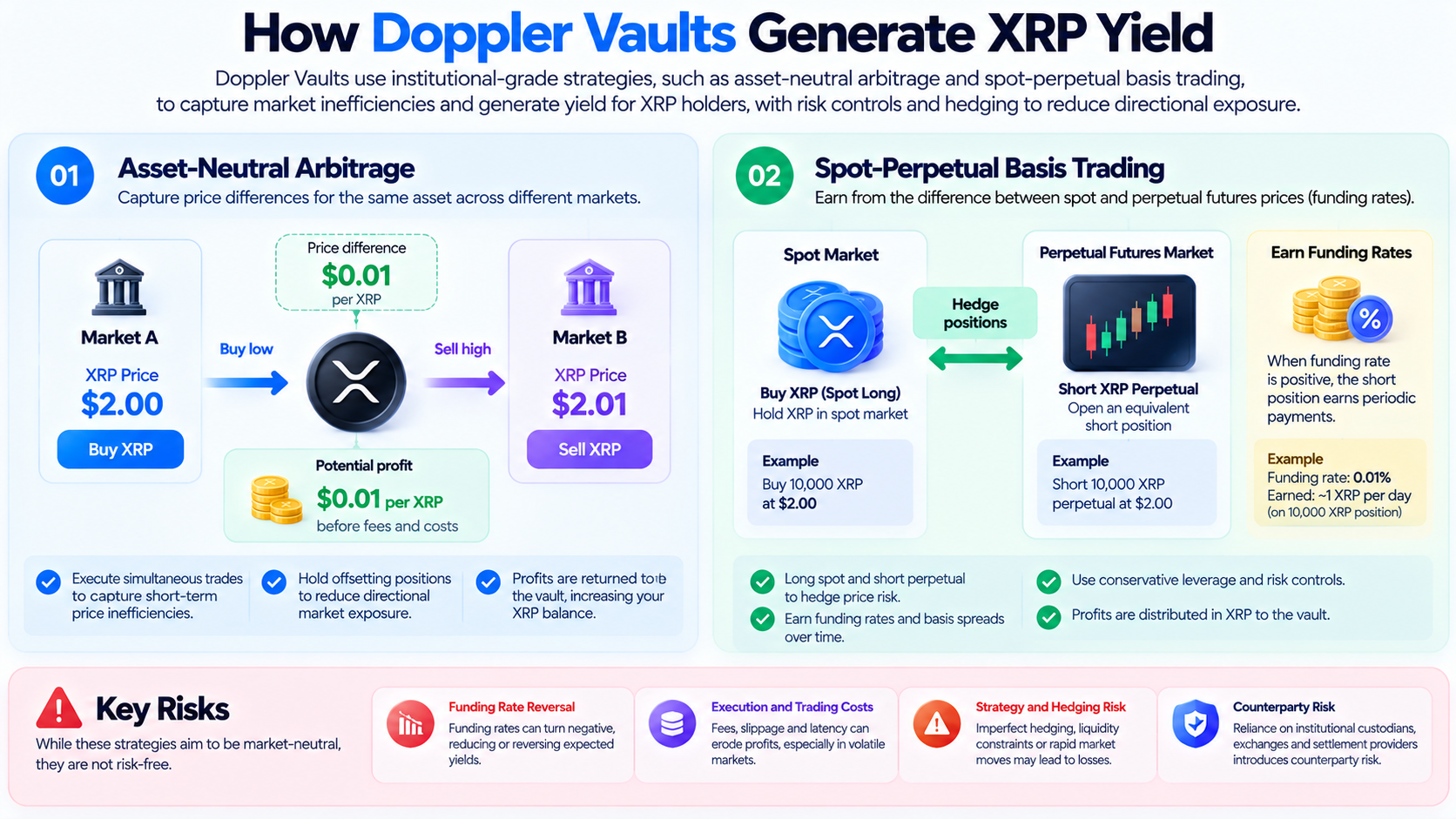
Doppler Vaults generates yield primarily from market spreads and funding rate differences captured through professional trading strategies. Unlike directional trading that relies on a continued rise in XRP’s price, the strategies disclosed by the protocol place greater emphasis on reducing dependence on a single market direction and seeking potential returns through relatively hedged asset portfolios.
According to official disclosures from Doppler Finance, its primary strategies include asset-neutral arbitrage and spot-perpetual basis trading. Both strategies involve price relationships across different trading markets, though their specific execution methods, hedge ratios, and risk exposures may be adjusted based on market conditions.
How Does Asset-Neutral Arbitrage Generate XRP Yield?
Asset-neutral arbitrage typically generates returns by capturing price differences between different trading venues or instruments. For example, the same asset may temporarily trade at different prices in two markets. Professional traders may buy in the lower-priced market and sell in the higher-priced market, seeking to capture the spread.
Suppose that at a given time, XRP is priced at $2.00 in Market A and $2.01 in Market B. In theory, a trader could simultaneously buy and sell XRP to capture a $0.01 price difference per XRP. However, actual returns must also account for fees, slippage, fund transfer costs, and the effects of execution delays. If the price difference disappears before the orders are completed, the trade may not be profitable.
For Doppler Vaults, the purpose of asset-neutral arbitrage is to reduce reliance on one-way XRP price movements through hedged trades and reflect the strategy’s net returns as additional XRP. However, the official documentation does not disclose the specific execution path of each trade. Therefore, the example above is intended only to explain the principle of arbitrage and does not represent an actual Doppler trade.
How Does Spot-Perpetual Basis Trading Generate Yield?
Spot-perpetual basis trading seeks to capture price differences between spot and derivatives markets or funding rate income by establishing spot and derivatives positions at the same time.
For example, when long demand in the perpetual futures market is strong and funding rates are positive, holding a spot long position while establishing a corresponding perpetual futures short position may generate funding rate income while hedging part of the price volatility. Because the spot and short positions move in opposite directions, some gains and losses resulting from XRP price increases or declines may offset each other.
However, this strategy is not risk-free arbitrage. Funding rates may turn negative, spot and futures prices may temporarily diverge, and margin requirements may increase during significant market volatility. If the hedge size is insufficient, liquidity declines suddenly, or a trading platform experiences an outage, the strategy may still incur losses.
Doppler states that its basis trading uses relatively conservative loan-to-value (LTV) ratios and continuous monitoring mechanisms to manage trading risks. However, low market directional exposure does not mean there are no leverage risks, counterparty risks, or losses during extreme market conditions.
How Does the CeDeFi Architecture Manage User Funds and Institutional Trading Risks?
Doppler Vaults uses a CeDeFi architecture that combines on-chain asset interactions with institutional custody and professional trade execution. Users deposit XRP through the protocol interface, and funds enter the relevant custody and management system before being used in market trading through professional strategies. Compared with trading methods managed entirely by users, this model can centralize strategy execution, but it also introduces reliance on custodians, trading service providers, and operational processes.
According to Doppler’s official introduction, the protocol uses institutional custody infrastructure such as Fireblocks and Ceffu, with multi-signature approvals used to control asset transfers. At the same time, Doppler has disclosed its use of Off-Exchange Settlement (OES) arrangements, allowing trading strategies to access centralized exchange order book liquidity while seeking to avoid directly transferring asset ownership to trading platforms.
The primary value of OES is that it reduces some of the risks associated with trading platforms directly holding assets, but it cannot fully eliminate counterparty risk. Funds may still be affected by changes in settlement services, custodians, trading systems, or market liquidity. In addition, institutional custody generally means users must rely on established withdrawal approval and fund management processes, rather than independently transferring all assets at any time as they could with a self-custody wallet.
Doppler has also disclosed Proof of Reserves and periodic transparency reporting mechanisms intended to help users and partners understand the condition of vault assets. However, Proof of Reserves is primarily used to demonstrate the existence of specific assets and cannot independently verify all liabilities, derivatives exposure, and potential losses. Therefore, assessing the security of a CeDeFi vault requires consideration of asset reserves, liabilities, strategy risks, and custody arrangements together.
How Is Doppler Vaults Yield Calculated? What Is the Difference Between APR and APY?
When reviewing Doppler Vaults, users generally need to distinguish between APR (Annual Percentage Rate) and APY (Annual Percentage Yield). APR primarily represents the annualized rate of return without considering compounding, while APY includes the potential compounding effect of reinvesting earnings.
According to Doppler’s official documentation, XRP Vault uses an automatic compounding mechanism, meaning that earnings are gradually credited to a user’s vault balance without requiring the user to manually withdraw and redeposit them.
For example, assume a user deposits 10,000 XRP, a strategy maintains a 5% APR throughout one year, and earnings compound daily. The theoretical APY would be approximately:
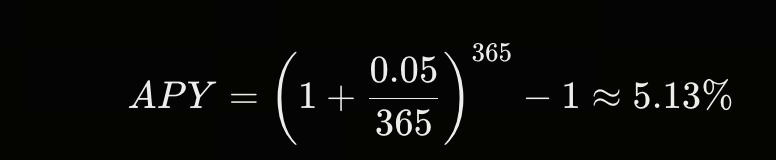
Under this purely hypothetical scenario, the asset balance after one year would be approximately 10,513 XRP.
However, actual vault yield may not remain constant. Arbitrage opportunities, funding rates, strategy capacity, trading costs, and risk management requirements can all affect final returns. Therefore, the calculation above is intended only to help readers understand the compounding mechanism and does not represent that Doppler Vaults can currently or in the future achieve a 5% yield.
In addition, XRP-denominated yield differs from dollar-denominated yield. If the amount of XRP held by a user increases by 5% but the market price of XRP falls by 20% during the same period, the total dollar value of the user’s assets may still decline. When evaluating vault performance, users should consider changes in asset quantity, the method used to calculate yield, and the price risk of the underlying asset.
How Do Doppler Vaults Withdrawals Work? Why Is There a 7-Day Wait?
The withdrawal mechanism for Doppler Vaults differs from that of an ordinary self-custody wallet. Users can submit a withdrawal request through the platform, but funds may not arrive immediately. According to official XRP Vault documentation, withdrawal requests require a 7-day waiting period and are then processed in batches by the system at approximately 01:00 UTC. Under normal circumstances, the actual waiting time may therefore be slightly longer than 7 days.
The withdrawal waiting period is related to CeDeFi’s asset management model. Because some funds may be participating in institutional trading strategies, the protocol needs to coordinate fund recovery, position management, custody approvals, and final settlement. The waiting period also provides operational time for abnormal withdrawal detection and security reviews. However, this does not mean that a 7-day waiting period guarantees fund security or ensures that funds will arrive on time in every market environment.
Before participating in XRP Vault, users should pay particular attention to whether the withdrawal rules meet their liquidity needs. For example, users who plan to use XRP for short-term trading, payments, or portfolio rebalancing may not be able to withdraw all funds immediately when market conditions change. For assets that may need to be accessed at any time, the withdrawal period should be considered alongside expected yield.
In addition, Doppler’s RLUSD Vault also has a withdrawal waiting period, though the specific procedures vary by network. According to official information, RLUSD withdrawals on XRPL can be automatically sent to a user’s wallet after processing, while RLUSD withdrawals on Ethereum require users to manually claim them. Therefore, operational details for different assets and networks should be reviewed separately.
What CeDeFi Risks Do Doppler Vaults Face?
The risks of Doppler Vaults extend beyond XRP price volatility and include professional trading strategies, institutional custody, counterparties, and fund liquidity. Even with asset-neutral strategies, a vault cannot be guaranteed to remain profitable, nor should it be treated as a fixed-interest deposit product.
First, there is strategy execution risk. Asset-neutral arbitrage relies on price differences between markets, while basis trading depends on relationships among spot prices, perpetual futures, and funding rates. If arbitrage spreads narrow, funding rates reverse, trading costs rise, or hedge positions deviate, strategy returns may decrease or turn into losses. Extreme market conditions may also result in insufficient liquidity, margin pressure, and forced liquidation risk.
Second, there are custody and counterparty risks. The CeDeFi model relies on institutional custody services, trading platforms, and settlement systems. Even with multi-signature and OES arrangements, the effects of service provider operational failures, asset freezes, settlement delays, or security incidents cannot be fully excluded. Official risk documentation identifies potential risks, including custody administrator keys, institutional private keys, and smart contract vulnerabilities, and describes corresponding monitoring and emergency measures.
Finally, there are withdrawal and transparency risks. Because XRP Vault has a waiting period, users cannot be assured of immediately recovering their assets at any given time. On-chain Proof of Reserves may also not fully reflect off-chain derivatives positions and real-time changes in net asset value. Therefore, users should not assess product security solely based on displayed APR, reserve balances, or institutional custody partnerships.
Overall, Doppler Vaults provides XRP holders with potential yield opportunities through professional strategies, but this yield comes with additional financial risks. Before participating, users should understand the strategy types, custody structure, withdrawal rules, and potential principal losses rather than viewing the product as risk-free staking interest provided by the XRP network.
Summary
Doppler Vaults is a yield vault built by Doppler Finance around digital assets such as XRP. Its core objective is to increase the quantity of assets held through professional financial strategies without requiring users to actively sell their XRP. Because XRP Ledger does not provide native staking rewards, Doppler’s yield primarily comes from market activities such as asset-neutral arbitrage and spot-perpetual basis trading, rather than interest directly distributed by a blockchain protocol.
From a technical architecture perspective, Doppler uses a CeDeFi model that combines on-chain deposits, institutional custody, over-the-counter settlement, and professional trade execution. This approach can help access broader market liquidity, but it also means that fund security depends not only on smart contracts, but also on custodians, trading service providers, and strategy management capabilities.
For XRP holders, the key to understanding Doppler Vaults is distinguishing between yield sources and yield commitments. Vaults may provide potential XRP-denominated returns, but they cannot eliminate underlying asset price volatility or guarantee that strategies will always be profitable. In particular, the approximately 7–8-day withdrawal period makes liquidity management an important factor to evaluate before participating.