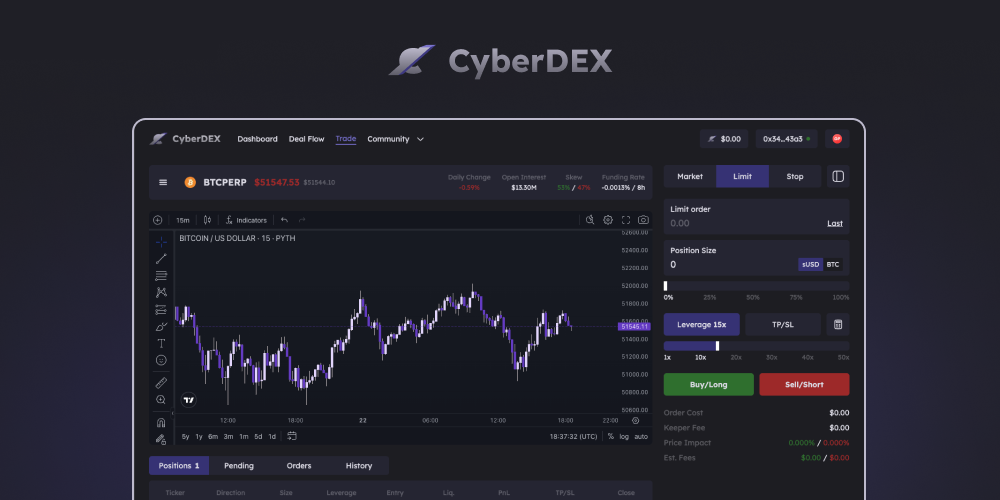
In recent years, the DeFi market has evolved from simple token swaps to encompass lending, yield aggregation, and derivatives trading. Perpetual Futures have emerged as one of the most significant on-chain financial products, offering leverage, directional trading, and risk hedging. The launch of CyberDEX highlights a shift in DeFi derivatives protocols from building isolated liquidity pools to leveraging shared infrastructure.
Within the DeFi derivatives ecosystem, CyberDEX operates as an application-layer protocol. It focuses on delivering trading capabilities and product innovation for users, while foundational protocols like Optimism and Synthetix handle liquidity and settlement at the infrastructure layer.
Background and Strategic Positioning of CyberDEX
In the early stages of decentralized finance, development was centered on spot trading, and the introduction of the AMM model addressed initial on-chain liquidity shortages. As user demand shifted toward more sophisticated services—such as leveraged trading, risk hedging, and price discovery—derivatives markets became the focal point of DeFi’s growth.
Unlike spot trading, Perpetual Futures require deeper liquidity, more reliable price feeds, and robust risk management. Many protocols established independent liquidity pools to support trading, but this approach often resulted in fragmented liquidity and lower capital efficiency.
CyberDEX is built atop the Synthetix ecosystem, utilizing its mature shared liquidity framework to power derivatives trading. This enables the platform to forego building its own liquidity network and instead focus resources on enhancing trading products and the user experience.
How CyberDEX Works
CyberDEX’s core architectural principle is the separation of liquidity from the trading interface. When users execute trades on the platform, they interact directly with a liquidity pool collectively backed by Synthetix stakers, rather than matching orders with other traders.
When a user opens a position, the system executes the trade at real-time market prices provided by oracles and uses smart contracts to continuously calculate P&L and margin status. By relying on a unified liquidity pool instead of an order book, CyberDEX minimizes price slippage caused by shallow order depth.
From a systems perspective, CyberDEX is an application built atop a multilayered infrastructure:
| Component |
Functional Layer |
Primary Role |
| Optimism |
Settlement Layer |
Low-cost, high-efficiency trade execution |
| Synthetix |
Liquidity Layer |
Shared liquidity and support for synthetic assets |
| CyberDEX |
Application Layer |
User interface and derivatives functionality |
This layered model enhances protocol synergy and exemplifies leading modular blockchain design.
Core Infrastructure of CyberDEX
Optimism Network
Optimism is a leading Layer 2 network in the Ethereum ecosystem, utilizing Optimistic Rollup technology to achieve higher throughput and lower transaction costs. For Perpetual Futures trading, where users frequently open, close, and adjust positions, reduced on-chain costs are essential for a superior user experience.
Synthetix Liquidity Network
Synthetix stands as one of DeFi’s flagship synthetic asset protocols, introducing the Debt Pool model as its core innovation. Stakers collectively bear system debt, pooling liquidity into a unified market.
By integrating directly with this liquidity network, CyberDEX enables Perpetual Futures trading without relying on independent market makers. This approach eliminates liquidity fragmentation and enhances capital efficiency.
Oracle System
Accurate price feeds are critical for Perpetual Futures markets. CyberDEX sources external market prices from on-chain oracles, which are used for trade execution, position calculations, and risk management.
Because oracles directly impact margin calculations and liquidation logic, their reliability is essential to the platform’s overall stability.
Smart Contract Settlement
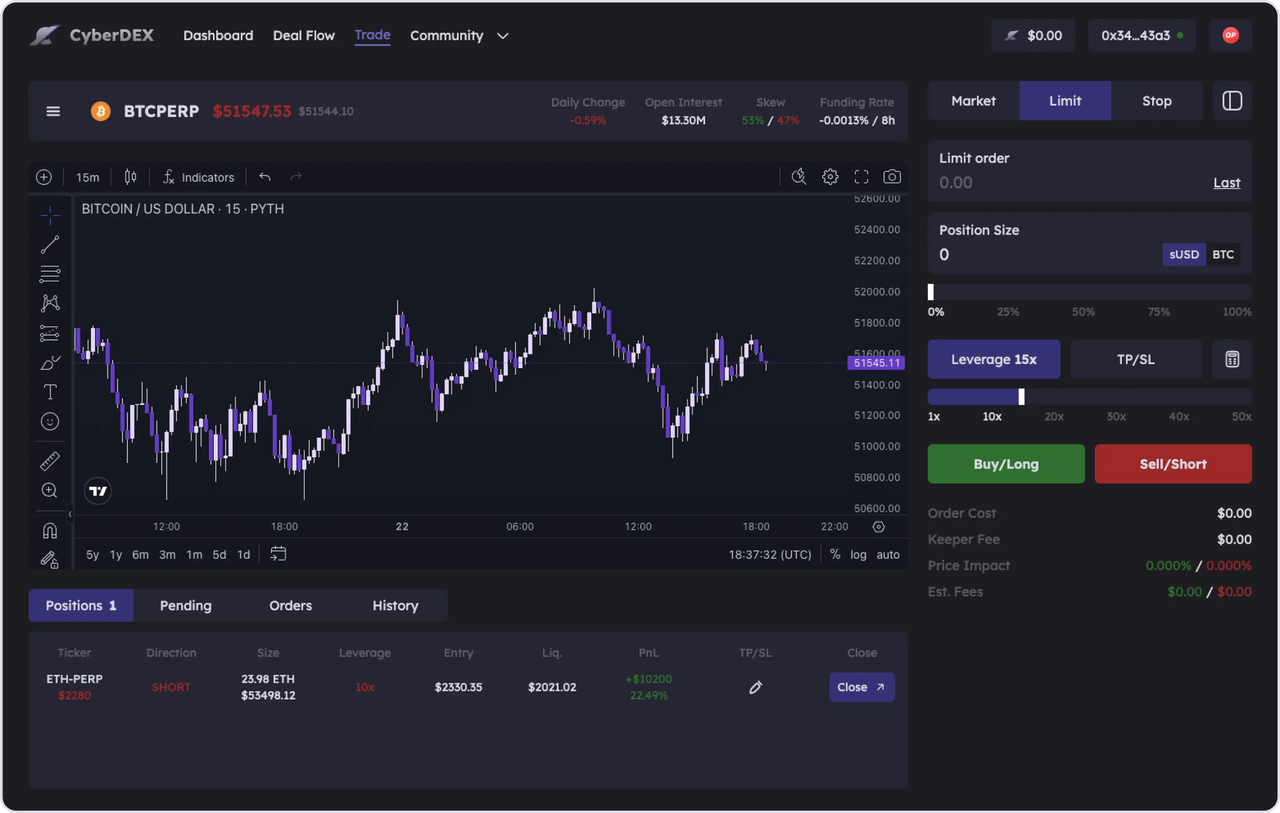
All CyberDEX trading operations—including opening/closing positions, margin management, P&L settlement, and funding rate calculations—are executed via smart contracts. This on-chain settlement model reduces human intervention, delivering transparent and verifiable trading.
CyberDEX Perpetual Futures Trading Mechanism
Perpetual Futures are derivatives contracts with no expiration date; their prices are kept in line with spot markets via a funding rate mechanism. Users can go long or short based on their market outlook and employ leverage to amplify both gains and risks.
On CyberDEX, a typical trade involves depositing margin, choosing leverage, opening a position, paying or receiving the funding rate, and closing the position to settle. Throughout, liquidity is provided by the unified Synthetix pool, so users never have to wait for counterparties’ orders.
CyberDEX vs. Order Book Model
| Dimension |
CyberDEX |
Order Book DEX |
| Liquidity Source |
Synthetix Debt Pool |
User orders |
| Execution |
Trades against pool |
Buyer-seller matching |
| Slippage |
Low |
Depends on order depth |
| Market Maker |
Not required |
Relies on market makers |
| Scalability |
High |
More complex |
This design positions CyberDEX as a shared liquidity-driven derivatives platform, distinct from traditional matching exchanges.
What Are Cyber Leverage Tokens?
In addition to standard Perpetual Futures, CyberDEX offers Leverage Tokens—financial products that encapsulate leveraged positions into a single token. By holding these tokens, users gain leveraged market exposure without manually managing margin or leverage ratios.
Unlike conventional leveraged trading, Leverage Tokens use automatic rebalancing to maintain the target leverage. During sharp market moves, the system automatically adjusts the underlying positions, reducing the need for active risk management by the user.
Leverage Tokens vs. Perpetual Futures
| Feature |
Leverage Tokens |
Perpetual Futures |
| Margin Management |
Automatic |
User-managed |
| Liquidation Risk |
No traditional liquidation |
Forced liquidation present |
| Complexity |
Low |
High |
| Leverage Adjustment |
Auto-rebalancing |
Manual |
| Target User |
General users |
Professional traders |
CYDX Token and Ecosystem Incentives
CYDX is central to the CyberDEX ecosystem, serving both governance and incentive functions. In decentralized protocols, governance tokens enable community participation and align stakeholder interests.
Through governance, token holders help decide on protocol parameters, product upgrades, and ecosystem direction. CYDX can also be used to incentivize liquidity providers and ecosystem contributors, driving the protocol’s long-term growth.
Within a shared liquidity framework, incentive mechanisms are crucial for maintaining ecosystem vitality and fostering network expansion.
How Does CyberDEX Differ from Other Derivatives DEXs?
The DeFi derivatives market features a variety of technical models. GMX uses a multi-asset liquidity pool, Hyperliquid adopts a high-performance order book, and dYdX leverages a professional matching engine and independent chain environment.
CyberDEX’s key differentiator is its deep integration with Synthetix. By leveraging a shared liquidity pool, CyberDEX achieves superior capital efficiency and market depth without needing its own market makers.
| Platform |
Liquidity Source |
Trading Model |
Key Features |
| CyberDEX |
Synthetix Debt Pool |
Perpetual Futures |
Shared liquidity |
| GMX |
GLP pool |
Perpetual Futures |
Multi-asset pool |
| dYdX |
Order book |
Perpetual Futures |
Professional matching |
| Hyperliquid |
Native order book |
Perpetual Futures |
High-performance execution |
This shared infrastructure approach is shaping the modular future of DeFi.
CyberDEX Advantages, Limitations, and Use Cases
CyberDEX’s strengths include shared liquidity, high capital efficiency, and a modular architecture. By accessing Synthetix’s unified liquidity, the platform avoids fragmented markets and lowers expansion costs.
However, this model also means CyberDEX is inherently dependent on the stability of its underlying infrastructure. Disruptions in Synthetix or oracle systems can affect platform operations—so while efficiency improves, protocol dependencies increase.
CyberDEX’s primary use cases include Perpetual Futures trading, risk hedging, leveraged investing, and on-chain derivatives innovation.
Summary
CyberDEX is a decentralized Perpetual Futures trading platform on Optimism, integrating Synthetix’s shared liquidity network and on-chain oracles to deliver low-slippage, capital-efficient derivatives trading. Its innovation lies in building superior trading products and user experiences atop established infrastructure, rather than recreating the liquidity system.
From an industry perspective, CyberDEX exemplifies DeFi’s shift from standalone applications to modular, collaborative protocols. As liquidity, settlement, and application layers specialize further, shared infrastructure like CyberDEX is poised to become a cornerstone of on-chain financial markets.
FAQs
Is CyberDEX a decentralized exchange?
CyberDEX is a decentralized derivatives trading platform specializing in Perpetual Futures and leverage products. All transactions are executed via on-chain smart contracts, and user assets remain under direct on-chain control.
Why does CyberDEX rely on Synthetix for liquidity?
Synthetix offers a mature shared liquidity network and synthetic asset system. Integrating this infrastructure enables CyberDEX to achieve deep liquidity and capital efficiency without building its own pools.
Does CyberDEX use an order book model?
CyberDEX does not rely on a traditional order book. Instead, it leverages the Synthetix Debt Pool for unified liquidity, with trades executed at oracle-determined prices.
What distinguishes Cyber Leverage Tokens from Perpetual Futures?
Cyber Leverage Tokens package leveraged positions into tokens and use automatic rebalancing to maintain leverage, while Perpetual Futures require users to actively manage margin and risk.
What are the utilities of the CYDX token?
CYDX is used for protocol governance, ecosystem incentives, and participation. Token holders can vote on decisions and help coordinate ecosystem development.
What is CyberDEX’s role in the DeFi ecosystem?
CyberDEX is an application-layer protocol in the DeFi derivatives sector, offering trading products and user experience, while liquidity and settlement rely on infrastructure like Optimism and Synthetix.