CyberDEX leverages Synthetix’s Debt Pool liquidity network to deliver perpetual futures trading without the need for order books or independent market makers. Unlike conventional decentralized exchanges that depend on user maker orders or Automated Market Maker (AMM) liquidity pools, CyberDEX sources its trading liquidity from a unified, shared capital pool. In this model, users effectively trade against the entire liquidity network rather than settling with a single counterparty.
The decentralized derivatives market has long faced persistent challenges with liquidity shortages and limited trading depth. Unlike centralized exchanges, which leverage professional market makers and significant capital resources, many on-chain trading platforms must independently establish liquidity pools—leading to diminished capital efficiency and fragmented market liquidity.
The launch of CyberDEX introduces a novel approach. Built as a perpetual futures trading platform on the Optimism network, CyberDEX forgoes building its own liquidity infrastructure and instead directly integrates with the shared liquidity network established by Synthetix. This strategy enables CyberDEX to access deeper liquidity, deliver a more stable trading experience, and minimize protocol scaling costs.
What Is the CyberDEX Trading Architecture?
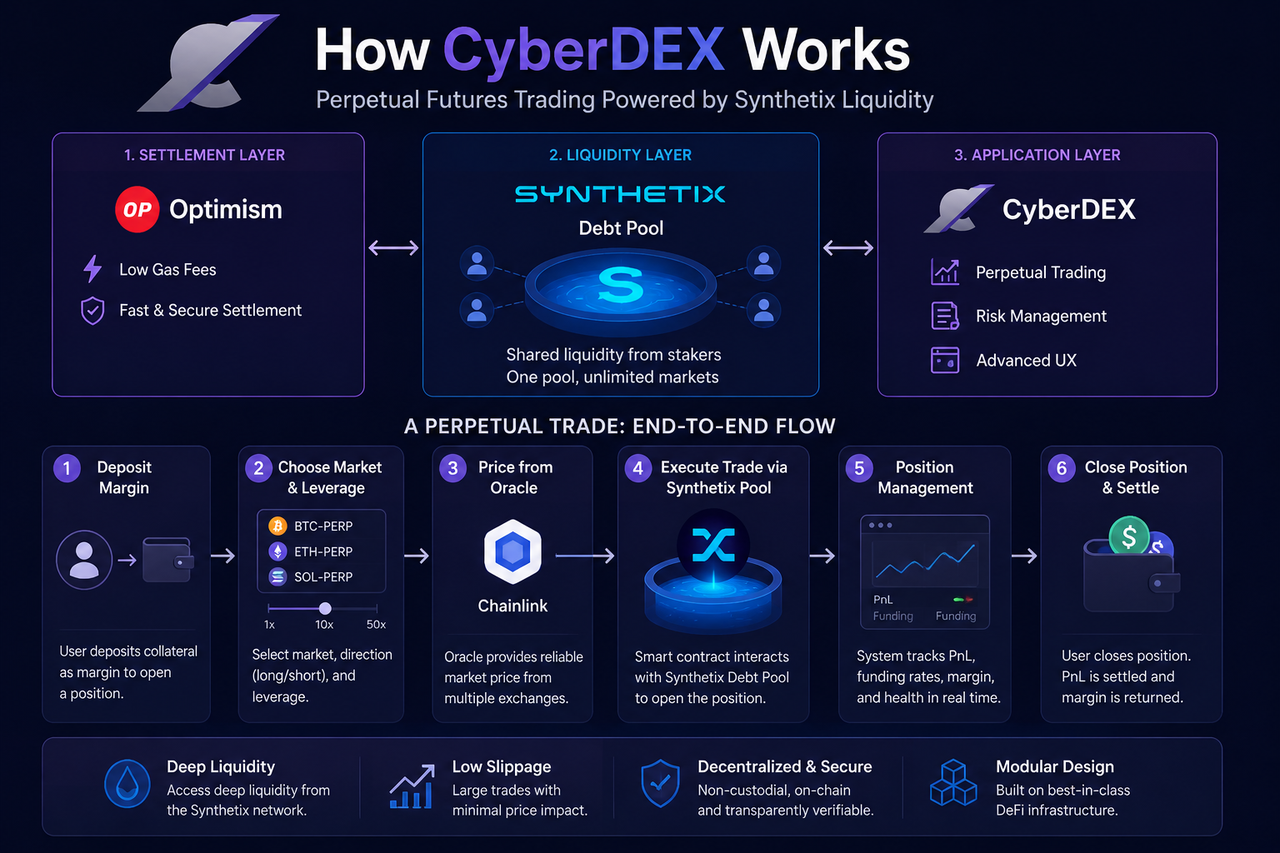
CyberDEX’s trading architecture is composed of three distinct layers: the Optimism settlement layer, the Synthetix liquidity layer, and the CyberDEX application layer. Together, they form a comprehensive on-chain derivatives trading system.
Optimism manages trade execution and on-chain settlement with low gas costs and high efficiency. Synthetix supplies a unified liquidity pool and the foundational synthetic asset infrastructure. CyberDEX is responsible for order management, the trading interface, and overall user experience.
This layered approach means CyberDEX does not shoulder the burden of building liquidity, allowing it to focus on product innovation and the development of advanced derivatives trading features.
Architecture Layer
Core Protocol
Core Functionality
Application Layer
CyberDEX
Trading interface and features
Liquidity Layer
Synthetix
Shared liquidity provision
Settlement Layer
Optimism
On-chain execution and settlement
This structure stands in stark contrast to traditional exchanges, where all functions are centralized within a single system.
How Does the Synthetix Debt Pool Provide Liquidity?
Synthetix’s core innovation is its Debt Pool mechanism. Unlike conventional liquidity pools, which require users to deposit specific trading pair assets, Synthetix aggregates all staked assets into a single, unified liquidity source.
When users stake assets to mint synthetic assets, they collectively enter the system's Debt Pool. All stakers share the system’s debt and jointly benefit from trading fees and ecosystem incentives.
Once CyberDEX connects to this liquidity network, users no longer need to find counterparties to open positions—they transact directly with the Debt Pool. Regardless of market direction, the unified liquidity pool ensures robust market depth.
This model resolves the liquidity fragmentation that plagues many traditional DeFi trading platforms, while significantly improving capital efficiency.
How Does CyberDEX Achieve Low Slippage?
Slippage typically arises when market depth is lacking. Large trades consume multiple orders in the market, causing fill prices to deviate from expectations.
By adopting a shared liquidity model, CyberDEX eliminates reliance on individual trading pairs or isolated capital pools. Instead, it sources liquidity from the entire Synthetix network’s unified pool.
With all trades drawing from the same liquidity source, the market can accommodate larger trades and reduce price impact risk. This is a key reason why Synthetix-based derivatives platforms can deliver an institutional-grade trading experience.
That said, slippage cannot be entirely eliminated. Extreme market volatility or high liquidity utilization can still result in price deviations.
How Do Chainlink and Oracles Deliver Price Data?
The stability of perpetual futures markets depends on accurate pricing data. Any discrepancy in price feeds can trigger erroneous liquidations, arbitrage exploits, and systemic risk.
CyberDEX utilizes on-chain oracles to acquire real-time external market prices for both trade execution and risk management. These oracle networks aggregate data from multiple sources to provide robust price feeds.
When users open or close positions, the system ignores order book quotes and instead uses oracle prices for calculations. This approach reduces the scope for market manipulation and enhances trading fairness.
Oracle prices are mainly used for:
Position opening
Position closing
Margin calculations
Funding rate settlements
Liquidation assessments
As such, oracles serve as a vital component of the CyberDEX trading architecture.
How Does a Perpetual Futures Trade Execute?
From the user’s perspective, the CyberDEX trading flow resembles that of a centralized exchange, but the underlying execution logic is entirely on-chain and smart contract-driven.
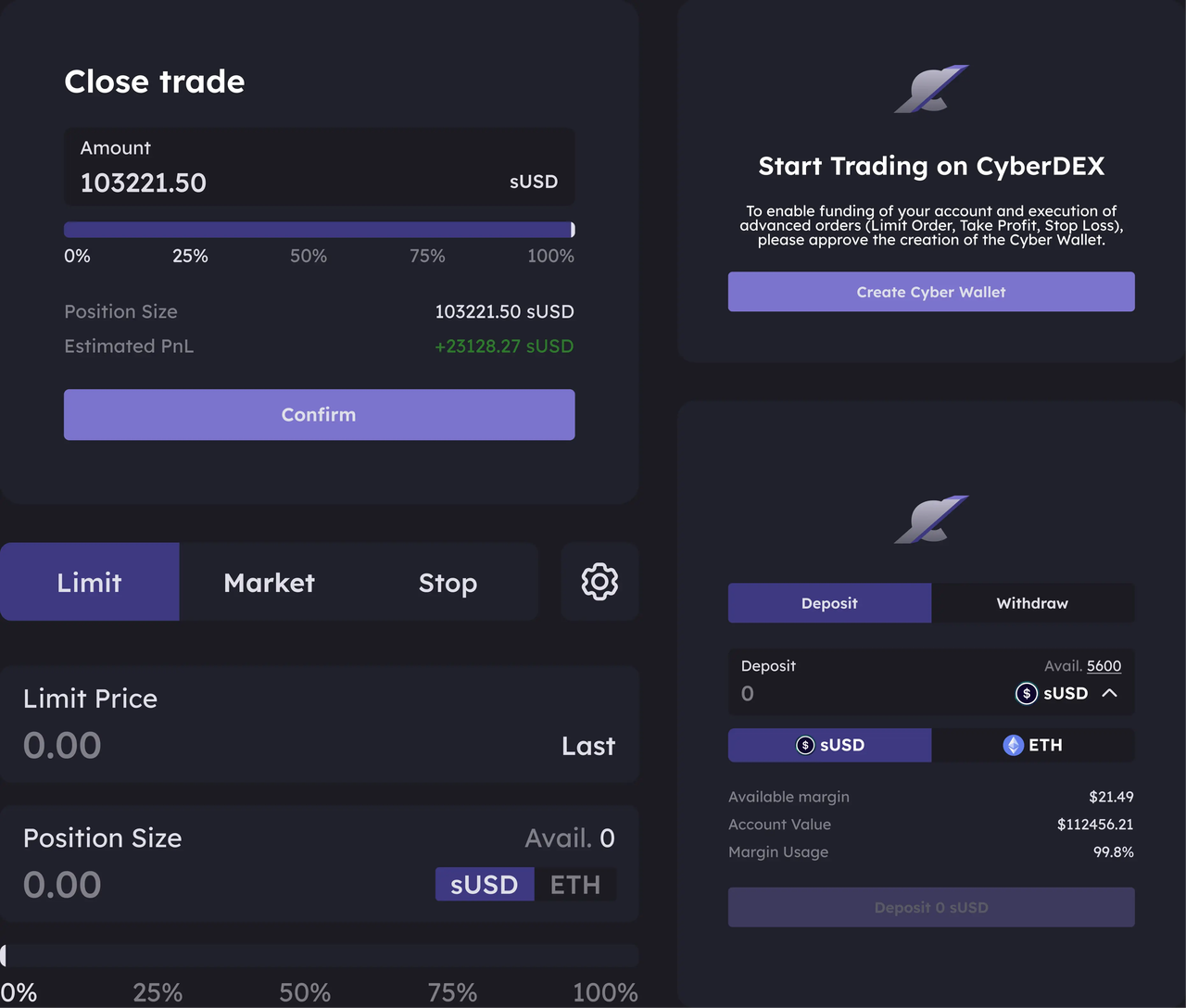
Users first deposit margin on the platform and select their trading market. Next, they configure leverage and position direction, with the system calculating the maximum allowable position size using current oracle prices.
Upon order submission, a smart contract interacts with the Synthetix liquidity pool to execute the trade and record position data. Throughout the position’s lifetime, the system continuously updates floating PnL and funding rate changes.
When the user closes the position, the smart contract again references the oracle price to calculate final PnL and settle the assets.
The streamlined process is as follows:
Stage
System Action
Core Functionality
Margin Deposit
Lock trading funds
Trading interface and features
Open Position
Tap Debt Pool liquidity
Shared liquidity provision
Position Holding
Real-time PnL calculation
On-chain execution and settlement
Funding Rate Settlement
Adjust long-short balance
Close Position
Settle PnL
All operations are fully automated via on-chain smart contracts, eliminating the need for centralized intermediaries.
How Does CyberDEX Compare With AMM DEXs?
While CyberDEX is often compared to AMM-based DEXs like Uniswap, the two serve different markets and rely on fundamentally different mechanisms.
AMMs use a liquidity pool pricing model, with prices determined by the asset ratio within the pool. As trade size grows, prices shift, causing slippage.
CyberDEX, in contrast, leverages an oracle-driven perpetual futures model. Prices are pegged to external market data, and liquidity is supplied by the shared Debt Pool.
Comparison Metric
CyberDEX
AMM DEX
Product Type
Perpetual Futures
Spot Trading
Liquidity Source
Debt Pool
LP Liquidity Pool
Pricing Model
Oracle Price
AMM Curve
Counterparty
Shared Liquidity Pool
Liquidity Pool
Main Use
Leverage & Hedging
Token Swaps
Although both are DeFi trading platforms, they address distinct user needs.
Advantages and Limitations of CyberDEX’s Operational Model
CyberDEX’s primary advantage is its shared liquidity architecture. By leveraging Synthetix’s established liquidity network, the platform avoids duplicating liquidity pools, boosts capital efficiency, and offers deeper market depth to users.
The modular design allows CyberDEX to concentrate on product innovation without the responsibility of managing underlying liquidity. This division of labor drives the DeFi ecosystem toward greater specialization and maturity.
However, reliance on shared infrastructure means CyberDEX’s operations are contingent on upstream protocols. If the Synthetix liquidity layer or oracle systems malfunction, CyberDEX’s trading functions may be affected. Inter-protocol dependencies are a critical challenge for this model.
Summary
CyberDEX’s fundamental operating model is built on Synthetix’s shared liquidity network. When users trade perpetual futures on CyberDEX, they interact directly with the unified Debt Pool, rather than relying on order book matching or AMM liquidity pools.
By positioning Optimism as the settlement layer, Synthetix as the liquidity layer, and CyberDEX as the application layer, the platform delivers a modular DeFi derivatives trading architecture. This design enhances capital efficiency and establishes a new infrastructure paradigm for the evolving on-chain derivatives market.
FAQs
Why Doesn’t CyberDEX Need Traditional Market Makers?
CyberDEX leverages the Synthetix Debt Pool for unified liquidity. Trades are executed directly with the shared pool, eliminating the need for traditional market makers to maintain market depth.
Where Does CyberDEX’s Liquidity Originate?
CyberDEX’s liquidity is sourced from the Synthetix Debt Pool, which aggregates all staked assets. This collective pool forms a unified source of market liquidity.
Does CyberDEX Use an Order Book?
CyberDEX does not employ a traditional order book. Trade prices are determined by oracle data, with execution handled via smart contracts and the shared liquidity pool.
How Does CyberDEX Minimize Slippage?
Since liquidity is pooled from the entire Synthetix network, market depth is enhanced and large trades cause less price impact compared to isolated pools.
How Does CyberDEX’s Liquidity Mechanism Differ From GMX?
CyberDEX relies on the Synthetix Debt Pool for liquidity, while GMX uses a GLP multi-asset liquidity pool. Both employ shared liquidity models, but their underlying structures and risk-sharing mechanisms differ.
Author: Jayne
Disclaimer
* The information is not intended to be and does not constitute financial advice or any other recommendation of any sort offered or endorsed by Gate.
* This article may not be reproduced, transmitted or copied without referencing Gate. Contravention is an infringement of Copyright Act and may be subject to legal action.
Yala is a modular Bitcoin DeFi infrastructure that connects BTC liquidity with multi-chain ecosystems through its YU stablecoin and MetaMint protocol. It enables Bitcoin holders to earn native DeFi yields across EVM and non-EVM networks securely and seamlessly.
Sui is a PoS L1 blockchain with a novel architecture whose object-centric model enables parallelization of transactions through verifier level scaling. In this research paper the unique features of the Sui blockchain will be introduced, the economic prospects of SUI tokens will be presented, and it will be explained how investors can learn about which dApps are driving the use of the chain through the Sui application campaign.
Hyperliquid's vision is to develop an on-chain open financial system. At the core of this ecosystem is Hyperliquid L1, where every interaction, whether an order, cancellation, or settlement, is executed on-chain. Hyperliquid excels in product and marketing and has no external investors. With the launch of its second season points program, more and more people are becoming enthusiastic about on-chain trading. Hyperliquid has expanded from a trading product to building its own ecosystem.
CoW Protocol is an intent-based trading protocol that helps users swap crypto through batch auctions and competing solvers rather than direct on-chain order execution. Its design aims to improve price discovery, reduce MEV exposure, and match compatible orders through Coincidence of Wants when possible.
A stablecoin is a cryptocurrency with a stable price, which is often pegged to a legal tender in the real world. Take USDT, currently the most commonly used stablecoin, for example, USDT is pegged to the US dollar, with 1 USDT = 1 USD.