In multichain ecosystems, liquidity and users are scattered across different public blockchains, presenting challenges for traditional cross-chain bridges such as committee attacks, fragmented liquidity, and asset non-fungibility. Most solutions depend on external validator networks, multisig, or threshold signatures, which introduce security assumptions beyond the underlying chain consensus. c8ntinuum positions itself as a permissionless Layer 0, reducing reliance on privileged third parties through a bridgeless architecture and on-chain state verification.
From a digital asset perspective, c8ntinuum uses its native token, CTM, to connect validation, governance, and ecosystem incentives. The SuperApp layer aggregates trading, launches, staking, and creator tools, offering a unified Web3 gateway for end users. The protocol treasury and mint-burn balancing mechanism structurally anchor CTM supply to counterpart assets across multiple chains.
What is c8ntinuum? What cross-chain challenges does it solve?
c8ntinuum is a multichain-powered Layer 0 protocol whose core mission is to make interoperability an extra dimension linking different chains, allowing each chain to offload performance bottlenecks to more suitable networks. The protocol provides a universal framework for message passing and asset transfer, with a protocol-level treasury injecting ongoing value into the ecosystem.
Current cross-chain connections rely on centralized exchanges or quasi-centralized bridges, which expose users to risks of attacks, censorship, and third-party intervention. After assets move cross-chain, issues such as wrapped token depegging and fragmented liquidity often arise.
c8ntinuum adopts a bridgeless architecture, avoiding additional bridges, oracles, or multisig/threshold signatures as the root of cross-chain trust. Unlike solutions relying on external DVNs or MPC threshold signing, c8ntinuum vs committee cross-chain bridge trust model distinguishes state verification from committee proof based on trust gradients: c8ntinuum narrows security assumptions to source chain consensus and the reliability of zero-knowledge proof systems.
| Cross-chain Challenge |
Typical Manifestation |
c8ntinuum Solution |
| Committee/Multisig Risk |
Bridge contract breach or validator collusion |
On-chain zk light client state verification |
| Fragmented Liquidity |
Multiple wrapped versions of the same asset across chains |
Horizontal topology and protocol-level treasury |
| Fragmented User Experience |
Users must switch wallets and dApps across chains |
SuperApp unified gateway |
The table summarizes three common cross-chain challenges: security is anchored in cryptographic proofs rather than committees; liquidity fragmentation is mitigated via horizontal topology; user experience is unified through SuperApp’s aggregation of multichain capabilities.
How does c8ntinuum’s three-layer architecture divide responsibilities? What are the roles of Apps, Chain, and Infrastructure?
c8ntinuum utilizes a vertically segmented three-layer architecture: the Apps layer serves end users and creators, the Chain layer provides consensus and contract execution, and the Infrastructure layer offers B2B cross-chain messaging to clients on any chain.
The Apps layer features the c8ntinuum SuperApp, enabling users to view holdings, trade, stake, and participate in Launchpad from a single interface. SuperApp also integrates Tasks, Quests, Rewards, and community modules, plus vesting, airdrop, and SocialFi tools for creators. The Chain layer uses CometBFT consensus and is forward-compatible with EVM. Developers can deploy contracts using standard tools like Hardhat and Foundry, and access Cosmos ecosystem capabilities through IBC precompiles (ICS02/ICS20). The Infrastructure layer replaces committee proofs with state verification, supporting IBC flows, Solana-aware verification, and zkVM proof validation as cryptographic primitives.
| Layer |
Target Audience |
Core Capabilities |
| Apps |
End users, creators |
SuperApp, Launchpad, Tasks/Quests, SocialFi |
| Chain |
Developers, validators |
CometBFT consensus, forward-compatible EVM, IBC precompiles |
| Infrastructure |
Cross-chain clients |
Cross-chain messaging, zk light client state verification |
This three-layer structure enables c8ntinuum to address consumer experience, on-chain development environments, and cross-chain infrastructure: Apps lower the usage barrier, Chain supports native applications, Infrastructure exports interoperability to external ecosystems.
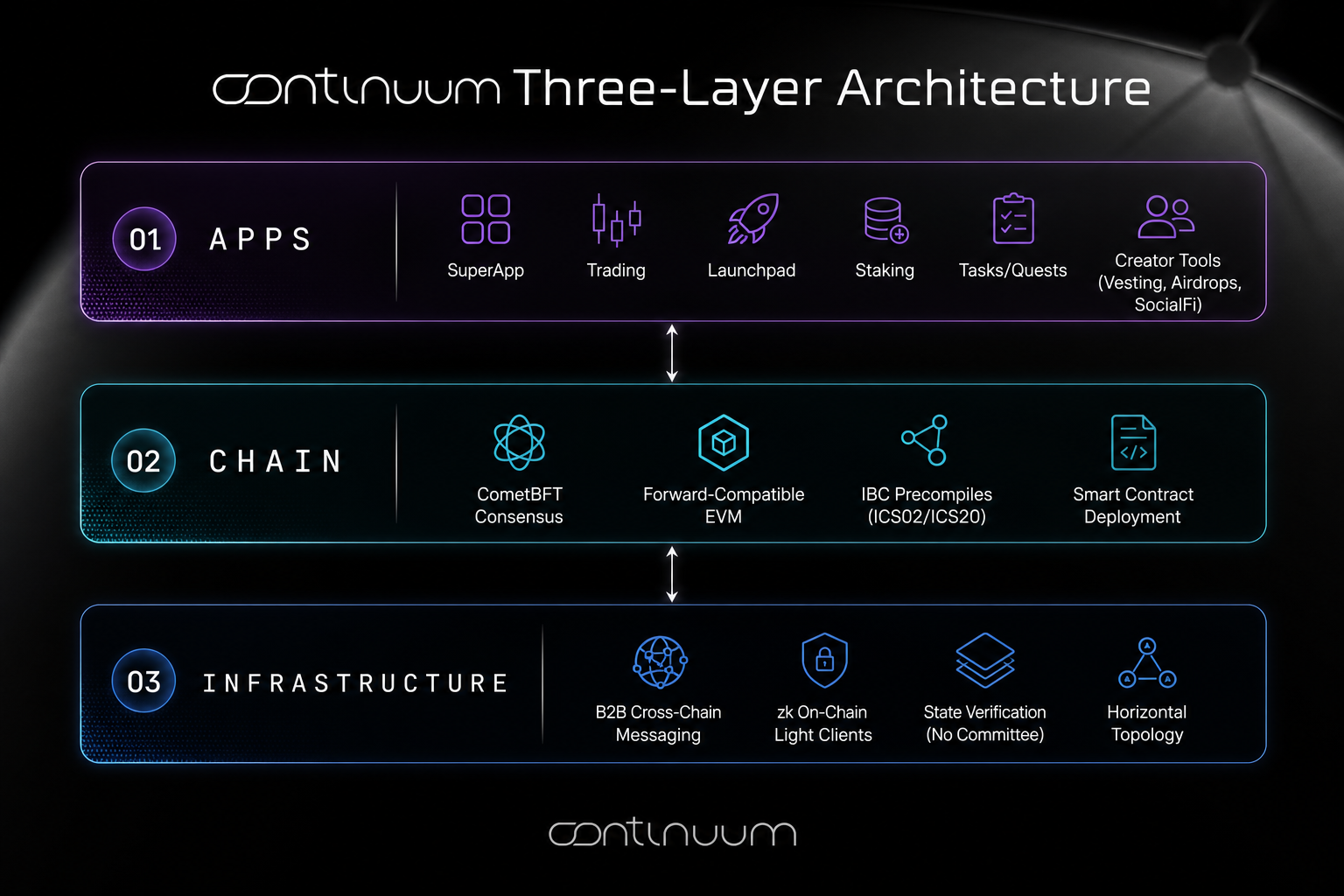 Figure 1. c8ntinuum’s three-layer architecture: Apps (SuperApp), Chain (CometBFT + EVM), and Infrastructure (B2B cross-chain messaging) division of responsibilities.
How does c8ntinuum achieve trust-minimized cross-chain communication on-chain?
c8ntinuum’s cross-chain communication leverages state verification as the highest trust gradient: source chain consensus state transitions are verified via on-chain zk light clients, rather than relying on external DVN, MPC threshold signing, or PoA committees. Security assumptions are limited to source chain consensus honesty and zk proof system reliability, without introducing privileged third parties.
The protocol generates consensus zero-knowledge proofs in zk-light-rollup; after settlement layer verification, it triggers lock-and-release or mint-and-burn. Relayers monitor chain state and relay block headers, with trust assumptions of “at least one honest node” and reliable zk circuits. Horizontal topology enables recursive aggregation of proofs across N chains, with each rollup independently verified, reducing bridge complexity from O(N²) to O(N). Non-SC chains use QTSS with FROST threshold signing for asset custody. IBC precompiles (ICS02/ICS20) and Solana-aware verification cover heterogeneous VMs.
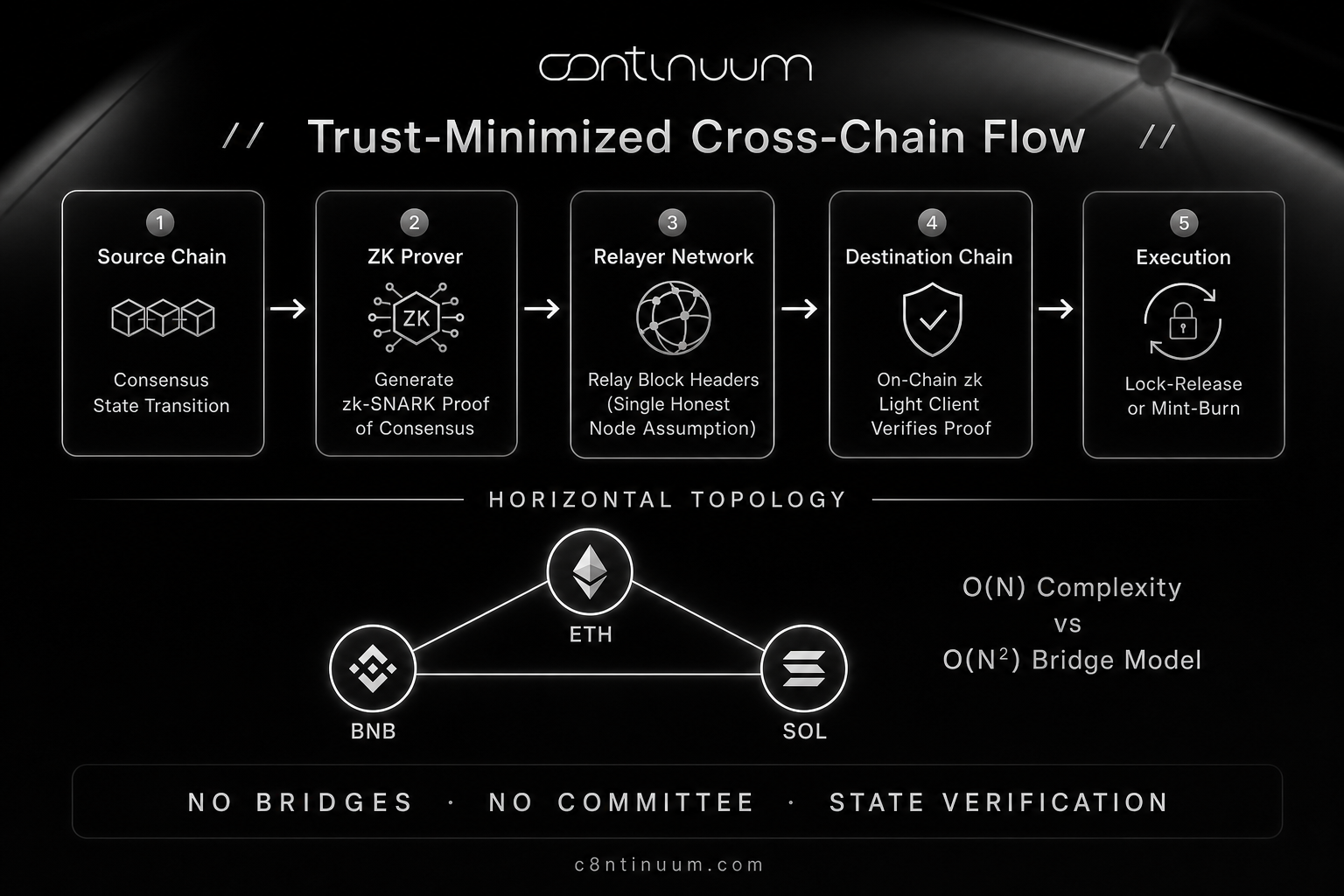 Figure 2. c8ntinuum trust-minimized cross-chain flow: source chain consensus proof verified by zk light client, Relayer relays block headers, horizontal topology aggregates multichain proofs.
How is the CTM token generated and distributed? What is the supply cap and mint-burn balance?
CTM is c8ntinuum’s native utility token, capped at 8,888,888,888, using a mint-burn balanced dynamic supply mechanism. CTM is minted by users permanently locking whitelisted counterpart assets (ETH, BNB, SOL, etc.) in the protocol treasury, not distributed via traditional ICO or private sale.
During Public Generation, locked assets are allocated as 40% liquidity pool, 10% invitation incentives, and 50% protocol restaking. Yield from external chain restaking is used by the liquidity pool to buy back CTM, creating an external value cycle. As minted CTM increases, the minimum minting threshold is dynamically raised. CTM generation flow details the locking, allocation, and minting process for ETH, BNB, SOL, and other counterpart assets.
The other side of mint-burn balance comes from internal value cycles: 50% of protocol execution fees and staking rewards are used to buy back and burn CTM, while the remaining 50% is distributed to validators. Cross-chain messaging fees are also included in the buyback-burn channel.
| Allocation Segment |
Ratio |
Purpose |
| Liquidity Pool |
40% |
Ensures CTM trading depth |
| Invitation Incentive |
10% |
Expands Generation participation |
| Protocol Restaking |
50% |
Generates ongoing yield on external chains |
| Staking Rewards |
50% buyback-burn / 50% validators |
Maintains mint-burn balance and network security |
The table shows the tripartite Generation allocation and bipartite staking rewards: the former ensures CTM has liquidity and external yield at inception; the latter maintains dynamic supply balance via buyback-burn and validator incentives.
What roles does CTM play in the ecosystem? How do staking, governance, and interactive staking work?
CTM fulfills three main functions: validation security, governance decision-making, and ecosystem incentives. Validators stake CTM to participate in CometBFT consensus; holders influence protocol upgrades and ecosystem grants through on-chain voting.
External value cycles distribute buyback CTM as 30% to validators, 30% to active stakers, 10% to interactive staking, and 30% to contract deployers. Interactive staking requires users to interact with contracts for interest accrual; passive locking does not qualify for rewards. CTM tokenomics further analyzes mint-burn balance, dual value cycles, and interactive staking parameters.
What products and creator capabilities does c8ntinuum SuperApp offer?
SuperApp is designed as “One App for Everything,” aggregating trading, launches, staking, and Launchpad, plus Tasks, Quests, Rewards, and creator tools for vesting, airdrop, and SocialFi. Cross-chain operations are completed via Infrastructure’s zk verification path, and Chain layer dApps can access SuperApp for traffic distribution.
What are the advantages and risks of using or participating in the c8ntinuum ecosystem?
Advantages: zk light clients enable trust-minimized cross-chain; bridgeless architecture and horizontal topology reduce single-point risks; forward-compatible EVM supports standard toolchains; SuperApp unifies multichain access; CTM dual value cycles align incentives for validators, stakers, and developers.
Risks and limitations: zk proofs incur computational overhead; Relayer assumes at least one honest node; QTSS path has lower security than pure zk verification; counterpart assets are permanently locked and non-redeemable; interactive staking requires ongoing contract interaction; smart contract vulnerabilities and counterfeit tokens are inherent risks requiring user verification.
Summary
c8ntinuum, as a Layer 0 interoperability protocol, serves users, developers, and B2B integrators through Apps, Chain, and Infrastructure. CTM is capped at 8,888,888,888 and minted by permanent locking of ETH/BNB/SOL, aligning incentives for validators, stakers, and developers via dual value cycles. SuperApp aggregates trading, launches, staking, and creator tools.
FAQ
What is c8ntinuum?
c8ntinuum is a Layer 0 interoperability protocol with the slogan “Ultimate Interoperability.” The protocol achieves trust-minimized cross-chain communication via a bridgeless architecture and zk on-chain light clients. Its three-layer stack consists of SuperApp (Apps), CometBFT + EVM chain (Chain), and B2B cross-chain messaging layer (Infrastructure). The native token CTM is used for validation, governance, and ecosystem incentives.
What distinguishes c8ntinuum from LayerZero?
The core difference is in the cross-chain trust model: LayerZero relies on external DVN to validate cross-chain messages, which falls under the committee/external validator trust gradient. c8ntinuum uses on-chain zk light clients for state verification, narrowing security assumptions to source chain consensus and zero-knowledge proof systems, without privileged third parties.
How does c8ntinuum achieve cross-chain interoperability?
c8ntinuum generates source chain consensus zero-knowledge proofs in zk-light-rollup. Target chain contracts verify zk-SNARKs and then trigger lock-and-release or mint-and-burn. Relayers relay block headers, horizontal topology aggregates multichain proofs; IBC precompiles and Solana-aware verification cover heterogeneous VMs.
What is the total CTM supply? How is it minted?
CTM is capped at 8,888,888,888. Users mint CTM by permanently locking ETH, BNB, SOL, and other whitelisted counterpart assets into the protocol treasury, allocated as 40% liquidity pool, 10% invitation incentive, and 50% protocol restaking.
What is c8ntinuum’s interactive staking?
Interactive staking requires users to interact with ecosystem contracts while staking CTM; passive locking does not qualify for interactive staking rewards. In the external value cycle, 10% of CTM buyback is specifically allocated to interactive staking participants, directly tying rewards to user activity.
Is c8ntinuum secure? Are cross-chain bridge risks significant?
c8ntinuum uses a bridgeless architecture and zk state verification, not relying on committee bridge multisig or DVN proofs. Relayer still assumes at least one honest node; QTSS path has lower security than pure zk verification. 50% of staking rewards buy back and burn CTM, 50% go to validators, maintaining mint-burn balance with Generation minting.







