CTM’s generation path must be understood within the Layer 0 interoperability protocol and mint-burn equilibrium framework outlined in c8ntinuum (CTM): native tokens are not distributed through traditional ICOs or private placements. Instead, users mint CTM by permanently locking whitelist counterpart assets into the protocol treasury.
During Public Generation, the Generation contract receives ETH, BNB, and SOL on Ethereum, BNB Chain, and Solana, respectively. Once the locking transaction is confirmed, funds are split at a fixed ratio and CTM is minted for users. As the total amount of minted CTM grows, the minimum minting threshold is dynamically raised, and the early participation bonus decreases in stages.
What should you prepare before starting?
Before participating in CTM Generation, you must confirm three essentials: wallet, assets, and eligibility. The Generation contract only accepts whitelist native counterpart assets—ETH, BNB, and SOL. You must hold sufficient assets on the corresponding source chain to cover the locking amount and Gas fees, and access the Generation portal at app.c8ntinuum.com with a valid invitation code.
| Preparation |
Requirement |
Impact |
| Multi-chain wallet |
Supports native ETH / BNB / SOL transfers |
Determines which chain you can use for Generation |
| Whitelist counterpart assets |
ETH, BNB, or SOL |
Non-whitelist assets cannot enter the contract |
| Valid invitation code |
Public Generation access credential |
No invitation code typically means no access |
| Gas reservation |
Native Gas tokens on each chain |
Additional trading fees required for locking transactions |
Locked assets are permanent; once counterpart assets enter the protocol treasury, they cannot be redeemed. Before proceeding, verify the contract address and interface source to avoid phishing pages. Smart contract interactions carry inherent risks—ensure you accept the irreversible locking constraint before participating.
How does the Generation contract receive counterpart assets?
During Public Generation, the Generation contract is deployed across multiple external chains, receiving the corresponding native counterpart assets. After you initiate a locking transaction on your chosen chain, the contract executes permanent locking: ETH enters the Ethereum contract, BNB enters the BNB Chain contract, and SOL enters the Solana program. Once the lock is confirmed, the system mints CTM to your address based on the current generation parameters.
The process consists of four steps: select the source chain and counterpart asset, confirm the lock amount and expected CTM, sign the on-chain locking transaction, and wait for confirmation to receive CTM. Upon lock confirmation, the contract immediately triggers internal allocation, splitting the locked assets 40% / 10% / 50%—no further action required from you. As the cumulative CTM minted increases, the minimum minting threshold rises dynamically, and the CTM obtainable with the same lock amount decreases as the stage progresses. CTM Tokenomics provides further details on external value cycles and buyback-burn rules.
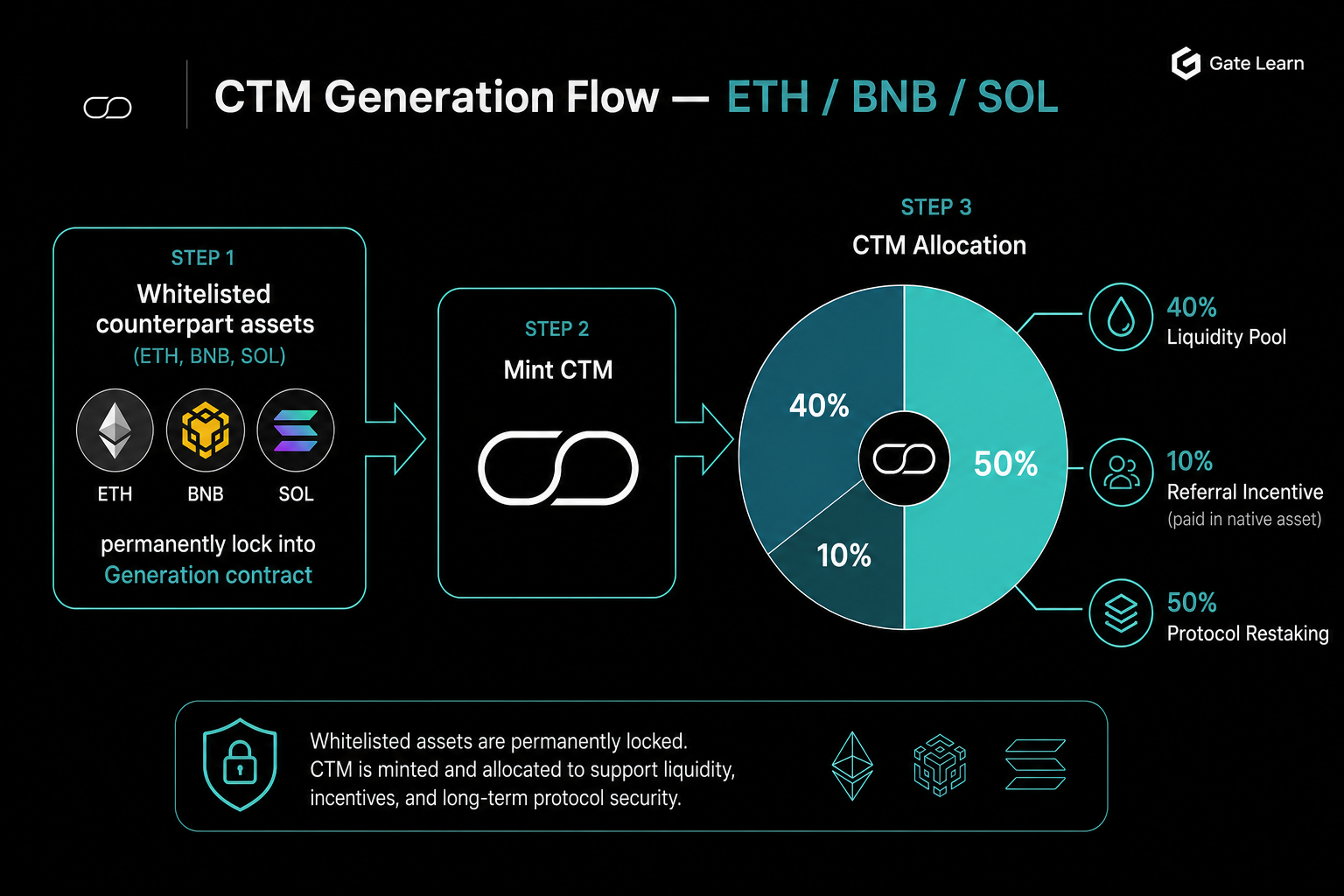 Figure 1. CTM Generation flow: permanent lock of ETH / BNB / SOL, Generation contract reception, and three-way allocation of 40% / 10% / 50%.
Three-way fund allocation: 40% / 10% / 50%
During Public Generation, each counterpart asset locked into the Generation contract is divided into three fixed proportions: 40% injected into the CTM liquidity pool, 10% allocated for invitation incentives, and 50% restaked by the protocol on external chains. Allocation is executed automatically upon lock confirmation.
| Proportion |
Destination |
Function |
| 40% |
CTM liquidity pool |
Ensures trading depth and supports subsequent buybacks |
| 10% |
Invitation incentive pool |
Direct payment to referrers in ETH / BNB / SOL |
| 50% |
Protocol external chain restaking |
Generates continuous staking yield on external networks |
The 40% liquidity pool share ensures CTM has trading depth immediately after Generation launches and provides a market channel for buybacks in external value cycles. The 10% invitation incentive is paid directly in the same native asset as the invitee’s locked chain, not in CTM. The 50% protocol restaking is managed centrally by the protocol, and staking inflation or yield generated is used to buy back CTM through the liquidity pool. This structure aligns with the multi-chain treasury management approach highlighted in c8ntinuum vs committee cross-chain bridge trust model: counterpart assets are managed by the protocol, not by external bridges or committee custodians.
Protocol restaking and CTM buyback trigger logic
The 50% protocol restaking share, after being staked on external chains, generates inflation or staking yield as input for external value cycles. The protocol uses this value to buy back CTM through the liquidity pool, with buybacks distributed four ways: 30% to validators, 30% to active stakers, 10% to interactive staking, and 30% to contract deployers.
The trigger sequence is: lock counterpart assets → 50% protocol restaking → external chain staking generates yield → protocol buys back CTM from liquidity pool → four-way distribution to ecosystem participants. This cycle operates alongside the internal value cycle (50% of protocol execution fees buy back and burn CTM, 50% to validators), jointly maintaining CTM mint-burn equilibrium. Buyback scale depends on liquidity pool depth and ongoing yield from external chain staking; interactive staking requires users to actively interact with ecosystem contracts to accrue interest—passive locks are excluded from the 10% interactive staking share.
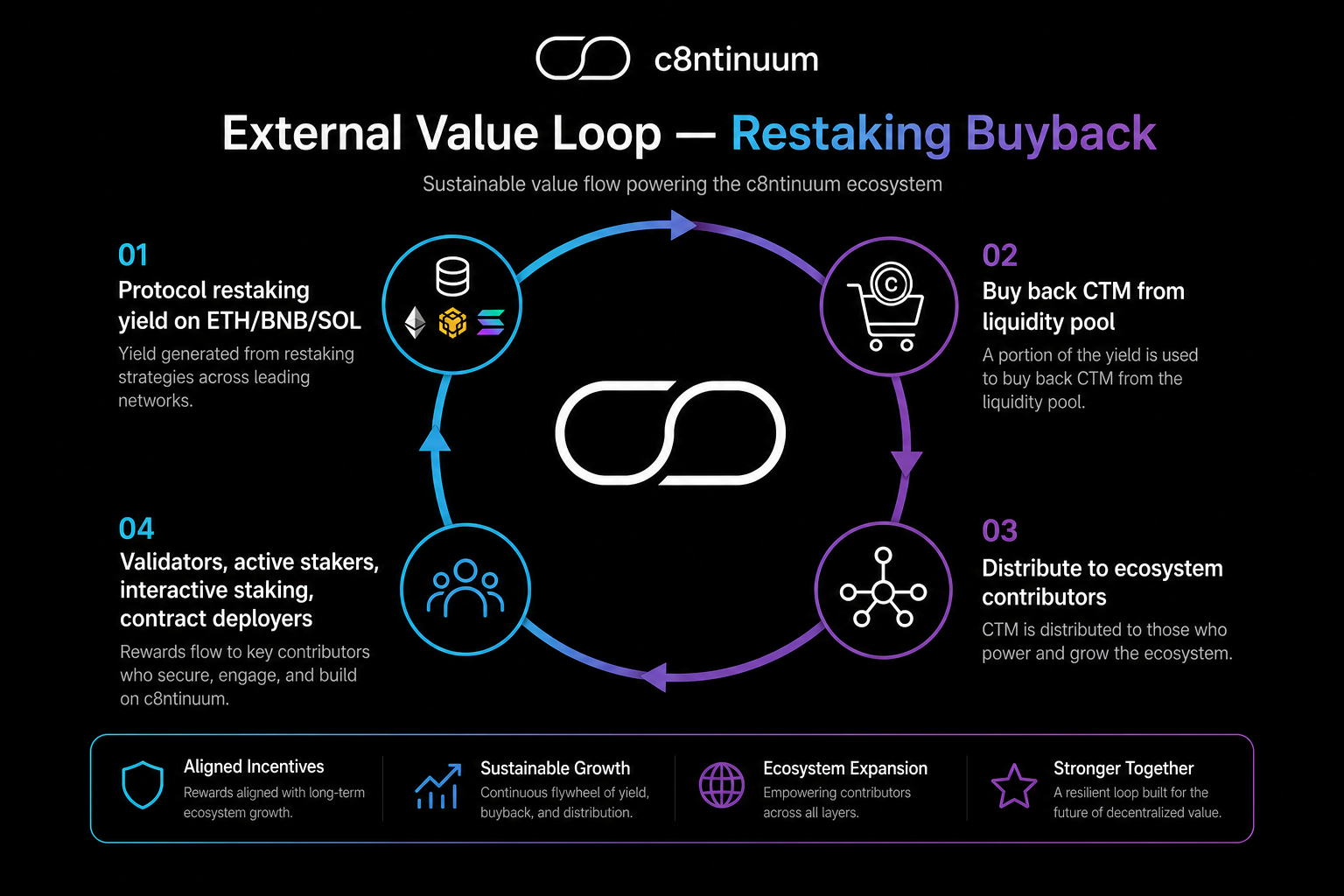 Figure 2. External value cycle: protocol restaking yield buys back CTM through liquidity pool, distributed four ways to validators, stakers, interactive staking, and developers.
How does the early participation bonus decrease?
Public Generation offers an early participation bonus: in the initial stage, you can receive up to a 50% CTM bonus. For every 888 million CTM minted, the bonus decreases by 10%. With the same counterpart asset lock amount, earlier participation yields more CTM.
| Cumulative minting stage |
Bonus change |
| Initial stage |
Up to 50% bonus |
| Every +888 million CTM |
Bonus -10% |
| Near supply cap |
Bonus approaches zero |
Bonus reduction and dynamic increase of the minimum minting threshold occur simultaneously, tightening CTM distribution as supply advances during Generation, until the cap of 8,888,888,888 is reached. The bonus only affects mint quantity and does not change the 40% / 10% / 50% counterpart asset allocation ratio.
How are invitation rewards settled?
The 10% invitation incentive share rewards referral relationships: after a new user participates in Generation with an invitation code and completes locking, the referrer receives a reward paid in ETH, BNB, or SOL, matching the invitee’s locked chain—not in CTM.
Settlement logic: invitee completes locking → contract calculates referrer share from the 10% incentive pool → direct payment in the corresponding native asset to the referrer’s address. The invitation code serves as both the Public Generation access credential and the reward tracking identifier; users should obtain codes from verifiable portals like app.c8ntinuum.com to avoid codes from unknown sources.
Operational and verification precautions
Generation operations involve permanent multi-chain locking. Before participating, complete three core verifications: portal, contract address, and irreversible lock. Once counterpart assets are locked into the Generation contract, they cannot be redeemed or withdrawn.
Recommendations: verify the Generation portal domain is app.c8ntinuum.com; contract addresses on each chain match public disclosure; wallet connects to the target chain network; confirm amount, expected CTM, and bonus stage before locking; verify lock and CTM minting records in the block explorer after trading. Main risks include: permanent lock unrecoverable, smart contract vulnerabilities, counterfeit interfaces, external chain staking yield fluctuations affecting buyback scale, and structural uncertainty from multi-chain integration and regulatory policy changes.
Summary
During Public Generation, CTM is minted by permanently locking ETH, BNB, and SOL through the Generation contract, with a supply cap of 8,888,888,888. Locked assets are allocated as 40% liquidity pool, 10% invitation incentive, and 50% protocol restaking. External chain restaking yield is used to buy back CTM through the liquidity pool. The early bonus decreases by 10% for every 888 million minted, the minimum minting threshold dynamically rises with cumulative minting, and locking is irreversible.
FAQ
What is the total supply of CTM? How is it minted?
CTM has a supply cap of 8,888,888,888. During Public Generation, users permanently lock whitelist counterpart assets such as ETH, BNB, and SOL into the Generation contract to mint CTM. Locked assets are allocated as 40% liquidity pool, 10% invitation incentive, and 50% protocol restaking. CTM is not issued through traditional ICO or private placement.
How do I generate CTM using ETH, BNB, or SOL?
Access the Generation interface at app.c8ntinuum.com with a valid invitation code, select the corresponding chain, confirm the lock amount, and sign the on-chain transaction. After the contract permanently locks ETH, BNB, or SOL, CTM is minted to your address based on the current bonus and minting threshold.
What is the purpose of the CTM token?
CTM serves as a security validator, enables on-chain governance, and drives ecosystem incentives within the c8ntinuum ecosystem. Minted CTM can be staked and used for governance, and is distributed in both external and internal value cycles. Validators stake CTM to secure CometBFT consensus, and interactive staking requires contract interaction to accrue interest.
Can counterpart assets locked into Generation be withdrawn?
No. The Generation contract permanently locks ETH, BNB, and SOL, and assets cannot be redeemed or withdrawn after entering the protocol treasury. This design structurally anchors CTM supply to multi-chain counterpart assets; participants must confirm acceptance of the irreversible constraint before locking.
How is the early participation bonus calculated?
The initial stage offers up to a 50% CTM bonus. For every 888 million CTM minted, the bonus decreases by 10%. The bonus only affects mint quantity and does not change the 40% / 10% / 50% allocation ratio. As supply advances, both the bonus and minimum minting threshold tighten.
What are the main risks of Generation?
Main risks include: counterpart assets permanently locked and unrecoverable; smart contract vulnerabilities or counterfeit interfaces; external chain staking yield fluctuations affecting buyback scale; multi-chain integration and regulatory policy changes. Always verify contract address and portal source before participating.







