As the number of public chains, Layer 2 networks, Rollups, and appchains continues to grow, more blockchains need to build their own security systems. However, new networks often lack a large enough validator set and sufficient token economic scale, which leaves them facing high security bootstrapping costs and potential attack risks.
Against this backdrop, Babylon introduced the concept of Bitcoin Security Network, aiming to use the economic security that Bitcoin has accumulated over time to protect more blockchains. As an important part of the Bitcoin Staking system, BSN is seen as key infrastructure connecting Bitcoin with the multichain ecosystem. Its goal is to make BTC a security resource that can be shared across networks without changing Bitcoin’s consensus mechanism.
What Is Bitcoin Security Network (BSN)
Bitcoin Security Network (BSN) is an architecture that uses Bitcoin’s security to provide shared security services for multiple blockchain networks. Its distinctiveness lies in the fact that traditional blockchains usually rely on their own tokens and validators to maintain network security, while BSN brings BTC into the security system through Bitcoin Staking, allowing multiple networks to share the same pool of economic security resources.
Conceptually, BSN is similar to a security service network. Blockchains connected to BSN do not need to rely entirely on the value of their own tokens to build a security barrier. Instead, they can use the economic backing provided by Bitcoin to improve their overall security.
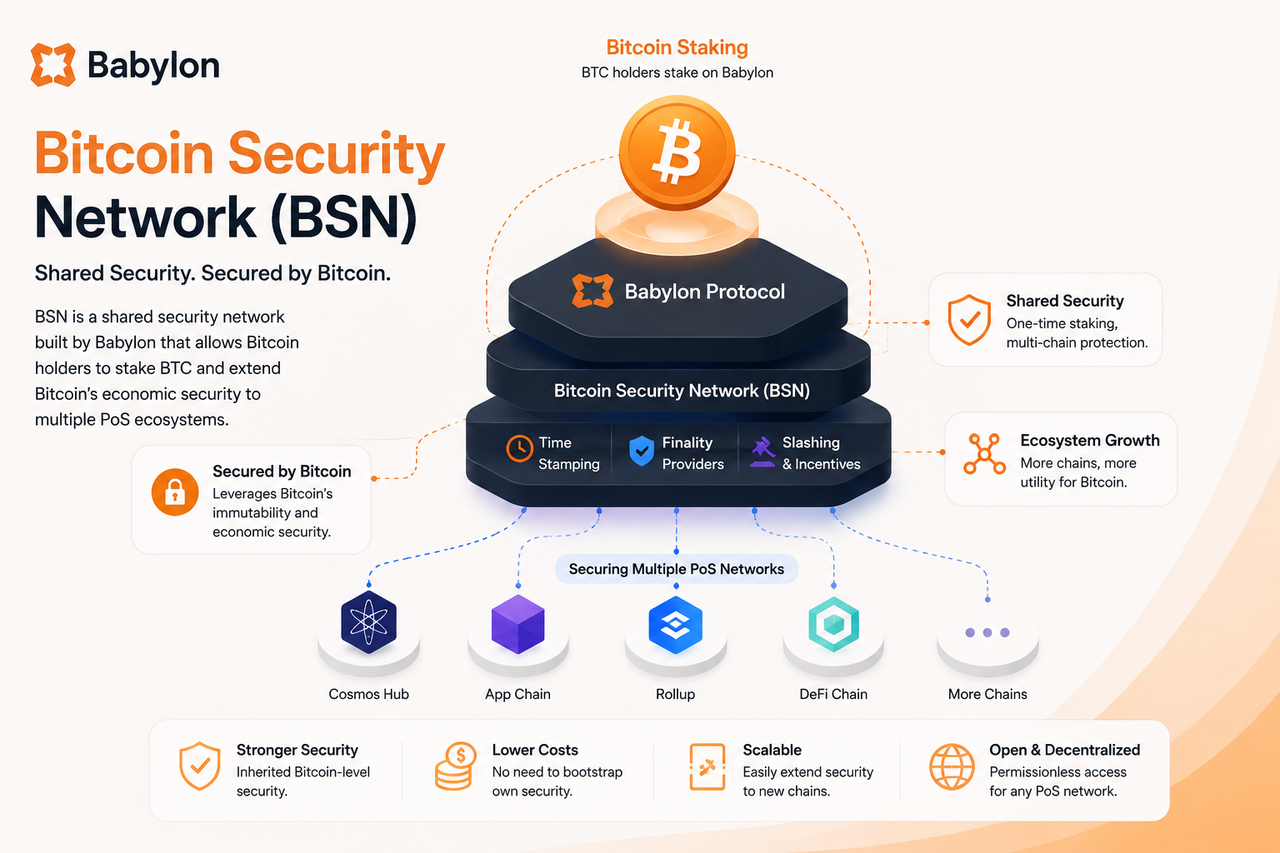
How Babylon Builds the Bitcoin Security Network
Babylon builds BSN through Bitcoin Staking and a shared security architecture.
BTC holders can lock their bitcoin assets through the Babylon protocol and use them as economic backing resources for network security.
These locked BTC do not leave the Bitcoin network and do not need to be converted into wrapped assets on another chain. The protocol records the relevant states through cryptographic proofs and allocates these security resources to blockchains connected to the Babylon ecosystem.
What Role Does Bitcoin Staking Play in BSN
Bitcoin Staking is the core foundation of BSN.
In Babylon’s architecture, BTC is treated as a source of economic security. After users lock BTC, the protocol can use these assets to provide backing for other blockchains.
When network participants follow protocol rules, the shared security system can operate normally. When malicious behavior occurs, the protocol can raise the cost of violations through predefined mechanisms.
As a result, Bitcoin Staking provides the economic foundation for BSN, while shared security is the final objective it aims to achieve.
How Finality Providers Maintain Shared Security
Finality Providers play an important role in BSN.
In Babylon’s system, Finality Providers help blockchain networks complete the finality process and verify shared security states.
These nodes monitor Bitcoin Staking states, participate in consensus activities, and coordinate the transmission of security information between networks.
For appchains connected to BSN, Finality Providers act as a bridge between security resources and network operations. Their responsibilities are directly tied to the stable operation of the shared security system.
How the Timestamping Protocol Enhances Security
The Timestamping Protocol is another key technology in BSN.
Babylon uses the tamper resistant nature of the Bitcoin blockchain to record important states from other networks on the Bitcoin chain.
Because changing historical blocks would require an extremely high cost, these records can provide connected networks with an additional trusted basis for verification.
This design means BSN relies not only on the economic value of BTC, but also on the security properties of the Bitcoin network itself to build an extra layer of protection.
How Is BSN Different from Traditional Blockchain Security Models
BSN and traditional blockchain security systems differ clearly in their sources of security and how resources are used.
| Comparison Dimension |
Bitcoin Security Network (BSN) |
Traditional Blockchain Security Model |
| Security source |
BTC economic security |
Native token economic security |
| Service scope |
Multichain sharing |
Independent single chain |
| Validation model |
Shared security network |
Separate validation system |
| Resource efficiency |
Security resources are reusable |
Security resources are isolated from each other |
| Bootstrapping cost |
Lower |
Higher |
| Applicable targets |
Appchains, Rollups, PoS networks |
Various independent blockchains |
From an overall architecture perspective, BSN places greater emphasis on sharing security resources, while the traditional model places more emphasis on network independence.
What Are the Use Cases of Bitcoin Security Network
BSN’s use cases are mainly focused on blockchain networks that need additional security protection.
In the Cosmos ecosystem, appchains can use BSN to obtain stronger economic security support.
For Rollups and modular blockchains, BSN can serve as an external security layer, providing additional protection for network state confirmation and data verification.
What Challenges Does BSN Face
Although BSN offers a new shared security solution, its development still faces several challenges.
First, a shared security system involves coordinated operation across multiple networks, so its system complexity is higher than that of a traditional single chain model.
Second, responsibility allocation, security policy coordination, and incentive mechanism design across different blockchains still need continuous improvement.
In addition, shared security models are still developing, and industry standards and long term governance frameworks are still evolving.
Conclusion
Bitcoin Security Network (BSN), as a shared security architecture promoted by Babylon, extends Bitcoin’s economic security to a broader blockchain ecosystem through Bitcoin Staking, Finality Providers, and the timestamping protocol. The core idea of BSN is to transform BTC from a store of value into a reusable cross network security resource, providing additional security for appchains, PoS networks, and modular blockchains.
FAQs
What Is the Relationship Between BSN and Bitcoin Staking?
Bitcoin Staking is the foundational mechanism of BSN. By locking BTC and participating in the Babylon protocol, users provide economic security resources, while BSN allocates these resources to blockchain networks that need security protection.
Does Bitcoin Security Network Change Bitcoin’s Consensus Mechanism?
Bitcoin Security Network does not change Bitcoin’s original proof of work (PoW) consensus mechanism. BSN uses Bitcoin’s existing security to build a shared security system without affecting the operating rules of the Bitcoin network itself.
What Role Do Finality Providers Play in BSN?
Finality Providers maintain the operation of the shared security system, provide finality services, and verify network states. Their role is similar to that of security coordination nodes, helping connected networks obtain more reliable state confirmation.
How Is BSN Different from the Security Model of Traditional PoS Networks?
Traditional PoS networks mainly rely on their own tokens to maintain security, while BSN uses BTC to provide economic security backing. BSN emphasizes shared security resources, while the traditional model focuses more on each individual network building its own security system.
Which Blockchains Might Use Bitcoin Security Network?
Appchains, Cosmos ecosystem networks, Rollups, modular blockchains, and PoS networks that need additional security support could all become potential users of Bitcoin Security Network.