Bitcoin has long been regarded as one of the most secure and decentralized networks in the blockchain industry. For most of its history, however, Bitcoin’s main functions have centered on storing value and transferring assets, while large amounts of BTC have not directly contributed to the security of other blockchain networks. As modular blockchains, appchains, and the concept of shared security continue to develop, the industry has begun exploring how Bitcoin’s security can be extended to a broader ecosystem.
Against this backdrop, Babylon introduced the Bitcoin Staking mechanism. Unlike traditional PoS staking, Babylon does not require users to bridge BTC to another network, nor does it rely on centralized custodians. Instead, it uses Bitcoin’s native security model to build a shared security system. As a core component of the Bitcoin Security Network (BSN), Bitcoin Staking has become an important direction for bringing the Bitcoin ecosystem and the PoS ecosystem closer together.
What Is Bitcoin Staking
Bitcoin Staking is a mechanism that uses Bitcoin to provide security for other blockchain networks.
In the traditional sense, staking usually takes place within proof of stake (PoS) networks, where users lock native tokens to participate in network validation and receive rewards. Bitcoin, by contrast, uses a proof of work (PoW) mechanism and does not have native staking functionality.
The Bitcoin Staking proposed by Babylon does not change Bitcoin’s consensus mechanism. Instead, it uses BTC as an economic collateral asset to provide security support for other networks. This allows Bitcoin to participate in a shared security system while keeping its original network rules unchanged.
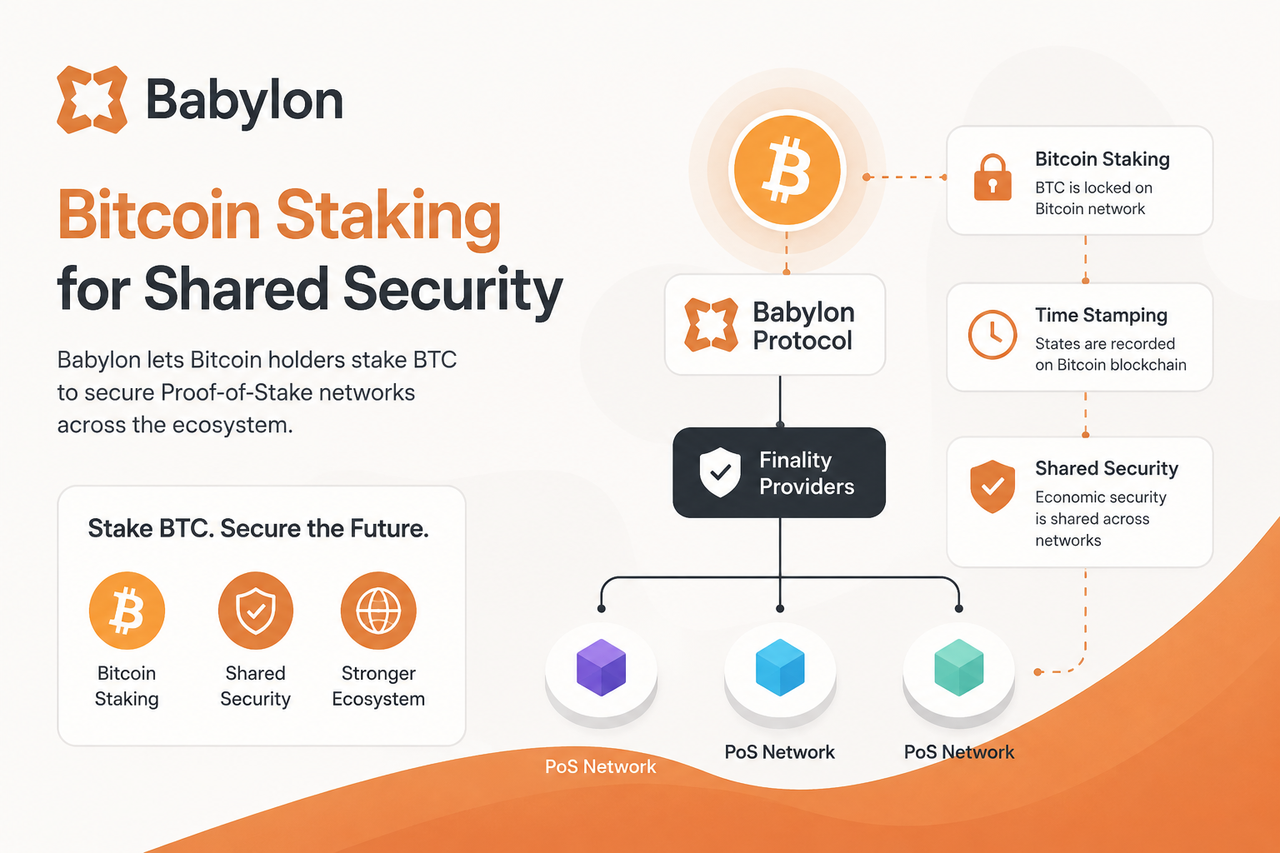
The Complete Process for Participating in Babylon Bitcoin Staking
Bitcoin Staking works through several steps, each centered on security verification.
Step 1: Lock BTC
Users first create a Bitcoin transaction that follows Babylon’s protocol rules and lock BTC in a specific script.
The entire process takes place on the Bitcoin network. BTC does not leave its native chain and is not converted into a wrapped asset.
Step 2: Generate a Staking Proof
After BTC is locked, the relevant information is used to generate a verifiable cryptographic proof.
These proofs show the Babylon network that a specific amount of BTC has entered the shared security system.
Step 3: Connect to a Finality Provider
Users need to delegate their staking status to a selected Finality Provider.
Finality Providers participate in network security activities on behalf of stakers and provide finality services to other chains.
Step 4: Provide Shared Security
The locked BTC is treated as an economic security resource.
Once multiple networks connect to the Babylon ecosystem, they can jointly use the security provided by BTC, forming a shared security model.
Step 5: Receive Protocol Incentives
According to protocol rules, users who participate in Bitcoin Staking may receive rewards.
These rewards are generally tied to Babylon’s network operation mechanism, validation services, and ecosystem incentive system.
How the Timestamping Protocol Protects Network Security
The Timestamping Protocol is an important part of Babylon’s technical architecture.
The Bitcoin blockchain is highly resistant to tampering, so Babylon uses Bitcoin blocks to record important state information from external chains.
When other networks generate key events, the relevant data summaries can be written into Bitcoin blocks. Because altering Bitcoin’s historical records is extremely costly, these state records receive stronger security protection.
The timestamping mechanism provides an additional verification layer for shared security, making it one of Babylon’s key innovations compared with traditional staking protocols.
What Role Do Finality Providers Play in the System
Finality Providers are key participants in the Babylon network.
Traditional PoS networks rely on validators to confirm transactions and block states, while Babylon introduces Finality Providers specifically to provide finality services.
These nodes verify Bitcoin Staking states, participate in consensus processes, and coordinate the operation of shared security mechanisms.
For appchains connected to Babylon, Finality Providers can help networks obtain trusted confirmations more quickly and improve overall security.
How the Slashing Mechanism Works
A security system needs clear accountability rules.
In Babylon’s design, if a node participating in shared security violates protocol rules, it may trigger slashing conditions.
Because BTC has been locked in a specific way, the protocol can impose economic constraints on malicious behavior.
This mechanism raises the cost of attacks and encourages participants to operate according to protocol rules, helping maintain the stability of the entire shared security network.
How Is Bitcoin Staking Different from Traditional PoS Staking
Bitcoin Staking and traditional PoS Staking share a similar goal, using economic incentives to maintain network security, but they differ significantly in how they are implemented.
| Comparison Dimension |
Bitcoin Staking |
Traditional PoS Staking |
| Asset type |
BTC |
Network native token |
| Consensus mechanism |
Based on Bitcoin’s security model |
PoS network’s own consensus |
| Asset location |
Remains on the Bitcoin chain |
Locked in the PoS network |
| Cross chain requirement |
No cross chain bridge required |
Usually no cross chain bridge required |
| Security source |
Bitcoin economic security |
Network token economic security |
| Application scope |
Multichain shared security |
Single network security |
In essence, traditional PoS Staking serves a single blockchain, while Bitcoin Staking places greater emphasis on sharing and reusing security resources across multiple networks.
What Challenges Does Bitcoin Staking Face
Although Bitcoin Staking offers a new solution for shared security, its development still faces several challenges.
First, a shared security architecture involves coordination across multiple networks, making system design more complex than traditional staking.
Second, questions such as how security responsibilities should be allocated, how slashing mechanisms should be enforced, and how cross ecosystem coordination should be handled still require ongoing optimization.
In addition, the Bitcoin network itself does not natively support complex smart contracts, so Babylon must implement the relevant functions through additional protocol design. This also increases the difficulty of system development.
Conclusion
Babylon’s Bitcoin Staking is an innovative mechanism that uses BTC to provide shared security services for multiple blockchain networks. By locking BTC, generating cryptographic proofs, introducing Finality Providers, and using the timestamping protocol, Babylon extends Bitcoin’s security to the broader PoS ecosystem without changing Bitcoin’s consensus mechanism.
This model not only improves the capital efficiency of Bitcoin, but also provides a new source of security for modular blockchains, appchains, and shared security networks.
FAQs
Is Bitcoin Staking Real Staking?
Bitcoin Staking is not exactly the same as traditional PoS staking. It does not participate in Bitcoin network consensus. Instead, it uses BTC as an economic security resource to provide security for other blockchain networks.
Does Babylon Bitcoin Staking Require a Cross Chain Bridge?
One of Babylon’s design goals is to avoid relying on cross chain bridges. BTC remains on the Bitcoin network and participates in the shared security system through cryptographic proofs and protocol mechanisms.
Does Bitcoin Staking Affect BTC Ownership?
Bitcoin Staking does not change ownership of BTC. Users still control the relevant assets, while locking BTC under protocol rules to provide security backing.
What Is a Finality Provider?
A Finality Provider is a key node role in the Babylon network. It participates in the finality process, coordinates shared security mechanisms, and helps other networks obtain trusted state confirmation.
How Is Bitcoin Staking Different from EigenLayer Restaking?
Bitcoin Staking uses BTC to provide shared security, while EigenLayer Restaking uses ETH and its staked assets for security reuse. Both belong to the shared security sector, but they rely on different base assets and ecosystems.